What Are the Best Day Trips From Seville?
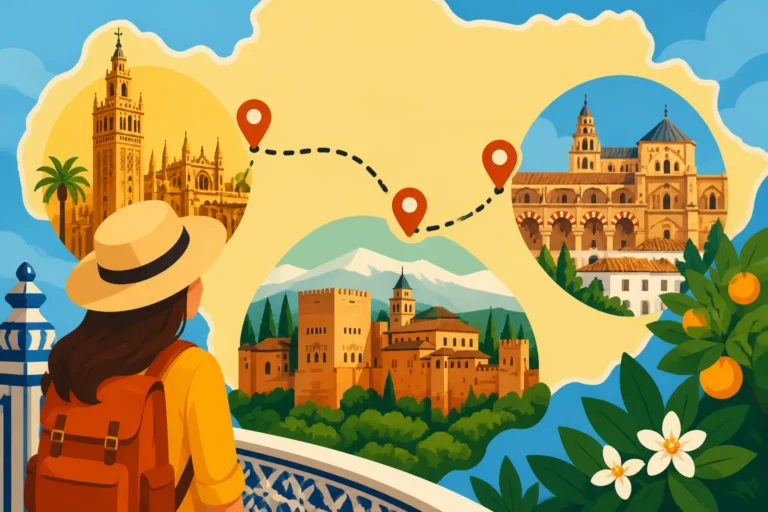
Every summer I watch newcomers to Seville try to squeeze Córdoba, Cádiz and Ronda into one frantic week. They miss buses, cook in the afternoon heat, and arrive at monuments just as they close. This guide covers the best day trips from Seville, how to reach each one, and how to plan days that are actually enjoyable.
Disclosure: This post may contain affiliate links. We may earn a commission at no extra cost to you if you make a purchase through these links. Read full disclosure.
How to Choose the Right Day Trip From Seville
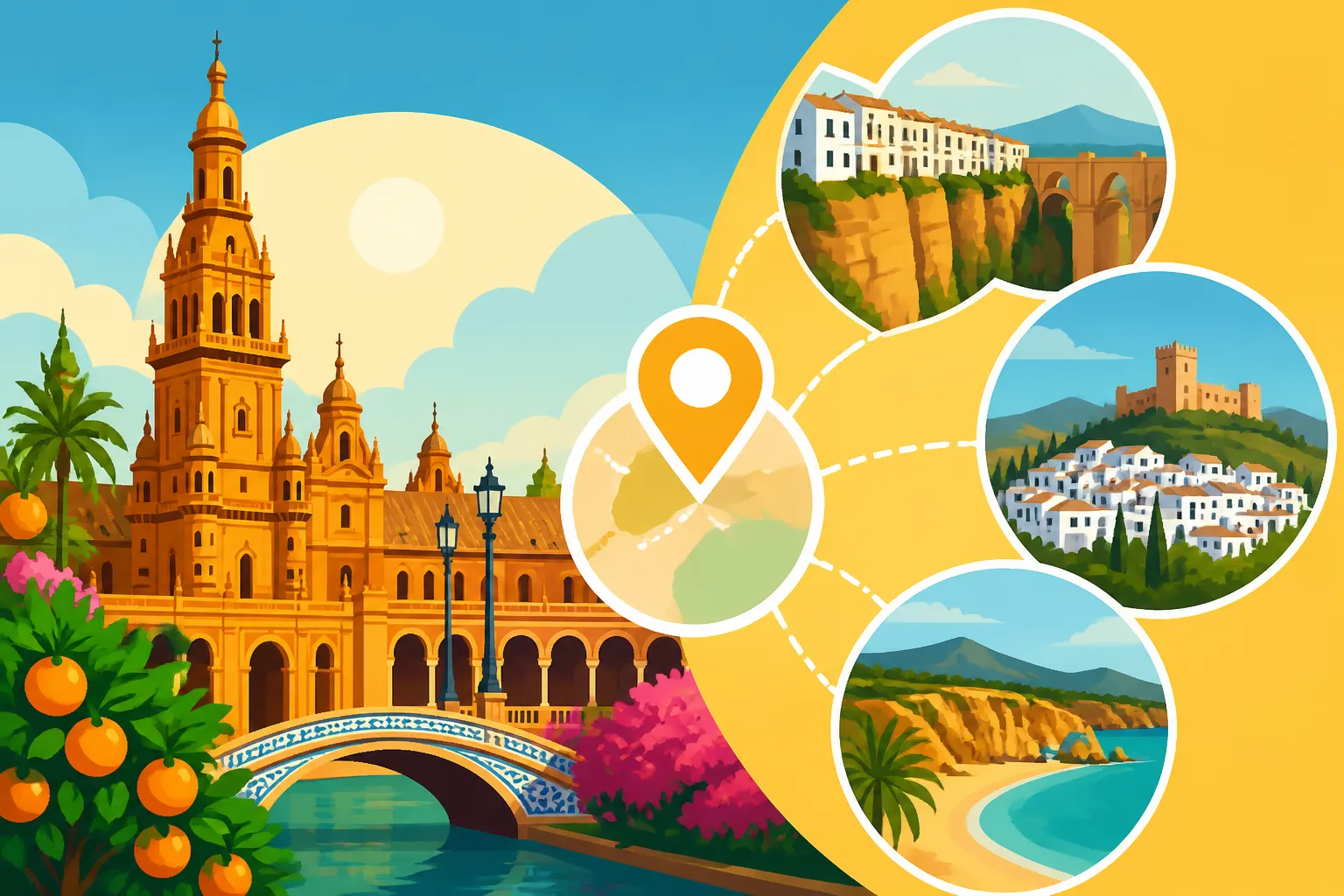
Seville is one of the best bases in Andalusia. Within a short radius you have a caliphal capital, an ancient port city, sherry country, Roman ruins, cliff-top towns and one of Europe’s most important wetlands. The difficulty is choosing. The wrong choice for your season, your transport or your energy level can turn a lovely outing into a long day of waiting at bus stations.
I spent my first year here saying yes to every trip a friend suggested. By spring I had learned that the best day trips are the ones that fit your logistics. The postcard is the least important part of the decision.
Train, Bus, or Car
Seville has two main transport hubs for day trips, and they serve different places. Santa Justa is the main railway station. High-speed trains to Córdoba leave from there, and so do the regional and medium-distance trains down to Jerez and Cádiz. For bus trips the two stations you will use most are Plaza de Armas, near the river, and Prado de San Sebastián, close to the university and the Parque de María Luisa. Before you leave home, check which station your bus departs from. Turning up at the wrong one is the classic newcomer mistake, and a taxi between them during rush hour will test your patience.
Trains are the comfortable choice for the big cities. Buses go to places the rail network ignores or serves awkwardly, such as Carmona, Osuna, Ronda and Aracena, and the Sierra towns. A car makes sense for the white villages and for linking two or three small places in one loop. Driving into central Seville is miserable, though, and parking in old towns like Arcos de la Frontera can be nerve-wracking. If you plan to hire a car, see Renting a Car in Spain: Requirements, Insurance, and Driving Tips before you book.
To compare train and bus options side by side, a journey planner like Omio helps when you are still deciding between destinations, because it shows the rail and coach operators for a route in one search. On the high-speed Córdoba corridor several operators may compete, and Renfe vs Ouigo vs Iryo vs Avlo: Spain’s High-Speed Competition Compared explains how they differ in practice.
Matching the Trip to the Season
Season matters more than people expect. In July and August the interior of Andalusia, which includes Córdoba, Carmona, Écija and Osuna, can be brutally hot by early afternoon. In those months I either head for the coast at Cádiz or Sanlúcar, or I leave on the earliest departure and am back on a shaded terrace in Seville by mid-afternoon. For a frank look at summer conditions, see Is It Too Hot to Visit Southern Spain in August?.
Spring and autumn are ideal for almost everything on this list. May is special in Córdoba because of the patio festival, when private courtyards full of flowers open to visitors. That also means crowds. Winter is underrated. Cádiz is quiet and bright, the Sierra de Aracena smells of woodsmoke and roasting chestnuts, and you can walk around Ronda in comfort.
Quick Comparison of the Top Day Trips
| Destination | Best Transport From Seville | Main Draw | Best For | Effort Level |
|---|---|---|---|---|
| Córdoba | High-speed train from Santa Justa | Mezquita-Catedral, Jewish Quarter | First-timers, history lovers | Low |
| Cádiz | Train from Santa Justa | Old town, sea walls, beaches | Coast lovers, food | Low to medium |
| Jerez de la Frontera | Train from Santa Justa | Sherry bodegas, equestrian shows | Wine and culture | Low |
| Carmona | Bus | Roman necropolis, walled old town | Short, easy outing | Very low |
| Itálica | Bus to Santiponce | Roman amphitheatre and mosaics | Half-day history | Very low |
| Osuna | Bus or car | Ducal monuments, bullring | Off-the-beaten-path | Medium |
| Ronda | Bus or car | Puente Nuevo and El Tajo gorge | Dramatic scenery | Medium to high |
| Aracena | Bus or car | Gruta de las Maravillas, ham country | Cooler weather, food | Medium |
| Doñana and El Rocío | Car or guided tour | Wetlands, wildlife, pilgrim village | Nature, birdwatching | Medium |
The Classic City Day Trips: Córdoba, Cádiz, and Jerez
These three are the trips most visitors take first. All are easy by rail, all are rewarding, and each feels completely different from Seville even though they are close.
Córdoba: The Easiest Big Win
If you only take one day trip from Seville, make it Córdoba. The high-speed train takes well under an hour, so you can leave after breakfast and be inside the Mezquita-Catedral before the tour groups have finished their coffee. The building is extraordinary. There is the forest of red-and-white arches, the mihrab, and then the shock of a Renaissance cathedral rising in the middle of it all. Photographs do not prepare you for it.
The usual day goes like this. Walk from the station into the old centre, then visit the Mezquita first thing in the morning. After that, wander the Judería and find the Calleja de las Flores. Cross the Roman bridge for the classic view back over the city. In the afternoon, visit the gardens of the Alcázar de los Reyes Cristianos. If you have extra time, the ruins of Medina Azahara, the palace-city just outside town, are worth the effort, but you need transport or a shuttle to get there.
Two tips from experience. Go early, or late in the afternoon, to avoid the worst crowds; see How to See Córdoba’s Mezquita Without the Queues. And remember that this is still an active place of worship, with dress expectations and quiet zones. How to Visit the Mezquita of Córdoba Respectfully covers that. For lunch, try salmorejo, Córdoba’s thicker and richer cousin of gazpacho, and flamenquín, a fried roll of ham and pork that suits a day of heavy walking.
Cádiz: Sea Air and an Ancient Port
Cádiz sits almost entirely surrounded by water on a narrow spit of land. After a few days in landlocked Seville, the first breath of Atlantic air when you step off the train feels like a reset. It is often described as one of the oldest continuously inhabited cities in western Europe. You feel that age in the tight grid of streets, the watchtowers on the rooftops and the weathered sea walls.
Start at the Mercado Central for fried fish and a look at the morning catch. Then climb the Torre Tavira, where a camera obscura projects a live image of the city onto a dish. The golden-domed cathedral and the seafront promenade can both fill an hour. End the afternoon at La Caleta, the small beach between two castles, where locals swim and the sunset is wonderful.
The train ride is longer than to Córdoba, but it is easy and scenic as you cross the salt marshes near the end. If one day is not enough, and in Cádiz it often is not, you can turn it into an overnight. Where to Stay in Cadiz and Jerez: Andalusian Coast Options compares the neighbourhoods, and Booking.com is handy for last-minute rooms in the old town if you decide over lunch that you are not ready to leave.
Jerez de la Frontera: Sherry, Horses, and Flamenco
Jerez is on the same rail line as Cádiz, so some people combine the two. In my experience that rushes both. Jerez deserves its own day, especially if you like wine. The city is the heart of the sherry triangle, and its bodegas, from the big famous names to small family cellars, run tours that explain fino, amontillado, oloroso and the solera ageing system. Book ahead, because tours run at set times and some are offered in English only at certain hours.
Jerez is also home to the Royal Andalusian School of Equestrian Art, whose horse shows run on set days of the week. Check the schedule before you choose your date. The Alcázar of Jerez, the old Moorish fortress, is compact and pleasant. The Santiago and San Miguel neighbourhoods are among the traditional heartlands of flamenco, and the tabancos are a joy. These old-style taverns pour sherry from the barrel, and you sometimes get spontaneous singing too.
If sherry opens a door for you, Spanish Wine Regions: A Beginner’s Guide puts it in the wider context of Spanish wine.
Small Towns, Roman Ruins, and White Villages
The big cities get the attention. The smaller trips are where I find the Andalusia I fell in love with: quiet plazas, an elderly man feeding pigeons outside a church, a bar where the owner remembers you on your second visit.
Carmona and Itálica: Half-Day History
Carmona is the trip I recommend to people who are tired, jet-lagged or travelling with children. Regular buses get you there quickly, and the old town sits on a ridge with views across the farmland of the Vega. Enter through the Puerta de Sevilla, a gateway with Roman, Moorish and Christian layers. Wander up through whitewashed streets to the ruined Alcázar del Rey Don Pedro, part of which now houses a Parador. Even if you are not staying there, a drink on its terrace with that view is one of the great small pleasures of the region. The Roman necropolis on the edge of town, with its underground family tombs, is fascinating and rarely crowded.
Itálica is even closer. It lies at Santiponce, just outside Seville, and buses from Plaza de Armas get you there in no time. This was a Roman city linked to the emperors Trajan and Hadrian. Its amphitheatre was one of the largest in the Roman world, and you can walk through the tunnels where gladiators and animals once waited. Game of Thrones fans will recognise it from the series. Bring water and a hat, because there is very little shade. Archaeological sites in Andalusia often have reduced hours and closure days, so confirm opening times before you set off. If Roman Spain catches your interest, How to See Roman Ruins in Spain (Mérida and Beyond) suggests where to go next.
Osuna: The Quiet Ducal Town
Osuna is the day trip for people who have already seen the headline sights and want something calmer. The town grew rich under the Dukes of Osuna, and it shows. On the hill above town you find the Colegiata de Santa María de la Asunción, with its ducal pantheon, and the old university building. Below, the streets are lined with baroque palaces and grand facades. Many of them belonged to noble families who competed to outdo each other.
The bullring is another Game of Thrones filming location, and the town embraced that fame, but Osuna’s appeal is its pace. Go on a weekday morning, climb to the Colegiata for the views over the olive groves, then come down for a long lunch. Buses run from Seville, though less often than to Carmona, so plan your return before you sit down to eat. A car gives you more flexibility, and you could add Écija on the way back. Écija is known for its bell towers, painted church spires and very hot summers.
Ronda and the Pueblos Blancos
Ronda is the most dramatic trip on this list, and the most demanding. The town sits on cliffs split by the deep El Tajo gorge, and the Puente Nuevo spans it in a way that makes your stomach drop the first time you lean over the parapet. Add the old bullring of the Real Maestranza, the Arab baths in the lower town and the hiking paths into the valley below, and it is easy to see why people make the effort.
That effort is real. The bus journey takes a couple of hours each way along winding roads, and the train needs a change, so a car or an organised tour often makes more sense. Platforms such as GetYourGuide list guided day trips that combine Ronda with one or two white villages. That suits you if you would rather not drive mountain roads or juggle rural bus timetables. Visitors staying on the Costa del Sol often come from the other direction; see How to See Ronda on a Day Trip From Málaga.
The pueblos blancos are the whitewashed villages scattered across the Sierra de Grazalema and the hills of Cádiz province, and they work best by car. Arcos de la Frontera, Zahara de la Sierra, Grazalema and Setenil de las Bodegas, where houses are built into the rock overhangs, can be linked in a long and beautiful loop. Spain’s Pueblos Blancos: Visiting the White Villages covers which villages suit which kind of traveller. If you do not drive, How to Reach Spain’s White Villages by Public Transport explains how to get there by bus without stranding yourself.
Nature, Food Trips, and Planning a Smooth Day
Not every day trip has to be about monuments. Some of my favourite days out of Seville involved no cathedrals at all.
Doñana, El Rocío, and Sanlúcar de Barrameda
Doñana National Park is one of Europe’s most important wetlands. It is a vast mosaic of marshes, dunes and pine forest, and it is a key stop for migrating birds. Access to the core of the park is restricted, so the usual way in is an authorised guided tour, often in an all-terrain vehicle. Book these in advance, and GetYourGuide is one place to compare the excursions on offer. Spring and autumn are the best seasons for birdlife.
The gateway village of El Rocío is a surprise. It has sandy streets with no asphalt, hitching rails for horses outside the bars, and a white hermitage at the centre. Around Pentecost it fills with the huge Romería del Rocío pilgrimage, which is spectacular but chaotic. On an ordinary day it is eerily calm, and you can watch flamingos on the marsh at the edge of the village.
On the other side of the Guadalquivir estuary is Sanlúcar de Barrameda. It is the home of manzanilla, the salty, delicate cousin of fino. Head for the Bajo de Guía waterfront for some of the best langostinos and fried fish in Andalusia. In late summer, the horse races on the beach at low tide are worth timing a visit around. Doñana, El Rocío and Sanlúcar make a natural nature-and-food circuit, but only by car or with a tour.
Aracena and the Sierra
When Seville is sweltering, I head north into the Sierra de Aracena y Picos de Aroche. It is noticeably cooler, green with chestnut and cork oak forests, and dotted with stone villages. Aracena itself is crowned by a castle and church. Its main attraction is the Gruta de las Maravillas, a cave system with underground lakes and formations, which you visit on guided tours with timed entry.
This is also ibérico ham country. The village of Jabugo is a pilgrimage site for anyone who loves jamón. A long lunch of ham, local mushrooms in season and pork dishes is the real point of the day. Buses run from Plaza de Armas, but a car lets you explore smaller villages like Alájar and Linares de la Sierra and walk some of the marked trails between them.
Step-by-Step: Planning a Stress-Free Day Trip
Here is the routine I follow now, after a few too many missed connections in my early years.
- Choose a destination that fits the season: coast or sierra in high summer, the interior cities in spring, autumn and winter.
- Confirm which Seville station you leave from: Santa Justa for trains, Plaza de Armas or Prado de San Sebastián for most buses.
- Check opening days and hours for your main sight, because some monuments and archaeological sites close one day a week or have shortened hours.
- Book timed tickets in advance for anything popular, especially the Mezquita at busy times, cave tours and bodega visits.
- Buy return transport ahead, or at least note the last departure back to Seville and set a phone alarm an hour before it.
- Plan lunch around Spanish meal times, since kitchens in small towns may close in the late afternoon and not reopen until evening.
- Pack water, sun protection and comfortable shoes, because old towns mean cobblestones, hills and little shade.
- Keep a backup plan, such as a nearby town or café, in case a bus is full or a site is unexpectedly closed.
For a broader template you can reuse anywhere in the country, see How to Plan a Self-Guided Day Trip in Spain. If you want to combine these destinations into a longer route rather than return to Seville each night, Seville to Granada and Cordoba: Andalusian Route Planning covers the connections.
A Note on Granada and Longer Trips
People often ask me about Granada as a day trip. It can be done, but it is a long day. The Alhambra needs timed tickets that sell out well ahead, so you lose any flexibility. I strongly recommend at least one night there; see How to Get Tickets for the Alhambra in Granada before you commit. The same goes for Málaga and the Costa del Sol. They are reachable, but more rewarding as part of a multi-day route.
Finally, do not let the day trips eat into your time in Seville itself. The Alcázar, Triana and the evening paseo along the river are reasons enough to keep some days free. If you are still building your itinerary, How to Spend a Weekend in Seville helps you balance the city with the countryside around it.
Disclaimer
This article is for general informational purposes only and does not constitute professional advice. Laws, prices and regulations vary by location and change over time. Consult a qualified professional for guidance on your specific situation.