How to Plan a Self-Guided Day Trip in Spain
Oh, the allure of a Spanish day trip! You've settled into life here, perhaps navigated a few bureaucratic hurdles like getting your NIE, TIE & Empadronamiento: Essential IDs and Registrations in Spain sorted, and now that wanderlust is kicking in. But planning a day out on your own, beyond the well-trodden tourist bus routes, can feel like a daunting task, especially with language barriers and a sometimes-unpredictable Spanish schedule. Fear not, fellow expat! This guide is here to empower you to ditch the tour groups, embrace true exploration, and plan your very own unforgettable self-guided day trips across this beautiful country.
Disclosure: This post may contain affiliate links. We may earn a commission at no extra cost to you if you make a purchase through these links. Read full disclosure.
Why Self-Guided Day Trips Are Worth the Effort in Spain
When you first arrive in Spain, the idea of a pre-packaged tour can be incredibly appealing. Everything is taken care of, from transport to tickets, and you don't have to worry about a thing. However, after a while, you might start to feel like you're missing out on the real Spain. That's where self-guided day trips shine, offering an unparalleled sense of freedom and a chance to truly connect with the local culture.
The Freedom and Authenticity You Crave
One of the biggest advantages of planning your own day trip is the complete control you have over your schedule. No more rushing through a charming village because the bus is leaving, or being dragged to a souvenir shop when all you want is another café con leche. You can linger in that hidden plaza, spend an extra hour people-watching, or stumble upon a local festival that a tour bus would never include. This flexibility allows for genuine, unscripted moments that become the most cherished memories of your expat life. It’s about more than just seeing the sights; it's about experiencing the rhythm of Spanish life on your own terms.
Imagine finding a tiny family-run taberna for lunch, far from the tourist menus, where the owner chats with you (or attempts to, with much gesturing and laughter!) and serves up the most incredible regional dish you've ever tasted. These are the authentic experiences that often elude those on strict itineraries. You become an explorer, not just a spectator, allowing for deeper engagement with the places and people you encounter. The serendipity of discovering something unexpected because you had the freedom to wander off the beaten path is truly a reward in itself.
Cost-Effectiveness Compared to Organized Tours
Let's be honest, living in Spain, while generally affordable, still requires some budgeting. Organized tours, while convenient, can add up quickly, especially if you're traveling as a couple or a family. Opting for a self-guided adventure often means significant savings. You get to choose your transport – perhaps a local train over a pricey coach – and pick your own food spots, which can range from a budget-friendly menú del día to a leisurely picnic. These choices allow you to allocate your funds where they matter most to you.
For instance, consider a trip from Madrid to Toledo. A guided tour might cost €60-€80 per person, including transport and a guided walk. If you go on your own, a return train ticket on the high-speed AVE could be around €20-€30 if booked in advance, and you can explore the city at your leisure for free, or pay for specific attractions that genuinely interest you. The savings can be substantial, leaving you more money for another adventure or perhaps to splurge on that beautiful artisanal souvenir you've been eyeing. Remember, every euro saved is a euro that can be reinvested into another wonderful experience in Spain!
Overcoming Language Barriers and Logistics
I know what you're thinking: "But what about the language? What if I get lost? What about tickets?" It's true, navigating a new country independently comes with its challenges. However, Spain is remarkably traveler-friendly, even for those with minimal Spanish. Most major transport hubs have English signage, and essential apps can bridge the communication gap. Embracing a bit of the unknown is part of the adventure!
The key is preparation, not perfection. You don't need to be fluent in Spanish, but knowing a few key phrases for Spanish Language and Everyday Communication for Visitors like "hola," "gracias," "por favor," and "cuánto cuesta?" goes a long way. Many digital tools, like Google Translate or DeepL, offer offline translation, which is a lifesaver when you're without data. Plus, remember that a friendly smile and pointing often communicate more than you think. Locals are generally very patient and helpful, especially if they see you making an effort. Don't let the fear of a language barrier hold you back from discovering a new corner of Spain.
The Nitty-Gritty of Planning Your Spanish Day Trip
Alright, let's get down to brass tacks. Planning doesn't have to be rigid, but a little structure ensures your day trip runs smoothly. Think of it as laying out a comfortable path, rather than building a concrete road.
Choosing Your Destination: Beyond the Obvious
Spain is absolutely overflowing with incredible places, from medieval towns to stunning natural parks. The first step is deciding where to go. While popular spots like Toledo, Segovia, or Girona are fantastic for a reason, don't be afraid to dig a little deeper. Do you love history? Consider Cáceres or Tarragona. Craving nature? The Sierra de Guadarrama near Madrid, or the beaches of Cádiz. Foodie adventures? San Sebastián or even a smaller town known for a specific local delicacy.
Think about your starting point and how far you're willing to travel. A day trip should ideally involve no more than 1.5-2 hours of travel each way to maximize your time at the destination. Websites like GetYourGuide can offer inspiration by showing popular destinations from your location, even if you don't book a guided tour. Simply seeing what's on offer can spark an idea for your own independent exploration. Local tourism websites for your comunidad autónoma (region) are also goldmines for less-known gems and upcoming events. Don't just follow the crowds; find a place that truly speaks to your interests.
Mastering Transport: Trains, Buses, and Cars
This is often the biggest logistical puzzle for expats. Spain boasts an excellent public transport network, but knowing which option is best is key.
Trains (Renfe, AVE)
Spain's train system, primarily operated by Renfe, is generally efficient and comfortable. The high-speed AVE trains are fantastic for covering longer distances quickly, connecting major cities like Madrid, Barcelona, Seville, and Valencia. For day trips, they can be a game-changer, turning a potentially long drive into a swift journey. However, they can be more expensive if not booked in advance. Regional trains (Media Distancia or Cercanías) are slower but often reach smaller towns and are usually more budget-friendly.
It is wise to check Omio or the official Renfe website well in advance, especially for AVE tickets. Booking early can save you a significant amount, sometimes up to 50% or more. For shorter routes, or if you're not planning far ahead, you can often buy tickets at the station on the day, but be prepared for potential queues. If you're a commuter, consider a multi-journey pass for Cercanías lines, which can offer savings. For more detailed insights, check out our guide on How to Buy AVE Train Tickets in Spain and Save Money.
Buses (ALSA, Avanza, etc.)
For destinations not easily reached by train, or if you're looking for a more economical option, intercity buses are your best friend. Companies like ALSA, Avanza, and many regional operators cover virtually every corner of Spain. Buses are generally very reliable, often equipped with Wi-Fi, and offer a comfortable ride. The main bus stations in larger cities can be bustling, so allow ample time to find your gate.
Again, booking in advance online through sites like Omio or the individual bus company websites (e.g., ALSA) is often a good idea, especially for popular routes or during peak season. You can usually print your ticket or keep it on your phone. Buses are a fantastic way to reach smaller villages, coastal towns, or specific natural parks that trains might bypass. They're also often cheaper than trains, making them perfect for budget-conscious explorers. Don't underestimate the Spanish bus network; it's a lifeline for many smaller communities. Our article on Intercity Buses in Spain: Networks, Booking, and Tips provides more helpful details.
Renting a Car
If you prefer maximum flexibility, especially for exploring rural areas, multiple destinations in one day, or places with limited public transport, renting a car is a great option. Spain has well-maintained roads, and driving outside major city centers is generally straightforward. Just be mindful of parking, which can be tricky and expensive in historic centers.
Major car rental companies like Hertz, Avis, or local Spanish providers are readily available at airports and larger cities. Always book well in advance for the best rates, and make sure you understand the insurance options. An International Driving Permit (IDP) might be required depending on your country of origin, so check the specific requirements for Renting a Car in Spain: Requirements, Insurance, and Driving Tips before you travel. Having a car truly opens up possibilities for off-the-beaten-path adventures, like exploring the White Villages of Andalusia or the dramatic coastlines of Galicia.
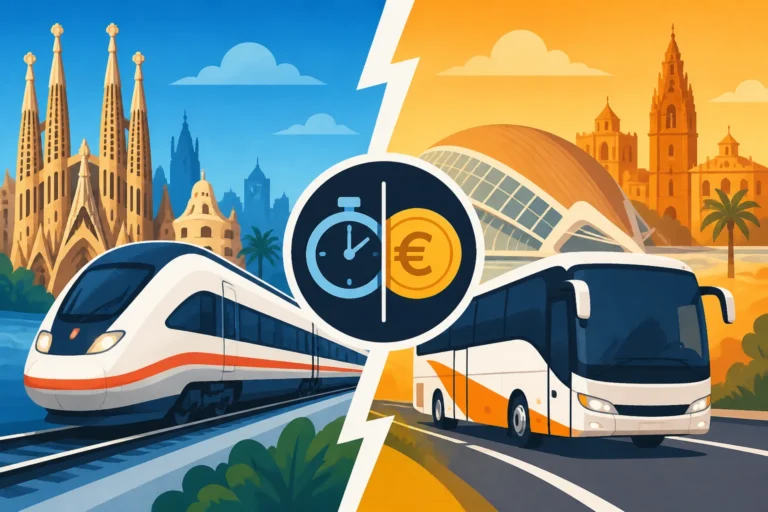
Here's a quick comparison of transport options:
| Transport Type | Pros | Cons | Best For | Booking Tips |
|---|---|---|---|---|
| High-Speed Train (AVE) | Fast, comfortable, city-center to city-center | More expensive, less flexible routes | Major city connections (e.g., Madrid-Seville, Barcelona-Valencia) | Book weeks in advance for best prices via Renfe or Omio. Look for Promo tickets. |
| Regional Train | Economical, comfortable, good for smaller towns | Slower than AVE, less frequent | Connecting mid-sized towns, shorter distances (e.g., Madrid-Toledo) | Buy at station or online. Not always necessary to book far ahead unless a specific time is crucial. |
| Intercity Bus | Economical, extensive network, reaches rural areas | Slower, can be less comfortable for very long journeys | Accessing smaller villages, coastal towns, direct airport transfers | Book via operator's website (e.g., ALSA) or Omio. Often cheaper than trains. |
| Rental Car | Maximum flexibility, ideal for rural exploration | Parking difficulties/cost in cities, fuel costs, insurance | Multi-stop trips, off-the-beaten-path destinations, national parks | Book via major rental companies. Ensure you have an IDP if needed. Check Renting a Car in Spain: Requirements, Insurance, and Driving Tips. |
Crafting Your Itinerary: Pacing and Priorities
Once you have your destination and transport sorted, it’s time to think about what you’ll actually do. Resist the urge to cram too much into one day. A day trip is not a race! Choose 2-3 main priorities and allow ample time for exploration, meals, and simply soaking it all in.
For example, if you're visiting Toledo from Madrid, your priorities might be the Cathedral, the Jewish Quarter, and a walk along the Tagus river. Don't try to see every single museum. Pick what truly interests you. Use online resources like travel blogs (like ours!), official tourism sites, and even Booking.com or GetYourGuide to see what attractions are popular and map out their locations. This helps you create a logical flow for your day, minimizing wasted travel time within the destination.
Remember to factor in Spanish meal times. Lunch (almuerzo) often starts around 2 PM, and dinner (cena) can be as late as 9 PM or 10 PM. Plan your activities accordingly, knowing that many smaller shops might close for a couple of hours in the early afternoon for the infamous siesta. This isn't always a full-blown nap, but many businesses do shut down. Our guide on Spanish Meal Times and Dining Etiquette Explained can give you a deeper understanding of this cultural rhythm.
Essential Tools and Resources for a Smooth Journey
A little preparation with the right tools can make all the difference between a stressful day and a delightful adventure.
Booking Accommodation and Activities
While a day trip typically means no overnight stay, sometimes you might find a fantastic deal or an experience that warrants an early start or a late return, making an overnight stop worthwhile. This is where platforms like Booking.com really shine. You can find everything from charming boutique hotels to budget-friendly hostels. For activities and tours, even if you’re planning a self-guided trip, GetYourGuide offers a wealth of inspiration and the option to book skip-the-line tickets for major attractions, which can be a huge time-saver in popular spots like the Alhambra in Granada or Sagrada Familia in Barcelona. You're still going "self-guided" in terms of your overall itinerary, but leveraging these platforms for specific bookings removes a layer of stress.
For example, if you're heading to Seville, checking GetYourGuide for options to pre-book tickets to the Alcázar or Seville Cathedral means you won't spend precious hours queuing. It’s all about working smarter, not harder, to maximize your independent exploration. Think of it as having a little helper in your pocket, without sacrificing your freedom.
Navigating with Apps and Local Info
Your smartphone is your best friend for self-guided travel. Google Maps is indispensable for directions (walking, driving, and public transport), finding restaurants, and checking opening hours. Download offline maps of your destination before you leave, just in case you lose signal. Another great option is Citymapper for public transport in major cities like Madrid and Barcelona.
Beyond navigation, consider a translation app like Google Translate or DeepL for quick look-ups. For finding local eateries, TripAdvisor or ElTenedor (TheFork) can be helpful, though sometimes just wandering and looking for places packed with locals is the best strategy for finding authentic restaurants in Spain. Make sure your phone has enough battery and consider a portable power bank, especially if you're relying on it for maps and tickets. Having a reliable Mobile Data and eSIMs for Travel in Spain plan is also crucial.
Packing Smart and Staying Safe
What you bring can significantly impact your day. Think light and practical. A comfortable pair of walking shoes is non-negotiable – you’ll be doing a lot of walking! Carry a small backpack with essentials: water, snacks, sunscreen (even in winter, the Spanish sun can be strong), a light jacket (evenings can get cool), and any personal medications.
When it comes to safety, Spain is generally very safe, but common sense still applies. Keep an eye on your belongings, especially in crowded tourist areas, and be aware of your surroundings. Avoid flashing expensive items. It’s also a good idea to have copies of important documents (passport, TIE card) stored digitally and physically in a separate location from the originals. For comprehensive advice on keeping yourself secure, read our guide on Staying Safe in Spain: Practical Safety Tips for New Residents.
Common Pitfalls and How to Avoid Them
Even with the best planning, a self-guided day trip can throw a curveball or two. But knowing what to expect can help you navigate these minor bumps with grace.
The Siren Song of the Siesta
Ah, the siesta. It’s a quintessential part of Spanish culture, and while not everyone takes a full nap, many smaller businesses, government offices, and even some restaurants will close for a few hours in the early afternoon, typically between 2 PM and 5 PM. For an expat, this can be frustrating when you’re on a tight schedule.
My advice? Embrace it! Use this time to have a leisurely lunch, perhaps a menú del día – a set-price lunch menu that’s fantastic value – or relax with a coffee in a bustling square. If you've planned your main sightseeing for the morning, the siesta period is a perfect opportunity for a meal and a break. Don't fight it; flow with it. You'll find that many larger shops and tourist attractions in major cities now remain open all day, but it’s always wise to check specific opening hours for smaller, independent businesses in advance.
Over-Packing Your Day
This is a classic rookie mistake. You look at a map, see all these amazing historical sites, and think, "I can see them all!" Then you find yourself rushing from one place to another, barely absorbing anything, and by late afternoon, you're exhausted and irritable. Remember the freedom and authenticity we talked about? That disappears when you're adhering to a rigid, overly ambitious schedule.
Instead, prioritize quality over quantity. Pick one or two "must-sees" and then allow for spontaneous exploration around them. Leave room for getting lost down a charming alleyway, popping into a random shop, or simply sitting on a bench and watching the world go by. That unhurried pace is what makes a self-guided trip so rewarding. You're not checking off a list; you're experiencing a place. Trust me, you'll enjoy your day so much more if you don't feel like you're constantly racing against the clock.
Underestimating the Spanish Way of Life
Spain operates on its own unique rhythm. Things might move a little slower, appointments might start a few minutes late, and sometimes, things just don't go according to the meticulously planned schedule you created. This isn't a sign of inefficiency; it's just the way things are. Expect queues at popular spots, even if you have tickets, and be prepared for potential delays in public transport.
Embrace a relaxed mindset, and don't let small inconveniences spoil your day. If your bus is 10 minutes late, shrug it off. If a restaurant you wanted to try is closed, find another charming spot. Learning to roll with the punches and appreciate the spontaneity is a crucial part of becoming a true expat in Spain. It's all part of the adventure, and often, these unexpected detours lead to the most memorable discoveries. So, pack your patience, a good attitude, and a sense of humor, and you'll be well on your way to a fantastic self-guided day trip in Spain!
Disclaimer
Please note that while we strive to provide accurate and up-to-date information, rules, regulations, and recommendations can change. Always verify details with official sources, such as local tourism boards, government websites, or transport providers, before making your travel plans. This guide is for informational purposes only and does not constitute professional advice.