Spain to the UK: Flight, Rail, and Ferry Combinations
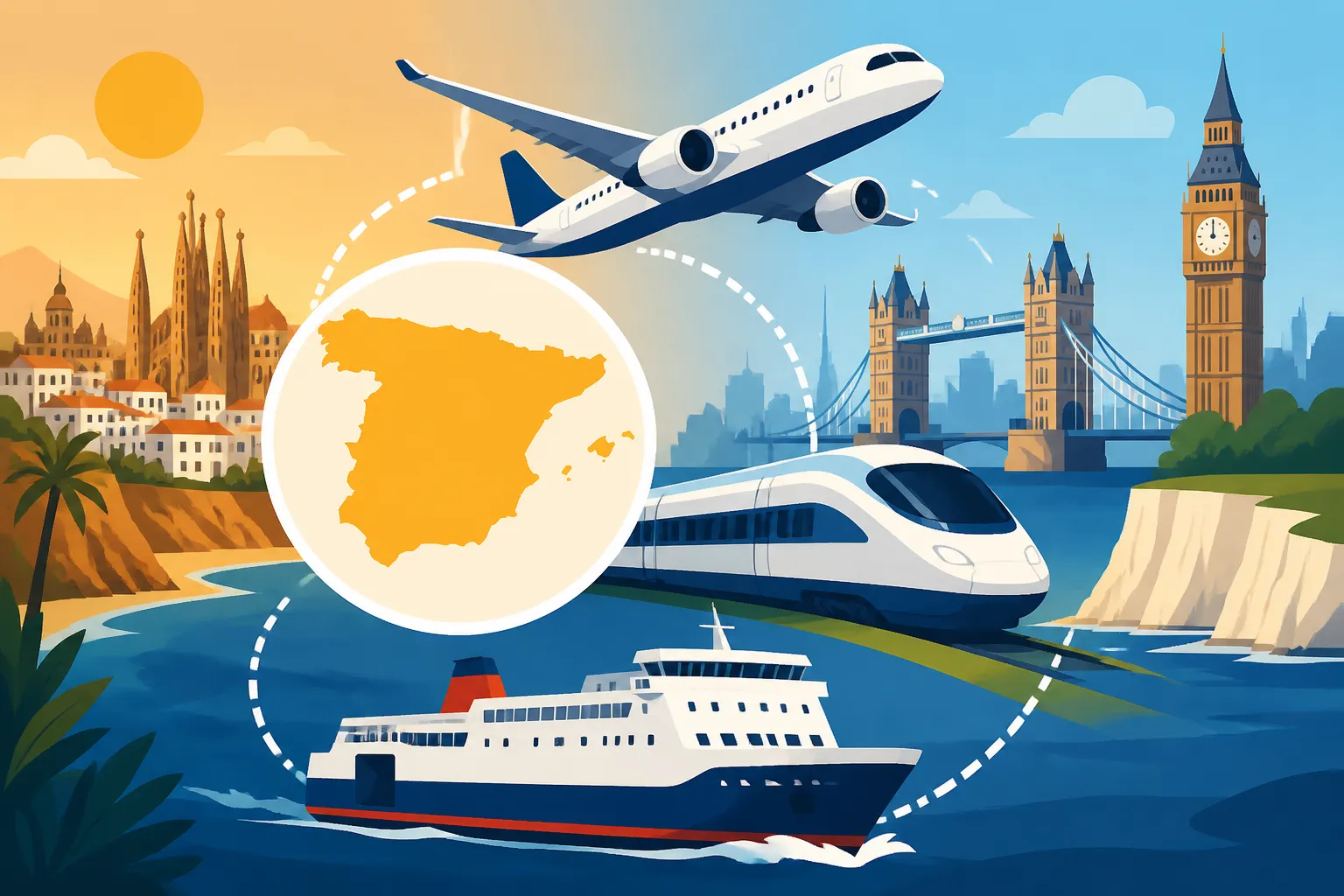
You are in Spain, you need to get to Britain, and every search tab shows something different. One says flying is cheapest, another pushes the train through Paris, and a third mentions an overnight ferry from Santander you didn’t know existed. This guide covers the real flight, rail and ferry combinations from Spain to the UK, and how to compare and book them without the headache.
Disclosure: This post may contain affiliate links. We may earn a commission at no extra cost to you if you make a purchase through these links. Read full disclosure.
Why Getting From Spain to the UK Feels More Complicated Than It Should
I have done this trip more times than I can count. I’ve flown out of Málaga at dawn for a family emergency, taken the slow train-and-Eurostar route with too much luggage, and once loaded the car onto the overnight boat from Bilbao because I refused to pay another airline’s bag fees. Each time, the hard part wasn’t the travel. It was working out which combination made sense before I’d lost an evening to twelve browser tabs.
The Problem Is Fragmentation, Not Distance
Spain and the UK are not far apart. The trouble is that no single operator runs the whole journey on the land and sea routes. A rail trip from Madrid to London might involve Renfe to Barcelona, a French high-speed train to Paris, and Eurostar to London. Those are three companies with three booking systems, three sets of luggage rules and three cancellation policies. A ferry trip means a Spanish train or drive to Cantabria or the Basque Country, then Brittany Ferries to Portsmouth or Plymouth.
This is the gap Omio fills well. Instead of checking Renfe, SNCF and Eurostar separately, you search one origin and one destination and see trains, buses and flights side by side, with total journey times and connection points. Seeing a Málaga flight next to a rail-via-Paris option on the same screen changes how you plan. You stop guessing and start comparing.
Who This Guide Is For
There are three kinds of travellers here. First, expats living in Spain who go back to Britain for Christmas, weddings, funerals or a spell of seeing family. Second, British holidaymakers finishing a Spanish trip who want to try the land route home. Third, non-British residents of Spain heading to the UK for work or tourism. Each group has slightly different priorities around cost, comfort, luggage, pets and border paperwork, and I’ll point out where those differences matter.
The Paperwork Side
Leaving Spain means leaving the Schengen Area, so there is an exit passport check at Spanish airports and, on the rail route, before you board Eurostar in Paris. British citizens arriving in the UK simply use their British passport, and many use the eGates at major airports and at St Pancras. Non-British nationals must meet the UK’s entry rules for their own nationality, which can include pre-travel authorisation. Check the official UK government guidance for your passport well before departure. Residents of Spain who are not EU citizens should travel with their TIE alongside their passport so the Schengen exit check runs smoothly. If you are watching your day count as a non-EU visitor in Spain, Spain Schengen Rules: 90/180 Day Rule Explained for Spain covers how leaving for the UK affects that clock.
The Three Core Routes: Flight, Rail and Ferry Compared
Before getting into combinations, it helps to understand the three building blocks on their own terms. Each one fits a different kind of traveller and a different kind of trip.
Flying Direct: Fast, Frequent, and Full of Fine Print
Flying is the default for good reason. Madrid, Barcelona, Málaga, Alicante, Valencia, Seville, Bilbao, Palma, the Canary Islands and many smaller airports have direct flights to London’s airports and to Manchester, Birmingham, Bristol, Edinburgh, Glasgow, Newcastle, Belfast and others. From the Costa del Sol or Costa Blanca, you can often fly to a regional airport near your family’s door, which saves hours on the British side.
The catch is the stuff around the flight. Airport transfers, security queues and arriving early all add time. The headline fare often shrinks against what you actually pay once you add a cabin bag, a checked bag and a seat next to your partner. I learned this when a “bargain” Alicante-to-Bristol fare ended up costing more than the train would have, once I added a suitcase and my daughter’s car seat. If you’re weighing low-cost carriers, Ryanair, Vueling, and Iberia Within Spain: Total Cost With Bags breaks down how those add-ons stack up on Spanish routes. The same logic applies to UK-bound flights.
Searching flights on Omio alongside rail options helps here. You can see door-to-door journey time and the realistic shape of the trip, not just the take-off and landing times.
Rail via France: The Scenic, Lower-Stress Route
The rail route goes from Spain into France and on to London via Eurostar. The most common spine is Barcelona to Paris on a direct high-speed train, a transfer across Paris from Gare de Lyon to Gare du Nord, then Eurostar to London St Pancras. From Madrid, you would first take the AVE to Barcelona. The alternative is a western route through Irún and Hendaye on the Basque border towards Bordeaux and Paris.
This is a full-day journey, sometimes with an overnight stop in Paris, and it works best when you treat it as part of the trip rather than an obstacle. You get generous luggage allowances compared with budget airlines, city-centre to city-centre travel, no liquids rules, and the chance to work, read or watch the Pyrenees and French countryside go by. I’ve written whole articles on the Barcelona-Paris leg with a coffee in hand and nobody asking me to put my tray table up.
The key planning point is the Eurostar check-in at Gare du Nord. You go through security and passport control before boarding, so you need a proper buffer after the Paris transfer. For a detailed look at that first international leg, see Barcelona to Paris by Train: Booking, Timing, and Cost vs Flying, and for the Basque alternative, Spain to France: Barcelona-Paris and San Sebastian-Bordeaux Options explains the San Sebastián and Bordeaux connections.
Ferry From Northern Spain: The Car-and-Pet Option
The direct sea link between Spain and the UK runs from the north coast. Brittany Ferries operates sailings from Santander and Bilbao to Portsmouth, and from Santander to Plymouth. These are long crossings on the Bay of Biscay, usually involving at least one night on board, so you will want a cabin.
The ferry is unbeatable when you’re bringing a car, a load of belongings, or a pet you don’t want to put in an aircraft hold. You drive on, park, and drive off on the south coast of England with everything still in the boot. For expats doing a “summer back in Britain” with the family car, or anyone moving a lot of stuff, it can be the most sensible option by a long way.
The downsides are time, the possibility of rough weather in the Bay of Biscay, and the fact that the ports are in the north. If you live in Andalusia, getting to Santander is a trip in itself. For more on when the boat makes sense, see Ferry Travel Around Spain: When It Beats Flying on Cost and Comfort. If you’re bringing an animal, also check the pet entry rules for Great Britain and the operator’s pet cabin or kennel policy well ahead, because these fill up.
Route Comparison at a Glance
| Route | Typical Journey Shape | Best For | Main Drawbacks | Luggage Freedom |
|---|---|---|---|---|
| Direct flight | A few hours in the air plus airport time | Speed, regional UK airports, short trips | Bag fees, airport transfers, security queues | Low unless you pay for checked bags |
| Rail via Barcelona and Paris | A full day, sometimes with a Paris overnight | Comfort, working en route, low-stress travel | Paris station transfer, Eurostar check-in buffer | High |
| Rail via Irún, Hendaye and Bordeaux | A full day or more with more changes | Travellers in the Basque Country or the north | More connections, fewer direct services | High |
| Ferry from Santander or Bilbao | Overnight crossing of a day or more | Cars, pets, moving belongings | Long travel time, weather, northern ports | Very high |
| Flight plus UK rail | Flight to London, then train onwards | Reaching UK towns without nearby airports | Extra transfer, timing risk | Low to moderate |
| Train to France plus Channel ferry | Rail or drive to Calais, ferry to Dover | Drivers who prefer a short sea crossing | Very long overland stretch through France | High |
The Smart Combinations: Mixing Flight, Rail and Ferry
Once you know the building blocks, the real value comes from combining them. Many of the best Spain-to-UK journeys aren’t pure flights or pure train trips. They’re hybrids that use each mode where it’s strongest.
Rail Out of Spain, Fly Home From France
This one surprised me. Sometimes flights from Paris, Bordeaux or Toulouse to your UK destination are more convenient than anything from your Spanish airport, especially on specific dates or to specific regional UK airports. A combination like Barcelona to Toulouse by train, then a flight to the UK, can work well.
Here’s how I’d plan a hybrid like this:
- Search your full Spanish city to UK city journey on Omio and note the fastest and cheapest options shown.
- Run a second search from your Spanish city to a French hub such as Paris, Toulouse or Bordeaux by train.
- Run a third search from that French hub to your UK destination, comparing Eurostar where relevant and flights.
- Add realistic buffer time between the train arrival and the flight departure, including the airport transfer.
- Book the legs only once the combined timing works, and keep confirmation emails for every leg in one folder.
Because these are separate tickets, a delayed train won’t automatically protect your onward flight. Build in slack, especially in summer and around French rail strike periods. Strikes and Cancellations in Spain: Your Rights and Rebooking Options is worth reading before you commit to any tight multi-operator itinerary.
Fly Into London, Then Rail Onward
For many British expats, the final UK destination isn’t London. It’s a market town in Yorkshire, a village in Devon or somewhere in the Scottish Borders. Sometimes the best trip is a flight from Spain to a London airport with a good rail link, followed by a British train to your final stop.
The planning trick is matching airport rail connections with your onward train. London airports with direct rail access make the transfer predictable. If a direct flight to your nearest regional UK airport isn’t available on your date, flying into London and catching a train north or west can beat a connecting flight on both time and stress. Omio searches British rail routes too, so you can check the UK leg in the same app you used to compare your Spain departure.
Ferry Plus Rail: Foot Passengers on the Biscay Route
Ferries aren’t only for cars. Foot passengers can travel to Santander or Bilbao by Spanish train or bus, cross on the overnight ferry, and pick up a British train from Portsmouth or Plymouth. It’s slow, but it can be a lovely, slower way to travel, with a cabin, a meal on board and a sea view instead of an airport gate.
I did this once with a friend who doesn’t fly, and it was one of the most relaxing journeys I’ve had between the two countries. We took the train to Santander the day before, had a proper dinner in the old port area, boarded in the morning, and woke up near the English coast.
For the Spanish leg, check rail and bus connections into Santander or Bilbao. Omio is handy here because it shows Renfe and long-distance bus options side by side, and in Cantabria the bus is sometimes the more direct option. For the crossing, confirm whether your sailing is bookable through Omio. If not, book with Brittany Ferries directly. Getting to Northern Spain’s Beaches: Asturias, Cantabria, and the Basque Coast has more on getting around the north coast if you want to turn the departure into a short break.
Driving Through France Plus a Channel Crossing
If you are driving but prefer a short sea crossing to the long Biscay sailing, the alternative is to drive north through France and take a Channel crossing, typically from Calais to Dover, or use the vehicle shuttle through the Channel Tunnel. It’s a long drive through France, usually split over one or two overnight stops, but it gives you flexibility over timing and route. It’s also an option when Biscay sailings are full or the weather in the bay looks unpleasant.
For non-drivers, the rail equivalent is simply the Eurostar route, which I’d almost always recommend over train-to-Calais-plus-foot-ferry. Foot passenger options on the short Channel crossings are more limited.
Matching the Combination to Your Situation
| Your Situation | Combination to Consider | Why It Works |
|---|---|---|
| Quick weekend visit to London | Direct flight | Fastest door-to-door for short stays |
| Travelling with heavy luggage but no car | Rail via Barcelona, Paris and Eurostar | Generous allowances, no bag fees on most tickets |
| Moving home or bringing the family car | Ferry from Santander or Bilbao | Drive on fully loaded, drive off in England |
| Travelling with a dog | Ferry with a pet-friendly cabin, or driving with a Channel crossing | Avoids putting the animal in an aircraft hold |
| Final destination far from any airport | Flight to London plus UK rail | Easier than a connecting flight |
| Want a holiday on the way | Rail with a Paris or Bordeaux stopover | The journey becomes part of the trip |
| Do not fly for personal reasons | Rail via Eurostar or ferry plus rail | No aircraft involved at any point |
How to Book Spain to UK Journeys Without Losing Your Mind
Here’s the practical part: how to actually search, compare and book these routes, and the mistakes to avoid.
Step-by-Step: Using Omio to Compare Every Mode
My routine for planning a Spain-to-UK trip is now fairly fixed:
- Open Omio and enter your Spanish departure city and your final UK destination, not just the nearest big city.
- Look at the results across trains, flights and buses together rather than filtering to one mode straight away.
- Sort by both price and duration and note where the gap between them is small. That’s often where the best value sits.
- Click into rail options to see each connection point, especially the Paris station change and the Eurostar departure.
- Check flight options for baggage terms before treating the headline fare as the real cost.
- Compare two or three candidate dates, because prices shift a lot on this corridor around school holidays and bank holidays.
- Book through Omio where the full journey is available, and check the provider’s own booking page for any fees and the exact fare conditions before paying.
- Save the e-tickets to your phone and download them for offline use in case of patchy signal in stations or on board.
What I like about this approach is that it forces an honest comparison. When the rail option shows a total journey of a full day against a flight’s few hours, and you can see the luggage terms for each, the decision is often obvious. If it isn’t obvious, at least you’re choosing between real options rather than guessing.
Payment, Cards and Booking Hiccups
Booking international journeys from Spain sometimes trips up on payment, especially if you mix Spanish and foreign cards, or if your bank flags a cross-border transaction as suspicious. Have a backup card ready and keep your banking app logged in so you can approve a security prompt quickly. Paying for Spanish Transport With a Foreign Card: Declines and Fixes covers the common issues and workarounds in detail.
Also note the currency shown at checkout. Booking in euros with a sterling card, or the other way round, can bring conversion charges. Pick the currency your card handles best.
Luggage, Timing and Connection Buffers
Luggage is where the land route really shines, but each operator still has its own rules. Spanish trains, French high-speed services and Eurostar all have their own allowances, and some limit the number or size of bags. Check every leg separately rather than assuming the most generous rule applies all the way through. Luggage Rules on Spanish Trains and Buses: Limits and Fees explains the Spanish side clearly.
On timing, my rule is simple: never book the tightest connection on separate tickets. The Paris cross-city transfer from Gare de Lyon to Gare du Nord is quick on the metro or RER when everything works, but with luggage, children or disruption it can take far longer than the journey planner suggests. Then add the Eurostar check-in, security and passport control before boarding. Give yourself a generous margin, or plan a night in Paris and enjoy it.
For ferries, check the operator’s check-in deadline for vehicles and foot passengers. These are strict, and turning up late can mean missing the sailing.
When to Book and How to Handle Disruption
The Spain-to-UK corridor gets very busy around Christmas, Easter, the British school summer holidays and UK bank holiday weekends. Spanish holiday periods such as Semana Santa and August add their own pressure. If your dates are fixed, book early, especially for ferry cabins and pet spaces, which are limited.
If something goes wrong, your rights depend on the operator and the ticket type. A single through-ticket generally gives you more protection than separately booked legs. When you book separate tickets for a hybrid trip, you take on more of the risk of a missed connection yourself. That’s not a reason to avoid hybrids, just a reason to build in time and know each operator’s rebooking policy before you travel.
If you’re planning a longer trip that strings together Spain, France and the UK, Multi-Country Europe Trips Starting in Spain: Route Planning and Booking has more on sequencing multi-country routes so the whole thing flows.
Final Thoughts From Someone Who Has Done It Every Way
After years of going back and forth, my honest advice is this. Fly when time matters most. Take the train when comfort, luggage or the pleasure of the journey matters. Take the ferry when you have a car, a pet or a lot of belongings. Whichever you choose, start by comparing everything in one place so you can see the real trade-offs instead of the headline fares.
That’s why Omio is my starting point every time. Search your Spanish city to your UK town, line up the flights, trains and buses, look at total journey times and luggage terms, and pick the combination that suits you and your trip. Then book, download your tickets, and enjoy the trip home.
Disclaimer
This article is for general informational purposes only and does not constitute professional advice. Laws, prices and regulations vary by location and change over time. Consult a qualified professional for guidance on your specific situation.