Multi-Country Europe Trips Starting in Spain: Route Planning and Booking
Disclosure: This article contains affiliate links. If you buy through them, we may earn a commission at no extra cost to you. Read our full disclosure.
Planning a grand tour of Europe can feel like trying to solve a Rubik's Cube blindfolded, especially when you're starting from Spain and aiming to hop across multiple countries. The sheer number of options for transport, accommodation, and itineraries can quickly turn an exciting dream into an administrative nightmare. This comprehensive guide will cut through the noise, offering practical strategies for seamless multi-country European trips right from your Spanish doorstep, with a focus on simplifying your booking process with tools like Omio.
The Allure and Challenge of Multi-Country European Travel from Spain
There’s something undeniably magical about being based in Spain and having the whole of Europe at your fingertips. One weekend you could be savoring pintxos in San Sebastián, and the next, you could be marveling at the Eiffel Tower. But let's be real, turning that dream into a well-executed plan is where the magic often meets a rather large brick wall of bureaucracy and logistical headaches.
Why Spain is Your Perfect European Gateway
Living in Spain truly places you at a prime European crossroads. Not only do you have fantastic connections to North Africa, but continental Europe is just a train, bus, or short flight away. Think about it: a quick hop over the Pyrenees and you're in France, opening up pathways to Belgium, the Netherlands, and beyond. Fly from Madrid or Barcelona, and major European hubs like Paris, Rome, Berlin, or Lisbon are often less than a two-hour journey. The cost of living in Spain can also be more manageable than in some other Western European countries, meaning your travel budget might stretch a little further for those adventures. Plus, the ease of access to diverse cultures and landscapes from one central point makes Spain an unparalleled base for intrepid explorers. It’s a bit like having a golden ticket to the best theme park in the world, with each country offering a new ride, a new flavor, a new experience.
Navigating the Initial Overwhelm: What Makes It Tricky
Now, let's talk about the elephant in the room: the planning. Oh, the planning! When you're dreaming of a multi-country European adventure, the initial excitement can quickly give way to a sense of dread. You're suddenly confronted with a dizzying array of questions: Which countries should I visit? What’s the best way to get from Madrid to Lisbon, and then from Lisbon to Rome? Should I fly, take a train, or a bus? Are there different visa rules for each country, or does the Schengen Agreement cover everything? (Spoiler alert: mostly, but you still need to be aware of the Spain Schengen Rules: 90/180 Day Rule Explained for Spain). And then there's the booking – juggling multiple airline websites, train operators, bus companies, all with different interfaces, payment systems, and cancellation policies. It's enough to make anyone want to just stick to a beach holiday in the Canary Islands. The sheer volume of information, the fear of missing a connection, or worse, booking the wrong ticket, can be paralyzing. It’s a common frustration, and I’ve certainly been there, poring over maps and schedules until my eyes glazed over.
Essential First Steps in Route Planning
Before you dive headfirst into booking tickets and reserving hotels, taking a moment to define your travel style and understand the lay of the land will save you a world of stress. This foundational planning is crucial for making sure your trip is an amazing experience, not just a series of logistical puzzles.
Defining Your Travel Style and Priorities
Every traveler is different, and what makes a perfect trip for one person might be another’s nightmare. Are you a fast-paced adventurer who wants to hit three major cities in a week, ticking off as many sights as possible? Or are you a slow traveler, preferring to spend several days in each location, really soaking in the local culture, perhaps enjoying the Spanish Customs, Etiquette, and Social Life or delving into Spanish Food and Drink: A Practical Culture Guide? Think about your budget: are you looking for luxury hotels and fine dining, or are hostels and street food more your style? Consider who you're traveling with – a solo backpacking trip has different needs than a family vacation with young children. Do you crave mountains and hiking trails, or are ancient ruins and art museums your calling? Jot down your top three priorities for the trip. For example, is it "culture," "relaxation," and "budget-friendly," or "adventure," "nightlife," and "culinary experiences"? Knowing this upfront will help you narrow down your choices and prevent decision fatigue later on.
The Schengen Zone and Beyond: Understanding Border Basics
One of the biggest advantages of traveling through Europe from Spain is the Schengen Area. If you're a legal resident of Spain (holding a Spanish residency card like a TIE) or a citizen of a Schengen member state, you can generally travel freely between the 26 Schengen countries without internal border checks. This means no passport stamps or lengthy queues when crossing from Spain to France, or Italy to Germany. It's a game-changer for multi-country trips, making land travel incredibly smooth. However, it's vital to remember that not all European countries are part of Schengen or the European Union. For instance, while Ireland is in the EU, it's not in Schengen. Countries like Croatia, Bulgaria, and Romania are in the EU but have only recently joined Schengen or are in the process, which can sometimes mean minor border checks. And then there are non-EU, non-Schengen countries like the UK, where you'll definitely need your passport and potentially a visa, depending on your nationality. Always double-check the entry requirements for your specific nationality and destination before you travel to avoid any nasty surprises at a border. Trust me, nothing sours a trip faster than being turned away!
Choosing Your Transport: Trains, Buses, and Flights
Once you have a clearer idea of your destination and travel style, it's time to consider how you'll move between countries and cities. Spain offers an excellent starting point for all major forms of European transport, each with its own advantages and disadvantages.
The Romance and Practicality of European Rail Travel
There’s a certain undeniable romance to European train travel, isn't there? Whizzing through picturesque landscapes, watching vineyards or ancient towns glide by, all while enjoying the comfort of a spacious seat with Wi-Fi – it’s often an experience in itself. From Spain, you can connect to major European rail networks. The High-Speed Trains in Spain (AVE): Routes, Booking, and Savings offer swift connections to French cities like Paris and Marseille. From there, the continent truly opens up, with high-speed lines connecting you to Brussels, Amsterdam, Frankfurt, and more. For shorter distances, or if you prefer a more leisurely pace, regional trains are fantastic. They drop you right in the city center, saving you the hassle of airport transfers, and you can usually bring more luggage without extra fees. Overnight trains, while less common than they used to be, can save you a night of accommodation and cover long distances efficiently. For those planning extensive rail travel, a Eurail Pass might seem tempting, but always do the math. Sometimes, individual tickets booked in advance (especially with a tool like Omio, which we'll get to!) can actually be cheaper, particularly for residents who don't qualify for specific tourist passes.
Budget-Friendly Bus Journeys Across Borders
For the budget-conscious traveler, or for routes not well-served by trains, international bus travel from Spain is an absolute lifesaver. Companies like ALSA, FlixBus, and BlaBlaBus (now known as BlaBlaCar Bus) operate extensive networks connecting Spain with virtually every major city in France, Portugal, and beyond. Many travellers take buses from Spain to Portugal, crossing the border seamlessly. You can find detailed information on Intercity Buses in Spain: Networks, Booking, and Tips. While a bus journey might take longer than a train or flight, the cost savings can be significant. Plus, modern coaches often come equipped with comfortable seating, air conditioning, power outlets, and Wi-Fi, making the journey much more pleasant than you might imagine. They also offer a fantastic way to see the countryside up close, allowing you to appreciate the changing landscapes as you cross borders. Think about a night bus from Barcelona to Nice, for example – you save on a night’s accommodation and wake up in a new country, ready to explore.
When Flying Makes Sense (and When It Doesn't)
Sometimes, no matter how much you love the scenery from a train window, flying is simply the most practical option. This is especially true for longer distances, like going from Madrid to Poland, or from Barcelona to Greece. Spain has major international airports in cities like Madrid (Adolfo Suárez Madrid-Barajas Airport, MAD), Barcelona (El Prat Airport, BCN), and Málaga (AGP), offering a plethora of direct flights across Europe with both full-service carriers and budget airlines like Ryanair and Vueling. If you're covering vast distances and time is of the essence, flying can cut travel time from a full day or more down to just a few hours.
However, flying also comes with its own set of considerations. You have to factor in airport transfer times and costs, security checks, and stricter baggage allowances, which can quickly erode your budget and time savings. A short 1-hour flight can easily become a 4-5 hour ordeal once you account for getting to the airport early, boarding, and then commuting from the destination airport into the city center. For relatively short distances, say from Madrid to Lisbon, a train or bus might be just as fast door-to-door, and often more comfortable. You can check out Domestic Flights in Spain: When They Beat the Train for a detailed comparison within Spain, but many of the same principles apply to international short-hauls.
Crafting Your Itinerary: Spain as Your Launchpad
With Spain as your starting point, you have an incredible array of routes and combinations to consider for your multi-country European adventure. The key is to blend popular destinations with perhaps a few lesser-known gems, all while maintaining a realistic pace.
Popular Routes and Combinations from Spain
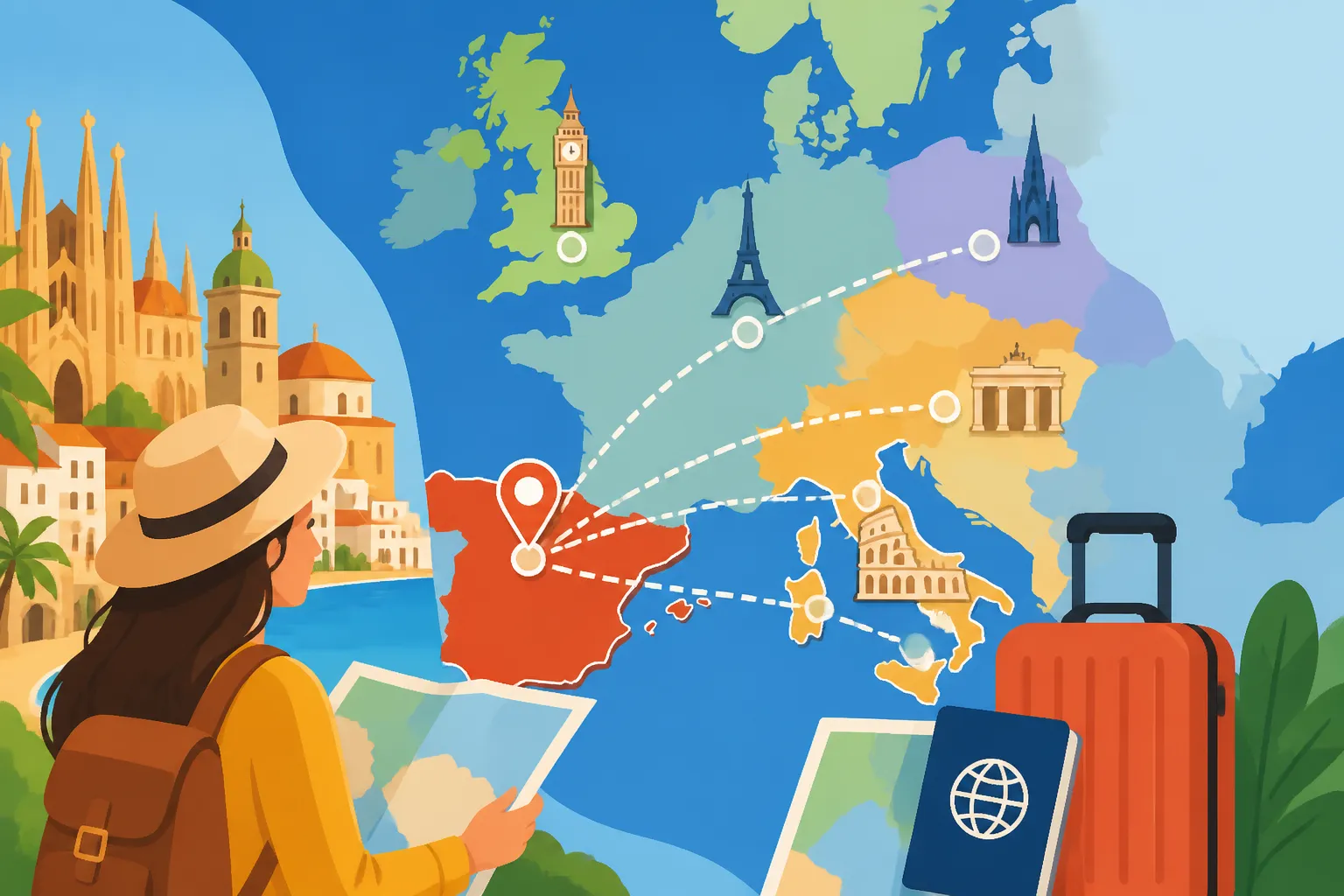
Given Spain's location, several classic multi-country routes naturally emerge. One of the most popular is a Spain-Portugal combination. You can start in Madrid, take a high-speed train to Lisbon (or a comfortable bus), explore Porto, and even dip into the Algarve before returning to Spain. This route is fantastic for history, food, and coastal beauty. Another beloved choice is Spain-France. Begin in Barcelona, head north to explore the vibrant cities of the south of France like Montpellier or Marseille, then potentially venture further to Paris. From Paris, the possibilities are endless – a quick train to Brussels, Amsterdam, or even London (though remember the UK isn't Schengen!). If you're keen on exploring the Mediterranean, a trip could involve Barcelona, then a flight or ferry to Italy (perhaps Rome or the Amalfi Coast), and potentially on to Greece. Eastern Europe is also more accessible than ever, with budget flights connecting major Spanish cities to Budapest, Prague, or Krakow. The beauty of starting in Spain is that you can choose routes that suit different travel seasons too – stick to the mild Mediterranean in spring/autumn, head north in summer, or enjoy the cities in winter.
Balancing Pace and Sightseeing: Don't Overdo It
This is where many first-time multi-country travelers trip up: trying to cram too much into too little time. It’s tempting to look at a map and think, "Oh, it's just a few hours by train to the next city, we can do Rome, Florence, and Venice in five days!" While technically possible, you'll spend more time commuting, checking in and out of hotels, and rushing through sights than actually experiencing anything. The result is often exhaustion, blurred memories, and a feeling of having missed out.
My advice as a seasoned expat is always to embrace a slightly slower pace. For a multi-country trip, aim for at least 3-4 full days per major city, or 5-7 days per smaller region. This allows you time to truly explore, get lost in charming side streets, revisit a favorite café, and not feel pressured to see everything in a whirlwind. For example, if you plan to visit Madrid, Barcelona, and then hop to Rome, consider a minimum of 10-12 days for those three cities alone. This way, you can properly engage with the local culture. Remember, it's not about how many stamps you get in your passport, but the quality of the experiences you gather along the way. Sometimes, less truly is more, especially when you're trying to soak in the nuances of distinct European cultures.
The Booking Maze: Simplifying with Omio
Alright, we’ve talked about the planning, the destinations, the transport options. Now, let’s tackle the part that often feels like wrestling an octopus: actually booking all those train tickets, bus fares, and flights across different providers and countries. This is where a reliable platform can be an absolute game-changer.
Why Omio Becomes Your Best Friend
For multi-country European travel starting from Spain, Omio truly is your best friend. Imagine this: instead of opening five different browser tabs for Renfe, ALSA, Vueling, SNCF, and Deutsche Bahn, you open just one app or website. Omio aggregates travel options for trains, buses, and flights across Europe (and beyond!), showing you all the available routes, prices, and travel times in one place. This means you can easily compare a train from Barcelona to Paris with a bus or a flight, seeing the real-time costs and durations side-by-side.
This level of consolidation is invaluable. Many cross-border travelers find that the sheer relief of not having to navigate multiple foreign-language booking systems, convert currencies mentally, or try to figure out if that bus company is even legitimate, is immense. Omio partners directly with over 1,000 transport providers worldwide, including major players like Renfe, Ouigo, Iryo, ALSA, FlixBus, Trenitalia, SNCF, Eurostar, and numerous airlines. This partnership ensures you’re seeing official prices and schedules, and you can book everything securely through a single transaction. Plus, their interface is designed with travelers in mind, making it incredibly intuitive to filter results by price, duration, departure time, and even the number of stops. When you're dealing with complex itineraries, having such a streamlined tool like Omio is a massive weight off your shoulders. It makes the entire booking process transparent and considerably less stressful.
Step-by-Step Booking with Omio
Let's walk through how easy it is to book your multi-country trip using Omio:
- Input Your Journey Details: Head to the Omio website or open the app. Enter your starting point (e.g., Madrid, Spain), your destination (e.g., Lisbon, Portugal), and your desired travel date. If you have multiple legs, you'll typically search one leg at a time.
- Compare Options: Omio will then present you with a comprehensive list of available trains, buses, and flights for that route. You'll see the carrier (e.g., Renfe, ALSA, TAP Air Portugal), departure and arrival times, total journey duration, and the price. This is where the magic happens: you can instantly compare if taking a high-speed train is faster but more expensive than a bus, or if a budget flight offers the best value for your time.
- Filter and Refine: Use the filters at the top or side to narrow down your results. You can filter by:
- Transport Type: See only trains, buses, or flights.
- Price Range: Stick to your budget.
- Departure/Arrival Time: Find options that fit your schedule.
- Journey Duration: Prioritize speed or scenic routes.
- Stops: Choose direct routes or those with connections.
- Select Your Ticket: Once you've found the best option for your needs, click on it to view more details, like specific stops or amenities onboard. Make sure to check the luggage policy if you're flying!
- Enter Passenger Details & Book: Provide your passenger information, review the fare details, and proceed to payment. Omio supports various payment methods, making it convenient for international travelers.
- Receive Your Tickets: Your tickets, often in digital format (e-tickets or mobile tickets), will be sent directly to your email or stored within the Omio app. No need to print in most cases, which is perfect when you’re constantly on the go.
It really is that simple. Using Omio transforms what could be hours of frustrating research and booking into a few clicks. It’s like having a personal travel agent who speaks all the languages and knows all the transport secrets of Europe, right there on your phone or laptop. For your next epic European adventure from Spain, make Omio your first port of call.
Practical Tips for a Seamless Journey
Beyond booking, there are a few essential considerations to keep in mind to ensure your multi-country trip from Spain goes off without a hitch. These practicalities can make all the difference between a smooth adventure and a series of minor annoyances.
Accommodation, Luggage, and Local Currency
When you're hopping across borders, a bit of foresight goes a long way. First, accommodation: book ahead, especially if you're traveling during peak season or to popular cities. Platforms like Booking.com or Airbnb are your friends. Consider staying near major transport hubs if you're making quick stops, but if you're settling in for a few days, choose a neighborhood that aligns with your interests. Also, remember that different European cities have varying standards and prices. What's a cheap hostel in Berlin might be a mid-range hotel in Lisbon.
Next, luggage: this is a big one. For multi-country trips, especially those involving trains and buses, try to pack light. Rolling suitcases are great, but a good quality travel backpack can be even better for navigating cobblestone streets and crowded stations. If you're flying, be acutely aware of budget airline baggage allowances – those extra fees can quickly add up! Look for versatile clothing items that can be mixed and matched.
Finally, local currency: most of Europe uses the Euro, which simplifies things immensely if you're starting in Spain. However, remember that some countries like the UK, Switzerland, Poland, Czech Republic, and Hungary use their own currencies. Always carry some local cash for small purchases, but rely mainly on a credit or debit card with low foreign transaction fees. Using a digital bank like Revolut or N26 can be incredibly helpful for managing multiple currencies and avoiding ATM fees. For more details, you can refer to Money for Travel in Spain: Cards, Cash, and ATMs which provides useful information about managing finances while travelling.
Staying Connected and Emergency Prep
Staying connected is non-negotiable for smooth travel. If you have an EU SIM card from Spain, you generally benefit from "Roam Like at Home" rules, meaning you can use your data, calls, and texts across the EU/EEA without extra charges. This is fantastic! However, if you're traveling outside the EU, or if you want a reliable backup, consider an eSIM. Services like Airalo allow you to download a data plan for a specific country or region directly to your phone, offering incredible flexibility without swapping physical SIM cards. You can learn more about this in Mobile Data and eSIMs for Travel in Spain. Having a working phone is crucial for navigation, booking last-minute changes, and staying in touch.
Beyond connectivity, emergency preparedness is key. Always have travel insurance – seriously, don't skimp on this. It covers everything from lost luggage to medical emergencies. Keep copies of your passport, visa, and insurance details (both physical and digital) separate from the originals. Familiarize yourself with local emergency numbers (112 works across the EU for all emergencies). While Spain is generally safe, it's always wise to be aware of your surroundings, especially in crowded tourist areas, as covered in Staying Safe in Spain: Common-Sense Tips for Travelers. Knowing basic first aid and carrying a small kit can also be very helpful. Remember, a little preparation goes a long way in ensuring peace of mind, allowing you to fully immerse yourself in the incredible experiences Europe has to offer. For added security, consider reviewing Travel Insurance for Trips to and Within Spain before you depart.
Navigating Cultural Nuances and Language
Stepping out of Spain and into other European countries, you’ll quickly notice that while many things are similar, subtle (and sometimes not-so-subtle) cultural differences exist. These nuances can greatly impact your travel experience, from how you order a coffee to how you interact with locals. Being aware and respectful of these variations will enhance your journey tenfold.
Embracing Local Etiquette and Communication Styles
One of the joys of multi-country travel is experiencing different ways of life. What’s perfectly normal in Spain might be considered impolite elsewhere, and vice-versa. For instance, while a casual greeting is common in Spain, in Germany or France, a more formal approach, especially with strangers or in professional settings, is often appreciated. Tipping customs also vary wildly – generous in some places, practically non-existent in others, and sometimes even seen as an insult. In Spain, a small tip for good service is common, but it's not usually expected to be as high as in North America. When you're in Italy, expect meal times to be a social event, often later than what you might be used to in Northern Europe, but perhaps not as late as the typical Spanish dinner.
Communication styles can also differ. Some cultures are very direct, while others prefer more indirect communication. A friendly smile and an attempt at local phrases almost always go a long way. Even if your Spanish Language and Everyday Communication for Visitors is fluent, remember that English proficiency can vary significantly outside major tourist hubs in other European countries. A quick "hello," "please," and "thank you" in the local language shows respect and can open doors. Being adaptable and observing local behavior before diving in will help you blend in and avoid unintentional faux pas.
Learning Basic Phrases and Using Translation Tools
Even if you only know a few words, making an effort to speak the local language is always appreciated. In France, for example, starting any interaction with "Bonjour" (hello) is almost mandatory before you switch to English. In Italy, "Grazie" (thank you) and "Ciao" (hello/goodbye, informal) are easy to pick up. For more complex interactions, or when you find yourself completely stuck, modern technology is your savior. Google Translate or DeepL are fantastic apps that offer instant text and voice translation, often with surprising accuracy. Download offline language packs before you travel, especially if you anticipate being in areas with spotty internet.
Beyond direct translation, these apps can help you understand menus, street signs, or even brief conversations. Don't be shy about using them – most locals appreciate the effort you’re making to bridge the language barrier. Coupled with your already strong Spanish foundation, these tools will empower you to navigate cities, order food confidently, and engage with people in a more meaningful way, enriching your overall multi-country adventure. Remember that while Spanish Medical Terminology: Common Words Expats Should Know might be handy in Spain, different countries will have different emergency services and medical terms, so always be prepared with an online translator for those specific situations.
Navigating Spain's Transport Hubs for International Departures
Since you're starting your grand European tour from Spain, understanding how to best utilize Spain's key transport hubs is vital. Whether you're flying out of a major airport or catching a train or bus to a neighboring country, knowing the ins and outs will make your departure seamless.
Major Airports: Madrid-Barajas and Barcelona-El Prat
Madrid's Adolfo Suárez Madrid-Barajas Airport (MAD) and Barcelona's El Prat Airport (BCN) are Spain's two busiest international gateways, offering a vast number of connections across Europe and globally.
- Madrid-Barajas (MAD): Located northeast of the city center, MAD is easily accessible via metro (Line 8 connects directly to all terminals), Cercanías regional trains (connecting Terminal 4 to Atocha and other stations), airport express bus, or taxi/ride-share. If you're coming from other parts of Spain, the high-speed AVE train network connects seamlessly to Atocha station, from where you can take the Cercanías train to the airport. MAD is a hub for Iberia and Air Europa, offering connections to virtually every major European city. Allow ample time for check-in and security, especially during peak travel seasons.
- Barcelona-El Prat (BCN): Situated southwest of Barcelona, BCN is also well-connected. The Aerobús provides direct express service to Plaça Catalunya and Plaça Espanya. Metro Line 9 Sud connects both terminals, and Cercanías R2 Nord train offers connections to Barcelona Sants station. BCN is a major base for budget airlines like Ryanair and Vueling, which fly extensively across Europe. It’s a fantastic starting point for trips to France, Italy, and beyond. As with Madrid, factor in at least 2-3 hours before your scheduled flight, especially for international departures.
Both airports are modern, well-equipped, and offer various services, but they can get incredibly busy. Always check your terminal number in advance, as flights can depart from different areas depending on the airline.
International Train and Bus Stations
For those opting for land travel, Spain's major cities boast excellent international train and bus stations.
- Madrid Atocha (Train) and Estación Sur (Bus): Atocha is Madrid's primary railway station and a major hub for high-speed trains. From here, you can catch direct trains to cities like Marseille and Lyon in France (via Renfe-SNCF international services) or connect to Lisbon via a changing service. Estación Sur de Autobuses is the main bus station, offering extensive international routes, particularly to Portugal and France, with companies like ALSA and FlixBus. You can get to Estación Sur via metro (Méndez Álvaro station, Line 6) or Cercanías train.
- Barcelona Sants (Train) and Estació del Nord (Bus): Barcelona Sants is the city's main train station, connecting to high-speed lines that link directly to French cities like Paris, Toulouse, and Lyon. It also serves as a hub for regional trains throughout Catalonia. Estació del Nord, Barcelona’s main bus station, is a hub for international bus routes, connecting to destinations across France, Italy, and Central Europe. It's easily accessible via metro (Arc de Triomf, Line 1) or a short walk from the city center.
When departing from these stations, it's always a good idea to arrive at least 30-45 minutes before your scheduled departure, especially for international connections, to locate your platform or bus gate and allow for any unexpected delays. Navigating these stations, particularly in a foreign language, can be daunting initially, but they are generally well-signed. Remember, using Omio for booking these tickets means you'll have all your departure and arrival details consolidated, making it much easier to find your way.
Final Thoughts on Your European Adventure from Spain
Embarking on a multi-country European trip from your base in Spain is an incredible opportunity to explore diverse cultures, breathtaking landscapes, and rich histories. While the planning might seem overwhelming at first, breaking it down into manageable steps and leveraging the right tools can transform it into an exciting part of the adventure itself.
From defining your travel style and understanding Schengen rules to choosing between the romantic allure of trains, the budget-friendly practicality of buses, or the speed of flights, every decision shapes your journey. Remember to balance your pace, allowing yourself to truly experience each destination rather than just rushing through a checklist. And critically, don't let the booking process dampen your spirits. With a powerful platform like Omio, you can consolidate all your travel options – trains, buses, and flights – into one easy-to-use interface, comparing prices and schedules from hundreds of providers instantly. This takes the headache out of juggling multiple websites and ensures you get the best deals for your itinerary.
Embrace the cultural nuances, learn a few key phrases, and stay connected while prioritizing your safety and preparedness. Spain provides the perfect launching pad for these unforgettable European escapades. So, go forth, plan wisely, book smartly with Omio, and immerse yourself in the wonders that await you just beyond your Spanish borders!
Disclaimer
The information provided in this guide is for general informational purposes only and does not constitute legal, financial, or professional travel advice. While we strive to keep the information up-to-date and correct, travel regulations, visa requirements, and transport schedules can change rapidly. Always consult official government websites, relevant embassies or consulates, and transportation providers for the most current and accurate information before making any travel plans or decisions. Specific experiences with travel platforms or services may vary.