Spain to France: Barcelona-Paris and San Sebastian-Bordeaux Options
Picture this: you are standing in Barcelona Sants with a backpack, a Paris hotel booked for tonight, and three browser tabs open. Renfe shows one thing, SNCF shows another, and a bus site shows something else. Or you are in San Sebastián and cannot work out how to reach Bordeaux at all. This guide covers both border crossings and how to book them without the headache.
Disclosure: This post may contain affiliate links. We may earn a commission at no extra cost to you if you make a purchase through these links. Read full disclosure.
Why the Spain to France Crossing Feels Harder Than It Should
I have lived in Spain long enough to cross into France by almost every method: high-speed train, sleepy regional connections, late-night buses, a borrowed car, and once a ride-share with a retired couple from Toulouse. Every time, the hard part was the planning. The journey itself was usually fine. Two national rail systems, two languages on the ticket, regional operators on both sides, and buses that do not always appear on the railway websites all mean the information is scattered.
If that has frustrated you, it is not your fault. A cross-border trip can mean dealing with Renfe, SNCF, a Basque commuter railway, and two or three coach companies, each with its own booking flow, its own rules, and its own idea of what counts as a valid ticket. The good news is that once you understand how each corridor actually works, the choices get much simpler.
Two Very Different Border Corridors
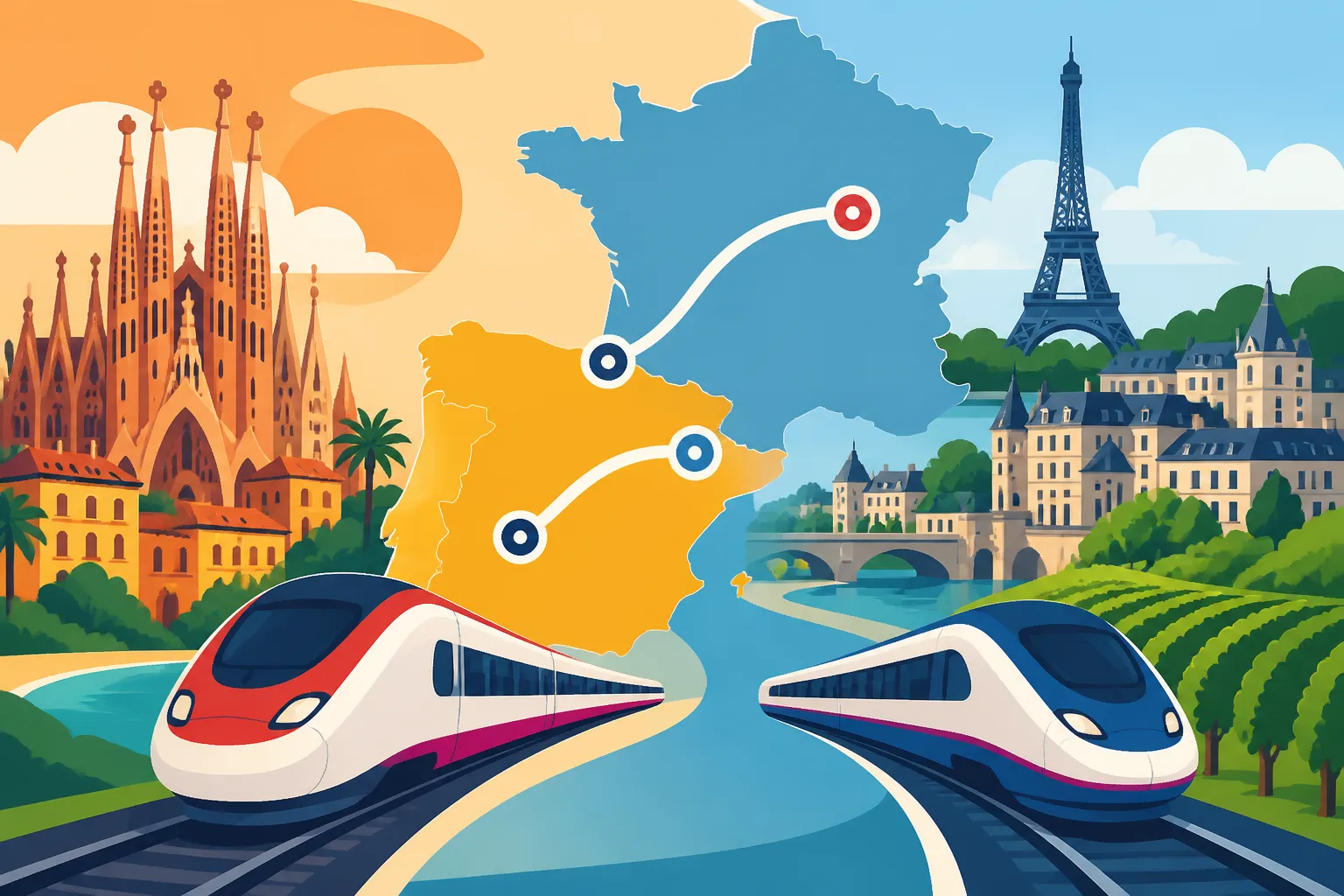
The Mediterranean corridor runs from Barcelona north through Girona and Figueres, under the Pyrenees, and into France at Perpignan. It is the modern high-speed crossing. The track is built for fast trains, the stations are large, and through services link Barcelona Sants with Paris Gare de Lyon. This is the corridor for travellers who want one seat, one ticket, and a long, scenic run up through Occitanie and the Rhône valley.
The Atlantic corridor, along the Basque coast, is completely different. San Sebastián does not have a high-speed through train to Bordeaux. The gauge changes at the border, the main stations are Irun on the Spanish side and Hendaye on the French side, and many people actually cross on the Euskotren commuter line nicknamed the Topo. This route is cheaper and more relaxed, but it needs more planning because you are often stitching two or three pieces together.
Knowing which corridor you are on shapes everything: how far ahead to book, whether a bus beats the train, and how much buffer to leave between connections. For more context on how Spain’s own rail network divides into fast and slow services, see Train Travel in Spain: High-Speed vs Regional Routes Explained.
Where Omio Fits Into the Planning
This is where Omio earns its place on your phone. Omio is a travel search and booking platform that puts trains, buses and flights from different operators side by side for the same route and date. You can compare a direct high-speed train against a cheaper split journey and a coach in one screen, instead of hopping between national rail sites that each show only their own services.
For the Barcelona to Paris run, that means you can see the through train alongside alternatives via other French cities. For San Sebastián to Bordeaux, it means you can weigh direct buses against rail connections from Hendaye without building the comparison yourself. I am not saying the national operators’ own websites are useless. They are not. But when you are new to the region, have a non-Spanish card, or simply want the whole picture at once, a single English-language search makes a real difference.
Barcelona to Paris: Your Realistic Options
This is the busier and better-connected of the two routes, and it is where you have the most choices. That also makes it the easiest to overthink. Here is how the main options break down.
The Direct High-Speed Train via Figueres and Perpignan
The direct high-speed train is the classic Barcelona to Paris experience, and honestly, it is one of my favourite train journeys in Europe. You board at Barcelona Sants, run up past Girona and Figueres, slip through the tunnel under the Pyrenees, and then cross the vineyards and lagoons of the French Mediterranean coast before the long sweep north to Paris. It takes most of a day, so think of it as a travel day rather than a quick hop. But it is city centre to city centre, and you never have to take off your shoes for security.
These through services are run by SNCF on French high-speed rolling stock. There are only a few direct departures each day, and they fill up, especially on Fridays, Sundays and around French and Spanish holidays. Fares move with demand, so the same seat can cost very different amounts depending on when you book. For a deeper look at timing and how the train stacks up against a flight, see Barcelona to Paris by Train: Booking, Timing, and Cost vs Flying.
A realistic scenario: a friend of mine, newly arrived in Barcelona on a work contract, wanted to surprise her partner in Paris for a long weekend. She left it until the Wednesday before and found the direct trains either sold out or priced well above what she had expected. She ended up booking a split journey through Lyon that left earlier and arrived later, but cost noticeably less. Searching on Omio showed her both options at once, which is how she spotted the alternative in the first place.
Splitting the Journey Through Lyon, Marseille or Montpellier
When the direct train is full or expensive, splitting the trip is the smart workaround. Renfe runs high-speed services from Barcelona into southern France, and SNCF has a very dense network from cities like Lyon, Marseille and Montpellier up to Paris. Combining a Spanish-operated leg south of the border with a French-operated leg north of it can open up many more departure times.
The trade-off is the connection. If your two legs are on separate tickets, a delay on the first one may not entitle you to free rebooking on the second. I always leave a generous buffer, more than feels necessary, and I avoid the very last connection of the evening. Lyon Part-Dieu, in particular, is a big, busy station, and finding your platform with luggage takes longer than you expect. For a broader method for linking separate services safely, see Combining Train and Bus in One Journey: Planning Connections That Hold.
Splitting also turns the journey into something more interesting. If you are not in a rush, a stopover makes the price of a full-day train trip feel like a bonus rather than a cost.
Flying Barcelona to Paris: When It Wins
I am a train person, but I will not pretend flying never makes sense. Several airlines connect Barcelona El Prat with Paris Orly and Charles de Gaulle, and the flight itself is short. If you live near the airport, are travelling with hand luggage only, or have to be in Paris for a morning meeting, flying can be the practical choice.
The catch is everything around the flight: getting to El Prat, security, boarding, then the transfer from either Paris airport into the city. Once you add those up, the time saving over the train shrinks a lot. Checked bags can also change the price comparison considerably on low-cost carriers. If you are starting from the airport side of Barcelona or just landed there, see How to Get From Barcelona Airport to the City Center for the onward connections in the opposite direction.
Omio lists flights alongside trains and buses, which is useful here. You can see the total journey time and decide whether the flight really saves you anything once you factor in the airport transfers on each end.
San Sebastián to Bordeaux: Navigating the Basque Border
The Basque route is where I hear the most confused messages from friends and readers. “Is there a train?” “Why does the station say Hendaia?” “Do I need to change at Irun?” All fair questions. This corridor works well once you understand it, but the information is scattered.
The Topo to Hendaye and the French Connection
The most local way to cross is the Euskotren commuter line known as the Topo. It runs from San Sebastián, with stops in the city such as Amara, east through Pasaia and Irun to Hendaye, just across the Bidasoa river in France. It is a frequent, no-frills commuter train used by locals going about their day, and riding it feels a bit like a secret shortcut.
At Hendaye, the Euskotren stop sits right beside the SNCF station. From there you can take French regional trains or high-speed services north along the coast through Saint-Jean-de-Luz, Biarritz and Bayonne towards Bordeaux Saint-Jean. Some journeys need a change at Bayonne, depending on the time of day. The Topo is usually bought locally at machines or with the operator’s own payment options rather than through a booking platform, so treat it as the short first hop and book the French leg separately.
Here is the simplest way to do this crossing:
- Check French train times from Hendaye to Bordeaux and choose your departure before you leave San Sebastián.
- Book the Hendaye to Bordeaux leg in advance, especially for weekends and summer travel.
- Take the Topo from your nearest San Sebastián stop to Hendaye, allowing extra time beyond what the timetable says you need.
- Walk the short distance from the Euskotren stop to the SNCF station and find your platform.
- Keep your French ticket ready on your phone or printed, as conductors may check it on board.
If you are also exploring the Spanish Basque coast before you cross, see Bilbao to San Sebastian and Santander: Northern Spain Connections for help planning the westward leg.
Direct Buses from San Sebastián
For many people, the direct bus is the easiest option on this route. Coach operators such as FlixBus, ALSA and BlaBlaCar Bus have run services from San Sebastián to Bordeaux, typically leaving from the underground bus station beside the Estación del Norte. You stay in one seat, your bag goes underneath, and you are dropped in Bordeaux with no connection to make.
Buses are often the cheapest choice, and on a clear day the views over the Landes forests are lovely in their own flat, pine-scented way. The downsides are traffic, especially around Bayonne and the Bordeaux ring road in summer, and less legroom than the train. I have done this ride with a good book and a podcast and arrived perfectly happy. I have also done it on a stuffy August Friday and arrived much later than planned.
Because several coach companies compete on this route, it pays to compare them. Omio shows multiple bus operators together with rail options, so you can weigh a cheaper coach against a slightly faster train via Hendaye in one search. For a closer look at how two of the main coach brands compare inside Spain, see ALSA vs FlixBus in Spain: Comfort, Price, and Route Coverage.
Driving or Ride-Sharing Across the Bidasoa
If you have your own car, the drive from San Sebastián to Bordeaux is straightforward, following the motorway up the French Atlantic coast. Expect toll motorways on both sides of the border, and fuel prices that differ between Spain and France. Many drivers from the Basque Country fill up before crossing for exactly that reason.
Ride-sharing is another option worth knowing. I have shared cars with students, commuting professionals and once a cheerful family heading to a wedding. It can be sociable and economical, but timing depends on the driver, and last-minute cancellations happen. It suits flexible travellers more than people with a fixed connection to catch.
If you are planning to cross this border regularly for work, a hobby or family visits, see Cross-Border Commuting From Spain: Regular Trips to France and Portugal, which covers the habits and logistics of frequent crossings.
Comparing Your Spain to France Options Side by Side
When I sit down to plan one of these trips, I always end up writing a little comparison for myself. Here is a cleaned-up version to save you the trouble.
Route and Mode Comparison Table
| Route | Option | Changes | Typical Departure Point | Best For | Main Drawback |
|---|---|---|---|---|---|
| Barcelona to Paris | Direct high-speed train | None | Barcelona Sants | Comfort, scenery, city-centre arrival | Limited daily departures, fills quickly |
| Barcelona to Paris | Split train via Lyon, Marseille or Montpellier | One or more | Barcelona Sants | More departure times, flexible stopovers | Connection risk on separate tickets |
| Barcelona to Paris | Flight | None in the air | Barcelona El Prat | Tight schedules, hand-luggage travellers | Airport transfers and baggage add time and cost |
| Barcelona to Paris | Long-distance bus | Varies | Barcelona bus stations | Lowest budgets | Very long journey |
| San Sebastián to Bordeaux | Topo plus French train | At least one | San Sebastián Euskotren stops | Rail lovers, scenic coastal views | Separate tickets, more planning |
| San Sebastián to Bordeaux | Direct bus | None | Bus station by Estación del Norte | Simplicity, value | Traffic, less legroom |
| San Sebastián to Bordeaux | Car or ride-share | None | Your door | Flexibility, groups | Tolls, fuel, parking in Bordeaux |
Which Option Suits Which Traveller
If you are a first-time visitor who wants an easy, memorable trip, the direct Barcelona to Paris train is hard to beat. On the Basque side, the direct bus is the least stressful choice for someone who does not want to manage a connection. Both options let you get on, sit down, and get off at your destination.
If you are a budget traveller or a student, splitting the Barcelona journey, or taking a bus on either corridor, will usually stretch your money further. Book early and stay flexible on dates. The difference between a Tuesday and a Friday can be significant.
If you are a family or a small group, the arithmetic changes. Four train tickets can cost more than one car with shared fuel and tolls, especially on the Basque coast. On the Mediterranean side, though, the comfort of a train with space for kids to move around often wins. Comparing all modes in one Omio search is especially helpful here, because you can quickly see the total for several passengers on each option.
How to Book Spain to France Journeys With Omio
I want to walk you through the booking process I actually use, because the details are where cross-border trips succeed or fall apart.
Searching and Comparing Routes
- Open Omio on your phone or laptop and enter your departure city and destination, for example Barcelona to Paris or San Sebastián to Bordeaux.
- Choose your date and the number of passengers, adding any discount cards you hold if the platform supports them for that operator.
- Switch between the train, bus and flight tabs to compare journey times, departure times and the number of changes.
- Open the details of each result to see the operator, stations and any connection points.
- Check the fare conditions before you pay, paying particular attention to whether changes and refunds are allowed.
- Look at the full price at checkout, including any service or booking fee the platform shows, and compare it with the operator’s own site if you want to be thorough.
That last step matters. Booking platforms may add a service charge on top of the operator’s fare, and the amount can vary by route and ticket type. Check the figures on Omio’s own checkout page and the operator’s page for the current picture, then decide whether the convenience of comparing everything together, in English and in one app, is worth it for your trip. For me, on unfamiliar cross-border routes, it usually is.
If you have had cards declined on Spanish rail sites before, you are far from alone. See Booking Spanish Trains From Abroad: Foreign Cards, Passports, and Failures for common payment problems and fixes.
Mobile Tickets, Passports and Seat Choice
Once booked, your tickets usually appear in the app as mobile tickets or downloadable PDFs, depending on the operator. I always download them for offline use before leaving, because mobile signal under the Pyrenees or in a crowded station is not something to rely on. A screenshot as a backup has saved me more than once.
Carry your passport or national ID card. Spain and France are both in the Schengen area, so there are usually no routine border checks, but spot checks do happen, especially at stations near the border, and the name on your ticket should match your ID. On the high-speed trains, seats are generally assigned. On many buses, seat selection depends on the operator and sometimes costs extra.
If you hold a rail pass, remember that high-speed trains between Spain and France generally require a seat reservation on top of the pass, and the number of reservations for pass holders on some services can be limited. See Interrail and Eurail in Spain: Reservation Fees and Whether It Works Here before assuming your pass covers everything.
What to Do When Plans Change
Plans change, especially on trips you booked months ahead. The rules depend entirely on the fare you bought, not on the platform you used. Some fares allow changes for a fee, some allow refunds, and the cheapest often allow neither. That is why checking the conditions before paying is so important.
If an operator cancels or seriously delays your service, you generally have passenger rights, and the operator’s terms and EU passenger rules will shape what you can claim. Omio’s customer support can help you understand your options for tickets bought through the platform, but the operator is still the one running the train or bus. Keep your booking confirmation and any delay notices. For how disruption works on the Spanish side, see Strikes and Cancellations in Spain: Your Rights and Rebooking Options.
Practical Tips for a Smooth Crossing
These are the small things I wish someone had told me before my first crossing. None of them is dramatic, but together they make the day far easier.
Luggage, Food and Timing
High-speed trains between Barcelona and Paris are generous with luggage compared with planes, but racks fill up fast on busy departures. Board early if you have a big case, and keep valuables with you rather than at the end of the carriage. Bus luggage allowances vary by operator, and an extra bag may cost more, so check before you pack. See Luggage Rules on Spanish Trains and Buses: Limits and Fees for more detail.
Bring food. Yes, there is usually a café car on the high-speed train, but prices are what you would expect on a captive journey, and the choice is limited. I stock up at the market near Sants or a bakery in San Sebastián’s Parte Vieja the day before. A bocadillo and some fruit improve any long journey. On buses, check whether there is a scheduled stop. Sometimes there is, sometimes there is not.
Plan your arrival time carefully. Arriving at Paris Gare de Lyon late in the evening is fine, but finding your accommodation in the dark after a long day is more tiring than it sounds. In Bordeaux, Saint-Jean station is well connected by tram to the centre, so a late arrival is not a problem, though a daytime arrival lets you enjoy the riverfront on your first evening.
Strikes, Holidays and Peak Weeks
French rail strikes are part of life, and they can affect cross-border trains. Spanish transport strikes happen too. Before any trip, I check the news in the days beforehand and keep notifications switched on in the app. If a strike is announced, a coach or a flight may be your best fallback, which is another reason to keep the full range of transport options visible.
Holiday periods on both sides of the border fill trains and buses quickly. Spanish puentes, French school holidays, Easter and the August exodus all push up demand and prices. If your dates fall on any of those, book as soon as you can. Fares on high-speed routes in particular tend to rise as departure approaches. See Spanish Train Price Curves: How Fares Move From 60 Days Out to Departure for how that pattern works on Spanish routes.
Finally, if this crossing is just one stop on a longer European trip, plan it as part of the whole route. Going on from Paris to Brussels, Amsterdam or Germany works well by rail, and Bordeaux has good connections onward too. See Multi-Country Europe Trips Starting in Spain: Route Planning and Booking for help sequencing a bigger itinerary. When you are ready to book your Spain to France leg, open Omio, search both corridors, and compare the train, the bus and the flight side by side. It is the quickest way I know to turn three confusing browser tabs into one clear decision.
Disclaimer
This article is for general informational purposes only and does not constitute professional advice. Laws, prices and regulations vary by location and change over time. Consult a qualified professional for guidance on your specific situation.