Spain to Germany and the Netherlands: Overland Options for Long Trips
Alright, let's talk about hitting the road – or rather, the tracks and highways – from sunny Spain all the way up to Germany and the Netherlands. I know, the thought of such a long journey across countries can feel utterly overwhelming, especially when you're used to quick flights. But trust me, taking the overland route is an incredible experience, albeit one that requires a bit more planning than a quick hop. This guide is all about helping you navigate the options, conquer the logistics, and make that grand European adventure a reality, especially with handy tools like Omio to simplify your life.
Disclosure: This post may contain affiliate links. We may earn a commission at no extra cost to you if you make a purchase through these links. Read full disclosure.
Why Choose Overland Travel from Spain to Central Europe?
Let's be honest, flying is quick, but sometimes you just crave a different kind of journey, don't you? After living here in Spain for years, I’ve come to appreciate the beauty of slowing down and truly experiencing the transition from one culture to another. The sheer distance from Spain to Germany or the Netherlands might make you instinctively reach for flight comparison websites, but hear me out on why choosing an overland adventure could be the best decision you make.
The Scenic Journey and European Charm
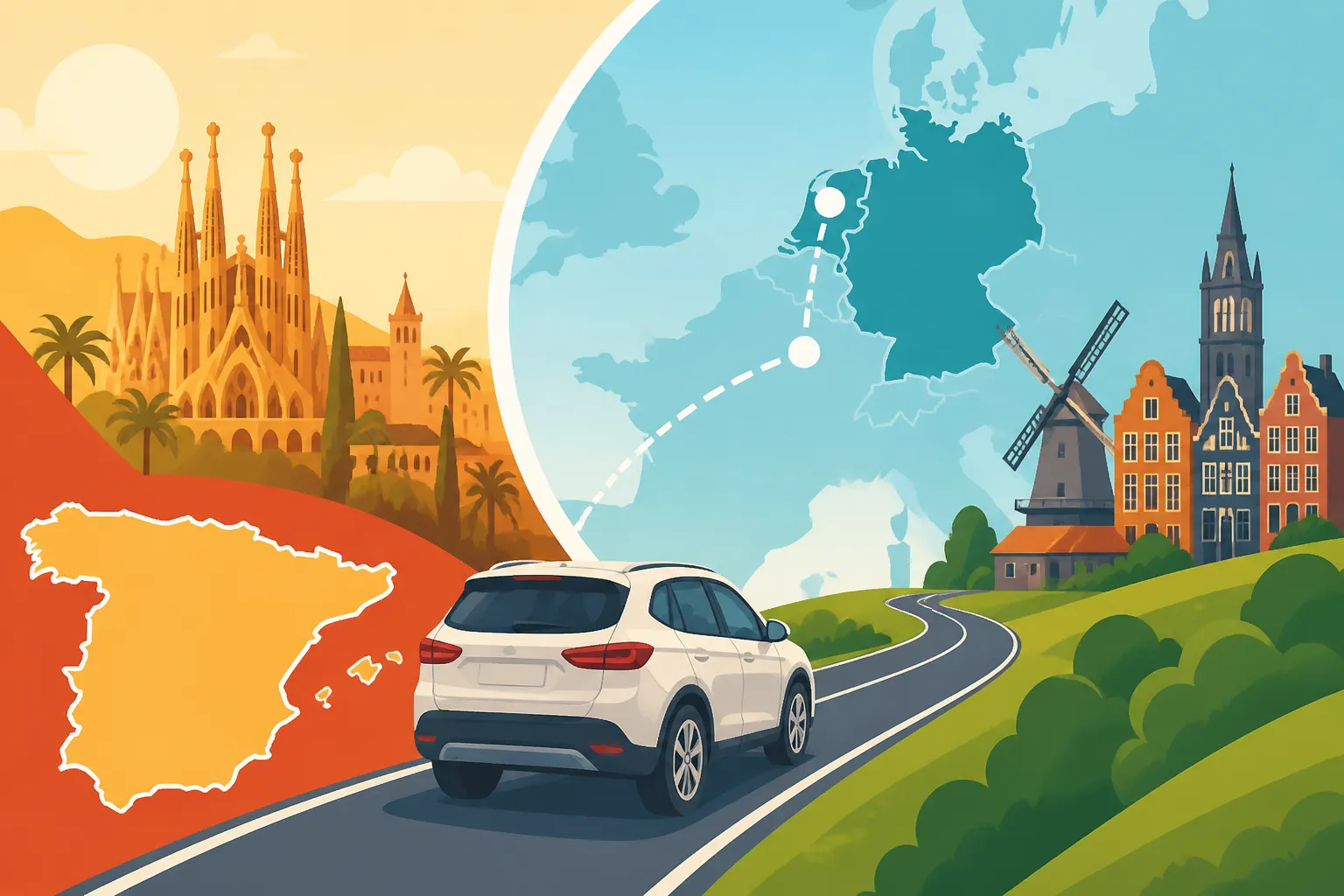
One of the biggest draws of overland travel is the incredible scenery you'll witness. Imagine leaving behind the olive groves and sun-baked landscapes of Spain, slowly transitioning through the rugged Pyrenees, across the picturesque countryside of France, perhaps skirting the Alps, and then into the rolling hills and charming towns of Germany or the flat, green expanses of the Netherlands. You see Europe unfold before your eyes, mile by mile, a panorama that simply can’t be experienced from 30,000 feet. There’s a certain magic in watching the architecture change, the languages shift, and the local life evolve as you move from one region to the next. It’s an immersion that starts the moment you step onto the train or bus.
Cost-Effectiveness vs. Flying
While flying often seems cheaper at first glance, especially with budget airlines, overland travel can often prove to be surprisingly cost-effective, particularly if you book in advance. Think about it: when you fly, you still need to factor in the cost of getting to and from airports (which are often far outside city centers), baggage fees, and often, an overpriced meal or two. With trains and buses, especially if you’re flexible with your travel dates and times, you can often find significantly cheaper tickets. Plus, many train stations are right in the heart of cities, saving you those extra transport costs and precious time. If you're looking to stretch your euros, making smart choices here can really help with the overall Cost of Living in Spain and your travel budget.
Environmental Impact and Slow Travel
For many of us, myself included, being mindful of our environmental footprint has become increasingly important. Long-distance train travel, in particular, boasts a significantly lower carbon footprint than flying. Choosing to travel overland is a conscious decision to support more sustainable tourism, contributing less to greenhouse gas emissions. Beyond the environmental benefits, there’s the philosophy of "slow travel." It's about more than just getting from point A to point B; it’s about savouring the journey itself. It allows for a deeper connection with the landscapes and cultures you pass through, giving you a chance to unwind, read a book, or simply watch the world go by. It’s a wonderful antidote to the rush of modern life, offering a truly relaxing start or end to your trip.
The Overland Routes: Spain to Germany and the Netherlands
So, you're convinced! Now, how do you actually do this? The beauty of European infrastructure is how well-connected it is, making cross-country travel surprisingly feasible, even if it requires a few changes. From Spain, your journey will typically involve traversing France before you hit Belgium, Luxembourg, and then your final destinations.
Train Journeys: Connecting Europe's Railways
Train travel is arguably the most romantic and comfortable way to cover these vast distances. Spain's high-speed rail network, Renfe, is excellent for getting you quickly to the French border. From there, you'll connect with France's SNCF trains, which offer a mix of high-speed (TGV) and regional services. For Germany, you'll then switch to Deutsche Bahn (DB), and for the Netherlands, Nederlandse Spoorwegen (NS).
The key here is understanding the connections. A typical route from, say, Madrid to Berlin might look something like this:
- Madrid/Barcelona to Paris: High-speed AVE or TGV trains. This leg is usually the longest single stretch and quite comfortable.
- Paris to a German city (e.g., Frankfurt, Cologne): High-speed TGV or ICE (Intercity-Express) trains run frequently, connecting major French and German hubs.
- From a German city to your final destination: Deutsche Bahn has an extensive network, easily connecting to cities across Germany and into the Netherlands (via NS).
Similarly, for the Netherlands:
- Madrid/Barcelona to Paris.
- Paris to Brussels: High-speed Thalys trains are your best bet here, taking just over an hour.
- Brussels to Amsterdam/Rotterdam: Continue with Thalys or switch to InterCity services.
The challenge, historically, has been coordinating tickets across different national operators. You'd be jumping from Renfe's website to SNCF's, then to DB's or NS's, potentially missing the best connections or deals. This is where a platform like Omio really shines, consolidating all these options into one easy search. If you’re planning a longer adventure, don't forget to review the Spain Schengen Rules: 90/180 Day Rule Explained for Spain to ensure your stay within the Schengen Area is compliant.
Long-Distance Bus Services: An Economical Alternative
If budget is your absolute top priority, then long-distance bus travel is a fantastic option. Companies like FlixBus offer incredibly affordable fares, often significantly cheaper than trains, especially if you're willing to endure longer journey times. Spain has excellent bus connections, with operators like Alsa linking major cities.
The bus routes often involve fewer transfers than trains, though the journey itself will take longer. For example, you might find direct buses from Barcelona to certain cities in Germany, or at least with only one major change in a hub like Paris or Brussels. While less luxurious than high-speed trains, modern long-distance buses are equipped with Wi-Fi, power outlets, and comfortable reclining seats, making the journey perfectly tolerable. You'll definitely have more legroom than on a budget flight! However, remember that bus stations can sometimes be a bit further out from city centres than train stations, so factor that into your arrival plans.
Hybrid Travel: Combining Modes for Efficiency
Sometimes, the best approach is a mix-and-match strategy. You might find a great deal on a high-speed train for the longest leg, but then switch to a bus for a shorter, less popular connection to save money, or vice-versa. For example, taking a swift train from Madrid to Paris, then catching a comfortable overnight bus from Paris directly to Amsterdam could be a great way to save time and money on accommodation.
Platforms like Omio are invaluable for this kind of hybrid planning. They allow you to compare train and bus routes side-by-side, seeing the total travel time, price, and number of changes for each option. This way, you can tailor your journey to your specific needs, whether that’s speed, cost, or comfort. Don't underestimate the convenience of having all your options laid out clearly, especially when navigating complex international routes. For other aspects of your daily life as an expat, remembering that there are many options for Utilities, Internet, and Essentials in Spain can help your overall transition to life abroad.
Planning Your Trip with Omio: A Step-by-Step Guide
Now, let's get down to the nitty-gritty of how to actually plan and book this epic journey. The key to making overland travel enjoyable, rather than a bureaucratic nightmare, is having the right tools. This is where Omio steps in as your absolute hero.
Navigating the Omio Platform
Omio is a brilliant, user-friendly platform that aggregates travel options across trains, buses, and even flights throughout Europe. This means you can type in your departure city in Spain and your destination in Germany or the Netherlands, and it will instantly show you all the available routes, sorted by price, duration, and number of transfers. No more juggling multiple websites, trying to translate booking pages, or worrying about missed connections between different transport providers. It truly streamlines the entire process.
Here's how you'd typically use it:
- Enter Your Journey Details: Head to Omio and input your departure city (e.g., Barcelona) and your arrival city (e.g., Berlin). Don't forget your travel dates!
- Compare Options: Omio will then present you with a comprehensive list of results. You'll see a mix of trains (from high-speed to regional), buses (often FlixBus or similar operators), and even flights if you wanted to see the comparison.
- Filter and Sort: Use the filters to refine your search. Want the cheapest option? Sort by price. Need to get there fastest? Sort by duration. Prefer fewer transfers? Filter by that. You can also specify preferred modes of transport if you know you definitely want a train or bus.
- Review Details: Click on any given option to see more details: the specific train or bus operators, transfer points, and even station names. This transparency is crucial for long, multi-leg journeys.
It makes the often-frustrating process of international travel planning feel incredibly manageable. Think of it as your personal multilingual travel agent, but without the fees!
Booking Tickets and Managing Your Itinerary
Once you’ve found the perfect route on Omio, booking is a breeze. The platform allows you to purchase all your tickets, even for different operators, in one go. This means you get a single booking confirmation and all your tickets are typically stored within the Omio app or sent directly to your email.
Why this is a game-changer:
- Single Transaction: No need for multiple payments across different currencies or different websites.
- Centralized Tickets: All your tickets for each leg of the journey are in one place, reducing the chance of misplacing them.
- Real-Time Updates: The Omio app often provides real-time updates on delays or platform changes, which can be a lifesaver when you're navigating unfamiliar stations.
After booking, make sure to download the Omio app. It’s incredibly handy for storing your e-tickets, checking your itinerary on the go, and getting notifications. This simplifies managing your trip, allowing you to relax and focus on the adventure. If you're going to be traveling around Spain more extensively, take a look at our guide on Traveling Around Spain: Trains, Buses, Flights, and Car Hire to see how all these options connect within the country too.
Essential Travel Tips for Long Journeys
Embarking on such a long overland journey requires a bit of preparation to ensure it’s as smooth and enjoyable as possible.
- Book in Advance: Especially for popular high-speed train routes and during peak seasons, booking your tickets well in advance through Omio can lead to significant savings. Prices tend to creep up closer to the travel date.
- Pack Smart: You'll be carrying your luggage between platforms and stations, so pack light! A rolling suitcase and a good backpack are your best friends. Think layers for changing climates as you traverse Europe.
- Comfort is Key: Bring snacks, a water bottle, a good book, headphones, and a portable charger. You'll be spending a fair bit of time seated, so make yourself comfortable. A travel pillow can be a lifesaver for overnight bus or train segments.
- Stay Connected: While many trains and buses offer Wi-Fi, it can be spotty. Consider an eSIM or a travel data plan for reliable internet access, especially for checking connections or using mapping apps during transfers.
- Learn Basic Phrases: Even if you rely on apps, knowing a few polite phrases in French, German, and Dutch (or even just English, which is widely spoken in transport hubs) can go a long way. Check out our Spanish Language and Everyday Communication for Visitors post for ideas on how to approach this.
Practical Considerations for Your Grand European Traverse
Beyond the bookings, there are a few other things to keep in mind to ensure your journey from Spain to Germany or the Netherlands is seamless.
Visa and Border Crossings
Since Spain, Germany, and the Netherlands are all part of the Schengen Area, once you've entered Spain legally (assuming you're a non-EU citizen with a valid Schengen visa or visa-free entry), you won't encounter traditional border controls between these countries. This is one of the fantastic benefits of the EU! You might see police or customs officials randomly check IDs on trains or buses, but there won't be passport stamping at each internal border.
Important Note for Non-EU Citizens: Always be mindful of the Schengen 90/180 day rule. This means you can stay a maximum of 90 days within any 180-day period across all Schengen countries. Your overland journey contributes to these days. Keep your passport and any visa documents easily accessible, even if not strictly required at internal borders. Understanding Spain Schengen Rules: 90/180 Day Rule Explained for Spain is paramount for any long-term stay or multi-country travel.
Packing for a Multi-Country Journey
Packing for an overland trip through multiple climates and cultures can be tricky. My personal rule of thumb is "less is more," especially when you're managing your own luggage through bustling stations.
- Versatile Clothing: Think layers and items that can be mixed and matched. A good waterproof jacket is a must, no matter the season, especially as you head north.
- Comfortable Shoes: You'll be doing a fair amount of walking, both at stations and exploring stopovers.
- Essentials Bag: Keep a smaller bag with your absolute necessities (documents, wallet, phone, chargers, a change of clothes, basic toiletries) within easy reach, not tucked away in an overhead rack or luggage compartment.
- Snacks and Water: While food is available at stations and sometimes on board, having your own snacks saves money and ensures you have something you like.
- Travel Adapters: You'll need the standard two-pin European plug (Type F or E) which works across Spain, France, Belgium, Netherlands, and Germany.
Here’s a quick comparison of the primary overland travel options:
| Feature | High-Speed Train | Long-Distance Bus |
|---|---|---|
| Speed | Fastest overland option | Slower, subject to traffic |
| Comfort | More legroom, space to walk, often dining/cafe cars | Generally comfortable seats, but confined |
| Cost | Mid to High (cheaper if booked in advance) | Low to Mid (often the most economical) |
| Views | Excellent, large windows | Good, but often higher up |
| Environmental | Lower carbon footprint than flying | Lower carbon footprint than flying (can vary) |
| Connectivity | Direct city-center to city-center | Often goes to specific bus stations, sometimes city-center |
| Luggage | Generous allowance, easy to store overhead/behind seats | Limited allowance, stored in undercarriage |
| Transfers | Potentially multiple, but well-integrated (e.g., via Omio) | Often fewer direct routes, but longer travel times overall |
| Convenience | Generally very high, especially with digital tickets | Good for budget, but journey duration is a factor |
Accommodation and Stopovers
Unless you're planning an epic non-stop marathon (which I wouldn't recommend!), you'll likely want to break up your journey with a stopover or two. Paris, Lyon, or Brussels are natural choices for a night or two, allowing you to rest, stretch your legs, and perhaps enjoy a different city before continuing your adventure.
When planning stopovers, consider:
- Location of Stations: European train and bus stations are often well-connected to public transport, making it easy to reach accommodation.
- Luggage Storage: Many major stations offer luggage lockers (consigna) if you want to explore a city for a few hours without your bags.
- Booking Ahead: Especially in popular cities like Paris, book your accommodation in advance.
- Embrace the Unexpected: Sometimes the best memories are made during an unplanned wander during a layover.
Using Omio to plan your core journey allows you the mental space to think about these enjoyable intermediate stops, transforming a long trip into a series of mini-adventures. It takes the stress out of the logistics, letting you focus on the richer cultural experience. For broader tips on Travel Logistics in Spain: Money, Safety, and Connectivity, you might find some useful insights as you kick off your journey from Spanish soil.
Enjoy your grand European adventure, my friends! It's a journey well worth taking.
Disclaimer
Please remember that travel information, visa requirements, and public transport schedules can change. Always verify the latest details with official government sources and transport operators (or your booking platform like Omio) before making definitive travel plans. This guide offers general advice for informational purposes.