How to Explore San Sebastián in a Day
You have one day in San Sebastián, maybe a stop between Bilbao and Biarritz or a gap in a northern Spain road trip. Everyone tells you it is the best food city in Europe, and you are worried you will spend the day queuing at the wrong bar or stuck halfway up a hill. This guide gives you a realistic, timed plan so the day works.
Disclosure: This post may contain affiliate links. We may earn a commission at no extra cost to you if you make a purchase through these links. Read full disclosure.
I have done this city as a rushed day-tripper and as a resident with time to wander. The first approach goes wrong when people try to cram in three viewpoints, two museums and a full pintxo crawl and end up doing none of them well. The plan below is the one I now give friends who visit me in the Basque Country. It is paced, it accounts for walking distances, and it leaves room for the long lunch that is the real point of coming here.
Getting to San Sebastián and Planning Your Day
San Sebastián, called Donostia in Basque, is compact. Almost everything a day visitor wants sits along one curved bay, and you can walk from one end to the other in well under an hour. That makes a single day very doable, provided you arrive early and do not waste the morning on transport confusion.
Arriving From Bilbao, France, or Further Afield
Most day-trippers come from Bilbao. The regional buses between the two cities are the fastest public option, taking a little over an hour, and they drop you at the bus station next to the Renfe station, on the east bank of the river. From there it is a pleasant walk along the Urumea river to the old town. The Euskotren narrow-gauge train also links the two cities, but it stops at every small town on the way and takes much longer. Use it only if you want to see the countryside rather than maximise your time in the city. For a full comparison of routes, see Bilbao to San Sebastian and Santander: Northern Spain Connections.
If you are coming from France, the Euskotren line known locally as the Topo runs from Hendaye, just across the border, into the city. It is the classic cross-border hop. Long-distance trains from Madrid and other Spanish cities arrive at the main Renfe station, Estación del Norte, which sits on the east bank of the river near the María Cristina bridge. You can reach the Parte Vieja on foot in about fifteen minutes.
Comparing bus and train times from abroad is easier on a multi-operator booking platform. Omio is useful here because it lets you see bus and rail options side by side for routes like Bilbao to San Sebastián before you commit. Always confirm the final departure time with the operator itself, since schedules change by season. If you are continuing into France afterwards, see Spain to France: Barcelona-Paris and San Sebastian-Bordeaux Options.
When to Go and What to Pack
San Sebastián is in green Spain, and it rains here far more than visitors expect. A soft drizzle called sirimiri can hang over the bay for hours, then lift into a bright afternoon. Pack a light rain jacket even in summer, and wear shoes you can walk in all day, because the old town has stone streets and Monte Urgull involves real climbing.
Summer brings crowds, especially in July and August when Spanish families arrive and the beaches fill up. Late spring and early autumn are my favourite times for a day visit, as the light is beautiful and the pintxo bars are busy without being impossible. Late September also brings the international film festival, when the city is lively but hotels are hard to find.
Check the day of the week before you go. Many of the best pintxo bars close one day a week, often Sunday evening, Monday or Tuesday, and some take holidays in winter. A quick look at each bar’s own social media or website the day before can save you a disappointing walk.
A Realistic San Sebastián One-Day Itinerary
This is the timed plan. The day splits into three blocks: a four-hour morning, a five-hour afternoon, and a flexible evening. Each block is built around walking distance, so you are never doubling back across the city.
| Time Block | Activities | Time Needed |
|---|---|---|
| Morning, 8:00 AM to 12:00 PM | Arrival and Basque breakfast | 1 hour |
| La Concha beach and promenade | 1.5 hours | |
| Parte Vieja old town | 1.5 hours | |
| Afternoon, 12:00 PM to 5:00 PM | Pintxos lunch crawl | 2 to 3 hours |
| Monte Igueldo or San Telmo Museoa | 1.5 to 2 hours | |
| Evening, from 5:00 PM | Gros, Zurriola beach, and an evening pintxo round | Flexible |
The afternoon pace depends on how long you linger at lunch.
Morning 8:00 AM to 12:00 PM: Breakfast, La Concha, and the Old Town
Give yourself one hour for arrival and breakfast. Whether you come in by bus or train, head towards the old town and find a café for a café con leche and something to eat. In the Basque Country, breakfast is often a slice of tortilla de patatas on the bar counter or a pastry, eaten standing up or at a small table. Take your time. This hour also absorbs the small delays of arrival, like finding the right exit from the station or a slow bus.
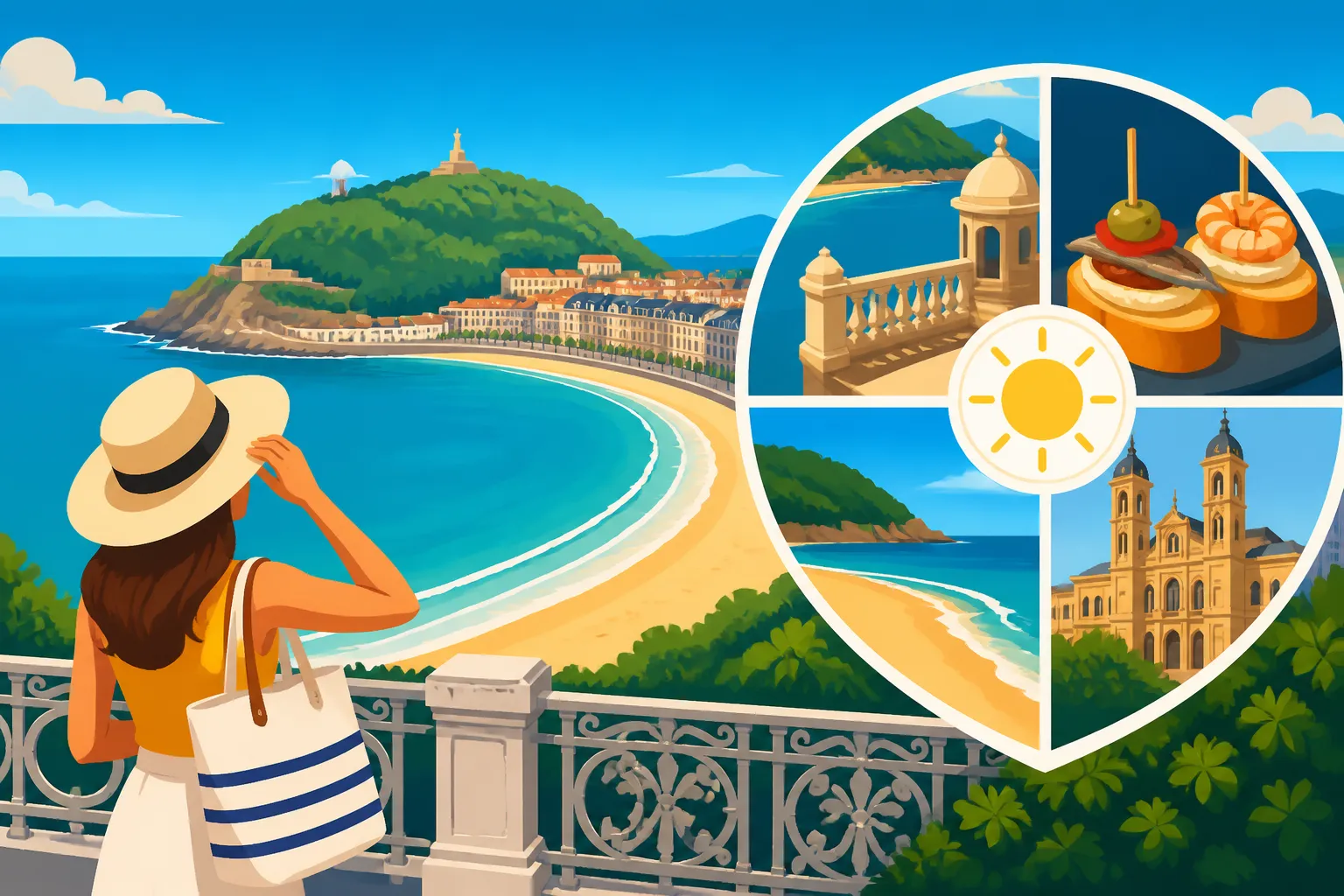
Next, spend one and a half hours on La Concha beach and its promenade. Walk west from the old town along the white railings, with Isla Santa Clara sitting in the middle of the bay. Locals swim here in almost all weather. If it is low tide, walk on the sand itself. Keep going past Miramar Palace towards Ondarreta beach if you have the energy, and you will see the bay curving behind you. Many visitors rate this as the most photogenic city beach in Spain.
Head back east for one and a half hours in the Parte Vieja. This dense grid of narrow streets sits at the foot of Monte Urgull and holds most of the famous pintxo bars. Visit the Basílica de Santa María del Coro, whose ornate baroque facade faces straight down Calle Mayor towards the Buen Pastor cathedral. Walk into Plaza de la Constitución, a square whose numbered balconies once served as seats for bullfights. Browse the Mercado de la Bretxa if it is open. If you are fit and the weather is clear, a short climb up the paths of Monte Urgull gives you views over the old town roofs. Keep it brief, though, because lunch starts at noon.
Afternoon 12:00 PM to 5:00 PM: Pintxos Lunch, Then Monte Igueldo or San Telmo
Budget two to three hours for the pintxos lunch crawl. Starting at noon is earlier than locals usually eat, which works to your advantage. You get counter space and attention from the bartenders before the lunchtime crowd arrives. For background on Spanish meal timing, see What Time Do Spaniards Eat Lunch and Dinner?. Plan on three or four bars, one or two pintxos and a small drink at each. The next main section covers how to do this well.
After lunch, choose one of two options, each taking one and a half to two hours.
Monte Igueldo is the hill at the far western end of the bay. An old wooden funicular climbs to the top, where you get the classic postcard view of La Concha, the island and the city. There is a small, old-fashioned amusement park on the summit that feels frozen in time. On the way, stop at the Peine del Viento, Eduardo Chillida’s iron sculptures anchored into the rocks at the end of Ondarreta, where the waves crash through blowholes in rough weather. It is a long walk from the old town, so take a city bus along the bay if your legs are tired after lunch.
San Telmo Museoa is the better choice on a rainy day. It sits right at the edge of the Parte Vieja, so you do not need to cross the city. The museum combines a sixteenth-century convent with a modern extension and focuses on Basque society and history. It is a good way to understand the region before you head back out for the evening.
Evening From 5:00 PM: Gros, Zurriola, and a Second Pintxo Round
Cross the Urumea river by the Zurriola bridge into Gros. This neighbourhood has a younger, more relaxed feel than the old town. Zurriola beach faces the open Atlantic, so the waves are bigger here, and you will see surfers in the water most of the year. The Kursaal congress centre, two glass cubes by Rafael Moneo, sits at the western end of the beach and glows at dusk.
Gros has its own excellent pintxo scene, often with shorter queues than the Parte Vieja. If you have a train or bus to catch, this is the moment to plan your final round and work backwards from your departure time. If you are staying overnight, wander back over the bridge and watch the old town fill up as locals come out after work.
How to Do a Pintxo Crawl Without Overspending or Overeating
Pintxos are the heart of a San Sebastián visit. These small bites, often skewered on a toothpick, line the bar counters in the morning and through lunch. Many bars also have a short board of hot pintxos made to order. The hot ones are often the best things they serve. A good crawl is about choosing well, not eating everything you see.
Bar Etiquette That Locals Actually Follow
The system can feel chaotic the first time. Here is how it works in most bars:
- Squeeze politely towards the counter. Crowds are normal, and nobody expects a formal queue.
- Catch the bartender’s eye and order a drink first. A small glass of beer called a zurito, a glass of local red, or a txakoli, the slightly sparkling Basque white poured from a height, are all typical.
- Ask for a plate if you want cold pintxos from the counter, or point at what you want and let the staff serve you.
- Order hot pintxos from the board by name. If you cannot pronounce it, pointing at the board is perfectly acceptable.
- Keep track of what you have eaten. Many bars ask you at the end what you had, and the system relies on honesty.
- Pay before you leave, then move on to the next bar. Staying at one place all afternoon is not the custom.
A good rule is one or two pintxos per bar, then move on. Eating six cold pintxos at the first bar is the fastest way to be full before you reach the best places. For more on pacing and ordering, see How to Order Tapas in Spain Without Overdoing It. If you want to understand the unwritten rules of standing at a Spanish bar, Spanish Bar and Café Etiquette for Newcomers covers them well.
Prices vary between bars and between cold and hot pintxos, and many places do not display them clearly. If cost matters, ask before you order, or check the price board where there is one. Hot pintxos made to order generally cost more than the ones already on the counter.
Bars Worth Seeking Out in the Parte Vieja
Every visitor has a favourite list, and the best bar is often the one where you found a free corner of the counter. These are well-known places with a clear specialty, which makes them easy to build a crawl around.
| Bar | Neighbourhood | Known For |
|---|---|---|
| La Cuchara de San Telmo | Parte Vieja | Hot pintxos made to order, such as slow-cooked meats |
| Gandarias | Parte Vieja | A wide counter selection and grilled steak bites |
| Borda Berri | Parte Vieja | Small, creative hot dishes from a chalkboard menu |
| Bar Nestor | Parte Vieja | A tortilla served at set times and a simple tomato salad |
| Txepetxa | Parte Vieja | Anchovy pintxos in many variations |
| Casa Vallés | Centro | Often credited as the birthplace of the Gilda pintxo |
| La Viña | Parte Vieja | The burnt Basque cheesecake |
Bar Nestor is the most specific of these. Its tortilla is made in limited quantities and served at fixed times, and people often put their names down in advance. Ask at the bar early in the day if you want a slice. La Viña’s cheesecake makes a good last stop, or something to take away for the journey home.
If you would rather have someone else do the planning, a guided pintxo tour can be a smart use of a single day. A local guide takes you to several bars, orders for the group and explains the food and the Basque culture behind it. GetYourGuide lists a range of food tours in the city, and reading recent reviews there helps you judge group size and route before you book. Check the tour provider’s own page for what is included, as some cover drinks and some do not.
Practical Tips for a Smooth Day Trip
A few small decisions make a big difference to how relaxed your day feels. Most of them come down to how you move around and how you read the city.
Getting Around on Foot, Bike, and Bus
Walking is the best way to see San Sebastián. The distances from Gros to the Parte Vieja to La Concha are short, and the flat promenade makes it easy. The only part that really stretches the legs is the far end of the bay towards Monte Igueldo and the Peine del Viento, which is where a city bus helps.
The city has a good network of bike lanes, and cycling along the river and the bay is a pleasure on a dry day. The local public bike system is mainly aimed at residents. Visitors usually do better with one of the private rental shops in the centre. Ask about locks and where you can leave the bike before you set off.
City buses run frequently along the main routes around the bay. If you plan to use them more than once, ask at a tourist office or check the local transport operator’s site for card options, since paying per ride every time adds up. If you have driven in, park once in a public underground car park and leave the car there. Old town streets are not built for cars. For a wider route that includes the city, see How to Plan a Road Trip Through Northern Spain.
Language, Signs, and Basque Culture
You will see two languages everywhere. Street signs, menus and announcements often appear in both Basque and Spanish, and sometimes Basque comes first. Donostia is San Sebastián, kalea means street, and Parte Zaharra is the Basque name for the old town. Learning a few words like kaixo for hello and eskerrik asko for thank you is appreciated, though everyone will happily speak Spanish with you. For a primer, see How to Handle Catalan or Basque Signs as a Visitor.
English is common in the busiest bars and tourist areas, but not universal. Pointing at the pintxo you want and smiling works fine. Basque identity is strong and proud here, and you will notice it in the food, the flags and the sports. It is worth reading up a little before you visit. The Basque Country: Food, Coast, and Culture is a good place to start.
When One Day Is Not Enough
Many day-trippers leave wishing they had stayed the night. The evening atmosphere in the old town is a big part of the experience, and an overnight stay lets you do the evening pintxo round without watching the clock. It also opens up easy half-day trips to the fishing villages along the coast, such as Pasaia, Hondarribia or Getaria.
If you decide to stay, book early in summer and during the film festival, as the city fills up fast. Booking.com is handy for comparing small hotels and guesthouses around the Parte Vieja, Gros and La Concha, and the map view makes it easy to see how far each one is from the bars. Check the cancellation terms on each listing before you confirm. To choose a neighbourhood, Where to Stay in San Sebastian: Parte Vieja, Gros, and La Concha breaks down the trade-offs.
If you are planning a longer trip through the region, it helps to think about the bigger picture. How Many Days Do You Need to See the Basque Country? helps you balance San Sebastián with the coast and the interior. Bilbao and San Sebastián: The Basque City Pair explains how to split time between the two cities. Even if today is your only chance, this plan covers the essentials: a beach walk, the old town, a proper pintxo lunch, one great viewpoint or museum, and a sunset by the Atlantic.
Disclaimer
This article is for general informational purposes only and does not constitute professional advice. Laws, prices and regulations vary by location and change over time. Consult a qualified professional for guidance on your specific situation.