Travelling Spain on a Budget: A Two-Week Route Priced Out
Traveling across Spain on a budget often feels like navigating a maze of competing transit websites, unexpected booking fees, and wildly fluctuating accommodation prices. Many visitors waste hundreds of Euros simply because they do not know how local transport connections align or when to choose a bus over a high-speed train. This guide lays out a realistic, price-conscious two-week itinerary across Spain’s top destinations, demonstrating exactly how to structure your route, control daily expenses, and secure the best transit deals using multi-modal search engines like Omio.
Disclosure: This post may contain affiliate links. We may earn a commission at no extra cost to you if you make a purchase through these links. Read full disclosure.
Planning Your Budget Spain Itinerary: Routes, Transit, and Logistics
Why Route Selection Dictates Your Total Travel Spend
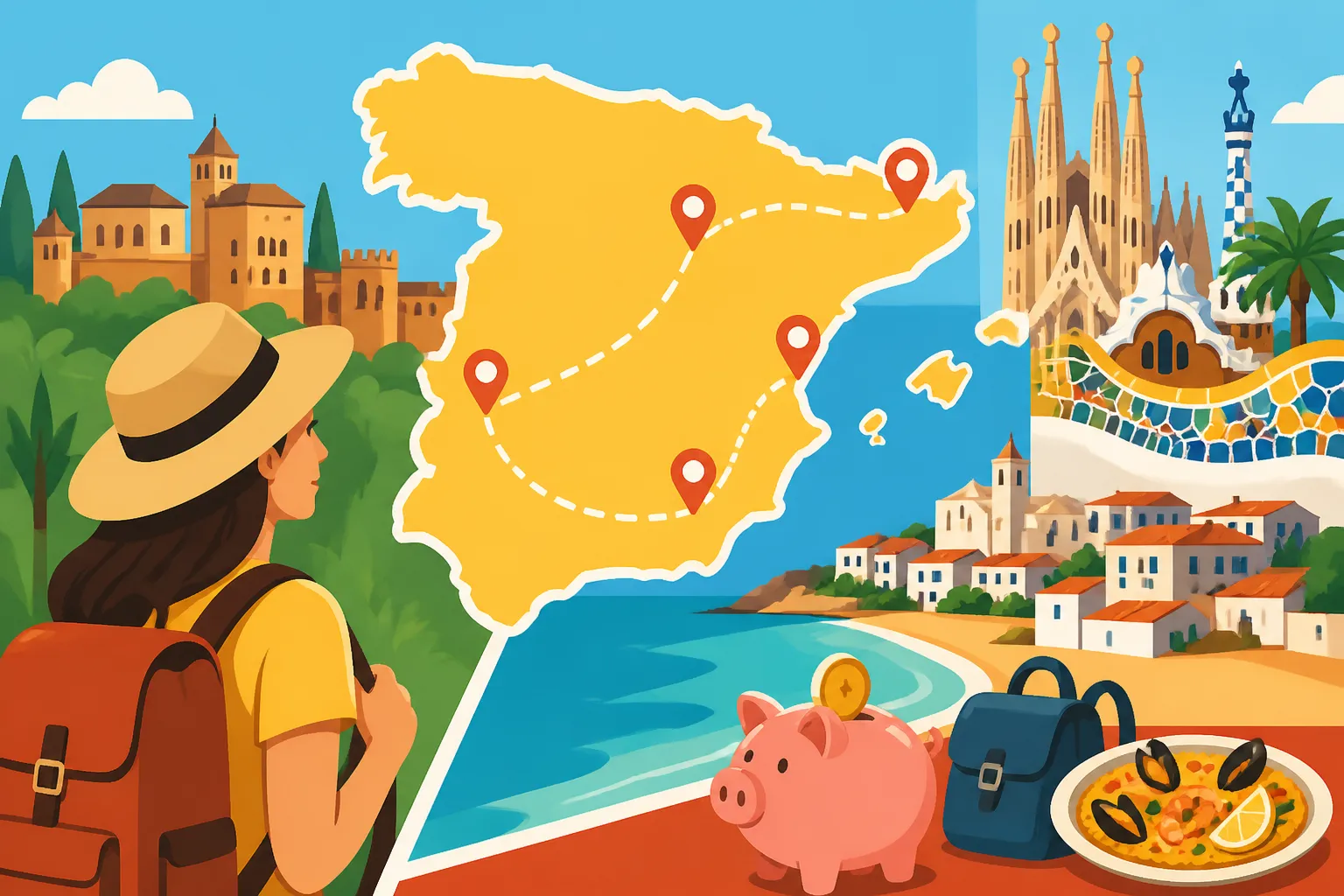
When planning a two-week trip through Spain, the physical route you take plays a larger role in your bank balance than almost any other decision. Spain is the second-largest country in the European Union, and taking an erratic, zigzagging route across its vast central plateau will quickly bleed your wallet through unnecessary transit tickets and lost time. A linear or circular loop—such as starting in Madrid, sweeping south into Andalusia, moving east along the Mediterranean coast, and finishing in Barcelona—minimizes back-tracking and ensures you spend your holiday enjoying historic plazas rather than sitting in transit hubs.
By keeping your geographical trajectory focused, you unlock significant savings on intercity travel. Connecting major regional hubs like Seville, Córdoba, Valencia, and Barcelona sequentially allows you to take advantage of short, regional transit legs rather than costly long-distance express runs. Moreover, understanding regional price differences helps stretch your daily allowances; southern regions like Andalusia generally offer cheaper dining and lodging than northern coastal strongholds or bustling commercial capitals like Madrid and Catalonia.
To maximize your savings, you need a full overview of all travel options between each city. Booking individual legs across fragmented, native Spanish transport platforms can be frustrating and confusing. Using a platform like Omio allows you to view train, bus, and flight options side by side on a single screen, helping you instantly spot the most cost-effective option for every step of your journey.
Navigating Spanish Transport Networks Without Overspending
Spain boasts one of the most sophisticated public transport infrastructures in the world, featuring a massive high-speed rail network alongside an extensive web of long-distance intercity buses. However, navigating these choices requires a strategic approach if you want to avoid paying premium rates. The national rail operator runs high-speed services across major corridors, but private high-speed competitors have entered the market in recent years, driving prices down considerably on routes like Madrid to Barcelona or Madrid to Seville.
For budget-conscious travelers, buses represent the unsung heroes of Spanish travel. Long-distance coaches operated by national and regional carriers offer pristine modern fleets equipped with free Wi-Fi, air conditioning, and comfortable seating, often at a fraction of the cost of a train ticket. Buses are particularly essential when traveling between smaller towns in Andalusia, such as moving from Granada into the white villages or along the southern coast where rail links are sparse or non-existent.
Knowing when to choose rail over road requires balancing time against money. While a train might save you two hours on a long leg, a bus might cost less than half the price. Rather than cross-checking multiple individual transport sites with differing payment interfaces, Omio streamlines the entire search process by consolidating all available train companies and bus operators into a clear comparison layout, making it effortless to pick the right option for your budget.
Booking Strategies to Keep Intercity Transit Low
The single biggest mistake budget travelers make in Spain is waiting until the last minute to purchase intercity transport tickets. Transport operators in Spain use dynamic pricing models similar to commercial airlines; a ticket purchased six weeks in advance can cost a small fraction of the price charged at the station ticket window on the day of departure. If you show up at Madrid’s Atocha station expecting a cheap walk-up fare on a high-speed train, you will likely face severe sticker shock.
To secure low-cost fares, you should aim to book your primary travel routes as early as possible. Mid-week travel—specifically Tuesdays and Wednesdays—is almost always cheaper than moving on Fridays or Sundays when locals travel for weekend getaways. Additionally, choosing off-peak departure times, such as early morning or mid-afternoon slots, yields substantial savings across both rail and bus networks.
Managing multiple bookings across foreign websites with language barriers and international payment hurdles can easily turn into a head-scratching nightmare. Omio simplifies this by presenting all schedules and pricing in English, accepting international credit cards without glitchy payment gateways, and storing all your digital mobile tickets in one secure app. To explore the broader transport ecosystem, check out our guide on High-Speed Trains in Spain (AVE): Routes, Booking, and Savings.
Day-by-Day Two-Week Budget Itinerary: Madrid to Andalusia and Catalonia
Days 1 to 4 – Madrid, Toledo, and Central Spain Hubs
Your two-week Spanish journey begins in Madrid, the vibrant central capital. Madrid is an ideal entry point because its international airport receives competitively priced flights from around the globe. Spend your first full day exploring iconic neighborhoods like Malasaña, La Latina, and the historic center around the Plaza Mayor. You can keep your initial costs extremely low by taking advantage of Madrid’s world-class public parks, such as El Retiro, and visiting its grand art museums during their daily free admission hours in the late afternoon and evening.
On Day 3, take a short, budget-friendly day trip south to the ancient imperial city of Toledo. Perched on a dramatic gorge overlooking the Tagus River, Toledo offers a stunning blend of Christian, Muslim, and Jewish historical architecture. Regional trains and direct buses run continuously from Madrid throughout the day, making it an easy, low-cost excursion. For detailed advice on planning this outing without overspending, refer to our walkthrough on Best Day Trips From Madrid by Train.
Returning to Madrid for your final night in the central hub gives you time to prepare for the trip south. Madrid serves as a fantastic testing ground for managing daily expenses: utilize the metro system with multi-trip tickets, eat your heavy meal during the afternoon lunch special, and sample free tapas served alongside draft beers in traditional neighborhood taverns.
Days 5 to 9 – Seville, Córdoba, and the Magic of Andalusia
On the morning of Day 5, depart Madrid and head south toward Andalusia. Your first stop is Córdoba, where you can spend the day marveling at the breathtaking Mosque-Cathedral (Mezquita) and wandering through the whitewashed lanes of the Judería. Storage lockers at or near the transit stations allow you to explore the city for several hours without carrying your backpack, after which you can hop on a quick evening train or bus onward to Seville.
Seville serves as your base for Days 6 through 8. As the passionate heart of Andalusian culture, Seville provides an incredible backdrop for budget travelers. Stroll through the historic Barrio de Santa Cruz, admire the sprawling Plaza de España, and take in the magnificent Cathedral and Alcázar. Seville is renowned for its affordable, high-quality tapas scene, allowing you to sample local delicacies like espinacas con garbanzos (spinach with chickpeas) and salmorejo for just a few Euros per plate. For a broader look at the region, dive into our article on Seville, Granada, and Córdoba: Andalusia’s Great Cities.
On Day 9, travel east to Granada, home to the world-famous Alhambra palace complex. Nestled at the foot of the Sierra Nevada mountains, Granada retains the marvelous tradition of serving a free, substantial plate of tapas with every drink ordered at a local bar. Because entry tickets to the Moorish complex sell out weeks or months in advance, it is crucial to book your entrance well ahead of time. Learn how to secure your spot cleanly by reading How to Get Tickets for the Alhambra in Granada.
Days 10 to 14 – Valencia, Barcelona, and the Mediterranean Coast
On Day 10, leave Granada and make your way northeast toward the Mediterranean coast, targeting Valencia. Valencia offers a wonderful, relaxed balance of historic charm, futuristic architecture at the City of Arts and Sciences, and wide urban beaches. It is also the undisputed birthplace of paella. You can enjoy an authentic, hearty lunch of paella valenciana at a beachside chiringuito without breaking the bank, provided you avoid the immediate tourist traps surrounding the main plaza.
On Day 12, take a coastal train or long-distance bus from Valencia to Barcelona, the cosmopolitan capital of Catalonia. Spend your final days taking in Antoni Gaudí’s extraordinary architectural masterworks, including the Sagrada Família and Park Güell, while wandering through the historic Gothic Quarter and El Born districts. While Barcelona is undeniably one of Spain’s pricier cities, you can keep costs manageable by relying on the efficient metro network, staying in budget accommodations outside the immediate center, and buying fresh produce at local markets.
Wrap up your trip on Day 14 by enjoying a sunset walk along the Barceloneta beachfront before preparing for your flight home. By comparing transit routes for this final stretch on Omio, you can choose between coastal regional trains, direct express coaches, or quick flights, picking the exact option that aligns with your remaining travel funds. To maximize your time in the Catalan capital, check out our guide on Barcelona for First-Time Visitors: What to See and Skip.
Breaking Down the Costs: Transit, Lodging, Food, and Activities
Transit vs Lodging: Managing the Two Big Expense Pillars
For any budget traveler in Spain, transport and accommodation will absorb the vast majority of the overall budget. Managing these two pillars effectively determines whether your trip stays affordable or spirals into an expensive ordeal. On the lodging side, hostelling is widespread across all major Spanish cities, offering both shared dorm rooms and private rooms that suit single travelers, couples, and groups alike.
Another growing trend for budget travelers is booking mid-term room rentals or simple family-run guesthouses known locally as pensiones or hostales (not to be confused with youth hostels). These establishments are frequently family-run, impeccably clean, and located in prime city-center spots at a fraction of the cost of standard hotel chains. Booking accommodations well in advance, especially during peak holiday periods, prevents you from being forced into high-priced emergency lodging.
On the transit side, avoiding last-minute ticket purchases is the single most practical habit you can build. By mapping out your entire route ahead of time and comparing fares using Omio, you can lock in cheap early-bird rates across major rail lines and long-distance bus operators. This keeps your fixed transit costs minimal, leaving you with far more flexible spending cash for food, drinks, and museum tickets each day.
ESTIMATED 14-DAY SPAIN BUDGET BREAKDOWN (PER PERSON)
| Expense Category | Budget (Hostels) | Mid-Range (Hotels) | Cost Control Strategy |
|---|---|---|---|
| Intercity Transit | Modest / Low | Moderate | Book early via Omio |
| Local City Transport | Minimal | Low | Multi-trip cards |
| Lodging (13 Nights) | Budget / Fair | Moderate / High | Hostales & Pensions |
| Food & Dining | Low / Reasonable | Moderate | Menú del Día & Tapas |
| Attractions & Sight | Minimal | Low | Free museum hours |
Eating Well on a Budget: Tapas, Menú del Día, and Supermarkets
Dining in Spain can be astonishingly cheap if you adapt to local eating habits and schedule your meals like a resident. Spain’s legendary culinary culture is built around fresh regional ingredients, simple preparation, and communal sharing. The absolute crown jewel of budget dining in Spain is the menú del día (fixed-price lunch menu). Offered by traditional neighborhood bars and restaurants on weekdays during lunch hours, this fixed-price option typically includes a first course, second course, bread, drink, and dessert or coffee.
To get the most out of your food budget, adopt the Spanish habit of making lunch your largest meal of the day. In the evening, pivot to light eating by exploring local tapas spots. In cities like Granada and Almería, tapas are served completely free alongside a ordered beverage, meaning two small drinks can double as a full, delicious dinner. To master the art of dining out without spending a fortune, consult our comprehensive guide on What Is a ‘Menú del Día’ and How Does It Work?.
TYPICAL SPANISH DAILY MEAL PATTERN & SAVINGS
| Time of Day | Local Meal Custom | Budget Strategy |
|---|---|---|
| Morning (8-10 AM) | Desayuno (Coffee/Toast | Toast with tomato/olive oil at a café |
| Mid-Day (2-4 PM) | Almuerzo / Main Meal | Seek out a local Menú del Día |
| Evening (8-11 PM) | Cena / Tapas | Free tapas with drinks or light bites |
When you want to save even more money, pop into local supermarkets like Mercadona, Carrefour, or Dia. You can easily assemble a high-quality picnic lunch consisting of freshly baked baguettes, cured Jamón Serrano, local manchego cheese, and fresh fruit for just a few Euros. Enjoying a picnic in Madrid’s Retiro Park or on the beaches of Valencia is not just a budget strategy—it is a classic Spanish experience. For more advice on local food customs, see Spanish Tapas Culture: How to Order and Where to Go.
Sightseeing and Attractions: Free Days and Smart Booking
Spain’s rich cultural heritage means you could spend thousands of Euros on admission fees if you bought full-price individual tickets for every cathedral, museum, and monument along your route. However, with a bit of advance planning, you can experience the nation’s premier historical sites for free or at heavily discounted rates. Almost every state-run museum in Spain offers recurring free entry hours on specific days of the week or during designated evening slots.
For instance, Madrid’s famous Prado Museum and the Reina Sofía Art Center both offer free admission during specific evening windows from Monday through Saturday, as well as Sunday afternoons. Similarly, many historic cathedrals and monuments across Andalusia allow free entry during early morning hours prior to scheduled religious services. Planning your sightseeing schedule around these recurring free windows frees up a substantial portion of your budget.
When free entry is not an option, consider purchasing city pass bundles or booking student/youth tickets if you qualify. Always purchase attraction tickets directly through official museum websites rather than third-party resellers who add steep service fees. For a complete collection of practical financial strategies for your journey, explore Traveling Spain on a Budget: Practical Money-Savers.
Comparing Regional Transport Modes Across Spain
High-Speed Trains vs Regional Rail and Long-Distance Buses
Selecting the correct transport mode for each leg of your Spanish route requires comparing speed, convenience, and overall cost. Spain’s high-speed rail lines offer astounding speed, connecting major metropolitan centers like Madrid and Barcelona in as little as two and a half hours. However, high-speed rail fares can escalate rapidly as the travel date approaches, making them less ideal for last-minute decisions.
Regional rail lines operate at lower speeds and make more frequent stops, but they offer stable, flat-rate pricing that does not fluctuate based on demand. These trains are fantastic for mid-distance trips, such as traveling between Barcelona and coastal towns, or navigating the suburban rail systems surrounding Madrid and Seville. They offer a comfortable, scenic journey without requiring advance seat reservations.
Long-distance buses represent the undisputed leader in low-cost travel across Spain. Operators like Alsa cover an extensive network reaching virtually every corner of the Iberian Peninsula, including rural areas completely bypassed by rail. Buses are exceptionally reliable, comfortable, and priced far lower than high-speed train tickets. To dive deeper into road transport options, check out our guide on Intercity Buses in Spain: Networks, Booking, and Tips.
When weighing high-speed rail against regional buses, utilizing Omio gives you an immediate, unbiased comparison of all transport providers. By viewing the total travel times and exact prices side by side, you can decide whether paying a little extra for high-speed rail is worth the time saved, or whether taking a comfortable coach better protects your travel fund.
When Domestic Flights Make Sense and When They Do Not
Budget travelers often default to searching for cheap domestic flights when planning long jumps across European countries. In Spain, low-cost carriers do operate frequent flights connecting major cities like Madrid, Barcelona, Seville, and Málaga. On paper, airfares can appear deceptively cheap, sometimes matching or beating rail prices for long journeys.
However, flying within mainland Spain rarely makes economic or practical sense once you factor in all the hidden costs and logistical friction. Airports are typically located far outside city centers, requiring paid airport shuttle trains or metro surcharges just to reach the terminal. Furthermore, budget airlines enforce strict baggage weight limits and charge hefty add-on fees for carry-on suitcases or checked bags, easily doubling or tripling the initial ticket price.
When you factor in the time required to travel to the airport, clear security checkpoints, wait at boarding gates, and collect luggage upon arrival, high-speed trains or direct intercity buses are almost always faster door-to-door. Trains drop you directly into central city train stations, eliminating extra airport transit fees and offering generous, hassle-free luggage allowances. The primary exception where flying remains practical is when crossing from the mainland to the Balearic or Canary Islands.
Practical Route Cost and Travel Time Comparison Table
To help you plan the transport budget for your two-week itinerary, the following table compares typical travel characteristics across key transit legs using standard regional options.
| Route Leg | Primary Transport Options | Average Duration | Cost Profile | Best Choice for Budget Travelers |
|---|---|---|---|---|
| Madrid to Toledo | Regional Train / Intercity Bus | 30m – 1h | Very Low | Bus for maximum cash savings; Train for speed |
| Madrid to Córdoba | High-Speed Rail / Express Bus | 1h 45m – 4h 30m | Moderate / Low | Advance High-Speed Train or Budget Bus |
| Córdoba to Seville | Regional Train / High-Speed Rail | 45m – 1h 15m | Low | Regional Train (stable pricing) |
| Seville to Granada | Express Bus / Regional Train | 2h 30m – 3h | Low | Direct Express Bus (scenic and cheap) |
| Granada to Valencia | Long-Distance Bus / Flight | 7h 30m – 9h (Bus) | Moderate | Direct Overnight Bus or Early Rail Link |
| Valencia to Barcelona | Coastal Regional Rail / Bus | 3h – 4h | Low / Moderate | Regional Express Rail along the coast |
Essential Money-Saving Hacks for Expats and Long-Term Visitors
Navigating Local Transit Cards and Multi-Journey Passes
Once you arrive in a Spanish city, individual single-ride transit tickets will steadily drain your daily budget. Buying single subway or bus passes every time you board a vehicle is the most expensive way to get around town. Fortunately, Spanish cities offer multi-trip travel cards designed to lower per-ride costs dramatically for both locals and visitors.
In Madrid, you can purchase a multi-person travel card that holds ten rides, usable across both the subway network and urban blue buses. This card can be shared among a group of travelers simultaneously, saving you money compared to buying individual tickets every single time. Barcelona offers a similar multi-journey card format that provides substantial discounts per ride across its subway, tram, and city bus networks.
Always take a moment upon arrival at a city’s central transit station to research local travel card options at automated ticket machines, which usually feature multi-lingual touchscreens. For long-term visitors or digital nomads staying several weeks in one region, monthly or regional suburban rail passes offer even greater savings. To handle day-to-day spending seamlessly while moving between cities, take a look at our financial primer on Money for Travel in Spain: Cards, Cash, and ATMs.
Sidestepping Common Tourist Traps and Hidden Fees
Keeping your holiday within budget requires staying alert to common tourist traps that inflate everyday costs. The most ubiquitous trap in major Spanish cities is dining directly on central tourist thoroughfares, such as Barcelona’s Las Ramblas or Madrid’s Plaza Mayor. Restaurants along these corridors often charge double or triple the standard prices for sub-par food, and frequently levy hidden table service fees (terraza) for outdoor seating.
To avoid overpaying, step just two or three blocks off the main tourist drag into quiet side streets where neighborhood residents eat. Always review restaurant menus carefully before sitting down, checking whether tax (IVA) is included and verifying whether an unexpected charge for bread (pan y servicio) will be added to your bill. If bread is brought to your table unprompted, you have the right to politely decline it if you do not want to pay the small charge.
Another common financial pitfall involves currency conversion fees. When paying with a credit card or withdrawing cash from ATMs in Spain, the machine will often ask if you want to be charged in your home currency or in Euros. Always select Euros. Accepting the machine’s offered conversion rate triggers dynamic currency conversion, allowing the foreign bank to apply inflated exchange rates and extra transaction fees.
Leveraging Digital Booking Tools for Last-Minute Savings
While booking your primary routes months in advance yields the lowest fares, travel plans sometimes need to change on the fly. If you decide to alter your route spontaneously while in Spain, relying on smart digital tools is essential to prevent last-minute expenses from spiraling out of control.
Traditional ticket counters at train and bus stations often add processing markups or present long queues that waste precious sightseeing time. Using mobile search applications allows you to instantly scan for last-minute deals across multiple transportation operators while sitting in a plaza sipping a coffee.
Omio excels in these last-minute scenarios by allowing you to compare real-time departure schedules, ticket availability, and prices across all transit modes in seconds. Securing an e-ticket directly on your smartphone eliminates paper printing headaches, bypasses ticket counter queues, and ensures you always snag the lowest available price for your sudden change of plans.
Final Tips for a Stress-Free Budget Journey Through Spain
Packing Light to Avoid Transport Extra Charges
Packing light is one of the most effective habits for keeping travel costs down in Spain. Carrying a single compact backpack or a light carry-on suit-case gives you immense mobility and saves money across every stage of your trip. Navigating cobblestone streets, narrow apartment staircases, and crowded subway systems is infinitely easier when you are not struggling with massive, heavy luggage.
From a financial perspective, packing light prevents you from incurring unexpected baggage surcharges on budget airlines or long-distance buses. While Spanish trains generally feature generous luggage allowances, maneuvering large bags onto overhead train racks or securing them in end-of-car storage areas can be stressful during peak commuting hours.
Additionally, keeping your luggage compact allows you to utilize public transport easily rather than relying on expensive taxis or ride-share apps when moving between transit stations and your accommodation. If you need to wash clothes halfway through your two-week route, self-service laundromats (lavanderías autoservicio) are plentiful, cheap, and fast across all major Spanish cities.
Balancing Spontaneity with Pre-Booked Transit Deals
The ultimate secret to a successful budget trip across Spain lies in striking the right balance between structured advance planning and open-ended exploration. Locking in your primary intercity transit legs through Omio six to eight weeks before your departure date secures early-bird prices, safeguarding the foundation of your travel budget.
Once your major transit routes and city accommodations are secured, leave your daily city schedules open for spontaneous discovery. Explore hidden neighborhood markets, spend unhurried afternoons lounging in sunlit parks, or take advantage of free evening museum hours without a rigid, minute-by-minute itinerary.
By pairing smart, early transit bookings with flexible daily explorations, you can experience the very best of Spain’s rich culture, delicious regional cuisine, and historic architecture on a comfortable, realistic budget. Start building your ideal Spanish route today, compare transport routes effortlessly on Omio, and prepare for an unforgettable Iberian adventure.
Disclaimer
This article is for general informational purposes only and does not constitute professional advice. Laws, prices and regulations vary by location and change over time. Consult a qualified professional for guidance on your specific situation.