Combining Train and Bus in One Journey: Planning Connections That Hold
Missing a rural bus connection because your high-speed train pulled into the station ten minutes late is an expat rite of passage you definitely want to avoid. While Spain boasts an incredible high-speed rail system alongside an extensive long-distance coach network, navigating both systems on a single trip often leaves travelers juggling different operator schedules and tight transfer windows. This guide breaks down exactly how to design seamless train-and-bus itineraries across Spain so your connections hold, your stress stays low, and your journey runs smoothly from start to finish.
Disclosure: This post may contain affiliate links. We may earn a commission at no extra cost to you if you make a purchase through these links. Read full disclosure.
Navigating Spain’s Transport Network: Why Combined Rail and Road Makes Sense
Spain’s transit infrastructure is world-class, but it is divided by geography and service types. High-speed rail lines sweep across major corridors, connecting metropolis to metropolis at breath-taking speeds. Meanwhile, long-distance and regional buses navigate the winding roads into coastal pockets, mountain ranges, and historic white villages where track layers never ventured. Trying to rely on only one mode of transport often means overpaying, missing out on smaller destinations, or enduring unnecessarily long routes.
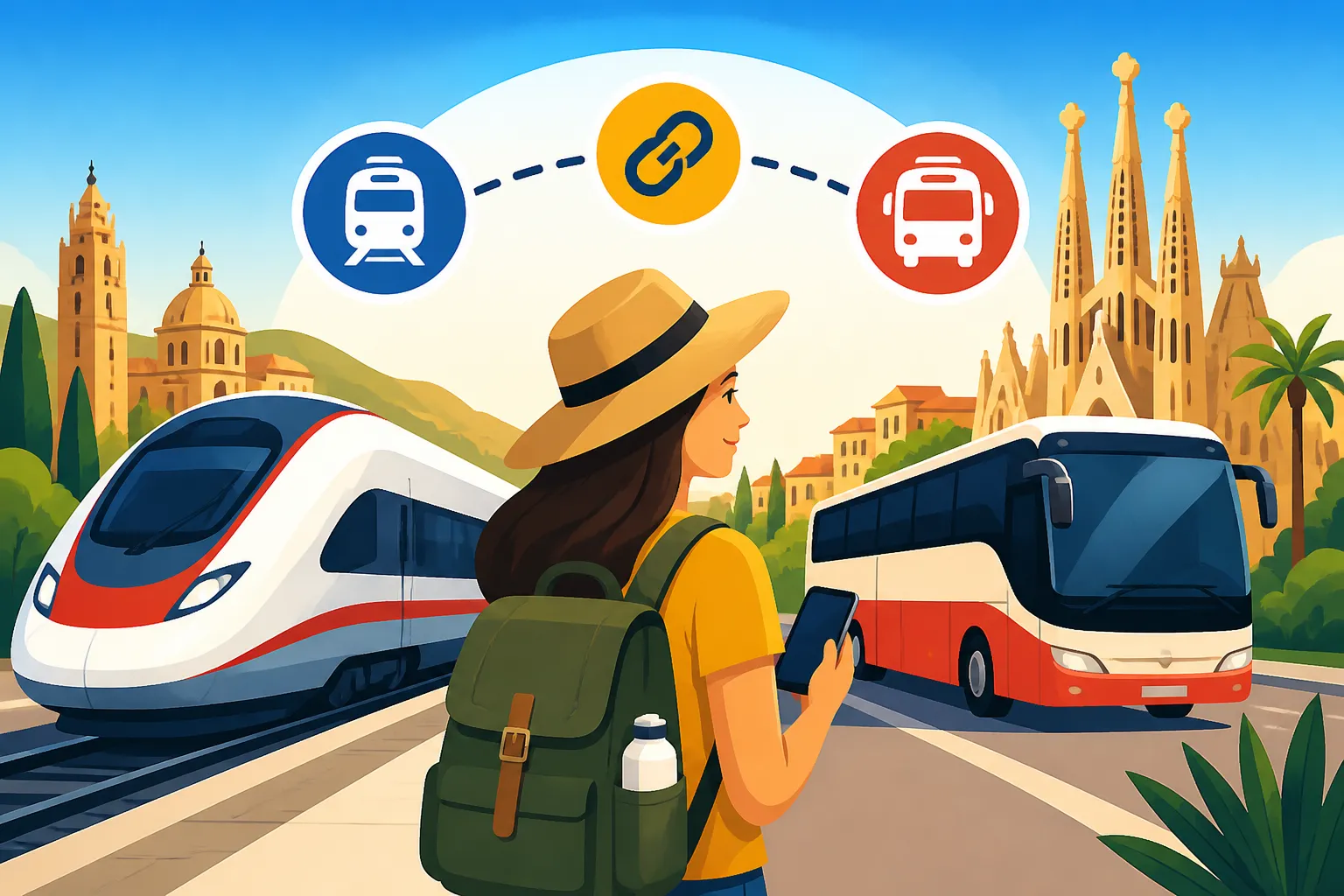
By strategically blending trains and buses, you unlock the full map of the country. You can travel across the high-speed core on steel rails, then pivot to regional roads for the final leg. Mastering this multi-modal approach turns complex cross-country journeys into straightforward, enjoyable travel days.
High-Speed Trains vs. Regional Bus Lines
When planning a multi-leg journey, it helps to understand the strengths of each transport type. High-speed trains, such as those covered in our guide on High-Speed Trains in Spain (AVE): Routes, Booking, and Savings, excel at moving passengers between major urban centers like Madrid, Barcelona, Valencia, and Seville. They are fast, comfortable, and remarkably punctual, running on dedicated track networks insulated from city traffic.
Buses, on the other hand, handle the heavy lifting when it comes to regional connectivity. Networks like ALSA, Avanza, and Samar cover thousands of routes reaching every corner of the country. While coaches are subject to highway traffic and local road conditions, they offer unparalleled route density at budget-friendly price points. Combining the speed of train travel for long distances with the capillary reach of regional buses gives you the ultimate balance of speed, coverage, and value.
Common Route Gaps Across Regions
While major cities are well-connected by rail, moving beyond capital cities quickly reveals gaps in the track system. For instance, if you want to explore the southern interior, learning How to Reach Spain’s White Villages by Public Transport demonstrates how rail lines carry you swiftly to Seville or Ronda, but local buses are essential to reach perched villages like Grazalema or Zahara de la Sierra.
Similarly, travelers heading to northern coastal towns or eastern beach spots often run into rail dead-ends. A high-speed train might get you to Girona or Alicante effortlessly, but reaching coastal coves requires jumping on a regional coach. Rather than giving up on these non-rail destinations or defaulting to Renting a Car in Spain: Requirements, Insurance, and Driving Tips, connecting high-speed rail with intercity buses keeps your travel seamless and cost-effective.
Key Station Hubs for Multi-Modal Travel
Spain has invested heavily in integrated transport hubs, making physical transfers far easier than in many other European countries. Many major cities feature Estaciones Intermodales—transit hubs where train platforms, long-distance bus bays, and city metro lines sit within the same complex or directly across the street from one another.
- Madrid Atocha & Méndez Álvaro: High-speed trains arrive at Atocha, which links via a short Cercanías commuter train to the South Bus Station (Estación Sur) at Méndez Álvaro.
- Madrid Chamartín: Serves northern train destinations and integrates directly with local metro and suburban rail lines to connect to regional bus terminals.
- Barcelona Sants: Offers immediate access to main rail lines, city buses, and regional coach services operating out of adjacent terminals.
- Seville Santa Justa & Plaza de Armas / Prado de San Sebastián: High-speed trains pull into Santa Justa, requiring a short city bus or taxi ride to reach the primary intercity bus stations.
- Málaga María Zambrano: A ideal intermodal facility where the main train terminal and long-distance bus station sit side-by-side, sharing a courtyard.
Recognizing whether your transfer requires walking across a shared terminal concourse or taking a city transit connection across town is the foundational step in building a connection schedule that holds up in real life.
TYPICAL MULTI-MODAL ROUTE
- Origin City
- High-Speed Train
- Hub Station
- Terminal Walk / City Transit
- Bus Terminal
- Regional Coach
- Destination
Step-by-Step Strategy for Planning Rock-Solid Connections
Designing a multi-leg journey requires more than just picking the quickest departure times off two separate schedules. To build an itinerary that absorbs minor delays without causing panic, you need a clear framework for timing, booking, and managing your route.
How Much Connection Time Do You Really Need?
The single biggest mistake travelers make when combining train and bus travel is underestimating the buffer time needed between legs. While a fifteen-minute platform change works fine when transferring from one train to another on the same line, switching from a train to an independent bus operator demands a far more conservative approach.
As a rule of thumb, always allow at least 45 to 60 minutes for transfers within the same physical terminal complex (such as Málaga or Girona). If your journey requires switching between different stations within a large city—such as moving from Madrid Atocha to the Méndez Álvaro bus station—budget at least 90 minutes. This transfer buffer accounts for several potential friction points:
- Platform Exit & Security: Disembarking a crowded train and walking through large multi-level train stations takes time, especially with luggage.
- Urban Transfers: Waiting for a local metro or commuter train connection, as detailed in our guide to Getting Around Spanish Cities: Metro, Bus, Tram, and Bikes, introduces minor variables into your timeline.
- Bus Boarding Procedures: Unlike city buses, long-distance coaches in Spain require ticket scanning, luggage loading under the bus, and prompt departure times, with boarding typically closing five to ten minutes before departure.
Building this extra breathing room into your schedule transforms an otherwise nerve-wracking transfer into a relaxed opportunity to grab a café con leche or quick snack at the station.
Dealing with Station Transfers and Ticket Validations
Navigating Spanish transit stations requires a basic understanding of how ticket access works across different operators. When arriving by train, keep your physical or digital rail ticket handy until you have completely exited the station gates. In many major stations, rail tickets include a Combinado Cercanías code, which provides a free transfer on local commuter trains within four hours of your arrival—ideal for reaching a secondary bus station across the city without buying an extra metro pass.
When arriving at the bus terminal, locate your specific departure bay (docks or andenes) on the station display screens. Unlike train platforms, which are often announced only 15 to 20 minutes before departure, bus bays are usually assigned further in advance. Queue near your assigned bay around 15 minutes before departure to ensure your luggage is stowed safely and your seat is secured.
Simplifying Bookings and Itineraries with Omio
The historical challenge of multi-modal travel in Spain has been navigating separate carrier websites, comparing incompatible schedules, and managing fragmented booking receipts. This is where using a dedicated, multi-modal travel platform like Omio completely alters the equation.
Omio brings together national rail operators, regional train lines, and major coach companies into a single, clean search interface. Instead of manually cross-referencing train timetables against separate bus schedules to figure out how to reach smaller towns, Omio automatically evaluates routes across multiple modes of transport. It shows you side-by-side comparisons of journey times, connection points, and total costs, helping you spot logical transfer windows without doing manual math across time zones or operator websites.
By using Omio to plan your complete itinerary, you also eliminate the headache of keeping track of disparate booking references. Having your train seats and coach passes organized inside a single digital platform makes navigating multi-leg travel days effortless, especially when you are on the move and need fast access to ticket barcodes at station gates.
Comparing Transport Combinations across Popular Spanish Routes
To illustrate how blending rail and coach travel works across real destinations, let’s examine common travel routes where multi-modal planning unlocks smooth, efficient trips.
| Route Corridor | Train Leg | Bus Leg | Transfer Hub | Why This Combination Works |
|---|---|---|---|---|
| Madrid to Ronda / Pueblos Blancos | High-speed train to Antequera or Seville | Regional coach to Ronda / Grazelema | Antequera-Santa Ana or Seville Prado | Saves hours compared to all-bus options while offering scenic road access to hillside towns. |
| Barcelona to Costa Brava (e.g., Begur, Cadaqués) | Regional or High-speed train to Girona | Regional coach to coastal towns | Girona Bus Station | Trains avoid coastal highway bottlenecks; buses link directly from Girona’s station hub. |
| Madrid to Costa del Sol Towns (e.g., Nerja) | High-speed train to Málaga | Intercity coach to Nerja | Málaga María Zambrano | Ultra-fast rail link across the interior followed by a short, seamless bus transfer next door. |
| Valencia to Inland Villages (e.g., Morella) | Regional train to Castellón de la Plana | Regional coach to Morella | Castellón Station | Combines fast coastal rail travel with essential mountain bus connections. |
Evaluating these routes through Omio allows you to see all live departures for both modes at once. For example, when traveling from Madrid toward coastal villages, Omio highlights whether a high-speed train connection via Málaga or an all-bus itinerary fits your schedule and budget better. This level of clarity eliminates the guesswork, allowing you to weigh time savings directly against cost differences.
Practical Tips for Stress-Free Journey Execution
Once your multi-modal route is booked, executing the journey calmly comes down to preparation and knowing what to expect on the ground.
Managing Luggage Between Trains and Coaches
One key difference between rail and coach travel in Spain involves luggage storage rules and practices:
- Train Requirements: On Spanish trains, you carry your bags onto the carriage yourself. Overhead racks accommodate standard trolley bags, while larger suitcases fit into racks at the end of each car. X-ray scanners check luggage at entry gates in main stations, but there are generally no strict weight limits for typical tourist luggage.
- Bus Requirements: On long-distance coaches, large luggage must be stored in the cargo hold beneath the bus before boarding. You hand your suitcase to the driver or load it into the bay designated for your destination stop. Keep small daypacks, valuables, and digital devices with you in the main seating area.
When making a connection, ensure you have enough time to retrieve your checked luggage from the bus hold before making your way to the train platform, or vice versa. If you are carrying multiple large bags, factor in an extra ten minutes of buffer time just for luggage handling at the hub station.
Contingency Plans for Delays and Missed Connections
Even the best-planned itineraries can face unexpected road delays or rail maintenance. When booking separate travel tickets across different operators, remember that carriers generally do not owe you automatic rebooking if a delay on one line causes you to miss a connection on another independent operator.
To protect yourself against disruptions:
- Monitor Live Schedules: Keep an eye on live transit boards and route progress inside the Omio app. If you notice your initial train or bus is running late, you can identify alternative connecting departures early.
- Know Alternative Operators: If a tight connection breaks down, major hub stations usually have frequent secondary bus or commuter train options departing throughout the day.
- Keep Digital Copies Handy: Have your ticket PDFs downloaded directly to your phone so you can present proof of booking instantly, even if mobile data drops inside large concrete terminals.
In practice, opting for generous connection windows—like 60 minutes at shared stations—means that even a 20-minute train delay will not derail your onward coach connection.
Digital Tickets, Apps, and Station Navigation
Modern travel across Spain is almost entirely paperless, but seamless digital transit requires a little pre-trip coordination. Before setting off, ensure your mobile device is fully charged and that you have all necessary travel apps installed.
Using Omio allows you to keep both your train boarding passes and coach e-tickets stored in one centralized digital wallet. This eliminates the need to print physical paper passes or scramble through email inbox search results while standing at ticket turnstiles. When approaching ticket scanners, maximize your phone screen’s brightness and have the QR code or barcode open before reaching the front of the line.
Additionally, pay close attention to station signage in Spain. Train platforms are marked as Vías, while bus bays are marked as Andanes or Docks. Signs reading Salida (Exit), Correspondencia (Connections), and Estación de Autobuses (Bus Station) will guide you clearly through intermodal transit complexes without requiring fluent Spanish.
By combining the speed of Spain’s high-speed rail with the reach of its regional coach lines, you unlock seamless access to every corner of the country. Planning your transfers thoughtfully, building in practical buffer times, and organizing your combined route through Omio ensures your connections hold up—leaving you free to sit back, relax, and enjoy the scenery along the way.
Disclaimer
This article is for general informational purposes only and does not constitute professional advice. Laws, prices and regulations vary by location and change over time. Consult a qualified professional for guidance on your specific situation.