The Basque Country: Food, Coast, and Culture
Many travelers arrive in Spain expecting sun-drenched plazas and sangria, only to be caught off guard by the misty, emerald landscapes and the linguistic isolation of the North. I remember my first rainy afternoon in San Sebastián, standing confused before a bar of "pintxos" with no idea how to pay or what I was eating. This guide solves that cultural friction by diving deep into the food, coastline, and heritage of the Basque Country.
Disclosure: This post may contain affiliate links. We may earn a commission at no extra cost to you if you make a purchase through these links. Read full disclosure.
Gastronomy: The Heart of Basque Identity
To understand the Basque Country (Euskadi), you must first understand its relationship with the kitchen. Food here isn't just sustenance; it is a social glue, a political statement, and a source of intense regional pride. Unlike the rest of Spain, where lunch might be a casual affair, in the Basque Country, every meal is treated with a reverence that borders on the religious.
The Art of the Pintxo Crawl
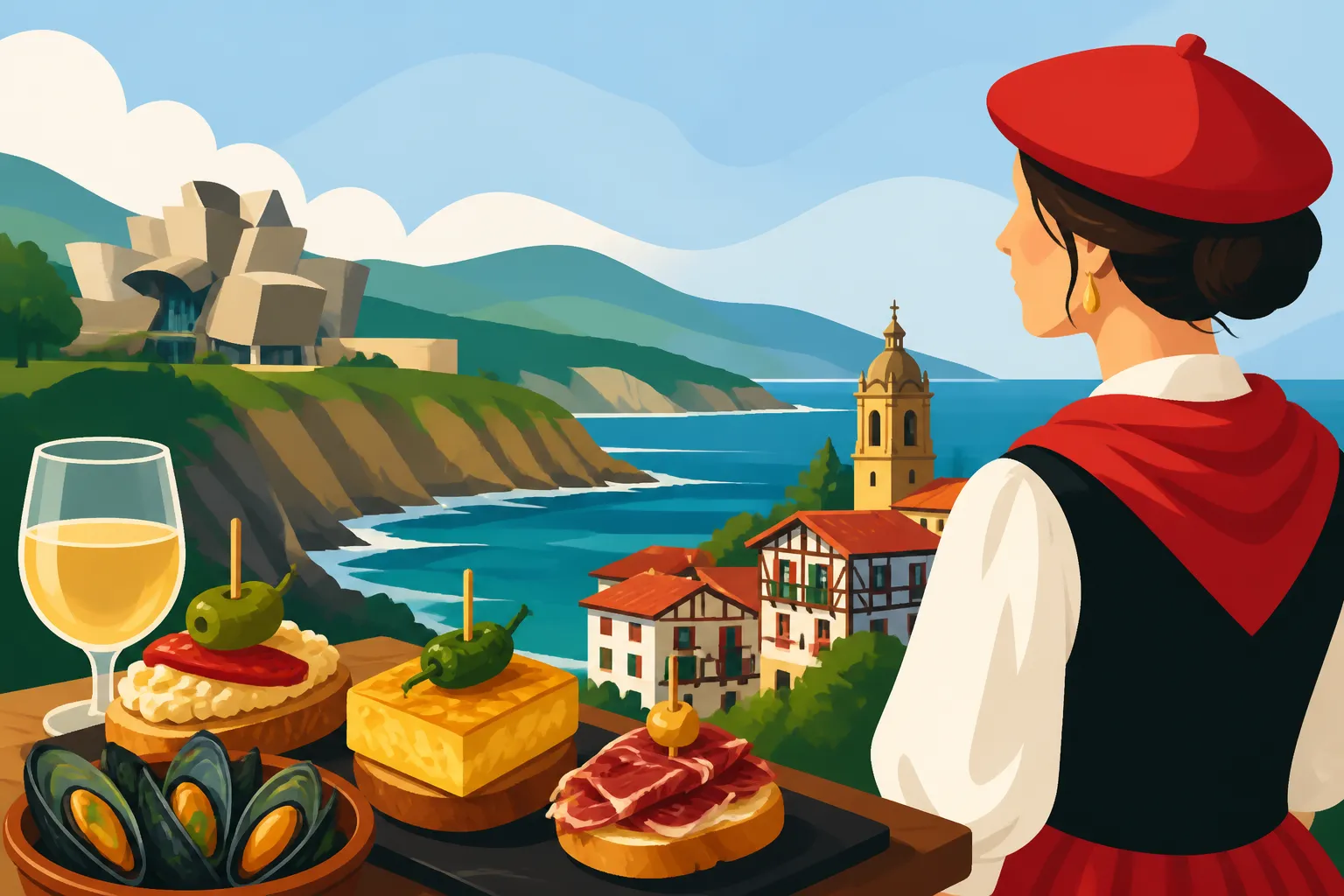
The most immediate culinary shock for any expat or tourist is the transition from standard tapas to the "pintxo." While Spanish Tapas Culture: How to Order and Where to Go provides a great foundation for the rest of the country, the Basque pintxo is a different beast entirely. Typically served on a slice of baguette and pierced with a toothpick (the "pintxo" or spike), these are miniature works of haute cuisine.
The etiquette is where most foreigners trip up. In a traditional bar in Bilbao’s Casco Viejo or San Sebastián’s Parte Vieja, you don’t just order a plate of food and sit down. You engage in a "txikiteo"—a social pub crawl where you have one small glass of wine (a "txikito") or a local cider, eat one specific pintxo that the bar is famous for, and then move on to the next establishment. Many newcomers make the mistake of piling ten different items onto a single plate; this is a cardinal sin. You should cherry-pick the freshest items, often those being brought out hot from the kitchen, rather than just the cold ones sitting on the counter. When you are ready to leave, you simply tell the bartender how many pintxos you had. It is an honor-based system that often baffles those used to more rigid service structures.
Michelin Stars and Fine Dining
If you are looking for a more formal experience, the Basque Country has one of the highest concentrations of Michelin stars per capita in the world. San Sebastián, in particular, is a global pilgrimage site for foodies. Names like Arzak, Akelarre, and Martin Berasategui are legendary, but the real magic often happens in the mid-range "reposteros" where traditional recipes are elevated with modern techniques.
Booking these high-end tables requires planning months in advance, often through platforms like Booking.com for integrated travel packages or directly via the restaurants' competitive portals. However, don’t ignore the "Sociedades Gastronómicas." These are private, historically male-only cooking clubs where members gather to cook and eat. While they are private, being invited to one is the ultimate sign of expat integration. If you can't get into a private club, look for "Km 0" restaurants that focus on locally sourced ingredients from the Bay of Biscay and the surrounding mountains. Even your morning routine will change here; Coffee Culture in Spain: How to Order Like a Local is still relevant, but expect to pair your "café con leche" with a "pastel vasco," a dense, creamy almond cake that is a staple of the northern breakfast.
The Ritual of the Sagardotegia
The cider house (Sagardotegia) experience is perhaps the most authentic Basque tradition you can participate in. Located primarily in the hills of Gipuzkoa, these rustic warehouses open their doors during the cider season (January to April). The menu is almost always identical: cod omelet, fried cod with peppers, a massive bone-in ribeye (chuletón), and local Idiazabal cheese with quince paste and walnuts.
The highlight is the "txotx." When the owner shouts this word, everyone grabs their glass and heads to the massive chestnut barrels. You catch the cider in a thin stream as it shoots out of the barrel, which aerates the drink and brings out its natural carbonation. It is loud, communal, and often involves standing up at high tables. It’s a far cry from the refined dining rooms of Madrid, and it’s where you’ll truly feel the "I’ve-been-there" grit of Basque life.
The Rugged Coastline: Surfing and Sacred Sites
The Basque coast is a jagged, dramatic stretch of the Atlantic that looks more like Ireland or Brittany than the Mediterranean "Costa" many imagine. The Bay of Biscay provides a temperate, humid climate that keeps the hillsides a vibrant green year-round, but it also brings the "sirimiri"—a fine, persistent mist that locals don't even bother using umbrellas for.
San Sebastián: The Pearl of the Cantabrian Sea
San Sebastián (Donostia in Euskara) is frequently cited as one of the most beautiful cities in Europe. Its centerpiece is La Concha, a crescent-shaped beach flanked by Mount Urgull and Mount Igueldo. For an expat living here, life revolves around the tides. In the summer, the city is a playground for the wealthy, but in the winter, it retains a quiet, aristocratic dignity.
The city is divided into distinct neighborhoods. The Parte Vieja is the tourist hub, while Gros is the trendy, surfer-dominated district across the river. If you are comparing locations for a stay, Costa Brava vs Costa del Sol: Which Coast to Choose might offer insights on warmer climates, but the Basque coast offers a sense of "prestige" and outdoor adventure that is hard to match. Surfing at Zurriola beach in Gros is a daily ritual for many residents, regardless of the water temperature. The infrastructure for tourism is excellent, and you can often find guided coastal treks on GetYourGuide that take you from the city center out into the rugged cliffs of the Jaizkibel mountain range.
The Flysch and the Magic of Zumaia
Further west lies the Geopark of the Basque Coast, specifically the town of Zumaia. This area is famous for the "Flysch"—extraordinary rock formations that look like giant stone ribs stretching into the sea. These layers of sedimentary rock tell the story of Earth’s history, including the extinction of the dinosaurs.
Walking the coastal path from Zumaia to Deba is a rite of passage for any hiker in Spain. It is a grueling but rewarding trek that offers views of 100-meter-high cliffs and hidden coves. If you are planning a trip, check Spain's Best Mainland Beaches by Region to see how these Atlantic gems stack up against the more famous Mediterranean spots. The Flysch is not just a geological wonder; it has also become a pop-culture landmark, serving as a filming location for Dragonstone in "Game of Thrones." This has brought a surge of tourism, so visiting during the shoulder seasons (May or September) is highly recommended to avoid the crowds.
San Juan de Gaztelugatxe
Perhaps the most iconic image of the Basque Country is San Juan de Gaztelugatxe. This tiny island is topped by a hermitage dedicated to John the Baptist and is connected to the mainland by a winding stone bridge with 241 steps. Legend has it that after the climb, you should ring the bell at the top three times and make a wish.
The logistics of visiting Gaztelugatxe have become more complex recently due to its popularity. You now need to book a free entry ticket online in advance. For expats hosting family, this is the "must-see" spot, but be warned: the climb is steep and can be slippery in the rain. It is located near the town of Bermeo, a traditional fishing village that offers a glimpse into the industrial and maritime heart of the region, away from the polished streets of San Sebastián.
Deciphering the Basque Soul: Language and Traditions
What truly sets this region apart from the rest of the Iberian Peninsula is its culture. The Basques are often described as the "mystery people" of Europe. Their origins are debated, and their language is unlike any other on earth.
Euskara: Europe’s Oldest Mystery
Euskara, the Basque language, is a "language isolate," meaning it has no known linguistic relatives. It predates the arrival of Indo-European languages in Europe. While everyone in the Basque Country speaks Spanish, the presence of Euskara is everywhere—on street signs, in schools, and in daily greetings.
As an expat, learning even a few words goes an incredible way in building rapport. Saying "Agur" instead of "Adiós" or "Eskerrik asko" instead of "Gracias" signals a level of respect for the local identity that is deeply appreciated. This is part of the broader challenge discussed in Spanish Language and Everyday Communication for Visitors, where regional identities often supersede the national one. In rural areas of Bizkaia and Gipuzkoa, Euskara is the primary language of the home, and the culture is noticeably more reserved and traditional than the outgoing, boisterous stereotypes of Southern Spain.
Rural Sports and Pelota (Herri Kirolak)
Basque culture is also defined by its "Herri Kirolak" or rural sports. These grew out of daily farm labors and include activities like stone lifting (harrijasotzaileak), wood chopping (aizkolariak), and tug-of-war. Seeing a 300kg stone being lifted onto a man's shoulder in a village square is a visceral experience that connects you to the region's rugged, agrarian past.
The most famous sport, however, is Pelota. Played in a "frontón" (a three-walled court), it is a lightning-fast game that can be played with hands, wooden bats, or specialized baskets (Cesta Punta). Almost every Basque village, no matter how small, has a frontón at its center, often built right against the side of the church. Attending a professional match in Bilbao or San Sebastián is a great way to immerse yourself in the local atmosphere. These events are often tied to Festivals, Fiestas, and Public Holidays in Spain, where the town's patron saint is celebrated with sports, dancing, and, of course, a massive communal feast.
Urban Transformations: Bilbao and Vitoria-Gasteiz
While the coast and the mountains are breathtaking, the Basque cities offer a fascinating study in urban evolution. Bilbao and Vitoria-Gasteiz provide two very different visions of Basque life.
The Bilbao Miracle and the Guggenheim
Thirty years ago, Bilbao was a gritty, industrial port city in decline. Today, it is a global icon of urban renewal, a transformation often called the "Guggenheim Effect." The Frank Gehry-designed Guggenheim Museum is the city’s crown jewel, with its shimmering titanium plates reflecting the Nervión River.
But Bilbao is more than just one museum. The Casco Viejo (Old Town), known as the "Siete Calles" (Seven Streets), is a labyrinth of history where you can find traditional shops alongside modern boutiques. For those used to the scale of Madrid, Barcelona, and Spain's Great Cities: Explorer's Guide, Bilbao feels manageable and walkable. It has a "can-do" industrial spirit that is reflected in its bold architecture, including the Fosteritos (the glass subway entrances designed by Norman Foster). It is a city that prides itself on being "Bilbaíno"—a term that implies a certain level of swagger and grandiosity.
Vitoria-Gasteiz: The Green Capital
Vitoria-Gasteiz is the capital of the Basque Country but is often overlooked by tourists rushing between Bilbao and San Sebastián. This is a mistake. Vitoria is consistently ranked as one of the best places to live in Spain due to its "Green Belt"—a series of parks that encircle the city.
The medieval center, built in an almond shape on a hill, is exceptionally well-preserved. Vitoria feels more Spanish in its rhythm than the coastal cities, but it remains fiercely Basque. It is a city of "plazas" and "paseos," where families gather in the evenings to walk and socialize. For an expat looking for a slower pace of life with excellent public services and a lower cost of living than San Sebastián, Vitoria is often the preferred choice. It is also the gateway to the Rioja Alavesa, the Basque portion of the famous wine region, where you can find some of the best red wines in the country.
Navigating the North: Logistics and Practicalities
Getting around the Basque Country requires a bit more thought than the high-speed corridors of the south. The terrain is mountainous, and the weather is unpredictable, which influences everything from transport to packing.
Transport Networks and Regional Connectivity
The Basque Country is well-connected, but the "how" depends on your destination. The High-Speed Trains in Spain (AVE): Routes, Booking, and Savings network reaches into the north, but the internal Basque Y (the high-speed link between the three capitals) is still under construction. Currently, the most efficient way to travel between Bilbao, San Sebastián, and Vitoria is by the ALSA or PESA bus networks.
For a more scenic experience, the Euskotren is a narrow-gauge railway that hugs the coast and winds through the mountains. It is slow, but the views are spectacular. You can check schedules and book tickets across different modes of transport using Omio, which is particularly helpful for comparing bus vs. train times in the North. If you want the freedom to explore hidden villages like Getaria or Elantxobe, Renting a Car in Spain: Requirements, Insurance, and Driving Tips is your best bet. Be aware that mountain roads are narrow and can be foggy; driving here requires a steady hand and a bit of patience.
Comparing the Three Provinces
The Basque Country is divided into three provinces, each with its own character and landscape.
| Province | Capital | Main Draw | Atmosphere |
|---|---|---|---|
| Bizkaia | Bilbao | Guggenheim & Industrial History | Urban, Bold, Energetic |
| Gipuzkoa | San Sebastián | Culinary Excellence & Beaches | Sophisticated, Aristocratic |
| Araba | Vitoria-Gasteiz | Green Spaces & Rioja Wine | Relaxed, Traditional, Inland |
Weather Realities and Packing Essentials
If I could give one piece of advice to a new arrival, it’s this: ignore the weather forecast. In the Basque Country, you can experience four seasons in a single morning. The "sirimiri" can start at any moment, even if the sun is out.
Packing for this region is about layers and high-quality waterproofs. Forget the flimsy umbrellas you see in the south; the wind off the Atlantic will turn them inside out in seconds. A good rain shell and comfortable walking shoes are non-negotiable. If you are moving between regions, remember that Regional and Local Trains in Spain (Cercanías and Media Distancia) are reliable, but a sudden heavy rainfall can occasionally cause delays in the mountainous tracks of the Euskotren. Embracing the rain is part of becoming a local. When the clouds break and the sun hits the lime-green hills against the deep blue of the Atlantic, you’ll realize why the Basques are so fiercely protective of their home.
Disclaimer
The information provided in this guide is for informational purposes only. While every effort has been made to ensure the accuracy of the details regarding Basque culture, transport, and gastronomy as of 2026, travel conditions and local regulations can change. Always verify current requirements, such as visa rules or entry tickets for specific landmarks, through official government or service provider channels before planning your trip.