Seville, Granada, and Córdoba: Andalusia’s Great Cities
Navigating the logistics of Southern Spain can feel like a full-time job, especially when you realize the Alhambra sells out months in advance or that "summer" in Seville is a literal furnace. I’ve spent years navigating these dusty roads and crowded plazas, and I know exactly how overwhelming it is to balance the Big Three without burning out. This guide solves the puzzle of how to experience Seville, Granada, and Córdoba with the ease of a local veteran.
Disclosure: This post may contain affiliate links. We may earn a commission at no extra cost to you if you make a purchase through these links. Read full disclosure.
The Cultural Soul of Seville – More Than Just Flamenco
Seville is the undisputed heart of Andalusia, a city that manages to be both grand and intensely intimate. When you first arrive, the sheer scale of the historical center can be daunting. I remember my first week in the city, trying to find a specific tapas bar in the winding alleys of Santa Cruz and ending up in a dead-end courtyard three times. It is a city that demands you slow down, which is often hard for tourists on a tight schedule. The heat here isn't a joke; it’s a lifestyle. Between 2:00 PM and 6:00 PM, the city effectively shuts down. If you try to fight the rhythm and sightsee during the peak afternoon sun, you will lose.
Navigating the Cathedral and the Giralda
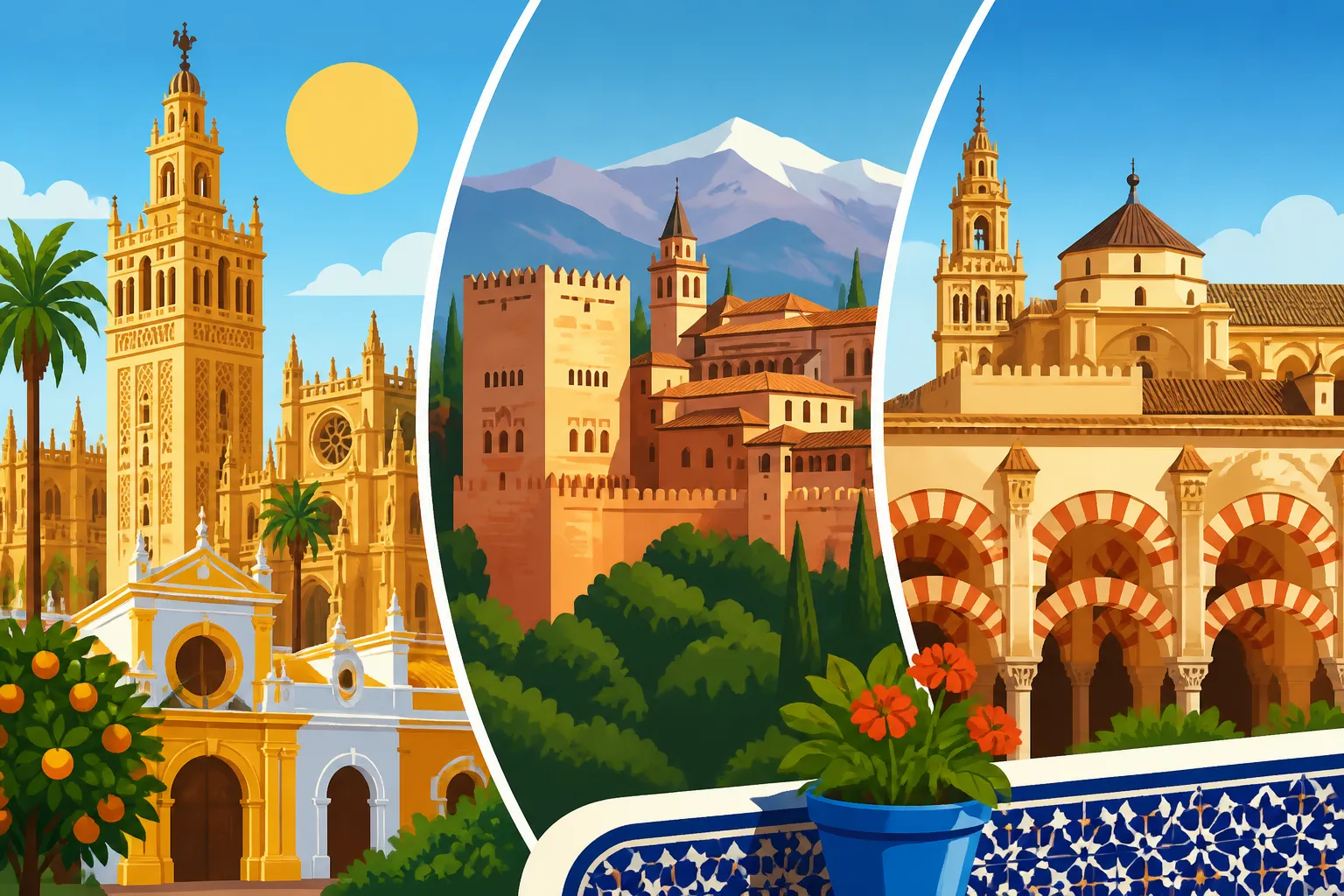
The Seville Cathedral is the largest Gothic cathedral in the world, and it feels every bit that size when you are standing inside it. Most visitors rush to see the tomb of Christopher Columbus, which is impressive, but the real magic is in the side chapels and the sheer height of the nave. One thing that always surprises newcomers is the Giralda tower. Unlike most European bell towers, there are no stairs. Instead, you walk up 34 sloping ramps. This was originally designed so the Muezzin could ride a horse to the top to call for prayer when it was still a mosque.
The frustration most people face here is the queue. Even if you have a pre-booked ticket, the line can snake around the Plaza Virgen de los Reyes. My advice? Look for "combo tickets" often sold at the nearby Church of the Savior (Iglesia del Salvador). Buying your ticket there first usually allows you to skip the main Cathedral line later. Once you’re at the top of the Giralda, you get a bird’s-eye view of the city’s rooftop terraces. This is a great time to scout for a place to have a drink later. If you are wondering about the flow of the day, it helps to understand What Time Do Spaniards Eat Lunch and Dinner? so you can time your visit to end just as the kitchens open.
The Alcázar: Why You Need to Pre-Book
The Real Alcázar is perhaps the most beautiful royal palace in Spain, still used by the Spanish royal family when they are in town. It is a masterpiece of Mudéjar architecture, a blend of Christian and Islamic styles that defines much of Andalusia. However, the Alcázar has become victim to its own fame, partly due to filming for major television shows. The daily capacity is strictly limited. Many travelers stand in the "no-ticket" line for three hours under the blazing sun, only to be told at 1:00 PM that the day is sold out.
When you go, don't just focus on the Peter the Cruel palace. The gardens are sprawling and provide a much-needed cooling effect. There is a "water organ" in the gardens that still plays on the hour—it’s a small, hidden detail that most people miss while they are busy taking photos of the peacocks. Because the site is so popular, Readers should check How to Plan a Multi-City Trip Across Spain to ensure your Seville dates align with ticket availability.
Santa Cruz and the Art of Getting Lost
The old Jewish quarter, Santa Cruz, is the quintessential Seville image: white-washed walls, wrought-iron balconies dripping with bougainvillea, and orange trees everywhere. It’s also a maze. The streets were intentionally built narrow and winding to create shade and funnel the breeze—a medieval form of air conditioning.
The struggle for most foreigners is the "tourist trap" factor. Many of the restaurants on the main thoroughfares of Santa Cruz serve frozen paella and overpriced sangria. To find the real Seville, you need to go two or three turns deeper. Look for bars where the locals are standing at high tables, spilling out into the street. If you are staying in this area, you will find plenty of boutique options on Booking.com, but be aware that taxis cannot reach many of these front doors. You will likely be dragging your suitcase over cobblestones for the last 200 meters.
Granada’s Moorish Majesty – The Alhambra and Beyond
If Seville is the heart of Andalusia, Granada is its soul. Tucked at the foot of the Sierra Nevada mountains, the air here is crisper and the history feels even more layered. Granada was the last stronghold of the Moorish empire in Spain, falling to the Catholic Monarchs in 1492. That transition is visible everywhere, from the Renaissance cathedral built over the old mosque to the tea houses of the Albaicín.
The Alhambra Ticket Struggle
Let’s address the elephant in the room: the Nasrid Palaces. The Alhambra is a massive complex, but the Nasrid Palaces are the crown jewels. They require a specific time slot, and if you are more than 15 minutes late, you are not getting in. Period. Some visitors have ended up in tears at the gate because they miscalculated the walk from the main entrance to the palace doors.
Tickets often sell out three months in advance. If you find yourself in the "I forgot to book" camp, don't panic yet. Platforms like GetYourGuide often have last-minute guided tour slots available when the official site is blank. These tours are more expensive, but they are often the only way to see the interiors. For a deeper dive into the logistics, check out How to Get Tickets for the Alhambra in Granada to avoid the most common mistakes travelers make when navigating the official government portal.
Tapas Culture: The Granada Exception
One of the most glorious things about Granada is that it is one of the last places in Spain where the tradition of the "free tapa" is strictly upheld. In most of the country, you pay for your drink and then pay for your food. In Granada, you order a beer, a glass of wine, or even a Coca-Cola, and a small plate of food arrives for free.
The catch? You don't get to choose what you eat. The first round might be olives or jamón, the second might be a mini-burger or fried eggplant with honey. It’s a beautiful system, but it can be frustrating if you have dietary restrictions. If you’re vegan or gluten-free, you’ll need to be proactive. I’ve found that the smaller, family-run bars are usually happy to swap a plate of meatballs for a salad if you ask nicely in Spanish. For those concerned about navigating menus, our guide on How to Order Tapas in Spain Without Overdoing It is a lifesaver.
The Albaicín and Sacromonte Viewpoints
Across the valley from the Alhambra lies the Albaicín, the old Moorish quarter. It’s a steep climb, but the reward is the Mirador de San Nicolás. This is where everyone goes to watch the sunset over the Alhambra. It gets crowded, loud, and full of street performers, but the view is truly world-class.
If you want a more "raw" experience, head further up into Sacromonte. This is the traditional cave-dwelling district of the Roma community. Many of the houses are literally dug into the hillside. This is also the place to see "Zambra" flamenco, which is performed in the caves. It’s a different vibe than the polished shows in Seville—it’s louder, more percussive, and intensely emotional. Be warned, though: the walk back down to the city center at night can be confusing. I always tell people to save a map offline or use a reliable app to find their way home through the dark, narrow alleys.
Córdoba – The City of Flowers and Philosophers
Córdoba is often treated as a day trip from Seville or Madrid, but that is a mistake I always urge people to reconsider. When the day-trippers leave at 5:00 PM, the city transforms into one of the most peaceful and atmospheric places in Spain. In the 10th century, Córdoba was the most advanced city in Europe, a center of learning where Muslims, Christians, and Jews lived in relative harmony. That spirit of "Convivencia" still lingers in the stone walls.
The Mezquita-Catedral: An Architectural Paradox
The Mezquita is unlike any other building on earth. You enter a vast forest of over 800 red-and-white striped arches, part of the original Great Mosque. Then, right in the center, you find a full 16th-century Renaissance cathedral rising out of the middle. When King Carlos V saw the finished cathedral, he famously said, "You have built what you or others might have built anywhere, but you have destroyed something that was unique in the world."
The frustration here is usually the lighting. The Mezquita is quite dark, which makes photography difficult. My veteran tip: go for the "early bird" entry. Between 8:30 AM and 9:30 AM (except on Sundays), entry is often free and silent. No groups are allowed, and you can wander the arches in the soft morning light before the crowds arrive.
The Patios of Córdoba and the Judería
Córdoba is famous for its flower-filled patios. Because the climate is so dry and hot, residents have spent centuries perfecting the art of the inner courtyard. Once a year in May, the city hosts the Patios Festival, where private homes open their doors to the public. If you aren't there in May, don't worry—the Palacio de Viana has 12 distinct patios that you can visit year-round.
The Judería, or old Jewish Quarter, is right next to the Mezquita. It’s home to one of the few remaining pre-1492 synagogues in Spain. The streets here are even tighter than in Seville. Look for the "Calleja de las Flores," a tiny alleyway where you can get a perfect photo of the Mezquita's bell tower framed by flower pots. It’s the most photographed spot in the city, so expect a bit of a queue for "the shot." If you are feeling overwhelmed by the history, checking How to Plan a Day Trip to a Pueblo Blanco can provide a nice contrast to the urban density of Córdoba.
Crossing the Roman Bridge at Sunset
The Roman Bridge (Puente Romano) has been the main entrance to the city for two thousand years. Walking across it toward the Mezquita at dusk is a rite of passage. You’ll see the Calahorra Tower at one end and the Puerta del Puente at the other. It’s a great spot to look back at the city skyline.
One practical frustration is that Córdoba can feel a bit "sleepy" compared to Seville. Shops close early, and the dining scene is more traditional. Try the Salmorejo—it’s like Gazpacho but thicker, creamier, and topped with hard-boiled egg and jamón. It originated here, and every restaurant claims to have the secret family recipe. If you’re traveling by rail, the station is a bit of a walk from the old town, so you might want to look into High-Speed Trains in Spain (AVE): Routes, Booking, and Savings to manage your arrival and departure times efficiently.
Logistics and Practicalities – Moving Between the Great Cities
Getting between these three cities is surprisingly easy if you plan ahead, but a nightmare if you leave it to the last minute. The infrastructure in Andalusia is fantastic, but the demand during peak season (Spring and Autumn) is massive.
Transport Options: AVE vs. Alsa
The high-speed train (AVE) is the gold standard. It connects Seville and Córdoba in about 45 minutes. However, the train to Granada can be a bit more complicated due to the mountainous terrain, though the high-speed link is now fully operational. For the best prices, I always use Omio to compare the train times against the Alsa bus schedules. Sometimes the bus is only 30 minutes slower but costs half as much, which is a great trade-off if you’re on a budget.
| Route | Train (AVE/AVANT) | Bus (Alsa) | Car |
|---|---|---|---|
| Seville to Córdoba | 45 mins | 2 hours | 1.5 hours |
| Córdoba to Granada | 1.5 hours | 2.5 hours | 2.5 hours |
| Seville to Granada | 2.5 hours | 3 hours | 3 hours |
If you are planning to drive, be aware that parking in any of these three cities is an absolute nightmare. Most of the historic centers are "ZBE" (Zonas de Bajas Emisiones), meaning only residents can drive in. If you accidentally drive your rental car into the Albaicín or Santa Cruz, expect a hefty fine in the mail three months later. It is worth parking in a large "public" garage on the outskirts and taking a taxi to your hotel.
Best Time to Visit (Avoiding the Frying Pan)
I cannot stress this enough: do not visit these cities in July or August unless you genuinely enjoy 45°C (113°F) heat. The heat in Seville and Córdoba is a heavy, dry heat that makes physical activity almost impossible during the day.
The best times are:
- Late March to Early May: You get the orange blossoms (Azahar) in Seville, the Patios in Córdoba, and mild weather.
- October to Early November: The autumn light is beautiful, and the summer crowds have thinned out.
If you are visiting in the winter, Granada will be much colder than Seville because of the altitude. You can actually go skiing in the Sierra Nevada and be back in the city for tapas by the evening. For more on seasonal changes, see When to Visit Each Spanish Region for the Best Weather.
Where to Stay for Maximum Efficiency
For a first-timer, it is wise to stay within walking distance of the main monuments, even if it’s a bit noisier. In Seville, the areas of Arenal or Santa Cruz are perfect. In Granada, look for something near Plaza Nueva or the lower part of the Albaicín. In Córdoba, staying within the Judería allows you to see the Mezquita early in the morning before the bus tours arrive. Use Booking.com to filter for "central" locations, but always read the reviews regarding noise—Spanish streets are lively well past midnight.
Comparative Analysis – Which City Fits Your Vibe?
Choosing how much time to spend in each city depends on what you value most in a trip. While they are close together, they have very different "personalities."
- Seville is for the lover of "Grand Spain." It’s theatrical, vibrant, and has the best nightlife. It feels like a major European capital. If you want the big monuments, the carriage rides, and the "flamenco dress" culture, spend more time here.
- Granada is for the bohemian and the history buff. It’s a university town, so it has a younger, edgier vibe than Seville. It’s also more affordable because of the free tapas. If you love mountain views and Moorish history, this is your base.
- Córdoba is for the slow traveler. It’s the quietest of the three. It’s a place for long walks, quiet courtyards, and deep historical contemplation. It’s less "performed" than Seville and less "gritty" than Granada.
If you are traveling as a family, you might find Seville's parks more accommodating. If you are a solo traveler on a budget, Granada’s food scene is a godsend. To help plan your daily costs, check out Cost of Living in Spain: Monthly Budget Guide for Expats, which gives a good baseline for food and transport prices in the region.
Regional Health Systems in Spain: How Coverage Differs by Comunidad
While you are traveling through Andalusia, it is important to know that Spain’s healthcare system is managed regionally. The Servicio Andaluz de Salud (SAS) is the provider here. If you are an expat or a long-term traveler, your health card from Madrid or Catalonia will work here, but the systems don't always "talk" to each other perfectly. Always keep a digital copy of your records or insurance. For those moving between regions, our guide on How to Register for Healthcare After Moving Between Spanish Regions provides the necessary steps to ensure you’re covered.
Disclaimer
The information provided in this guide is for informational purposes only. Travel requirements, ticket prices, and local regulations in Seville, Granada, and Córdoba can change frequently. While we strive to keep this information up to date, always verify details with official government or venue websites before making travel arrangements. Under no circumstances shall the author or publisher be liable for any loss or damage arising from the use of this information.