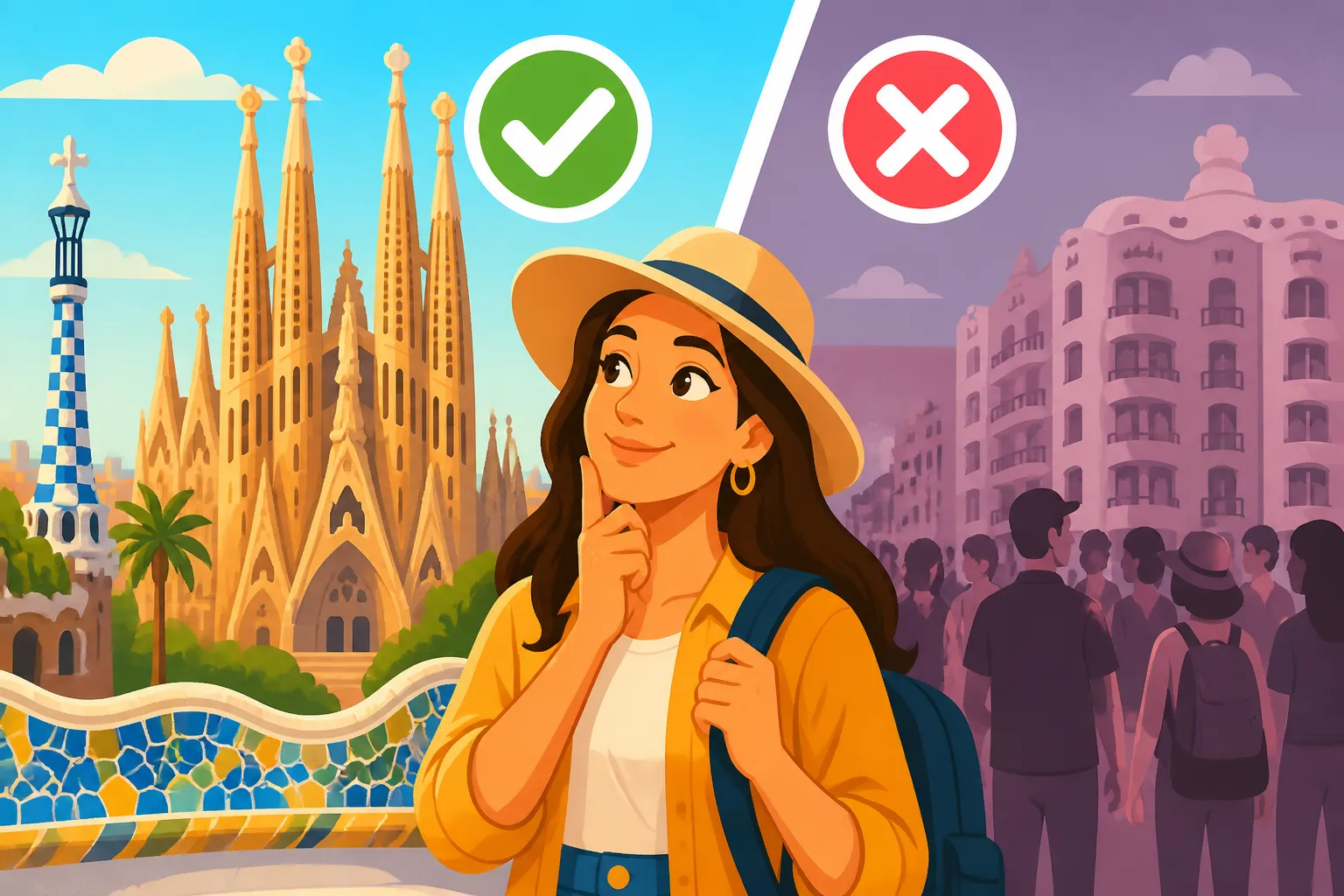
Barcelona for First-Time Visitors: What to See and Skip
Most first-time visitors to Barcelona find themselves trapped in a sea of selfie sticks on Las Ramblas, feeling more exhausted by the crowds than inspired by the art. I remember my own first weekend in the city; I spent four hours in a hot queue for a cathedral because I hadn't booked ahead, and ended up eating a frozen pizza in a tourist trap. This guide solves the overwhelm by showing you exactly what is worth your limited time and which famous "must-dos" are actually worth skipping.
Disclosure: This post may contain affiliate links. We may earn a commission at no extra cost to you if you make a purchase through these links. Read full disclosure.
Planning Your First Trip to Barcelona
The timing of your arrival in the Catalan capital can make or break your experience. Many travelers assume that because it is Spain, the sun is always welcoming, but Barcelona has a humid, Mediterranean climate that can be punishing in the height of summer. If you visit in August, you will find a city that is simultaneously overcrowded with tourists and abandoned by locals, as many small, authentic shops and restaurants close for the month-long summer break. The humidity can make even a short walk to the metro feel like a marathon.
Instead, it is best to aim for the "shoulder" seasons of May, June, or September and October. During these months, the light is golden, the air is crisp enough to keep you moving, and the city’s cultural calendar is at its peak. When you are looking for accommodation, I suggest using Booking.com to find boutique hotels in the Eixample or Gràcia districts rather than staying directly on Las Ramblas. These neighborhoods offer a much more realistic glimpse into daily life while remaining within walking distance of the major sites. You want to wake up to the sound of a neighborhood bakery opening, not a late-night stag party returning to their hostel.
Finding the right base is essential for a stress-free trip. I’ve lived in several corners of this city, and the difference between a good neighborhood and a noisy one is vast. For a deep dive into the specifics of the city's layout, check out my guide on What's the Best Area to Stay in Barcelona?. Getting your accommodation right means you won't have to rely on public transport for every single meal, allowing you to experience the city like someone who actually lives here rather than a passing ghost in a hotel corridor.
Navigating the Peak Season Crowds
If you do find yourself visiting during the busy summer months, you need a strategy. The heat in July and August isn't just a physical challenge; it dictates the rhythm of the city. Most locals will stay indoors between 2:00 PM and 5:00 PM, and you should too. This is the perfect time for a long lunch or a siesta. Don't try to power through the midday sun to see Park Güell; you will likely end up with heatstroke and a very negative memory of a beautiful place.
Another pro-tip for the peak season is to always look for the "pre-opening" or "late-night" tickets offered by some venues. Many Gaudí houses now offer sunrise tours which, while more expensive, provide a serene experience that is worlds apart from the mid-afternoon crush. Using platforms like GetYourGuide can help you secure these specific time slots and skip-the-line entries, which are non-negotiable if you want to maintain your sanity during your first visit.
Budgeting for the Catalan Capital
Barcelona is not as cheap as it was fifteen years ago, but it remains affordable compared to London, Paris, or New York. The biggest costs will be your accommodation and entrance fees for the major Gaudí monuments. To balance your budget, I recommend prioritizing two or three paid entries and enjoying the rest of the city's architecture from the outside. Walking through the Eixample district is like visiting an open-air museum of Modernism, and it doesn't cost a cent to admire the facades of Casa Batlló or Casa Milà.
For daily expenses, eating out can be very reasonable if you stick to the local rhythm. Look for the "Menú del Día" during lunchtime, which usually includes three courses and a drink for a fixed price. This is the secret to eating well without breaking the bank. For transport, avoid individual tickets and look for T-Usual or T-Casual cards at the metro stations. If you are coming from further afield, you might use Omio to compare prices for trains and buses, but within the city, your feet and the metro are your best friends.
The Icons: Landmarks That Are Actually Worth the Hype
There are certain places in Barcelona that appear in every brochure, and for good reason. However, the experience of visiting them depends entirely on your preparation. The Sagrada Família is the most obvious example. It is easy to become cynical about "top ten" lists, but once you step inside Antoni Gaudí’s unfinished masterpiece and see the way the light filters through the stained glass, you will understand why it’s the most visited site in Spain. It is an architectural experience unlike any other in the world, evoking the feeling of standing in a prehistoric stone forest.
However, do not simply show up at the gates expecting to buy a ticket. They have been sold out days in advance for years. You must book online. To ensure you get the best out of your visit and don't end up frustrated by the logistics, read my detailed breakdown on How to Avoid Crowds at the Sagrada Família. It will help you choose the right time of day—usually late afternoon—when the sun hits the "Passion" facade and floods the nave with deep reds and oranges.
Mastering the Gaudí Trail
Beyond the Great Cathedral, Gaudí’s influence is everywhere. Park Güell is another essential stop, though it is often misunderstood. Many visitors don't realize that the park is divided into a free zone and a restricted "Monumental Zone." The latter is where you’ll find the famous mosaic lizard and the gingerbread-style houses. It is beautiful, but it requires a ticket and a specific time slot. Many travelers trek up the hill only to be turned away because they didn't have a reservation.
For those with limited time, it can be hard to choose which houses to enter. Casa Batlló is often the favorite for its whimsical, oceanic interior, while La Pedrera (Casa Milà) offers a more intellectual look at Gaudí’s engineering and an incredible rooftop with "warrior" chimneys. If you are trying to see everything in a single day, you need a tight itinerary. You can follow my guide on How to See Gaudí's Buildings in Barcelona in One Day to make sure you don't miss the hidden gems like Casa Vicens, which is often much quieter than the others.
The Historic Heart: The Gothic Quarter
Stepping into the Barri Gòtic (Gothic Quarter) is like stepping back into the Middle Ages. The narrow, winding alleys are a labyrinth where it is genuinely fun to get lost. You will find hidden plazas like Plaça de Sant Felip Neri, which still bears the scars of the Spanish Civil War, and the stunning Barcelona Cathedral with its courtyard full of thirteen white geese. The history here is layered; you can literally see Roman walls integrated into medieval buildings.
The key to enjoying the Gothic Quarter is to go early. By 11:00 AM, the narrow streets are flooded with walking tours. If you can get there by 8:30 AM, you’ll have the plazas to yourself and can watch the city wake up. It’s a magical experience that most tourists miss because they are still at their hotel breakfast buffets. Just be aware that this area is a maze, so keep your GPS handy, but don't be afraid to put it away and just follow the smell of fresh coffee and incense.
| Landmark | Recommended Time | Booking Needed? | Best For |
|---|---|---|---|
| Sagrada Família | Late Afternoon | Yes (Weeks Ahead) | Architecture & Light |
| Park Güell | Sunrise or Sunset | Yes (For Monumental Zone) | Views & Mosaics |
| Gothic Quarter | Early Morning | No | History & Atmosphere |
| Picasso Museum | Tuesday Afternoon | Yes | Art Lovers |
| Montjuïc | Mid-morning | No | Gardens & Museums |
What to Skip: Avoiding the Tourist Traps
Now for the honest part of this guide. Barcelona has some notorious tourist traps that can sour your impression of the city. The most famous is Las Ramblas. While you will inevitably walk down it at least once, don't make it your destination. It is the epicenter for pickpockets and overpriced, low-quality food. I have lived in Spain for a long time, and I can tell you that no local would ever sit down for a meal on Las Ramblas. The "paella" served there is often frozen and mass-produced, and the "sangria" is usually overpriced sugar water.
If you want to experience a market, La Boqueria is the world-famous choice, but it has become a victim of its own success. It is now so crowded that it is difficult for the actual stallholders to do business. If you go, go at 8:00 AM to see the fishmongers in action. If you go at noon, you will just be part of a slow-moving human traffic jam. For a more authentic experience, head to the Mercat de Santa Caterina or the Mercat de Sant Antoni. They are just as beautiful and far more pleasant to navigate.
The Barceloneta Beach Debate
Many first-timers head straight to Barceloneta Beach because it is the closest to the city center. This is a mistake. Barceloneta is often crowded, noisy, and unfortunately, not the cleanest. You will be constantly approached by people selling drinks, blankets, or massages, making it impossible to relax. If you want a "real" beach day, I suggest taking a short walk or a bike ride further north to Bogatell or Mar Bella beaches. They are wider, cleaner, and have a much more local vibe.
If you have a full day to spare, I highly recommend getting out of the city entirely. You can use Omio to book a quick train to Sitges or the Costa Brava. These areas offer the crystal-clear Mediterranean waters you are likely dreaming of, far away from the urban grit of the city's central port. A twenty-minute train ride can completely change the tone of your holiday from "busy city break" to "relaxing coastal retreat."
Avoiding "Photo-Only" Dining
In the era of social media, many restaurants in Barcelona have been designed specifically to look good on a phone screen, but the food is an afterthought. Avoid any place that has a person outside waving a menu at you or that features large, faded photos of food on a board. These are guaranteed to be disappointing. Instead, look for places where the menu is only in Spanish or Catalan, or where the "Menú del Día" is handwritten on a chalkboard.
Also, be wary of the "tapas crawl" tours that only take you to the most famous spots. While some are excellent, many have partnerships with restaurants that cater only to tourists. You are much better off doing your own research or asking a local for their favorite "Xampanyeria" or "Bodega." For a truly authentic look at how to navigate the culinary landscape, see my guide on Spanish Tapas Culture: How to Order and Where to Go.
Dining and Nightlife: A Practical Culture Guide
One of the biggest shocks for visitors to Spain is the schedule. If you try to go to dinner at 6:30 PM, you will find the restaurant closed or empty, with the staff still setting the tables. Spaniards eat lunch between 2:00 PM and 4:00 PM and dinner rarely begins before 9:00 PM. On a Friday or Saturday night, the best spots won't even be full until 10:30 PM. Adjusting your body clock is the best thing you can do to enjoy the local culture.
Lunch is actually the main meal of the day here. This is when you should seek out a What Is a 'Menú del Día' and How Does It Work? deal. It’s a fantastic way to try traditional dishes like arròs negre (black rice with squid ink) or escalivada (roasted vegetables) without spending a fortune. Dinner is usually a lighter affair, often consisting of tapas or a simple sandwich. To avoid any awkward moments at the table, I recommend reading up on Spanish Meal Times and Dining Etiquette Explained.
Tapas vs. Pintxos: Knowing the Difference
In Barcelona, you will see two types of small plates: Tapas and Pintxos. Tapas are small portions of dishes that are meant to be shared. Pintxos (originally from the Basque Country but very popular in the Poble-sec neighborhood) are small snacks usually served on a piece of bread with a toothpick through them. In a traditional pintxo bar, you simply grab what you want from the counter and the waiter counts your toothpicks at the end to determine the bill.
The etiquette for ordering can be tricky. In a busy bar, don't wait for a waiter to come to you; you often have to catch their eye and be assertive. It’s not considered rude in Spain—it’s just the way it works. If you are standing at the bar, it is perfectly normal to order one drink and one tapa, then move on to the next place. This "moving feast" is the essence of Spanish socializing.
Where to Drink Like a Local
Skip the generic cocktail bars on the main drags and look for a traditional Vermutería. Drinking vermouth on ice with an olive and an orange slice is a beloved weekend tradition in Barcelona, usually enjoyed before lunch (the "hora del vermut"). It’s a social, sunny way to spend an hour. For the evening, head to the Gràcia district. It feels like a separate village within the city, full of low-key plazas where people of all ages gather to drink beer and wine under the trees.
If you are looking for late-night music, the city has a legendary jazz and electronic scene. Places like Jamboree in Plaça Reial or the Sala Apolo in Poble-sec are institutions. Just remember that the "night" doesn't really start until after midnight. If you show up at a club at 11:00 PM, you will likely be the only person there besides the bouncers.
Logistics and Staying Safe
Barcelona is generally a very safe city, but it is the world capital for petty theft, specifically pickpocketing. Many tourists lose their phones and wallets in the blink of an eye. The thieves here are professionals; they don't use violence, but they are incredibly fast. They often work in teams, with one person distracting you while another reaches into your bag.
The most important rule is to never put your phone or wallet on the table while you are eating at an outdoor terrace. It will be gone in seconds. Also, never keep your wallet in your back pocket. I always tell my visiting friends to treat their belongings with "aggressive awareness." For more detailed advice on protecting yourself, see my article on Staying Safe in Spain: Practical Safety Tips for New Residents. It covers the most common scams you might encounter near the major landmarks.
Getting Around: Metro and Beyond
The Barcelona metro is clean, fast, and covers almost the entire city. It is much more efficient than taking taxis, which can get stuck in the city's notorious traffic. When you arrive at the airport, you have several options for getting to the center, ranging from the Aerobús to the local train. Each has its pros and cons depending on where you are staying. You can find a complete breakdown in my guide on How to Get From Barcelona Airport to the City Center.
If you plan on taking day trips to places like Montserrat or Girona, the regional train system (Rodalies) is excellent. The Estació de França is one of the most beautiful train stations in Europe and is worth a visit even if you aren't catching a train. For booking regional travel, you can use Omio or the Renfe website, though the latter can be notoriously difficult for foreign credit cards. I’ve written a help guide on How to Use the Renfe App to Plan Train Travel in Spain to help you navigate the often-confusing booking process.
Essential Paperwork and Digital Tools
Before you arrive, make sure you have downloaded the local transport apps and saved your tickets to your phone. While most places in Barcelona accept card payments, it is always a good idea to have some cash (Euros) for small purchases in traditional bakeries or for tips in bars. Most museums now require digital booking, so having a reliable data plan is essential.
If you are a non-EU resident, keep a digital copy of your passport on your phone but leave the physical document in your hotel safe. You are legally required to carry ID in Spain, but a copy is usually sufficient for tourists unless you are dealing with the police. Finally, don't forget that Barcelona is a city that requires a lot of walking. Bring your most comfortable shoes; your feet will likely cover ten to fifteen kilometers a day as you explore the hidden corners of this incredible Mediterranean gem.
Disclaimer
This guide is intended for informational purposes only. While every effort has been made to provide accurate and up-to-date information, travel conditions, opening hours, and local regulations in Spain can change frequently. Always check official government websites and venue-specific pages before making travel arrangements. The author and publisher are not responsible for any issues arising from the use of this guide.