Toledo and Segovia: Historic Cities Near Madrid
Madrid’s relentless energy, while exhilarating, can eventually leave you feeling like a battery drained by concrete and sirens. I remember my first July in the capital, sweating through my shirt near Sol and realizing I desperately needed a break from the metro’s hum and the city's frantic pace. This guide solves the dilemma of where to go when you only have a day to spare, providing a deep dive into the two heavyweights of Central Spain: Toledo and Segovia.
Disclosure: This post may contain affiliate links. We may earn a commission at no extra cost to you if you make a purchase through these links. Read full disclosure.
Planning Your Escape from Madrid's Concrete Jungle
Escaping Madrid for a day is a rite of passage for every expat and a necessity for every tourist who wants to understand the soul of Castile. While Madrid is the modern heart of the country, the surrounding towns hold the keys to its history. However, the first hurdle you will face is not the language or the map; it is the logistics. If you try to wing it on a Saturday morning at Atocha station without a plan, you will likely find yourself standing in a very long line, watching the "Sold Out" signs flicker on the departure boards.
Choosing the Right Time to Visit
Timing is everything when you are dealing with the high-altitude climate of Central Spain. Many newcomers make the mistake of visiting Toledo in August, only to find themselves trapped in a literal oven where the stone walls radiate heat long after the sun goes down. My personal rule of thumb is to aim for the "shoulder seasons" of late April to early June, or the crisp, clear days of October and November. During these months, the light hitting the golden stone of these cities is breathtaking, and you won’t be fighting for air in the crowded alleys.
If you are a resident, try to visit on a Tuesday or Wednesday. The weekend rush in both Toledo and Segovia is intense, as Madrileños also flock to these towns for their Sunday roasts. Also, keep an eye on the calendar for Public Holidays in Spain: How They Affect Travel and Opening Hours. A random local holiday in the Castilla-La Mancha or Castilla y León regions can mean closed museums and fully booked restaurants when you least expect it.
Logistics and Transport Options
You have three main ways to reach these cities: the high-speed train (AVANT), the bus, or a rental car. For most people, the train is the gold standard. The AVANT train to Toledo takes exactly 33 minutes from Atocha, while the high-speed link to Segovia from Chamartín takes about 28 minutes. It is so fast that you barely have time to finish your coffee before you’re stepping out into another century. I usually check Omio to compare the train times and prices, as it’s much more user-friendly than the sometimes-glitchy official Renfe website.
The bus is the budget-friendly alternative. The ALSA bus to Toledo departs from Plaza Elíptica, and the Avanza bus to Segovia leaves from Moncloa. While it takes longer—about an hour to 90 minutes—it is significantly cheaper and rarely sells out. If you are a student or a young resident with a transport card, you should check Public Transport in Spain: Cards, Discounts, and Etiquette to see if your monthly pass covers these zones, which can save you a decent amount of "caña" money.
Maximizing Your Itinerary with Guided Support
Sometimes, the administrative burden of figuring out entry times for the Cathedral or finding the best vantage points for photos is just too much. If you’re in a "just show me the good stuff" kind of mood, GetYourGuide offers several day-trip packages that combine both cities in one day. While I generally prefer slow travel, I’ve had friends use these when they were short on time, and the convenience of a private bus between the two cities is a lifesaver. Just remember that doing both in one day is a marathon, not a sprint; you will be exhausted by the time you get back to Madrid.
Toledo: The Imperial City of Three Cultures
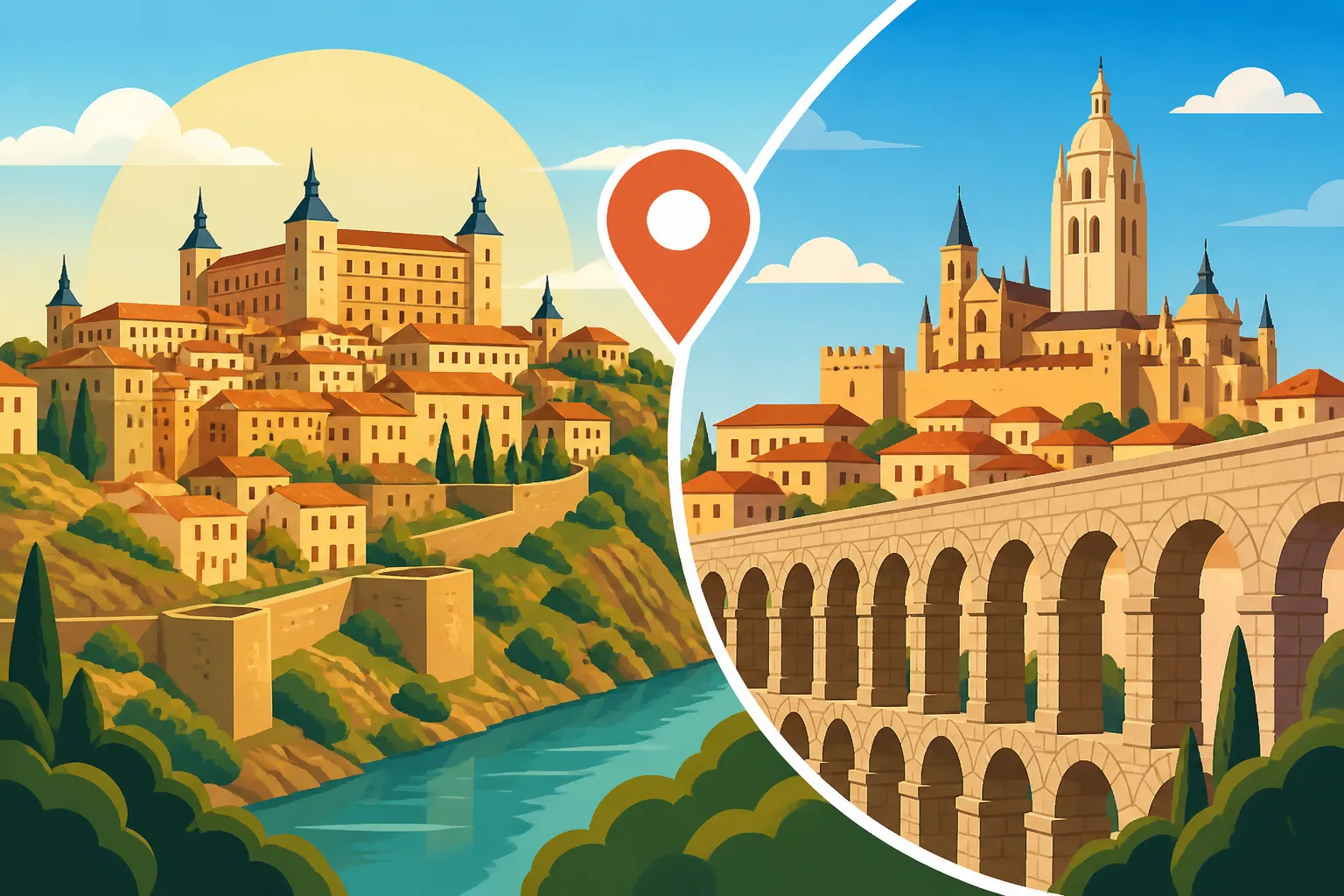
Toledo is not just a city; it is a vertical maze of history. Perched on a hill and surrounded on three sides by the Tajo River, it served as the capital of the Spanish Empire until Philip II moved the court to Madrid in 1561. What makes Toledo special is its nickname, the "City of Three Cultures," reflecting the centuries where Christians, Jews, and Muslims lived (mostly) in harmony, leaving behind a staggering architectural legacy.
Navigating the Medieval Labyrinth
When you arrive in Toledo, your first instinct will be to head straight up. My advice? Don't just follow the crowd up the main road. Use the series of outdoor escalators (escaleras mecánicas) near the Safont parking area. They are a godsend for your calves and provide a dramatic entry into the old town. Once you are in the historic center, forget your GPS. The streets were designed to confuse invading armies, and they will confuse you, too.
Embrace the act of getting lost. You’ll stumble upon hidden plazas, tiny bakeries selling marzipan (mazapán), and workshops where artisans still craft "Damasquino" jewelry—black steel inlaid with gold thread. If you are worried about the logistics of a full day out, check our guide on How to Visit Toledo From Madrid in a Day for a minute-by-minute breakdown of how to beat the crowds at the main gates.
Must-See Landmarks and Art
The Primate Cathedral of Saint Mary of Toledo is, in my humble opinion, the most impressive cathedral in Spain. It is a High Gothic masterpiece that feels more like a museum than a church. Don't miss the "Transparente," an incredible Baroque altarpiece that uses a hole in the ceiling to allow sunlight to illuminate the tabernacle. It’s one of those things you have to see to believe.
Art lovers will also find their Mecca here. El Greco, the Cretan painter who defined the Spanish Renaissance, lived and worked in Toledo. You can see his masterpiece, "The Burial of the Count of Orgaz," in the small Church of Santo Tomé. It’s a haunting, vertical composition that perfectly captures the spiritual intensity of 16th-century Spain. For more on the cultural nuances of visiting such sites, see Spanish Customs, Etiquette, and Social Life.
Gastronomy and Local Specialties
Toledo’s food is hearty, rustic, and unpretentious. This is the land of game meats—partridge (perdiz) is the star of the show here. If you see Perdiz a la Toledana on a menu, order it. It’s a slow-cooked stew with onions, garlic, and bay leaves that falls off the bone. For a more casual experience, many bars around Plaza de Zocodover offer "carcamusas," a local pork stew served in a clay dish with peas and tomatoes.
If you're looking for a place to stay to see the city at night when the day-trippers leave, Booking.com has some fantastic options, including boutique hotels housed in former palaces. Staying overnight allows you to see the city walls lit up, which is a magical experience that most visitors miss. Also, before you head into a restaurant, make sure you understand What Is a 'Menú del Día' and How Does It Work? to ensure you get the best value for your lunch.
Segovia: Roman Engineering and Fairytale Castles
If Toledo is dark, stony, and mysterious, Segovia is bright, elegant, and almost cinematic. Located north of Madrid, across the Sierra de Guadarrama mountains, Segovia feels distinctly more "Castilian" and airy. It is famous for three things: a Roman aqueduct that defies physics, a cathedral that looks like a wedding cake, and a castle that inspired Walt Disney.
The Roman Aqueduct and Beyond
The moment you step into Plaza del Azoguejo, the Aqueduct hits you. Built around the 1st century AD, it consists of roughly 25,000 granite blocks held together by… absolutely nothing. No mortar, no cement, just the sheer weight of the stones and the genius of Roman engineering. Standing at the base and looking up at the 28-meter arches makes you feel very small indeed.
Most people take a photo and leave, but the real secret is to climb the stairs next to the aqueduct to reach the "Postigo del Consuelo" viewpoint. From there, you can see the structure stretching out toward the mountains. For those interested in the travel mechanics of reaching this spot, How to Visit Segovia From Madrid by Train offers practical advice on navigating the Segovia-Guiomar station, which is actually a bit outside the city center.
Exploring the Alcázar and Cathedral
Walking from the Aqueduct to the Alcázar (the castle) takes you through the heart of the old city. You will pass the Segovia Cathedral, the last Gothic cathedral built in Spain. It is nicknamed "The Lady of Cathedrals" because of its grace and size. But the real showstopper is at the very tip of the rocky crag: the Alcázar of Segovia.
With its slate turrets and deep dry moat, the Alcázar looks like it was plucked from a storybook. It has served as a royal palace, a state prison, and a military academy. I highly recommend paying the extra few euros to climb the Tower of Juan II. The spiral staircase is tight and will make your legs burn, but the 360-degree view of the Castilian plains and the snowy peaks of the Guadarrama is the best in the province.
The Art of the Cochinillo (Suckling Pig)
You cannot visit Segovia without engaging in the ritual of the Cochinillo Asado. This is not just a meal; it’s a cultural performance. The suckling pig is roasted in a wood-fired oven until the skin is as crisp as glass and the meat is tender enough to be cut with the edge of a ceramic plate. In fact, at famous spots like Mesón de Cándido, the chef will literally cut the pig with a plate before smashing the plate on the floor for good luck.
It’s a bit theatrical, yes, but the flavor is extraordinary. If you’re not up for a heavy roast, the city also excels in Judiones de la Granja—massive, buttery white beans grown in the nearby royal gardens of La Granja. For those navigating the dining scene, remember to keep some "suelto" (change) on you, and check Money for Travel in Spain: Cards, Cash, and ATMs for tips on tipping and card payments in smaller traditional establishments.
Practical Comparison: Toledo vs. Segovia
Choosing between the two is like choosing between your favorite children. If you only have one day, you need to decide based on what "flavor" of Spain you are looking for. To help you decide, I’ve put together this comparison table based on my multiple trips to both.
| Feature | Toledo | Segovia |
|---|---|---|
| Primary Vibe | Medieval, intense, multi-layered | Fairytale, elegant, Roman |
| Key Landmark | The Gothic Cathedral | The Roman Aqueduct |
| Walking Difficulty | High (lots of steep hills/stairs) | Moderate (mostly flat main ridge) |
| Main Dish | Perdiz (Partridge) & Marzipan | Cochinillo (Suckling Pig) |
| Best For | History buffs and art lovers | Families and photography enthusiasts |
| Train Station | 15-minute walk or short bus to center | 15-minute bus/taxi ride to center |
| Crowd Levels | Very high in the Jewish Quarter | High around the Aqueduct |
Atmosphere and Vibes
Toledo feels older. When you walk its streets, you feel the weight of the Inquisition, the glory of the Empire, and the whispers of the Sephardic Jews. It’s a city that requires effort; you have to work for its views and navigate its complexities. It’s perfect if you want to immerse yourself in the "Leyendas de España" (Legends of Spain).
Segovia, on the other hand, is more "approachable." The layout is linear—you walk from the Aqueduct, past the Cathedral, to the Castle. It’s a beautiful, breezy walk that feels less claustrophobic than Toledo’s narrow alleys. If you have kids or someone who struggles with steep inclines, Segovia is the much friendlier option.
Budgeting and Costs
In terms of cost, both are comparable, but Segovia can get expensive quickly if you commit to a full cochinillo feast, which can run around €30-€40 per person just for the main dish. Toledo has more "tapa" culture in the backstreets, where you can grab a drink and a small plate for a few euros.
If you are planning to visit multiple monuments in Toledo, look for the "Pulsera Turística" (Tourist Bracelet). It costs about €12 and gives you access to seven major sites, including the Monastery of San Juan de los Reyes and the Synagogue of Santa María la Blanca. It pays for itself after just three visits. In Segovia, you mostly pay per monument, though the Cathedral and Alcázar offer various combined ticket options. Always bring your ID; if you have residency or are a student, discounts are common but rarely advertised.
Local Expat Tips for a Stress-Free Day Trip
After years of taking visiting family members to these two cities, I’ve learned a few things the hard way. The biggest mistake is trying to see everything. These cities are dense, and "monument fatigue" is real. If you spend four hours in the Toledo Cathedral, you won't have the energy for anything else.
Avoiding the Tourist Traps
In Toledo, avoid the restaurants on Plaza de Zocodover. They are expensive, the food is mediocre, and the service is rushed. Walk just five minutes into the side streets toward the university area, and you’ll find much better quality for half the price. Look for places where the menu is only in Spanish—that’s usually a good sign.
In Segovia, the "trap" is the gift shops around the Aqueduct. Most of what they sell is mass-produced. If you want something authentic, look for "Artesanía de Castilla," particularly the ceramics or the heavy wool blankets from the region. And a word on safety: while both cities are very safe, the high concentration of tourists means you should stay vigilant. Check Staying Safe in Spain: Common-Sense Tips for Travelers for a refresher on keeping your belongings secure in crowded plazas.
Maximizing Your Itinerary
If you are going to Toledo, go early. The Cathedral opens at 10:00 AM, and by 11:30 AM, the tour buses from Madrid have arrived in force. If you can get the 8:50 AM or 9:20 AM AVANT train, you will have a golden hour of quiet streets. Use High-Speed Trains in Spain (AVE): Routes, Booking, and Savings to understand how to navigate the ticketing system so you don't waste time at the station.
For Segovia, I actually recommend going a bit later and staying for the sunset. Seeing the sun dip below the horizon from the Eresma Valley, with the Alcázar glowing against the purple sky, is one of the most beautiful sights in all of Europe. You can then catch a late bus or train back to Madrid and be home by 10:00 PM for a late Spanish dinner. If you're feeling hungry after your trip, check out our guide on Spanish Tapas Culture: How to Order and Where to Go for the best ways to end your day back in the capital.
Disclaimer
The information provided in this guide is based on current travel conditions, transport schedules, and personal expat experiences in Spain as of 2026. While we strive for hyper-local accuracy, schedules for Renfe and local museum hours are subject to change due to seasonal adjustments or regional holidays. Always verify specific opening times and booking requirements through official channels or the brands mentioned before commencing your journey. This guide is for informational purposes and does not constitute official travel or legal advice.