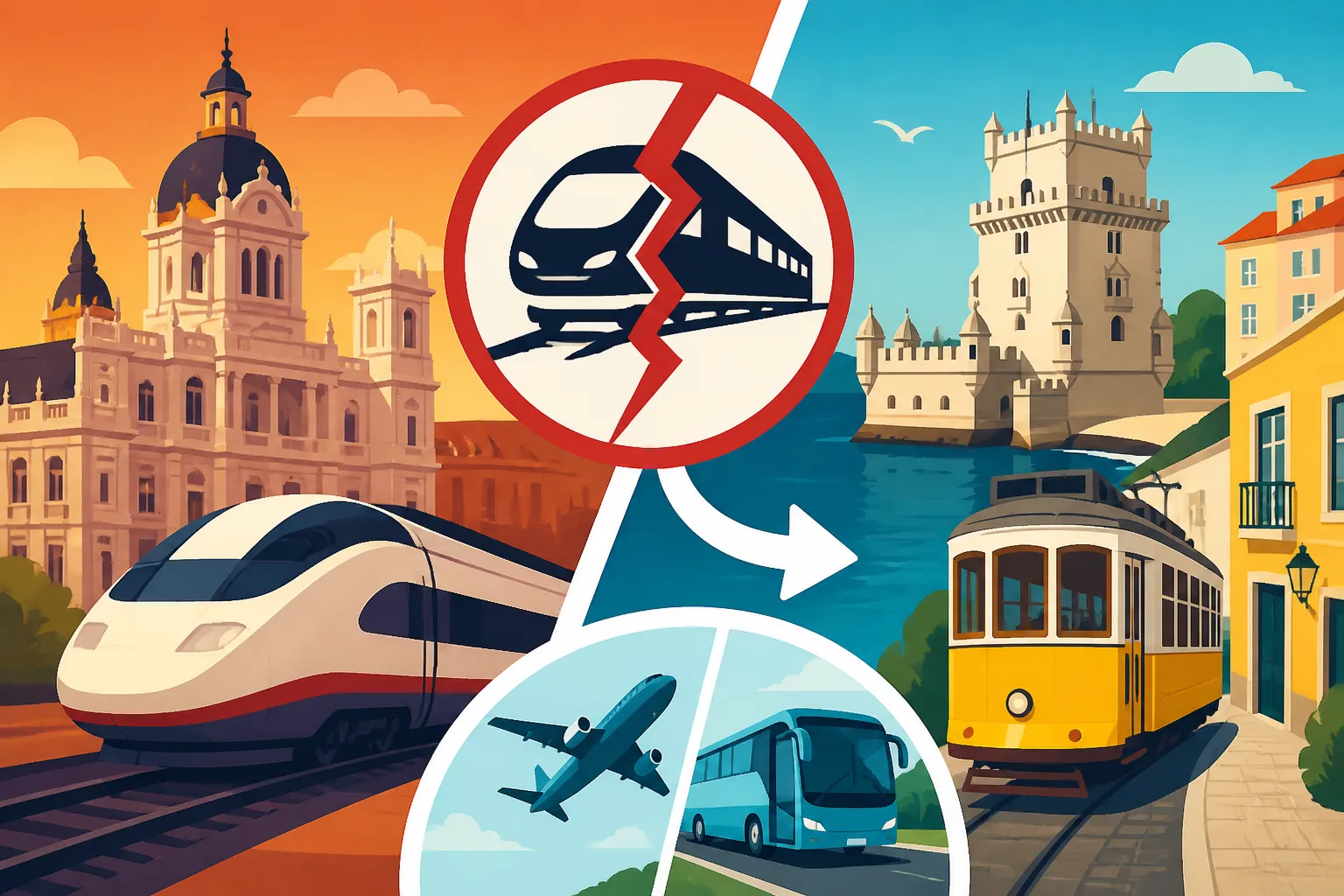
Madrid to Lisbon: Why the Direct Train Vanished and What to Book Now
Oh, the infamous Madrid to Lisbon direct train! If you've just landed in Spain, full of wanderlust and ready to explore our neighbor Portugal by rail, you've probably hit a wall of confusion and frustration. Many expats, myself included, have dreamt of a romantic overnight journey or a swift high-speed connection between these two incredible Iberian capitals. But alas, that dream is currently just that – a dream. This guide will cut through the misinformation, explain why that direct train vanished, and, most importantly, provide you with the realistic and best alternatives to get you from the bustling heart of Madrid to the charming hills of Lisbon, often highlighting how services like Omio can make your life a whole lot easier.
Disclosure: This post may contain affiliate links. We may earn a commission at no extra cost to you if you make a purchase through these links. Read full disclosure.
The Vanishing Act: What Happened to the Madrid to Lisbon Direct Train?
It's a common lament among travelers and expats in Spain: "Why can't I just take a train from Madrid to Lisbon?" Believe me, you're not alone in that thought. For years, the Trenhotel Lusitania offered an overnight sleeper service, a truly classic way to travel between these two magnificent cities. You'd board in the evening, drift off to sleep, and wake up ready to explore Lisbon, all while avoiding the hassle of airports or long bus rides. It was quaint, it was practical, and it was, for many of us, the ideal solution.
But then, 2020 happened. The pandemic, as it did with so many things, delivered a fatal blow to the Lusitania. Ridership plummeted, borders closed, and operations ceased. What started as a temporary suspension became permanent. The reasons for its discontinuation, however, go deeper than just COVID-19. For a long time, the Lusitania faced declining passenger numbers even before the pandemic, partly due to the rise of budget airlines offering quicker (if less comfortable) journeys, and partly due to the aging infrastructure on the Spanish and Portuguese sides of the border. Spain, quite rightly, has heavily invested in its incredible high-speed rail network, the AVE, but that focus has largely been on domestic routes and connections to France, not on developing a high-speed link with Portugal. Portugal also has its own priorities, and a direct high-speed connection between the capitals just wasn't top of the list for either government at the time.
So, while the romantic notion of a direct train remains, the reality is that the tracks aren't there for a seamless, efficient journey, and the political and economic will to create one hasn't materialized yet. It's a bummer, I know. I remember my first time trying to book a train thinking it would be as easy as hopping on the AVE from Madrid to Barcelona. Total culture shock when I realized that wasn't the case!
Your Best Bets for Traveling from Madrid to Lisbon Now
Alright, so the direct train is a no-go. Don't despair! Madrid and Lisbon are too amazing to miss, and getting between them, while it requires a bit more planning, is absolutely doable. You've got several solid options, each with its own set of pros and cons. When you're trying to figure out the best way for your trip, it is worth using a platform like Omio. It's truly a lifesaver for comparing flights, buses, and even those convoluted indirect train routes all in one place, saving you a ton of time and headache. Let's break down the realistic ways to make this journey.
The Bus: An Affordable and Convenient Alternative
For many expats and travelers, the bus is the unsung hero of Iberian travel, especially for routes like Madrid to Lisbon. It's often the most straightforward and budget-friendly option, offering a direct route without any complicated transfers.
Why the Bus is Popular:
- Direct Routes: Unlike trains, buses offer numerous direct connections between Madrid and Lisbon every day. No need to worry about multiple changes or missed connections. You hop on in one city and get off in the other.
- Affordability: Bus tickets are consistently cheaper than flights, especially if you book in advance. This is a huge plus if you're traveling on a budget, which, let's be honest, most of us are when living abroad!
- Comfort: Modern long-distance buses in Spain and Portugal are surprisingly comfortable. Companies like ALSA and Rede Expressos (the main Portuguese operator) offer reclining seats, air conditioning, Wi-Fi, and sometimes even individual entertainment screens. It's not a luxury cruise, but it's far from a cramped school bus. I've spent many hours on these routes and found them perfectly adequate for a day's journey.
- Convenient Stations: Bus stations are typically centrally located or easily accessible by public transport in both cities. In Madrid, you'll likely depart from Estación Sur de Autobuses (Méndez Álvaro), and in Lisbon, you'll arrive at Estação Rodoviária de Sete Rios or Estação do Oriente. These are both well-connected to the city metro systems.
What to Expect on the Journey:
The bus journey typically takes between 8 to 10 hours, depending on the number of stops and traffic conditions. It's a long haul, no doubt about it. You'll usually have at least one or two comfort stops along the way at service stations, giving you a chance to stretch your legs, grab a coffee, or use the facilities. Pack snacks, water, a good book, and a fully charged device with headphones. A neck pillow is also a game-changer!
Booking Your Bus Tickets:
This is where Omio truly shines. Instead of hopping between ALSA's website and Rede Expressos' site, trying to compare times and prices, Omio lets you see all the available bus options in one go. You can easily filter by departure time, price, and even duration. It streamlines the whole process, letting you quickly find the best deal and book your ticket without fuss. Trust me, navigating multiple foreign booking sites can be a headache, and Omio just makes it simple.
Flying: The Fastest, But Not Always the Easiest
If speed is your absolute top priority, flying is undeniably the quickest way to get from Madrid to Lisbon. The flight itself is usually just over an hour. However, it's crucial to consider the total travel time and cost.
Airlines and Airports:
Several airlines operate this route, including full-service carriers like Iberia and TAP Portugal, and budget airlines such as Ryanair and EasyJet. In Madrid, you'll fly from Adolfo Suárez Madrid-Barajas Airport (MAD), and in Lisbon, you'll arrive at Humberto Delgado Airport (LIS).
The Hidden Time Traps:
While the flight is short, remember to factor in:
- Getting to and from airports: Both MAD and LIS are a good 20-30 minutes outside their respective city centers by public transport or taxi. Factor in travel time to the airport, check-in, security, boarding, and then disembarking and getting into the city from the arrival airport. This can easily add 3-4 hours to your "1-hour flight."
- Security and Check-in: Standard airport procedures. You need to be there well in advance, especially if you're checking a bag.
- Luggage Restrictions and Costs: Budget airlines are notorious for charging extra for checked baggage, seat selection, and even carry-on bags. What looks like a cheap flight can quickly become more expensive than a bus ticket once you add these "extras."
Pros and Cons of Flying:
| Pros | Cons |
|---|---|
| Fastest actual travel time (1-1.5h) | High potential for hidden fees (luggage, seating) |
| More comfortable for short duration | Time-consuming airport transfers |
| Widest range of departure times | Environmental impact |
| Less scenic | |
| Can be more expensive than bus, especially last-minute |
When deciding, think about what you value more: sheer speed or overall convenience and cost. For shorter trips, flying might be worth the hassle. Again, Omio is an excellent tool here, as it allows you to compare prices across all these airlines, including filtering for those pesky baggage fees, giving you a clear picture of the total cost before you commit. It even shows you the actual total travel time, taking into account transfers to and from the airports. This really helps cut through the marketing fluff of "cheap flights."
The "Indirect" Train: A Scenic, But Lengthy Adventure
If you're still set on traveling by train, know that a direct route is unavailable, but an indirect journey is possible. Be warned: it's not the most efficient or fastest option, but it offers a unique, often scenic experience for the true train enthusiast. It definitely falls into the category of "journey as destination."
The Multi-Leg Reality:
To travel by train from Madrid to Lisbon, you'll need to break your journey into at least two, sometimes three, segments. The most common route involves:
- Madrid to Extremadura: Take a Spanish Renfe train from Madrid's Atocha station to a city in Extremadura, such as Badajoz or Cáceres. This leg typically takes around 4-5 hours.
- Extremadura to Lisbon: From Badajoz or Cáceres, you would then need to connect to a Portuguese train service (CP – Comboios de Portugal) that goes to Lisbon. This second leg can take another 3-4 hours, often involving older, slower regional trains.
Challenges and Considerations:
- Booking Multiple Tickets: You'll need to book separate tickets for each leg of the journey, usually through Renfe for the Spanish part and CP for the Portuguese part. This can be complex, especially with potential language barriers or if you're unfamiliar with the different booking systems. This is another area where Omio is a huge help, as it can sometimes piece these journeys together for you and present the full itinerary, though direct booking of the full indirect route isn't always seamless for all combinations. You might still have to book two separate tickets, but at least Omio shows you the options side-by-side.
- Layover Times: You'll need to factor in generous layover times between trains in the intermediate city. Missed connections are a real risk, and you don't want to be stranded.
- Time Commitment: The total journey time, including transfers, can easily stretch to 10-12 hours, sometimes more. This rivals, or even surpasses, the bus journey length, but without the direct convenience.
- Limited Services: The connections, especially the cross-border ones, are not as frequent as domestic routes. You might find only one or two suitable connections per day.
- Scenic Views: On the plus side, traveling through the Extremaduran countryside and into Portugal can offer some beautiful, less-seen landscapes. It's a chance to see a different side of the Iberian Peninsula.
If you have ample time, love trains, and don't mind the logistical puzzle, this can be an adventure. For those looking for efficiency, I'd suggest reconsidering. For a deeper dive into the Spanish train system, you might find this guide on High-Speed Trains in Spain AVE Routes Booking and Savings helpful, even if the direct link to Lisbon is missing.
Car Rental: Freedom on the Open Road (with Considerations)
Renting a car offers the ultimate flexibility, allowing you to stop wherever you please, explore small towns, and set your own pace. The drive from Madrid to Lisbon is generally straightforward, mostly on good highways.
The Drive Itself:
The distance is approximately 620-650 kilometers (385-400 miles), and the drive takes about 6-7 hours of pure driving time. Add in stops for fuel, food, and stretching, and you're looking at an 8-9 hour journey easily. The route is pretty scenic once you get past the immediate outskirts of Madrid, especially as you approach the Portuguese border and drive through the Alentejo region.
Key Considerations for Renting a Car:
- One-Way Fees: This is the biggest catch for cross-country rentals. Most rental companies charge a hefty "one-way fee" (also known as a drop-off charge) for picking up a car in one country and returning it in another. This fee can sometimes be more expensive than the rental itself. Always get a clear quote for this.
- Tolls: Both Spain and Portugal have extensive toll roads. Portugal's electronic tolls can be a bit confusing for foreign drivers. Make sure your rental car has a transponder for automatic payment, or understand how to pay manually. Ignoring tolls can lead to fines!
- Fuel Costs: Petrol and diesel prices in both Spain and Portugal are comparable, but still a significant expense, especially for a long journey.
- Parking: Finding and paying for parking in the city centers of both Madrid and Lisbon can be a challenge and an additional cost. Many cities have strict traffic restrictions in historical areas.
- Border Crossing: Crossing the border between Spain and Portugal is usually seamless for EU residents. There are no physical checks, but do ensure you have all your documents (ID, driving license, rental agreement) handy.
Is it Worth It?
Renting a car is ideal if you're traveling with family or a group, have a lot of luggage, or genuinely want to explore the countryside between the two cities. If you're just looking to get from point A to point B, the costs and complexities of a one-way international rental might outweigh the benefits. For more details on driving regulations and car rental tips in Spain, check out Renting a Car in Spain Requirements Insurance and Driving Tips.
Booking Your Journey Seamlessly with Omio
Now, let's talk about the tool that has genuinely simplified my life as an expat navigating European travel: Omio. Since the direct train between Madrid and Lisbon disappeared, Omio has become my go-to for finding the most practical and efficient way to bridge that gap.
Why Omio Makes Travel Planning Easier for Expats
When you're dealing with different transport companies, varying prices, and multiple languages, travel planning can quickly become a headache. This is where Omio steps in as your friendly travel assistant, especially for a complex route like Madrid to Lisbon.
- All-in-One Comparison: Imagine not having to open 10 different tabs for Renfe, ALSA, Iberia, Ryanair, and TAP Portugal. Omio aggregates all the available options for trains, buses, and flights for your chosen route, displaying them clearly on a single page. You can instantly see prices, journey times, and providers side-by-side. This is invaluable when you're trying to figure out if the cheaper flight is worth the extra airport hassle, or if the bus is the most sensible option overall.
- Multi-Language and Multi-Currency Support: Expats often struggle with foreign websites that suddenly switch to the local language or only display prices in a currency they may not quite grasp. Omio eliminates that friction, offering its service in multiple languages and allowing you to pay in your preferred currency. It's a small detail that makes a huge difference in reducing stress.
- Real-Time Information and Booking: The platform pulls real-time data, so you're seeing the most up-to-date availability and prices. Once you've made your choice, you can book directly through Omio, often with just a few clicks. Your tickets are usually sent straight to your email or the Omio app, making them easy to access on the go.
- Customer Support: Should you run into any issues (and let's face it, travel often has unexpected twists!), having a single point of contact for customer support, rather than dealing with multiple transport providers, is a massive relief.
For anyone who's ever tried to piece together a cross-border journey in Europe, you'll understand why a service like Omio isn't just a convenience, it's a necessity. It genuinely streamlines the process, giving you confidence that you've found the best possible option for your travel needs.
Step-by-Step: Using Omio to Book Your Madrid to Lisbon Trip
Using Omio is incredibly intuitive, but here's a quick walkthrough to get you started on your Madrid to Lisbon adventure:
- Head to the Omio Website or App: First things first, open up Omio. You'll be greeted with a clean interface asking for your departure and arrival cities, and your travel dates.
- Input Your Details: Type "Madrid" as your departure city and "Lisbon" as your arrival city. Select your travel dates. If you're flexible, you can even search for a range of dates to find the absolute best deals.
- Search and Compare: Hit the search button! Within seconds, Omio will populate a list of all available options: flights, buses, and any indirect train routes it can find. You'll see them neatly organized, usually with the fastest or cheapest options highlighted.
- Flights: Look at the total journey time (including transfers to/from airports) and the total cost (after adding any baggage or seat selection fees). Omio often provides a good estimate of these "hidden" costs upfront.
- Buses: These will likely appear as the most cost-effective and direct option. Pay attention to the journey duration and the departure/arrival stations.
- Trains: For Madrid to Lisbon, you'll primarily see indirect routes. Omio will show you the segments, the transfer points, and the overall time.
- Filter and Refine: Use the filters on the side to narrow down your choices. You can filter by:
- Mode of transport: Only want to see buses? Easy.
- Price range: Stick to your budget.
- Departure/Arrival Times: If you need to arrive by a certain time or prefer an early start.
- Providers: If you have a preferred bus company like ALSA, you can filter for that.
- Select Your Journey: Once you've found the option that best fits your budget and schedule, click on it for more details. You'll see specifics like exact departure/arrival times, stopovers, and any amenities offered.
- Book Your Ticket: Proceed to booking. You'll typically enter passenger details, select any extras (like luggage if not included), and then securely pay using your preferred method. Your e-ticket will be sent to you almost instantly.
It's that simple. Instead of wading through a swamp of different booking sites and trying to translate everything, Omio gives you the clarity you need to make an informed decision for your cross-border trip. Whether you opt for the convenience of the bus or the speed of a flight, using Omio ensures you're getting the best possible deal and itinerary. For broader travel within the country, don't forget to consult general guides on Traveling Around Spain Trains Buses Flights and Car Hire to make your adventures even smoother.
Navigating the Border and Beyond: Practical Tips
Once you've booked your ticket and you're ready to roll, there are a few practical tips that can make your Madrid to Lisbon journey even smoother, regardless of your chosen mode of transport.
Essential Documents for Border Crossing
While both Spain and Portugal are part of the Schengen Area, meaning there are no routine passport checks at the physical border, it's absolutely crucial to carry valid identification.
- For EU/Schengen Citizens: Your national ID card is usually sufficient.
- For Non-EU/Schengen Citizens: You must carry your passport, and your Spanish residency card (TIE) or valid visa. Even without border controls, authorities (like police during a random check, or transport staff) can request your documents at any time. Don't risk it! Keep these readily accessible, not buried in your checked luggage. If you're a non-EU citizen, make sure you understand the Spain Schengen Rules 90/180 Day Rule Explained for Spain to avoid any issues with overstaying.
Language Basics for Your Portuguese Adventure
While many people in tourist areas of Lisbon speak English, knowing a few basic Portuguese phrases will go a long way. Locals appreciate the effort, and it can really enhance your experience. Even simple greetings like Olá (hello), Obrigado/a (thank you – 'o' for male, 'a' for female), and Por favor (please) will be well-received. Spanish speakers will find some similarities, but don't assume they're interchangeable; Portuguese has its own distinct beauty. If you've been working on your Spanish, remember that Portuguese sounds quite different! For a head start on getting around, you might want to brush up on Spanish Language and Everyday Communication for Visitors for your time in Spain and then grab a Portuguese phrasebook for Lisbon.
Money Matters: Euros are Universal, but Payment Methods Vary
Both Spain and Portugal use the Euro (€), so no currency exchange is needed. This is one less thing to worry about!
- Cards vs. Cash: In both countries, card payments (credit and debit) are widely accepted, especially in cities and larger establishments. However, it's always wise to carry some cash for smaller purchases, local markets, or in case a card machine is out of order.
- ATMs: ATMs (Multibanco in Portugal, Cajero Automático in Spain) are plentiful. Be aware of potential foreign transaction fees from your bank or dynamic currency conversion charges at the ATM. It's often best to withdraw in local currency (Euros) and decline the ATM's offer to convert it for you. This guide on Money for Travel in Spain Cards Cash and ATMs offers useful insights applicable to Portugal too.
Staying Connected
Getting a local SIM card can be a lifesaver for navigation, looking up bus schedules, or simply staying in touch. You can easily purchase a prepaid SIM card at airports, mobile phone shops, or even some larger supermarkets in both Spain and Portugal. Alternatively, many travelers now opt for eSIMs, which offer a convenient digital solution without needing a physical card. Just make sure your phone is unlocked.
Safety First, Always
Both Madrid and Lisbon are generally safe cities, but like any major tourist destination, petty crime, especially pickpocketing, can be an issue in crowded areas or on public transport.
- Be Aware of Your Surroundings: Stay alert, especially in busy tourist spots, train stations, and on crowded buses or trams.
- Secure Your Valuables: Keep your passport, money, and phone in a secure, concealed place. Avoid putting wallets in back pockets or leaving phones unattended on tables.
- Emergency Numbers: Remember the pan-European emergency number 112 for police, fire, or ambulance services in both Spain and Portugal. For broader safety advice, take a look at Staying Safe in Spain Practical Safety Tips for New Residents.
By keeping these practical tips in mind, your journey from Madrid to Lisbon will be less about the logistics and more about the adventure and discovery that awaits you in Portugal!
Conclusion: Embrace the Journey, Even Without the Direct Train
While the absence of a direct train from Madrid to Lisbon might initially feel like a letdown, it's simply a small hurdle in what will undoubtedly be an incredible cross-cultural adventure. The Iberian Peninsula is a tapestry of vibrant cities, stunning landscapes, and rich histories, and getting from the Spanish capital to its Portuguese counterpart is part of that unique experience.
As we've explored, you have several excellent options: the cost-effective and direct bus, the speedy (but often logistically complex) flight, the scenic (but lengthy) indirect train route, or the freedom of a car rental. Each has its merits, and the "best" choice truly depends on your priorities, budget, and appetite for adventure.
My personal advice, as someone who's navigated these routes many times, is to always start your planning with a reliable comparison tool. That's why I wholeheartedly recommend Omio. It takes the guesswork out of cross-border travel, allowing you to quickly compare all your options – bus, flight, or even those tricky indirect train connections – in one place, in your language, and with transparent pricing. It streamlines the entire process, so you can spend less time stressing about booking and more time dreaming about pastéis de nata or exploring the winding streets of Alfama.
So, go ahead and book that trip! Whether you choose the panoramic window of a bus, the aerial view from a plane, or the meandering path of an indirect train, Lisbon is waiting. Don't let a missing train connection stop you from experiencing two of Europe's most captivating capitals. Your next adventure is just a search away on Omio!
Disclaimer
Please note that travel information, including schedules, prices, and visa requirements, can change rapidly. While we strive to provide the most accurate and up-to-date information, it is always advisable to double-check details with official sources and transportation providers before making any travel plans. This guide is for informational purposes only and does not constitute professional advice.