Booking Spanish Trains From Abroad: Foreign Cards, Passports, and Failures
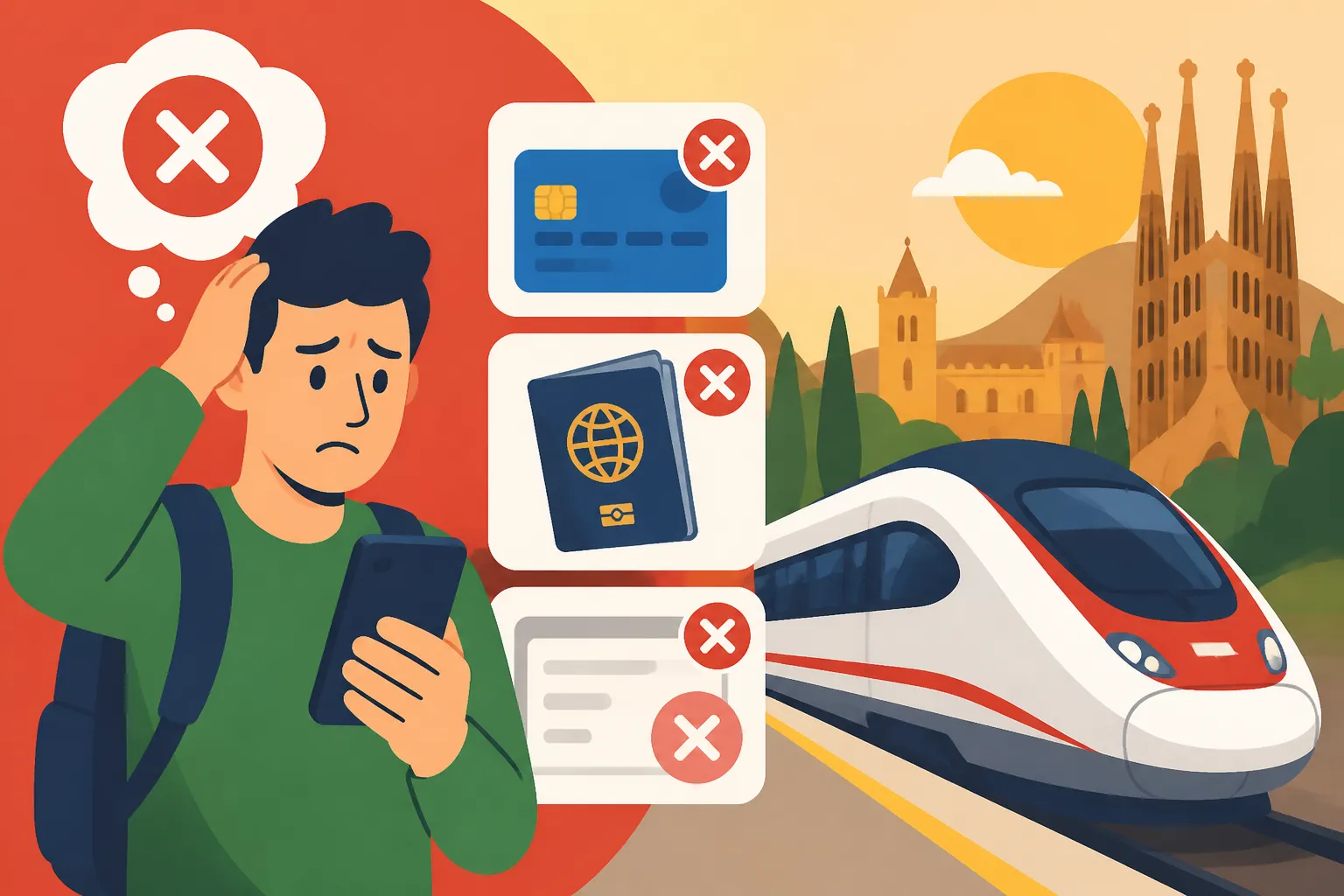
Imagine trying to book a Madrid to Seville train from your kitchen in Toronto. The card fails, the form wants a Spanish ID number you don’t have, and the error message is in Spanish. This guide covers how to book Spanish trains from abroad without those headaches. It explains foreign card payments, passport fields, name matching, and what to do when a booking fails.
Disclosure: This post may contain affiliate links. We may earn a commission at no extra cost to you if you make a purchase through these links. Read full disclosure.
Why Booking Spanish Trains From Abroad Goes Wrong
I remember my first attempt clearly. I was still living in Manchester, planning a scouting trip before my move, and I wanted a single seat from Madrid to Valencia. I tried three times on one evening. The first attempt timed out at payment, the second rejected my card, and the third appeared to work but never produced a ticket. I went to bed convinced Spanish trains simply did not want my money.
The problem was never the trains. Spain has one of the best high-speed rail networks in Europe, and once you are on board, it is a pleasure. The trouble sits at the booking stage, where systems built mainly for Spanish residents meet foreign cards, foreign passports, and foreign phone numbers. Once you understand where the friction comes from, most of it goes away.
The Operator Maze After Liberalisation
Not long ago, booking a Spanish train meant dealing with one company: Renfe. Spain then opened its high-speed lines to competition, and travellers now choose between Renfe’s AVE and Alvia services, Renfe’s low-cost Avlo brand, the French-owned Ouigo, and Iryo, which is part-owned by Italian rail interests. Competition has been good for travellers in many ways, with more departures and more pressure on fares on the busiest corridors.
For someone booking from abroad, though, it means a fragmented market. Each operator has its own website, its own app, its own account system, and its own way of handling payment and identity fields. A Madrid to Barcelona search on Renfe’s site will not show you the Ouigo or Iryo departures on the same route. You end up running three separate searches, comparing them in a spreadsheet, and then fighting three separate checkouts. For a full rundown of how the companies differ in comfort, pricing style, and onboard rules, see Renfe vs Ouigo vs Iryo vs Avlo: Spain’s High-Speed Competition Compared.
The maze gets worse when your journey goes beyond the high-speed core. Regional services, Cercanías commuter lines, and Media Distancia trains each follow their own ticketing logic. Some need advance reservations and some you can buy on the day at a machine. Knowing which trains need booking ahead matters before you even open a laptop, and Do You Need to Book Cercanias and Media Distancia? Ticketing Rules Explained covers that question in detail.
Foreign Cards and Bank Authentication
Card payments are where most foreign bookings fall apart. European rules on strong customer authentication mean that many online card payments trigger an extra verification step. Depending on your bank, that might be a push notification in your banking app, a one-time code by SMS, or a password screen. Spanish operator checkouts lean heavily on this step, and when the handshake between the merchant’s payment page and your bank’s verification system fails, the payment fails too.
Banks outside Europe add another layer. A card issued in the United States, Australia, or Brazil may treat a sudden charge from a Spanish rail operator as unusual activity, especially late at night your time. The bank may decline quietly, and the operator’s site often shows only a generic error. Sometimes the bank holds the funds anyway, so you see a pending charge with no ticket attached. Nothing makes a traveller panic faster than that.
The fixes are usually simple once you know them: warn your bank, approve the charge in your banking app, or use a payment route that handles international cards smoothly. The full set of card-specific workarounds, including what to do when every card you own is declined, is in Paying for Spanish Transport With a Foreign Card: Declines and Fixes.
Passports, ID Fields, and Name Matching
Spanish long-distance train tickets are usually tied to a named passenger, and checkout forms commonly ask for an identity document. Spanish residents enter a DNI or NIE. Visitors need to select the passport option instead, and on some forms that choice sits in a dropdown that defaults to the Spanish ID type. If you type a passport number into a field expecting the format of a Spanish ID, validation rejects it, often with a message that is easy to misread.
Names cause their own problems. Spanish naming conventions assume a first name plus one or two surnames, and some forms split these into separate boxes. If you have a single surname, a hyphenated name, an apostrophe, or characters outside the Spanish alphabet, the form may reject your entry or mangle it. The name on the ticket should correspond to the identity document you will carry, because staff can ask to see ID alongside the ticket.
Phone numbers and addresses are the final trap. Some systems expect a Spanish mobile number for verification, or a Spanish postcode format. A foreign number entered without the correct country code may cause a verification text to go nowhere. None of this is insurmountable, but it adds up when you are already tired and trying to plan a trip around a time difference.
How Omio Solves the Foreign Booking Problem
After that failed evening in Manchester, a friend who had lived in Barcelona for years told me to stop fighting the operator sites and use Omio. I was sceptical, because I assumed a third-party platform would be a middleman that complicated things further. The opposite turned out to be true, and it has been my default starting point for Spanish rail bookings ever since.
One Search Across Renfe, Ouigo, and Iryo
The biggest advantage is the single search. You enter your origin, destination, and date, and the results show departures from multiple rail operators side by side, along with bus and flight options where they exist. On a corridor like Madrid to Barcelona, that means you can see Renfe, Ouigo, and Iryo departures in one list, sorted by time or price, without juggling tabs.
That changes how you plan. Instead of picking an operator first and then hunting for a time, you pick the departure that suits your day and let the operator follow from that. If you are deciding whether rail even makes sense against flying for a given route, a combined view helps you judge it. For the Madrid to Barcelona question in particular, Madrid to Barcelona: Train vs Flight vs Bus Compared goes deeper into door-to-door times and real-world trade-offs.
The interface is fully in English, as well as several other languages, and the fare conditions are presented in a consistent layout across operators. That matters more than it sounds. Reading three different refund policies in three different formats, some partly in Spanish, is how people end up buying a fare they cannot change. Seeing them in a single, consistent format makes the comparison much quicker.
Checkout Built for International Travellers
Omio’s customer base is international by design, and the checkout reflects that. Passenger detail fields are built to accept foreign passports and international name formats, and the payment step is set up for cards and other payment methods from many countries. The available methods vary by market, so check the options shown at checkout for your country. In my experience, and in that of the newcomers I help each year, the card failures that plague direct operator checkouts happen far less often.
The platform also sends tickets in a consistent format, by email and in its app, whichever operator runs the train. You do not need to create separate accounts with each rail company or install each company’s app before you travel. For a short trip where you might ride Iryo one day and Renfe the next, keeping everything in one app is a real relief.
The cost works like this. Third-party platforms generally fund their service through a booking fee, a margin built into the displayed price, or both, and the amount can vary by route, operator, and payment method. Omio shows the total before you pay, so the sensible habit is to compare that final total against the operator’s own site for the same train and fare type. Decide whether the convenience and the reliable checkout are worth any difference. For most visitors booking from abroad, I find they are.
Where Booking Direct Still Makes Sense
I would not be honest if I told you a platform is always the answer. Some operator-specific perks, such as loyalty schemes, certain promotional fares, discount cards, and some resident discounts, may only be available when you book direct with that company. If you live in Spain and ride the same corridor every week, an operator account may serve you better over time.
Direct booking can also make sense when you want to manage changes through the operator itself. Each company has its own change and refund rules by fare class. When a booking is made through a platform, changes are typically handled through that platform, subject to the operator’s conditions. Before buying a cheap fare, read the conditions shown, and check Renfe Ticket Types: Change and Refund Rules by Fare Class for how Renfe’s fare families work.
The table below sums up how the two routes compare for someone booking from outside Spain.
| Factor | Booking via Omio | Booking Direct With Operator |
|---|---|---|
| Operators shown | Several rail operators plus buses and flights in one search | One operator only per site or app |
| Language | Full English interface and consistent fare layout | English available but varies in completeness |
| Foreign passport entry | Designed for international passengers | Can default to Spanish ID types |
| Foreign card payment | Built for international payment methods | More prone to authentication failures for some cards |
| Fees | May include a booking fee shown at checkout | Usually no third-party fee |
| Loyalty and discount cards | Limited access to operator schemes | Full access to operator perks |
| Ticket storage | All operators in one app | Separate app or email per operator |
| Best for | Visitors, multi-operator trips, first-timers | Frequent riders and residents with discount cards |
Step-by-Step: Booking a Spanish Train From Abroad With Omio
This is the routine I walk friends and readers through when they are booking from their home country. It takes about ten minutes once you have done it once, and it avoids nearly every common failure.
Before You Search
Preparation prevents most problems. Have your passport in front of you, not a photo of it, so you can copy the number exactly and check the spelling of your name as it appears on the document. If anyone in your party holds a different nationality or uses a national ID card instead of a passport, have their document handy too. For trips with children, check the child fare categories, which Booking Spanish Transport With Kids: Child Fares, Seats, and Prams covers in depth.
Next, think about timing. Spanish high-speed fares tend to move as departure approaches and as seats sell, so booking earlier usually gives you more choice. Holiday periods and long weekends are a different story. Spanish Train Price Curves: How Fares Move From 60 Days Out to Departure explains how fares typically behave, which helps you decide when to commit.
Finally, prepare your payment method. Open your banking app and make sure notifications are switched on so you can approve a verification request quickly. If your bank lets you set travel notices or flag expected foreign merchant charges, do that. Also decide which class you want before you start. Spanish trains offer quite different experiences across fare classes, and Spanish Train Classes Explained: Turista, Elige, and Premium is worth reading first if you are unsure.
The Booking Itself
Once you are prepared, the process looks like this:
- Open the Omio website or app and set your language and currency preferences if they are not already correct.
- Enter your departure and arrival cities. Use the city name rather than a specific station unless you know which station you need, since Madrid, Barcelona, and Seville each have more than one.
- Choose your travel date and the number of passengers, setting the age category for each traveller.
- Filter the results to trains if you only want rail, then compare departures by time, journey length, operator, and total price.
- Select a departure and review the fare options presented, paying close attention to the change and cancellation conditions.
- Choose seats if the operator offers seat selection for that fare.
- Enter each passenger’s name exactly as it appears on their identity document, and select the passport option where an ID type is requested.
- Enter your email address carefully and add a phone number with the correct international country code.
- Review the full total, including any fees, then proceed to payment.
- Complete your bank’s verification step promptly when it appears, without closing the browser tab or switching away for too long.
- Wait for the confirmation screen before doing anything else, then check your inbox for the ticket email.
The most common mistake at step 10 is switching to the banking app, approving the charge, and then not returning to the browser. Some payment pages wait for you to come back before they complete the booking. Approve, return, and wait for the confirmation screen to load.
After Payment
Once the confirmation arrives, download the ticket to your phone and save it in the app. Spanish stations generally have good connectivity, but underground platforms and crowded concourses are not where you want to rely on a slow connection to load a QR code. Some travellers also like to keep a printed copy as a backup.
Check every detail on the ticket against your plans: date, departure time, departure station, passenger names, and coach and seat numbers. Madrid has both Puerta de Atocha and Chamartín, and Barcelona has Sants and other stations. Turning up at the wrong one with a correct ticket is a classic visitor mistake that no booking platform can fix for you.
If you are combining your high-speed journey with local trains or buses at either end, now is the time to plan those links. Some of those journeys will not need advance tickets, while others will. If you want to manage the operator side of a Renfe journey as well, How to Use the Renfe App to Plan Train Travel in Spain shows how the operator’s own app handles timetables and station information.
Troubleshooting Common Failures
Even with good preparation, things occasionally go wrong. The good news is that almost every failure falls into a few predictable patterns. Here is how I handle each one, based on years of fielding panicked messages from friends.
Card Declined or Payment Loop
If your card is declined, do not keep retrying in quick succession. Repeated attempts can look like fraud to your bank and make the block last longer. Instead, open your banking app first and look for a pending authorisation request or a fraud alert. Many banks let you confirm that the attempt was genuine, after which a fresh try goes through.
If there is no alert, call your bank’s international support line and ask whether the transaction was blocked and why. Ask specifically whether online payments to European merchants are enabled on your card, because some cards have foreign online payments disabled by default. If the problem persists, try a different card or another payment method from those offered at checkout.
The payment loop is a different problem. Here the verification screen appears, you approve it, and the page returns you to the payment step as if nothing happened. That usually points to a browser issue. Try a different browser, disable aggressive privacy extensions that block third-party verification frames, or switch from desktop to the mobile app.
Passport and Name Errors
If the form rejects your passport number, first confirm you have selected passport as the document type rather than a Spanish ID. Then check for common transcription errors such as confusing the letter O with zero, or adding spaces that are not in the document. Passport numbers should be typed exactly as printed, without extra characters.
For names, type your given names in the first-name field and your surname or surnames in the surname field, matching your passport. If your name contains characters the form will not accept, use the version printed in the machine-readable zone at the bottom of your passport’s photo page, which uses only basic Latin letters. That version is the one most systems handle reliably, and it still matches your document.
If you notice a mistake in a name after booking, contact customer support as soon as possible rather than waiting until travel day. Whether a correction is possible depends on the operator and fare conditions, and acting early gives you the most options.
Missing Tickets and Confirmation Emails
You paid, the money left your account, and no ticket arrived. Before assuming the worst, check your spam, junk, and promotions folders, and search your inbox for the platform’s name. Also check that you typed the email address correctly, because a single wrong letter sends your ticket into the void.
If you booked through Omio and created an account or used the app, open the bookings section. Tickets often appear there even if the email is delayed. If nothing appears after a reasonable wait and you see a charge on your statement, contact customer support with the time of the attempt and the amount. A pending charge with no booking is usually a temporary authorisation that the bank releases on its own, but support can confirm this.
| Failure | Likely Cause | What to Do |
|---|---|---|
| Card declined instantly | Bank fraud filter or foreign online payments disabled | Check banking app alerts, call bank, then retry once |
| Verification screen loops | Browser blocking authentication frame | Switch browser, disable blockers, or use the app |
| Passport number rejected | Spanish ID type selected or typo | Select passport, retype exactly as printed |
| Name will not save | Unsupported characters or format | Use the machine-readable zone spelling |
| No verification text arrives | Missing country code on phone number | Re-enter number with the international prefix |
| Charge but no ticket | Temporary authorisation or email typo | Check app bookings, spam folder, then contact support |
| Train not showing in search | Tickets not yet released or route not served | Check again later or search nearby stations |
Station Day: Using Your Ticket in Spain
Booking is only half the journey. Spanish long-distance rail has a few station rituals that surprise first-timers, and knowing them means you walk through calmly instead of sprinting for a closing gate.
Security Screening and Boarding
Spanish high-speed and long-distance trains usually involve a security check before the platform. Bags go through an X-ray scanner, much like a lighter version of airport security. Boarding gates often close a short time before departure, so arriving at the last minute is risky, especially at large hubs like Madrid Puerta de Atocha or Barcelona Sants where the walk to the gate can be long.
At the gate, staff or automatic barriers scan the QR code on your ticket. Have it ready on your phone with the brightness turned up, and keep your passport accessible in case anyone asks to check that your identity matches the name on the ticket. Different operators can use different boarding areas within the same station, so look at the departure boards for your train number and operator rather than assuming everyone boards from the same place.
Once aboard, find your coach and seat number on the ticket. Coaches are numbered on the outside of the train and on screens along the platform. If you are travelling with large suitcases, board early to secure overhead or end-of-coach luggage space. Allowances differ between operators, and Luggage Rules on Spanish Trains and Buses: Limits and Fees covers what each typically permits.
Changes, Delays, and Cancellations
Plans change. If you need to move your journey, check the conditions of the fare you bought before doing anything. Flexible fares usually allow changes, though there may be a fare difference to pay, while the cheapest fares may allow nothing at all. Bookings made through a platform are normally changed or cancelled through that same platform, so start in your bookings section rather than at a station ticket desk.
Disruption is the scenario everyone dreads. Spanish rail can be affected by strikes, infrastructure incidents, and weather, and your rights depend on the circumstances and the operator. Keep your ticket and any notifications you receive, and follow the instructions from the operator and from the platform you booked through. Strikes and Cancellations in Spain: Your Rights and Rebooking Options explains what you can expect and how to push for rebooking or compensation.
If you travel on a rail pass rather than individual tickets, the logic is different again, because Spanish high-speed trains typically require seat reservations on top of the pass. Interrail and Eurail in Spain: Reservation Fees and Whether It Works Here explains whether a pass is worth it for a Spain-focused trip.
Real Scenarios From Travellers Booking From Overseas
Abstract advice only goes so far. Here are three composite stories based on the kinds of situations I hear about constantly, and how each was resolved.
The Canadian Couple and the Silent Decline
Margaret and David were planning a three-week trip from Ottawa: Madrid, Córdoba, Seville, and Granada. They booked their first leg directly on an operator site late one evening. The card failed with no explanation, and so did David’s. Fearing the trains would sell out, they tried again and again, and by morning both cards had been frozen by their bank’s fraud team.
After a call to the bank, the cards were unblocked, and the bank explained that the repeated foreign attempts in a short window had triggered the freeze. They switched to Omio for the rest of their bookings, approved each verification prompt in their banking app, and booked all four legs in one sitting. The single app view also helped them notice that one connection ran on a different operator from the others, which affected where they would board.
Their lesson is the one I repeat most often: one failed attempt is a signal to stop and investigate, not to try again faster. A frozen card abroad is a far bigger problem than a missed fare.
The Brazilian Student and the Name Field
Lucas was moving to Salamanca for a language course and wanted to visit Madrid and Valencia during a break. His full name included two given names and two surnames, plus an accented character. The operator form he tried kept splitting his surnames incorrectly, and the ticket preview showed a name that did not match his passport.
He started again, entered his name exactly as shown in the machine-readable zone of his passport, kept both surnames together in the surname field, and selected passport as his document type. The ticket matched his document. A brief check of his ID at boarding passed without a problem, which was exactly the outcome he wanted when travelling as a non-resident.
For readers in a similar position who also need help with language and interface issues, Booking Spanish Transport in English: Sites That Work and Sites That Don’t reviews which sites handle English-language booking well.
The British Family and the Wrong Station
The Patels booked a Barcelona to Madrid trip months in advance through Omio, with seats together for two adults and two children. The booking went perfectly. On the day, though, they arrived at the wrong Barcelona station, having assumed every high-speed train left from the same place. They made it to the right station with minutes to spare, but only after a stressful taxi dash across the city.
The ticket had shown the correct station all along. The lesson is simple: read the station name on your ticket the night before, look up how to get there, and allow extra time for security screening. The booking platform did its job; the final check was theirs to make.
What these stories share is that the failures were predictable and fixable. Spanish trains are well worth the effort, and once you have a reliable booking routine, you will spend your energy on the journey itself.
Disclaimer
This article is for general informational purposes only and does not constitute professional advice. Laws, prices and regulations vary by location and change over time. Consult a qualified professional for guidance on your specific situation.