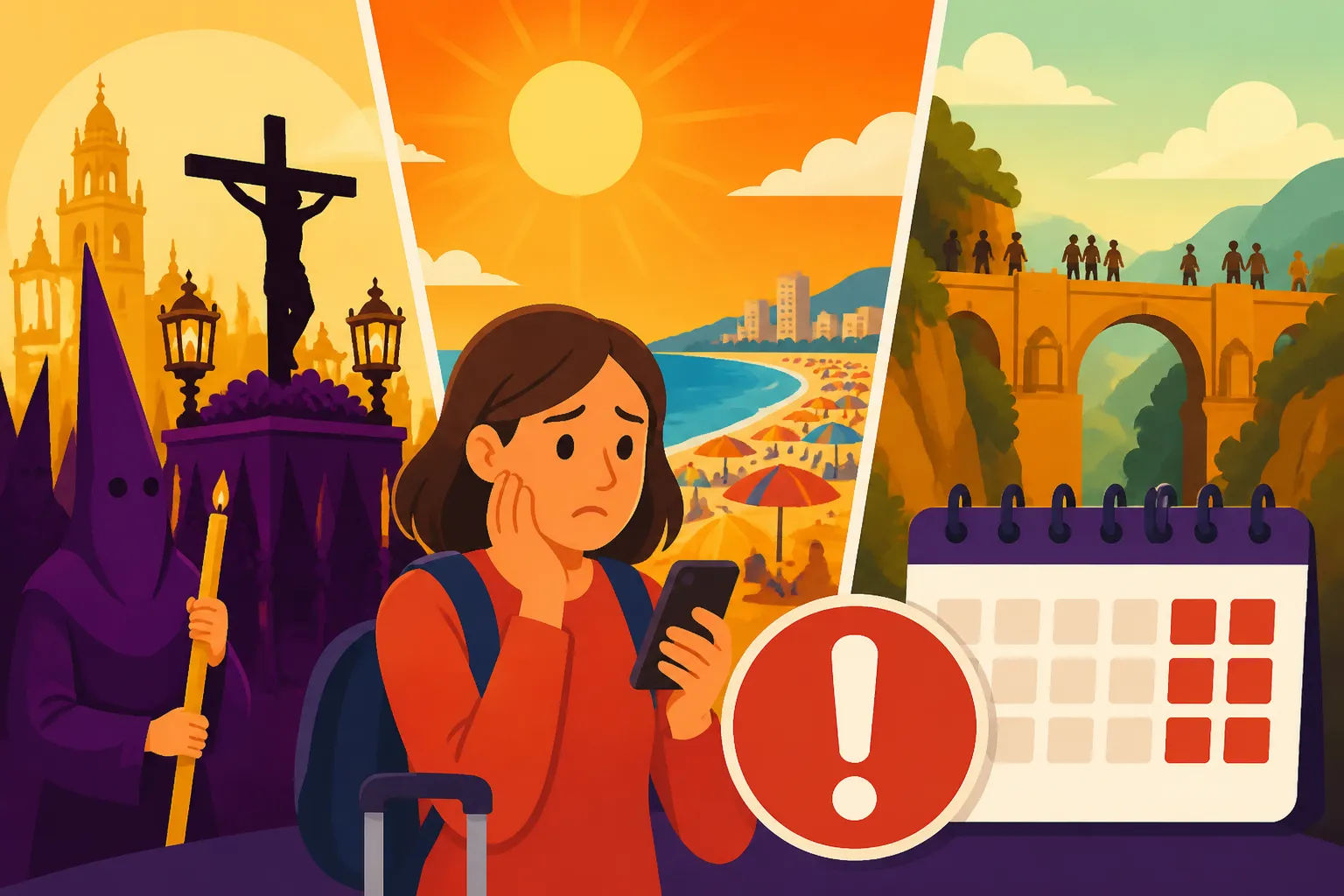
Semana Santa, August, and Puentes: Spain’s Worst Weeks to Book Late
Oh, Spain! The land of sun, siestas, and fiestas… which can quickly turn into a travel nightmare if you're not clued into the local calendar. Nothing sours the dream of exploring this beautiful country like finding out all the trains are inexplicably full, the hotels are triple the price, or worse, completely booked out, all because of some public holiday or tradition you never knew existed. This guide is here to save you from that very specific expat frustration, helping you navigate Spain's most notorious weeks for travel so you can plan smarter and smoother, especially with smart booking tools.
Disclosure: This post may contain affiliate links. We may earn a commission at no extra cost to you if you make a purchase through these links. Read full disclosure.
Semana Santa: The Religious Frenzy
If you've ever found yourself in Spain during Easter, you know it's a completely different beast than the quiet, chocolate-bunny-filled holiday back home. Semana Santa is deeply ingrained in Spanish culture, a solemn yet spectacular week of religious processions that sees towns and cities transform. But what might be a breathtaking cultural experience for some is a logistical nightmare for the unprepared traveler.
Understanding the Dates and Traditions
Semana Santa, or Holy Week, typically falls in late March or early April, leading up to Easter Sunday. The exact dates shift each year, so it's crucial to check the calendar well in advance. This isn't just a single holiday; it's an entire week (or even longer, depending on regional celebrations) of intense religious activity. Cities like Seville, Málaga, Granada, and Valladolid are world-renowned for their elaborate processions, where brotherhoods (cofradías) carry immense, ornate floats (pasos) depicting biblical scenes, accompanied by penitents in traditional robes and conical hoods. The atmosphere is thick with incense, somber music, and a palpable sense of devotion, attracting millions of visitors, both domestic and international.
But here's the kicker: many Spaniards take this entire week off, especially if it coincides with a puente (long weekend) or they've saved up vacation days. Families travel, friends reunite, and everyone descends upon the cities famous for their celebrations, or conversely, heads to the coast for a break before the full summer rush. This mass movement is what makes it so challenging for foreigners who aren't aware of the scale. You might think "Easter break," but Spaniards think "national travel event."
Travel Impact and Price Hikes
The sheer volume of people moving around Spain during Semana Santa causes a massive surge in demand for everything. Accommodation prices in popular destinations like Seville can skyrocket by 200-300%, and even then, finding a vacant room can feel like a quest for the Holy Grail if you haven't booked months ahead. Hostels, Airbnb rentals, and hotels fill up incredibly fast, often by late autumn of the previous year. You might find yourself scouring Booking.com or similar sites only to see "no availability" everywhere, or just a few obscure, overpriced options left.
Transport fares follow a similar trajectory. Train tickets, especially on high-speed AVE routes connecting major cities like Madrid, Barcelona, and Seville, sell out weeks, if not months, in advance. If you're hoping to spontaneously hop on a train from Madrid to Andalusia, forget about it. Buses, while often a more flexible and budget-friendly option, also experience extreme demand, leading to packed coaches and longer travel times. Even car rentals become scarce and expensive, and navigating the crowded streets and blocked routes due to processions in cities can be a nightmare. Trying to book last-minute often means paying extortionate prices or simply being stranded. Learn from my mistakes.
Navigating Semana Santa Travel
If your heart is set on experiencing Semana Santa, smart planning is your absolute lifeline. Your first step should be to check the exact dates and decide which city or region you want to visit. Then, book your accommodation at least six months in advance – seriously, no exaggeration. For transport, start looking for flights, trains, or buses as soon as tickets become available, usually three to four months prior. Platforms like Omio are incredibly useful here because they allow you to compare options across different modes of transport (trains, buses, flights) for your desired routes, which can save you a lot of time and potential headaches. By using Omio, you can see if flying is cheaper than a last-minute train ticket, or if a bus offers a viable alternative when trains are fully booked.
Consider staying in smaller towns just outside the main procession cities and commuting in, although even this can be a challenge with local transport during peak times. Alternatively, explore less famous, but equally authentic, Semana Santa celebrations in smaller towns, where crowds are thinner and prices slightly more reasonable. For instance, smaller towns in Castilla y León also have incredible, very traditional processions. If you absolutely must travel during this period, consider flying into smaller regional airports if possible and immediately booking onward travel. Don't underestimate the impact; it's a beautiful, moving experience, but it demands forethought.
August: The Great Spanish Exodus
Welcome to August in Spain, the month where the entire country seemingly decides to hit the beach, leave the cities, or simply disappear from their usual routines. As an expat, you'll quickly learn that August isn't just "summer"; it's the summer holiday for most Spaniards, and it dramatically changes the rhythm of life and travel.
Why August is Different
Unlike other countries where holidays might be staggered, in Spain, August is traditionally the month for a solid chunk of annual leave. Many businesses, especially smaller shops and services, operate on reduced hours, or close entirely for a few weeks, often with a sign saying "Cerrado por vacaciones" (Closed for holidays). Madrid and Barcelona, usually bustling hubs, become noticeably quieter, almost eerie in parts, as a significant portion of their populations decamp to coastal areas, cooler northern regions, or even abroad. This means that while some might enjoy the relative calm of a big city, many essential services might be harder to find, and the heat can be utterly relentless.
The main reason for this mass exodus is, quite simply, the weather. Inland cities like Madrid, Seville, and Córdoba can experience scorching temperatures well into the 40s Celsius (100s Fahrenheit), making daily life challenging and outdoor activities uncomfortable, if not dangerous. The allure of the refreshing sea breeze or the cooler mountain air becomes irresistible. Thus, millions of people simultaneously plan their escape, leading to predictable patterns of migration.
The Coastal and Island Crunch
This collective urge to escape the heat means that Spain's vast coastline and its beloved islands (the Balearics and Canaries) become incredibly popular – and expensive. Destinations like the Costa del Sol, Costa Brava, Valencia, Mallorca, Ibiza, and Tenerife swell with tourists, both Spanish and international. This influx translates into packed beaches, fully booked restaurants, and a constant battle for sun loungers and parking spots. If you’re looking for Quiet Beaches in Spain: Where to Escape the Crowds, August is definitively not the month.
Accommodation prices for anything near the sea can reach their absolute peak, often becoming unavailable entirely if you don't secure your booking months in advance. Imagine trying to find a decent family apartment in August along the Costa Blanca; it's virtually impossible without paying a premium or settling for something far from the beach. Flights to the islands, or popular coastal airports like Málaga and Alicante, become significantly more expensive and sell out quickly. Intercity buses and trains heading towards coastal destinations will also be at maximum capacity. Finding a car rental that isn't exorbitant or already taken becomes another major hurdle. I vividly remember trying to book a train to Valencia one August – every single high-speed connection was sold out for days, leaving me with a multi-leg, hours-long journey on regional trains. Platforms like Omio can be your savior, as they often show alternative routes and modes of transport you might not have considered, like connecting regional buses or less direct train lines, allowing you to compare train tickets against bus fares and even flights.
City Life Goes Quiet
While the coast bursts at the seams, the major inland cities experience a lull. Many local shops, particularly smaller, family-run establishments, close for the entire month. Imagine needing something specific only to find your favorite frutería (fruit shop) or hardware store shuttered for four weeks. This can be frustrating if you're reliant on local services. Even some larger businesses might run on skeleton staff or adjust opening hours.
Public transportation might operate on a reduced summer schedule, making commutes longer. While the tourist attractions in cities like Madrid and Barcelona remain open, they too can feel the pressure of the heat and the reduced local workforce. Finding parking, surprisingly, can be easier in the city center due to the exodus, but then you're faced with an inferno of heat radiating from the asphalt. For those who enjoy a slower pace and don't mind the heat, it can be a unique time to explore cultural sites with fewer local crowds, but expect a lot of international tourists. Don't forget your fan, rehydration salts, and to check your itinerary against Spanish Meal Times and Dining Etiquette Explained – some beloved spots might just be taking their own summer break!
Puentes: The Art of the Long Weekend
Spaniards are masters of the puente, literally "bridge," referring to those magical long weekends when a public holiday falls near a Saturday or Sunday. These aren't just isolated days off; they're opportunities for millions to travel, turning otherwise quiet weekends into miniature national migration events.
What Exactly is a Puente?
A puente occurs when a national or regional public holiday falls on a Tuesday or Thursday, allowing workers to take the intervening Monday or Friday off to "bridge" the gap, creating a four-day weekend. Sometimes, if a holiday falls on a Wednesday, many will take both Monday and Tuesday, or Thursday and Friday off, turning it into a spectacular five-day break. These are often unofficial but widely observed extensions of holidays.
Common puentes include those around Día de la Hispanidad (October 12th), All Saints' Day (November 1st), Día de la Constitución (December 6th), and Inmaculada Concepción (December 8th). When these two December holidays are close, it can even create an extra-long "mega-puente" or macropuente stretching for a full week, leading into Christmas. Each puente acts like a mini-August, but compressed into a few intense days, with a massive surge of people traveling simultaneously. The effect is particularly pronounced in urban areas, where city dwellers flee to their pueblos (hometowns), second homes on the coast, or popular rural tourism destinations.
Regional Variations and Surprises
One of the trickiest aspects of puentes is that not all holidays are national. Spain has a complex calendar of national, regional (autonomous community), and even local (municipal) holidays. So, while one region might be enjoying a puente, another might be business as usual. This regional variation means that travel patterns can be localized but no less intense. For example, the Día de Sant Jordi (St. George's Day) on April 23rd is a significant holiday in Catalonia, often leading to a puente if it falls favorably, drawing crowds to Barcelona for book and rose festivities.
This patchwork of holidays can catch unsuspecting expats off guard. You might be planning a quiet trip thinking it's a regular weekend, only to find that your destination is celebrating a local saint's day, and everything is either closed, fully booked, or swamped with visitors from nearby cities. It pays to consult a comprehensive calendar of Public Holidays in Spain: How They Affect Travel and Opening Hours for your specific region and destination before making any plans. Don't rely solely on national calendars; check the autonomous community's holiday schedule, too!
The Road to Gridlock and Booking Wars
The impact of puentes on travel is swift and severe. Roads leading out of major cities on the eve of a puente become notorious for gridlock, with traffic jams stretching for kilometers. Imagine leaving Madrid on a Thursday afternoon before a Friday puente – you could easily add an hour or two to a normally short drive. Renting a car also becomes a challenge, with availability dwindling and prices surging.
Just like with Semana Santa and August, trains and buses fill up incredibly fast. If you're planning to travel during a puente, you absolutely must book your tickets for any mode of transport well in advance. Again, I can't stress this enough: platforms like Omio become invaluable. They enable you to quickly check the availability and prices for buses, trains, and even flights all in one place. You can compare if a direct train from Madrid to Valencia is booked out but there's still a bus, or even a flight option if you're going further afield. The ability to see all these modes side-by-side on Omio helps you find any available slot, not just your preferred one, when options are scarce. Remember, during a puente, locals are competing for those spots too, so being proactive is key.
The Economics of Last-Minute Booking Failures
It's tempting to think you can always find a deal or squeeze into a last-minute slot, especially if you're used to more flexible travel markets. But in Spain, during these peak periods, a "last-minute booking failure" isn't just an inconvenience; it can be a budget-busting, stress-inducing ordeal.
Exorbitant Prices and Limited Choices
The basic principle of supply and demand hits hard during Semana Santa, August, and puentes. When millions of people are all trying to get to the same places at the same time, prices for everything inflate dramatically. Hotels, once affordable, suddenly demand luxury rates. A train ticket that would normally cost €30 could easily be €80-100, if you can even find one. This isn't just a slight increase; it's often a complete overhaul of standard pricing.
What's worse is the dwindling choice. You might be forced to compromise significantly on quality, location, or amenities. That charming boutique hotel? Long gone. The direct high-speed train? Forget it. You're left with either a room far from the action, a slow, convoluted multi-bus journey, or perhaps no option at all within your budget or desired timeframe. Many expats who've learned this the hard way will tell you that paying a little extra for early booking is a small price to pay for peace of mind and not being stuck with undesirable options.
The Domino Effect on Your Itinerary
A single missed booking or an unforeseen sold-out situation can have a cascading effect on your entire travel itinerary. Imagine you've planned a route through Andalusia during Semana Santa, hoping to see Seville, Granada, and Córdoba. If you can't get a train from Seville to Granada, your whole schedule falls apart. You might lose non-refundable deposits, miss out on attractions you've booked, or have to completely re-route, incurring significant extra costs and wasted time.
This domino effect is particularly frustrating for multi-city trips or those with fixed dates, such as connecting flights. Relying on last-minute availability during these notorious weeks is a gamble you'll almost certainly lose. It's not just about the cost of a single ticket; it's about the potential disruption and financial loss to your entire trip. For more guidance on managing travel finances, consider exploring Cost of Living in Spain: Realistic Budgets and Savings Tips.
The Mental Toll of Scrambling
Beyond the financial and logistical headaches, the stress of trying to scramble for last-minute bookings during peak Spanish holidays is immense. The constant refreshing of booking websites, the desperate calls to hotels, the feeling of being utterly defeated by the system – it's enough to make you want to just stay home. Many expats come to Spain seeking a more relaxed pace of life, and getting caught in this booking frenzy goes against that very ideal.
The mental exhaustion of not knowing if you'll be able to get where you need to go, or if you'll have a comfortable place to sleep, can overshadow the joy of the holiday itself. Being prepared alleviates this burden. It allows you to focus on the experience, whether it's the solemn beauty of Semana Santa, the vibrant beach life of August, or exploring a new town during a puente, rather than wrestling with logistics. This is where a reliable tool like Omio, which simplifies comparing travel options, can reduce a significant amount of anxiety by presenting clear choices.
Mastering Peak Season Travel with Smart Tools
Okay, so we've established the perils. Now, how do you actually master travel during these times and avoid becoming another cautionary tale? The answer lies in a combination of foresight, flexibility, and leveraging the right resources.
Your Best Friend: Early Planning (and Omio!)
I cannot emphasize this enough: plan early, book early. For Semana Santa, begin your research and bookings 6-8 months in advance for accommodation, and 3-4 months for major transport. For August, aim for 4-6 months out for coastal accommodation, and 2-3 months for flights/trains. For puentes, as soon as the holiday calendar is confirmed (usually a year in advance), mark the dates and start looking for transport and accommodation 2-3 months ahead.
This is precisely where multi-modal platforms like Omio shine. Instead of juggling tabs for Renfe, ALSA, Iberia, and various car rental sites, Omio consolidates all these options for trains, buses, and flights onto one user-friendly interface. You can input your origin and destination, and Omio will show you all available connections, their durations, and prices, allowing for easy comparison. Imagine you want to go from Madrid to Seville during a puente. Omio will show you if the AVE is already booked solid, but perhaps there's a bus option that's a bit longer but still available, or even a flight that, surprisingly, might be cheaper than a last-minute train ticket. It's about seeing the whole picture quickly to make an informed decision when demand is high and options are scarce. Use Omio to scout out options well in advance, giving you the best chance at securing reasonable prices and suitable travel times.
Exploring Alternative Destinations and Routes
Sometimes, even with early planning, popular destinations might be completely out of reach during peak weeks due to crowds or cost. This is your cue to get creative! Instead of Seville for Semana Santa, what about the equally traditional but less-hyped celebrations in Zamora or Cáceres? Rather than the packed beaches of Mallorca in August, perhaps explore the rugged beauty of Asturias or Galicia, where the weather is often milder and the crowds thinner.
Consider taking less direct routes or combining different modes of transport. For example, if a direct train from Madrid to Barcelona is full, could you take a regional train to a smaller town and then catch a bus from there? Omio's comprehensive search results can help you uncover these less obvious combinations, sometimes leading to more adventurous and rewarding travel experiences. Exploring Spain's Regions and Where to Go: A Traveler's Overview can give you ideas for these alternative, often charming, destinations that fly under the radar during peak times.
Leveraging Local Knowledge and Flexibility
Talk to your Spanish friends, colleagues, or other long-term expats. They are a treasure trove of information about local holiday customs, expected traffic, and even quieter spots to visit. They might know about a hidden beach, a less-traveled road, or a fantastic, family-run casa rural (country house) that isn't listed on major booking sites.
Building flexibility into your plans is also crucial. If you can, travel on the actual holiday itself rather than the day before, when everyone else is moving. For example, leaving on a Good Friday instead of a Maundy Thursday might mean fewer crowds and better availability for some routes. Being open to adjusting your dates by a day or two can make a huge difference in prices and availability. Remember, the goal is to enjoy Spain, not to fight its crowds! For general guidance, check out Traveling Around Spain: Trains, Buses, Flights, and Car Hire to better understand your transport choices.
Beyond the Busiest Weeks: Finding Your Sweet Spot
If the thought of battling crowds and inflated prices during Spain's peak weeks sends shivers down your spine, don't despair! Spain is a country that truly shines in its "shoulder seasons" and off-peak months, offering equally, if not more, rewarding experiences without the stress.
Embracing the Shoulder Seasons
The shoulder seasons – generally late April/May/early June and September/October – are arguably the best times to visit Spain. The weather is usually glorious: warm and sunny, but not oppressively hot. The major tourist attractions are open, but the overwhelming crowds of summer have either not yet arrived or have already dissipated. You can explore cities like Seville or Granada in comfortable temperatures, wander through charming pueblos blancos, or enjoy the beaches without having to fight for a spot.
Prices for flights and accommodation are significantly lower than in peak summer, making your travel budget stretch further. You'll find more availability for your preferred hotels and quieter train rides. Restaurants are less frantic, and you're more likely to get a table at that popular tapas bar without a long wait. Plus, you get to experience a more authentic side of Spanish life, as locals are back in their routine but still enjoying the pleasant weather. This is when you can truly appreciate the beauty of Spain without feeling rushed or overwhelmed. For a broader view, read Seasonal Spain: When to Visit and What's On.
Uncovering Off-Peak Charms
Even deep winter (November to February, excluding the Christmas/New Year period) has its charms, especially in Southern Spain. While it might not be beach weather, cities like Málaga, Cadiz, and Seville still enjoy mild temperatures, often hovering around 15-20°C (59-68°F) with plenty of sunshine. This is a fantastic time for cultural exploration, visiting museums, cathedrals, and historical sites without the oppressive heat or hordes of tourists. Accommodation deals are abundant, and transport is readily available.
Cities like Madrid and Barcelona also offer vibrant off-peak experiences, with their cultural calendars in full swing and a cozy, authentic atmosphere that is a stark contrast to the summer exodus. You can enjoy hearty traditional meals, explore lively markets, and experience the local nightlife. While some coastal resorts might be quieter, many smaller towns and cities maintain their charm year-round, offering a unique perspective on Spanish life. Plus, if you're into winter sports, Spain has excellent, often overlooked, ski resorts in the Sierra Nevada, Pyrenees, and Cantabrian Mountains.
The Joy of Spontaneity (When It's Safe)
While I've spent this entire guide warning against last-minute bookings during specific periods, Spain does offer immense joy for spontaneous travelers – just not during Semana Santa, August, or major puentes. Outside of these notorious windows, you can often find fantastic last-minute deals on accommodation and even some transport, particularly for buses or regional trains.
The flexibility to decide on a Friday morning to take a train to a new city for the weekend is a wonderful freedom, and outside of those peak times, it's often entirely possible. The key is knowing when to be rigid with your planning and when you can truly embrace the Spanish spirit of mañana (tomorrow, or "later," with a relaxed attitude). By understanding the calendar, you can strategically plan your major trips during the calmer periods, reserving those spontaneous adventures for the quieter, less stressful weeks. And remember, Omio can still be a handy tool for those spontaneous trips, allowing you to quickly check all your transport options from one place before you commit.
Spain's Peak Travel Periods at a Glance
To help you keep track, here's a quick overview of the periods to watch out for and some actionable advice.
| Peak Period | Typical Dates | Main Impact | Booking Advice |
|---|---|---|---|
| Semana Santa | Late March / Early April (varies annually) | High prices, sold-out hotels/transport in religious cities; general internal travel. | Book accommodation 6-8 months ahead; transport (trains, flights, buses) 3-4 months ahead. Use Omio to compare all options. |
| August | Entire month of August | Coastal/island areas packed & expensive; inland cities quieter but very hot. | Book coastal/island accommodation 4-6 months ahead; all transport (flights to islands, coastal trains/buses) 2-3 months ahead. Use Omio to find less direct routes. |
| Puentes | Occasional 3-5 day weekends throughout the year (e.g., May 1, Oct 12, Nov 1, Dec 6/8) | Roads jammed, popular destinations crowded, train/bus tickets sell out fast. | Check calendar early; book transport/accommodation 2-3 months ahead, especially for popular short-haul destinations. Omio is essential for checking last-minute alternatives. |
| Christmas/New Year | Mid-December to early January | High demand for city breaks and ski resorts; family travel. | Book 2-3 months ahead for popular destinations. |
| Major Festivals | E.g., Fallas (March), San Fermín (July) | Intense local impact on specific cities/regions, high accommodation prices. | Plan at least 6 months ahead for accommodation in the festival city; check Omio for transport. |
Disclaimer
The information provided in this guide is intended for general informational purposes only and does not constitute professional advice. While we strive to keep the content up-to-date and accurate, travel regulations, prices, and availability in Spain can change rapidly. Always consult official sources, check current travel advisories, and confirm details with service providers before making any travel plans or decisions. Personal experiences and specific situations may vary.