Reaching Gibraltar From Spain: Transport and Border Realities
Picture it: you are on the Costa del Sol, the Rock looms on the horizon, and you assume getting there is a quick hop. Then you learn there is no train into Gibraltar, the border queue can swallow an afternoon, and your phone suddenly starts roaming. This guide covers every realistic route to Gibraltar from Spain, the border itself, and how to book the journey without stress.
Disclosure: This post may contain affiliate links. We may earn a commission at no extra cost to you if you make a purchase through these links. Read full disclosure.
Getting to the Gibraltar Border From Spain: Your Real Transport Options
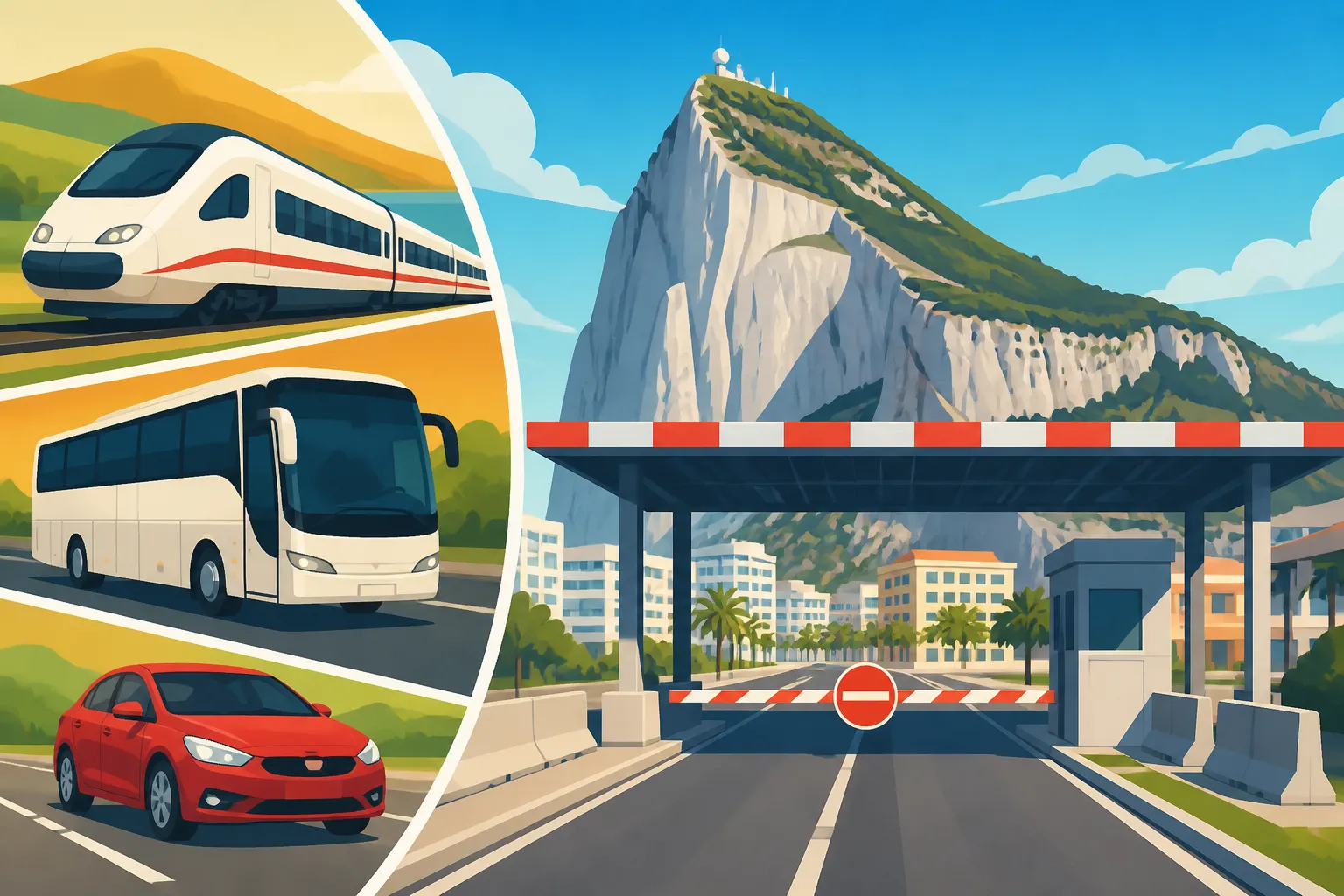
The first time I went to Gibraltar, I spent half an evening trying to book a train “to Gibraltar.” There isn’t one. Gibraltar is a British Overseas Territory with its own government, currency and border. No Spanish rail line crosses into it. Every land journey ends at the same place: the Spanish town of La Línea de la Concepción, which sits right against the frontier. You walk, drive or take a taxi across from there.
Once you plan around La Línea and not Gibraltar itself, everything gets simpler. The aim is to reach La Línea, or a transport hub close to it, as smoothly as possible. Omio is especially useful here because it shows buses, trains and flights side by side for that final approach. It is hard to see that bigger picture when you are bouncing between individual operator websites.
Taking the Bus to La Línea de la Concepción
For most travellers, the bus is the most direct way to reach the border. La Línea has its own bus station, a short walk from the frontier crossing. Regional coaches arrive there from:
- Málaga, Marbella and Estepona along the coast.
- Cádiz and Seville to the west and north.
- Algeciras, the nearby port city across the bay.
When you step off, you are within walking distance of passport control. No transfers, no taxis, no guesswork.
The catch is that these routes are run by different regional operators. Timetables also change between summer and winter, and Sunday services thin out. Search Omio for “La Línea de la Concepción” as your destination and you get the operators serving that route on your date in one list. You can then pick a departure that leaves you enough daylight to enjoy the Rock.
If you are deciding between coach companies for longer legs elsewhere in Spain, see ALSA vs FlixBus in Spain: Comfort, Price, and Route Coverage. For Gibraltar specifically, filtering by destination on Omio usually tells you more than any single operator’s brand.
Taking the Train: San Roque and Algeciras
Rail fans can still get close. Renfe trains run along the line that ends in Algeciras, with a stop at San Roque-La Línea along the way. Those trains connect with the wider network through Antequera and Ronda, so you can travel from Madrid or Granada towards the Bay of Gibraltar with a change en route.
Despite the name, San Roque-La Línea station is not at the border. You still need a taxi or a local bus to reach La Línea and the frontier. From Algeciras, regular buses run around the bay to La Línea. The ride is pleasant, with constant views of the Rock getting bigger, but you need to allow time for it.
The train makes the most sense when you are coming from inland Andalusia or further away and want to avoid a long coach ride. Ronda to Algeciras is one of the most scenic lines in southern Spain. On Omio you can compare the train-plus-bus combination with a direct coach and see which gets you to La Línea sooner on your chosen day. Sometimes the slower-looking option wins because the connection times line up better.
Driving or Flying to Gibraltar
Driving gives you flexibility, especially if you are touring Andalusia. Before you set off, check one thing: does your rental agreement allow you to take the car into Gibraltar? Gibraltar sits outside the EU’s customs territory, and some rental companies restrict cross-border trips or require extra cover. Renting a Car in Spain: Requirements, Insurance, and Driving Tips explains what to look for in the small print.
Inside Gibraltar, traffic drives on the right, just as it does in Spain, so you do not have to switch sides at the frontier. The real driving problem is the queue. Vehicle lines at the border can be long and unpredictable, especially at commuter times and on busy weekends. Many drivers park in La Línea and walk across instead.
Flying is a niche option. Gibraltar International Airport mainly serves flights to the United Kingdom, so it suits British visitors more than people already in Spain. Most international travellers fly into Málaga and continue by road. If that is your plan, see Reaching the Costa del Sol: Malaga Airport Connections Explained for the onward leg. Omio can line up the flight and the coach from Málaga towards La Línea in a single search.
Gibraltar Transport Options Compared
| Option | Where It Drops You | Border Walk Needed | Best For | Main Drawback |
|---|---|---|---|---|
| Coach to La Línea | La Línea bus station | Short walk | Day-trippers from the coast, Cádiz or Seville | Reduced Sunday and off-season timetables |
| Train to San Roque-La Línea | San Roque area | Taxi or bus, then walk | Travellers from inland Andalusia or Madrid | Station is not at the border |
| Train to Algeciras plus bus | Algeciras, then La Línea | Bus, then short walk | Rail travellers combining Gibraltar with ferries | Extra transfer adds time |
| Driving into Gibraltar | Gibraltar itself | None | Families and those with heavy luggage | Long vehicle queues and rental restrictions |
| Driving and parking in La Línea | La Línea car parks | Short walk | Drivers who want to skip the vehicle queue | Parking costs and finding a space |
| Flight to Gibraltar Airport | Gibraltar itself | None | Visitors arriving from the UK | Very limited route network |
Crossing the Gibraltar Border: Documents, Queues and Customs
The frontier between La Línea and Gibraltar is a real international border, and it feels like one. You will pass through passport control and customs on both sides. That surprises people who are used to drifting between European countries without noticing.
Documents and the Schengen Question
Bring your passport. EU citizens may be able to use a national ID card, but a passport is the safest choice for everyone. Gibraltar has its own entry rules, which are separate from Spain’s. Some nationalities need a Gibraltar visa even if they hold a Schengen visa. Check the Government of Gibraltar’s official guidance for your nationality before you travel.
The bigger trap involves Schengen. Gibraltar is outside the Schengen Area. When you walk into Gibraltar, you are leaving Schengen, and when you walk back into La Línea, you are re-entering it. For non-EU travellers this has real consequences:
- If you hold a single-entry Schengen visa, crossing into Gibraltar uses up that entry. You may not be allowed back into Spain.
- Your passport may be stamped on exit and entry, and those stamps form part of your travel record.
- Days you spend in Gibraltar are days outside the Schengen Area. Your Spain stamps need to reflect that accurately.
If you are juggling a longer stay, see Spain Schengen Rules: 90/180 Day Rule Explained for Spain. British travellers should also read Spain Visa Guide for UK Citizens: Tourist, Study & Work Basics. Border arrangements between Gibraltar and Spain have been the subject of ongoing UK-EU talks, so always check the latest official rules from both governments shortly before your trip.
Walking Across Versus Driving Across
I almost always walk. Here is why.
Pedestrian lanes generally move faster than the vehicle queue. The car line, by contrast, can stretch back into La Línea’s streets, especially on weekday afternoons when thousands of cross-border workers head home. Once you are through on foot, you can stroll into Gibraltar’s town centre or catch a local bus from near the frontier.
Depending on your route in, you may be held briefly while aircraft use the airport runway, which sits right next to the frontier. It is an odd experience, but these pauses are short.
Driving makes sense when:
- You are travelling with small children, elderly relatives or mobility needs.
- You want to explore Europa Point or the Upper Rock with your own wheels.
- You are carrying luggage because you are staying overnight.
If you drive, try to cross early in the morning and come back before the late-afternoon rush. Keep your documents on the passenger seat, not buried in a bag in the boot.
Customs on the Way Back Into Spain
Gibraltar has lower duties on tobacco, alcohol and some goods, so Spanish customs pay close attention to what comes back across the border. There are strict allowances on cigarettes, tobacco and spirits. Spanish officers do inspect bags and vehicles, and going over the limit can mean confiscation and fines.
My rule is simple: buy for yourself, not for the whole family back home. If you plan to pick up anything beyond a souvenir, check the current Spanish customs allowances on the Agencia Tributaria’s official website before you shop. Keep receipts for anything valuable, such as electronics or jewellery.
Once You Are Inside Gibraltar: Getting Around and Practical Differences
Stepping through the frontier is a jolt. Red post boxes, British-style shopfronts, English on every sign. Yet you also hear Spanish and Llanito, the local mix of English and Andalusian Spanish, on every street corner. It is a unique place, and a few practical differences catch visitors off guard.
Getting From the Frontier to Town and the Upper Rock
From the frontier, you can walk into the centre in roughly the time it takes to finish a podcast episode. You will reach Casemates Square, the lively main square and the gateway to Main Street. Local buses also run from near the frontier into town if you would rather save your legs for the Rock.
For the Upper Rock Nature Reserve, you have three main choices:
- The cable car from the bottom of the Alameda Gardens area takes you up quickly, with spectacular views.
- Organised minibus tours cover the main sights in one loop: St Michael’s Cave, the Great Siege Tunnels and the famous Barbary macaques.
- Walking up is a serious climb, best done on a cool morning with plenty of water.
A word on the macaques: they are wild animals. Do not feed them, keep food out of sight, and hold onto sunglasses and phones. I have watched a macaque unzip a tourist’s backpack with the confidence of a pickpocket in Barcelona.
Money, Phones and Plugs
Gibraltar uses the Gibraltar pound, which is at par with the British pound. Sterling notes circulate freely. Many shops accept euros, but they often give change in pounds and set their own exchange rate. Gibraltar-issued notes can be hard to exchange once you are back in Spain, so spend them before you leave. Paying by card is usually simplest. When a terminal offers to charge you in euros or your home currency, choose to pay in the local currency instead. Avoiding Dynamic Currency Conversion (DCC) at Spanish ATMs and Terminals explains why.
Phones are the sneakiest problem. Gibraltar is not part of the EU roaming area, so a Spanish or other EU SIM can rack up roaming charges once it connects to a Gibraltar network. Spanish signals often reach the border area, and your phone may jump between networks without warning. Before you cross:
- Check whether your plan includes Gibraltar. Many EU plans do not, and some UK plans do.
- Consider selecting a Spanish network manually while you are near the frontier.
- Download offline maps and your return tickets before you cross.
- Turn off mobile data if your plan does not cover Gibraltar, and rely on Wi-Fi in cafés.
For more on how roaming works across borders, see eSIM vs EU Roaming: What EU Citizens Actually Pay Using Their Home SIM in Spain.
Gibraltar uses UK-style three-pin plugs, not the two-pin sockets found in Spain. If you stay overnight, pack an adapter. It is a small thing that makes for a frustrating evening when your phone is on two percent and every socket looks wrong.
Combining Gibraltar With the Wider Region
Gibraltar slots neatly into a bigger trip around the Strait. Algeciras, across the bay, is one of Spain’s busiest ferry ports, with sailings to Morocco and to Ceuta. Many travellers do Gibraltar one day and Tangier the next. Spain to Morocco: Ferry Crossings From Algeciras and Tarifa covers the crossings, and Ceuta and Melilla: How to Actually Get There From Mainland Spain explains Spain’s North African cities.
For a base, staying in Gibraltar itself can be expensive. Plenty of visitors stay on the Spanish side or further along the coast. Where to Stay in Marbella and Estepona: Costa del Sol Comparison and Where to Stay in Cadiz and Jerez: Andalusian Coast Options are both good starting points for a comfortable base with easy bus links to La Línea.
How to Plan and Book Your Gibraltar Trip With Omio
After many trips to the Rock, I have settled on a routine that keeps things calm. Omio sits at the centre of it, because the hard part of reaching Gibraltar is not any single journey. It is stitching together buses, trains and sometimes flights from different operators. One search that shows every mode heading towards La Línea or Algeciras saves a surprising amount of time and second-guessing.
Step-by-Step Booking Routine
- Set your destination as La Línea de la Concepción, not Gibraltar. If you are combining the trip with a ferry, use Algeciras.
- Search Omio for your departure city and date, and compare coaches, trains and flight-plus-coach combinations in the results.
- Look at arrival times, not only journey length. Aim to reach the border by mid-morning so you have a full day on the Rock.
- Check the last return departure from La Línea before you book the outbound leg. Evening and Sunday services can end earlier than you expect.
- Book your outbound and return journeys and keep the mobile tickets in the Omio app. Download them before crossing so you are not relying on roaming data.
- Pack your passport, a UK plug adapter and a card that works abroad. If your card is declined, see Paying for Spanish Transport With a Foreign Card: Declines and Fixes.
- On the day, walk across the border, explore, and head back with a comfortable margin before your return departure. Allow extra time for the queue into Spain.
Sample Day Trip Plans
From Málaga by coach. Take a morning coach to La Línea bus station, walk across the border and head straight up the Rock while it is cool. Spend the afternoon on Main Street and catch an early-evening coach back. Book both legs on Omio in advance during peak season, when popular departures fill up.
From Seville by train and bus. Take the train south towards Algeciras with a change en route, then the local bus around the bay to La Línea. It is a long day, so many people stay one night in La Línea or Algeciras. Omio lets you compare this rail option with a direct coach from Seville on the same screen.
From the Costa del Sol by car. Drive to La Línea early, park in one of the car parks near the frontier and walk across. You skip the vehicle queue in both directions and save yourself a lot of stress. Note your parking location and closing times before you leave the car.
Why This Approach Works
Reaching Gibraltar rewards preparation. Know that the journey ends at La Línea. Carry the right documents. Respect the customs limits, and keep an eye on your phone settings. Do that, and the trip becomes one of the most memorable days you can have in southern Spain.
Let Omio handle the transport puzzle. Plan your Gibraltar trip on Omio today: search La Línea de la Concepción, compare every coach, train and flight connection, and walk up to that border knowing exactly how you are getting home.
Disclaimer
This article is for general informational purposes only and does not constitute professional advice. Laws, prices and regulations vary by location and change over time. Consult a qualified professional for guidance on your specific situation.