How to Plan a Visit to Spain’s UNESCO Sites
Most first-time planners make the same mistake with Spain’s World Heritage list. They pin the famous names onto a map and only later find that the Alhambra sold out weeks ago, that Mérida sits far from the high-speed rail they assumed it was on, and that August turns Córdoba’s patios into an oven. This guide shows you how to choose sites, group them into a realistic route, and handle tickets and timing.
Disclosure: This post may contain affiliate links. We may earn a commission at no extra cost to you if you make a purchase through these links. Read full disclosure.
Understanding Spain’s UNESCO World Heritage List Before You Plan
What the 50 Sites Actually Include
Spain has 50 UNESCO World Heritage properties. Four are natural sites and two are mixed sites, so the large majority are cultural. The most recent addition, Talayotic Menorca, was inscribed in 2023 and recognises the island’s prehistoric stone settlements.
The number itself can mislead you. A “property” is sometimes a single building, such as Burgos Cathedral or the Vizcaya Bridge near Bilbao. Sometimes it is an entire old town, such as Toledo, Salamanca, Cáceres or Cuenca. Sometimes it spreads across many sites, even several regions. The Routes of Santiago de Compostela, the Palaeolithic cave art of Northern Spain and the Mudéjar architecture of Aragon are all examples of that last type.
I learned this the hard way on my first trip north. I set aside a morning for “the Altamira site.” I then found that the inscription covers caves scattered across Cantabria, Asturias and the Basque Country, and that the original cave has extremely restricted access. Most visitors see the replica at the museum instead.
Before you list anything, read the official description of each property you care about. You need to know whether you are planning around one ticketed monument, a walkable historic centre or a landscape you will need a car to see. Our overview, Spain’s UNESCO World Heritage Sites: A Visitor’s Guide, walks through the full list region by region if you want the wider picture first.
The Natural and Mixed Sites Most Travellers Overlook
The four natural properties are very different from the cathedral-and-castle circuit:
- Doñana, the wetlands of western Andalusia.
- Teide National Park on Tenerife.
- Garajonay on La Gomera, a misty laurel forest.
- The ancient beech forests, a transnational listing that includes Spanish woodland.
The two mixed sites combine nature and culture. One is Ibiza’s biodiversity and culture listing, which covers seagrass meadows and the fortified old town of Dalt Vila. The other is Pyrénées–Mont Perdu, shared with France.
These sites reward a different kind of planning. Doñana is best seen with an authorised guided excursion, because much of the park cannot be entered independently. Teide’s summit cable car and the separate summit permit are in heavy demand. Garajonay needs a ferry from Tenerife and ideally a full day of hiking.
If you are combining a city break with a nature site, budget at least one extra travel day for each one. Trying to “squeeze in” Doñana between Seville’s cathedral and a train to Madrid is the kind of plan that looks fine on paper and falls apart at 7 a.m. at a deserted bus stop.
Choosing Your Priorities Honestly
Nobody sees all 50 sites on one trip, and you should not try. A useful exercise is to rank your interests:
- Moorish and Islamic heritage: Granada, Córdoba and Seville.
- Roman Spain: Mérida, Tarragona, Segovia’s aqueduct and Lugo’s walls.
- Modernist architecture: Gaudí’s works and the Palau de la Música Catalana in Barcelona.
- Medieval and Renaissance towns: Toledo, Ávila, Salamanca, Úbeda and Baeza.
- Prehistory: Atapuerca, the Antequera Dolmens and Menorca’s talayots.
Then pick one or two themes and let geography decide the rest. A traveller I met in Salamanca had planned a ten-day trip around “every UNESCO city.” He was exhausted by day four and admitted he could no longer tell the cathedrals apart. Depth beats a checklist every time.
Grouping Sites Into a Realistic Route
Regional Clusters That Make Sense
Spain is big. Its high-speed rail network is excellent along certain corridors and thin elsewhere. The smartest approach is to pick a base city for each cluster and do day trips from there.
| Cluster | Main Sites | Good Base | Typical Transport | Planning Note |
|---|---|---|---|---|
| Central Spain | Toledo, Segovia, Ávila, El Escorial, Aranjuez, Alcalá de Henares, Paseo del Prado and Retiro | Madrid | High-speed and regional trains, buses | Ideal for day trips without a car |
| Andalusia | Alhambra, Córdoba’s historic centre, Seville’s Cathedral and Alcázar, Medina Azahara, Úbeda and Baeza, Antequera Dolmens | Seville or Granada | AVE trains between main cities, buses for smaller towns | Alhambra tickets drive the whole schedule |
| Extremadura | Mérida, Cáceres, Guadalupe Monastery | Mérida or Cáceres | Bus or rental car | Rail is slow; a car saves real time |
| Catalonia and Valencia | Gaudí’s works, Palau de la Música, Sant Pau, Tarragona, Poblet, Valencia’s Silk Exchange, Elche’s Palm Grove | Barcelona or Valencia | Coastal and high-speed trains | Gaudí sites need timed entry |
| Northern Spain | Burgos Cathedral, Santiago de Compostela, Tower of Hercules, Lugo walls, Oviedo monuments, cave art, Vizcaya Bridge | Burgos, Santiago or Bilbao | Mix of train, bus and car | Distances feel longer than they look |
| Islands | Teide, Garajonay, San Cristóbal de La Laguna, Risco Caído, Ibiza, Tramuntana, Talayotic Menorca | Tenerife, Gran Canaria, Mallorca or Menorca | Flights, ferries, rental car | Treat each island as its own mini-trip |
Madrid is the easiest base for beginners. Toledo and Segovia are both manageable as day trips, and you can read our step-by-step guides on How to Visit Toledo From Madrid in a Day and How to Visit Segovia From Madrid by Train before booking anything.
Building the Route Step by Step
Here is the order I recommend working through. Most problems come from doing these steps backwards.
- Lock in the hardest ticket first. For most people this is the Alhambra, since Nasrid Palaces entry is timed and sells out. Barcelona’s Sagrada Família is the other usual bottleneck.
- Build your dates around that fixed slot. Plan the arrival into Granada or Barcelona the day before, not the same morning.
- Add your base cities. Choose one base per cluster and aim to stay at least two or three nights in each.
- Check how each day trip actually connects. Confirm whether a high-speed line exists or whether you are relying on a regional bus with limited departures.
- Book long-distance trains once the dates are fixed. Fares on popular routes often rise as departure approaches.
- Add accommodation last. Choose it based on walking distance to the sites, not just price.
- Leave one buffer day per week. Strikes, closures and simple fatigue happen.
For rail planning, comparison platforms such as Omio are handy at the early stage. They let you see Renfe, Iryo, Ouigo and bus options side by side, so you can tell which day trips are realistic before you commit. Our guide on How to Plan a Spain Itinerary by Train goes deeper into corridor-by-corridor logic.
Where a Car Changes Everything
Some UNESCO properties are almost impractical without a car. Las Médulas, the Roman gold-mining landscape in León province, is one. So are the Vall de Boí Romanesque churches in the Pyrenees, the Tramuntana mountains on Mallorca and Risco Caído in the highlands of Gran Canaria.
Extremadura is a similar story. Mérida’s Roman theatre, amphitheatre and bridge are wonderful, but trains into the region are slow and infrequent. Many travellers combine a car with Mérida, Cáceres and the Guadalupe monastery, then drop the car before heading back to the rail network. If Roman sites are your focus, How to See Roman Ruins in Spain (Mérida and Beyond) covers the logistics in more detail.
My honest advice: do not rent a car for the city sites. Parking in old towns like Toledo or Santiago is restricted and stressful, and most historic centres are best on foot. Rent only for the rural stretches.
Tickets, Timing and Making the Most of Each Visit
Booking Entry Without Overpaying
Ticket systems vary widely. The Alhambra, the Mosque-Cathedral of Córdoba, Seville’s Alcázar, the Sagrada Família, Casa Batlló and Casa Milà all use timed or capacity-controlled entry. A walkable old town like Ávila or Cáceres is free to wander, with individual monuments charging separately.
Always start with the official website of each monument. That is where you will find current prices, opening hours, concession rules and any free-entry periods. Resale sites sometimes list tickets at a large markup, and some sell “skip the line” tours that simply include a regular ticket you could have bought yourself. For the trickiest booking of all, read How to Get Tickets for the Alhambra in Granada before you choose your Granada dates.
Guided tours do have their place. If official tickets are gone, or you want context at a complex site like Medina Azahara or the Roman ensemble of Tarragona, booking platforms such as GetYourGuide list guided visits that include entry. Compare what the tour adds, whether that is a licensed guide, transport or bundled entry, against the official ticket price before you pay.
Some museums and monuments also have free or reduced entry at certain times. The Paseo del Prado listing includes the Prado itself, so How to Find Free Museum Days in Spanish Cities is worth reading if you are on a budget.
Choosing the Right Season and Time of Day
Timing matters as much as tickets. Southern Spain in high summer can be brutally hot. Córdoba, Seville and Mérida are regularly among the hottest places in the country, and much of the Alhambra visit is outdoors. If summer is your only option, read Is It Too Hot to Visit Southern Spain in August? and plan your outdoor sites for early morning.
Spring and autumn are the sweet spots for most of the country. Be aware, though, that Semana Santa and local fiestas can fill accommodation in Seville, Córdoba and Granada and change opening hours at religious sites. Northern sites like Santiago, Oviedo and Burgos are more comfortable in summer, but rain is a real factor much of the year.
On site, the first entry slot of the day is almost always the calmest. At Córdoba’s Mosque-Cathedral the early morning makes a dramatic difference. Our guide on How to See Córdoba’s Mezquita Without the Queues explains how to plan around crowd peaks.
Practical Etiquette and On-Site Tips
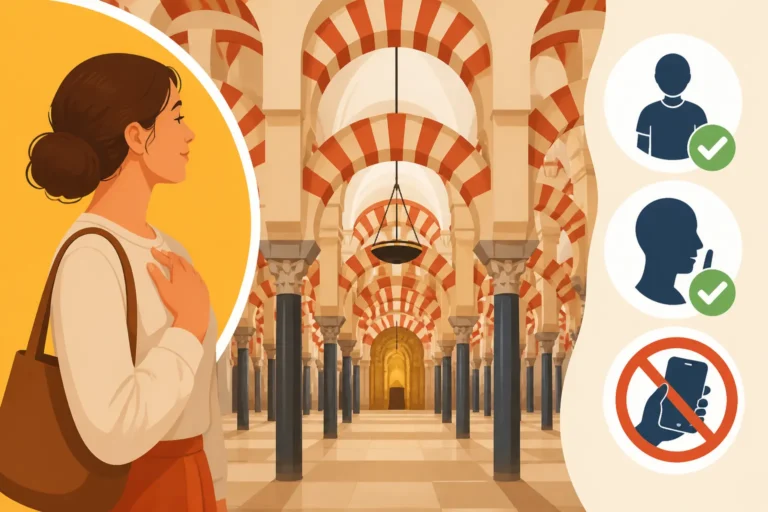
Many of Spain’s UNESCO properties are still active places of worship. These include the cathedrals of Burgos, Seville, Toledo and Santiago and the Mosque-Cathedral of Córdoba. Expect covered shoulders to be appreciated, quiet voices during services and occasional closures for Mass or religious events. See How to Dress for Churches and Religious Sites in Spain for what is generally expected.
A few habits will make every visit smoother:
- Carry your passport or ID. Named tickets at the Alhambra and some other sites are checked against it.
- Bring water and a hat for outdoor archaeological sites. Shade at places like Medina Azahara or Mérida’s theatre is limited.
- Check the official site for luggage rules. Large bags are often not allowed inside monuments.
- Download audio guides or site maps before you arrive. Mobile signal inside thick-walled buildings can be patchy.
- Allow more time than you think. The Alhambra and the Alcázar of Seville each easily fill half a day.
Choosing Where to Stay Near the Sites
Location saves more time than any other decision. In Granada, staying within walking distance of the Alhambra, or near a reliable bus stop up the hill, means you are not racing a taxi to make your Nasrid Palaces slot. Our comparison of Where to Stay in Granada: Albaicin vs Centro for Alhambra Access lays out the trade-offs.
When I search for accommodation in historic towns, I use the map view on Booking.com to filter for properties inside or right beside the old walls. That matters most in Toledo, Cáceres or Ávila, where evenings after the day-trippers leave are the real reward. Check the listing for lift access and parking details carefully, because old-town buildings often have steep stairs and no vehicle access.
If you remember one thing, make it this: let the hardest ticket set your dates, let geography set your route, and let each base city give you enough time to enjoy the places rather than just collect them.
Disclaimer
This article is for general informational purposes only and does not constitute professional advice. Laws, prices and regulations vary by location and change over time. Consult a qualified professional for guidance on your specific situation.