Spain’s UNESCO World Heritage Sites: A Visitor’s Guide
Trying to navigate Spain’s massive list of 50 UNESCO World Heritage sites can feel like staring at an endless tapas menu when you’re already starving—it is completely overwhelming. I remember my first year living here, spending hours on confusing regional transit websites just to see one cathedral, only to find out tickets were sold out weeks in advance. This guide solves that frustration by breaking down the must-see sites with the practical, boots-on-the-ground logic you need to actually enjoy them without the logistical headaches.
Disclosure: This post may contain affiliate links. We may earn a commission at no extra cost to you if you make a purchase through these links. Read full disclosure.
Planning Your UNESCO Journey Across Spain
When you first arrive in Spain, it’s tempting to try and "collect" as many UNESCO sites as possible in a single week. I made this mistake early on, rushing from Toledo to Segovia and ending up with a blur of stone arches and sore feet. Spain has the fourth-highest number of UNESCO sites in the world, and they are spread across diverse landscapes, from the humid forests of the north to the arid plains of Andalusia. To see them properly, you need a strategy that respects the distances and the distinct rhythms of each region.
Logistics and Transport Between Regions
The backbone of any heritage-focused trip in Spain is the rail network. For the long hauls between Madrid, Seville, and Barcelona, the high-speed AVE trains are a lifesaver. You can find detailed breakdowns on how to navigate this in my guide on High-Speed Trains in Spain (AVE): Routes, Booking, and Savings. However, for many of the more remote UNESCO sites, like the Roman mines of Las Médulas or the monasteries of San Millán de Yuso, the train won't get you all the way there.
In these cases, it is wise to check Omio to compare bus and train routes side-by-side. Sometimes a regional Alsa bus is actually more direct than a train that requires three transfers. If you are planning a multi-city heritage tour, booking your transit at least a few weeks in advance is essential, especially during the "Puentes" (long weekends) when locals flock to these historic towns. If you're coming from abroad, you might also want to look into Domestic Flights in Spain: When They Beat the Train for those long jumps from the mainland to the UNESCO sites in the Canary or Balearic Islands.
Booking Accommodations Near Historic Centers
One of the biggest lessons I’ve learned is that staying "near" a UNESCO site and staying "within" the historic district are two very different experiences. In cities like Toledo or Cáceres, the historic centers are often pedestrianized or have extremely narrow, winding streets. If you book a hotel on the outskirts to save twenty euros, you might spend that much on taxis just trying to get to the monuments.
I usually use Booking.com to filter for properties specifically within the "Old Town" or "Casco Antiguo." This allows you to experience the sites after the tour buses have left for the day. There is nothing quite like walking through the empty, moonlit streets of Santiago de Compostela or Segovia. For more on how to navigate these choices, check out How to Choose Between a Hotel and an Apartment in Spain. Just keep in mind that older buildings in these districts might not always have elevators, so if you have heavy luggage, check the property details carefully.
Ticketing and Guided Tours Strategy
The era of just showing up and buying a ticket at the gate for Spain’s major monuments is largely over. For heavy hitters like the Alhambra in Granada or the Sagrada Família in Barcelona, you need to book weeks, if not months, in advance. Many travelers end up standing dejectedly outside the Alhambra ticket office because they didn't realize the daily limits are strictly enforced.
If the official sites are sold out, I often turn to GetYourGuide to find authorized guided tours that include entry. Sometimes paying a bit extra for a guide is the only way to secure a last-minute slot, and honestly, at sites with this much history, having someone explain the symbolism of a Moorish arch or a Gothic gargoyle makes the experience ten times more meaningful.
The Moorish Legacy and Al-Andalus Treasures
The period of Al-Andalus left a mark on Spain that is unlike anything else in Europe. This Islamic heritage is centered primarily in Andalusia, and it represents a "Golden Age" of architecture, science, and philosophy. Visiting these sites isn't just about looking at pretty buildings; it’s about understanding a complex history of coexistence and conflict that defined the Iberian Peninsula for eight centuries.
The Alhambra Generalife and Albayzín in Granada
The Alhambra is the crown jewel of Spain’s UNESCO sites. It is a sprawling fortress-palace complex that sits on a hill overlooking Granada, with the snow-capped Sierra Nevada mountains as a backdrop. Inside, the Nasrid Palaces feature intricate stucco work and tile patterns that seem to defy the laws of physics. It’s important to understand that your ticket will have a specific time slot for the Nasrid Palaces; if you miss that window, you aren't getting in, even if you have a general admission ticket for the rest of the grounds.
Across the valley lies the Albayzín, the old Moorish quarter. This is also part of the UNESCO designation. I highly recommend spending an afternoon getting lost in its steep, narrow "callejones." The view of the Alhambra from the Mirador de San Nicolás at sunset is a rite of passage for any traveler. For practical advice on navigating this specific city, I’ve put together a guide on What Are the Must-See Towns in Andalusia for a First Visit?. Just be prepared for a lot of walking on cobblestones.
The Historic Center of Córdoba and the Mezquita
If the Alhambra is about delicate beauty, the Mezquita (Great Mosque-Cathedral) of Córdoba is about pure, overwhelming scale. Walking into the forest of red-and-white striped arches is a disorienting, spiritual experience. What makes this site unique is that a Renaissance cathedral was built right in the middle of the mosque after the Reconquista. It is a physical manifestation of Spain’s layered history.
The surrounding Jewish Quarter (La Judería) is also part of the UNESCO site and is famous for its flower-filled patios. If you visit in May, you can catch the Patios Festival, which is an intangible heritage experience in itself. Because Córdoba can get incredibly hot, I suggest reading How to Hike Safely in Spain's Summer Heat—even if you aren't hiking, the advice on staying hydrated and timing your walks is vital for exploring Córdoba’s stone-paved streets in July.
Seville’s Cathedral Alcázar and Archivo de Indias
Seville offers a "triple threat" of UNESCO sites all clustered together in the heart of the city. The Cathedral is the largest Gothic building in the world and houses the tomb of Christopher Columbus. Right next door is the Real Alcázar, a royal palace that is still used by the Spanish royal family today. It’s a stunning example of Mudéjar architecture—a style where Christian kings employed Muslim craftsmen to build their palaces.
The third part of the trio is the Archivo de Indias, which holds the precious documents of the Spanish Empire’s overseas history. Many people skip the Archivo, but it’s free to enter and offers a quiet, cool escape from the crowds. If you’re planning a weekend here, check out How to Spend a Weekend in Seville for a logical itinerary that hits all three without causing "monument fatigue."
Architectural Marvels of Central and Northern Spain
While the south is defined by its Moorish past, the center and north of Spain showcase the grandeur of the Roman Empire, the Romanesque period, and the unique genius of the 20th century. These sites often feel more "European" in their architectural DNA, but they always carry that specific Spanish flair for the dramatic.
The Old City of Salamanca and Its Universities
Salamanca is known as "La Ciudad Dorada" (The Golden City) because of the sandstone used in its buildings, which glows a brilliant honey-yellow at sunset. Its UNESCO-listed university is one of the oldest in the world, and the facade is a masterpiece of the Plateresque style—so detailed it looks like it was carved from silver rather than stone.
The heart of the city is the Plaza Mayor, widely considered the most beautiful square in Spain. I’ve spent many evenings there just people-watching with a coffee. The city actually has two cathedrals—the Old and the New—joined together, providing a rare chance to see the transition from Romanesque to Gothic and Baroque styles in a single walk. If you’re a student or working remotely, you might find my guide on Choosing a University in Spain: Admission Requirements for International Students helpful, as Salamanca remains a major hub for international learners.
Segovia’s Roman Aqueduct and Gothic Cathedral
Segovia is a city that feels like it was pulled straight from a fairy tale. As you arrive, you are greeted by the Roman Aqueduct, a massive structure of granite blocks held together without a single drop of mortar. It has stood for nearly 2,000 years. Then there is the Alcázar, the fortress-palace that allegedly inspired Walt Disney’s Cinderella Castle.
Between these two landmarks lies the "Lady of Cathedrals," Segovia’s elegant Gothic masterpiece. The city is compact enough to see in a day trip from Madrid, which I discuss in How to Visit Segovia From Madrid by Train. However, staying overnight allows you to eat a proper "cochinillo" (suckling pig) dinner without rushing back to the station.
Antoni Gaudí’s Modernist Wonders in Barcelona
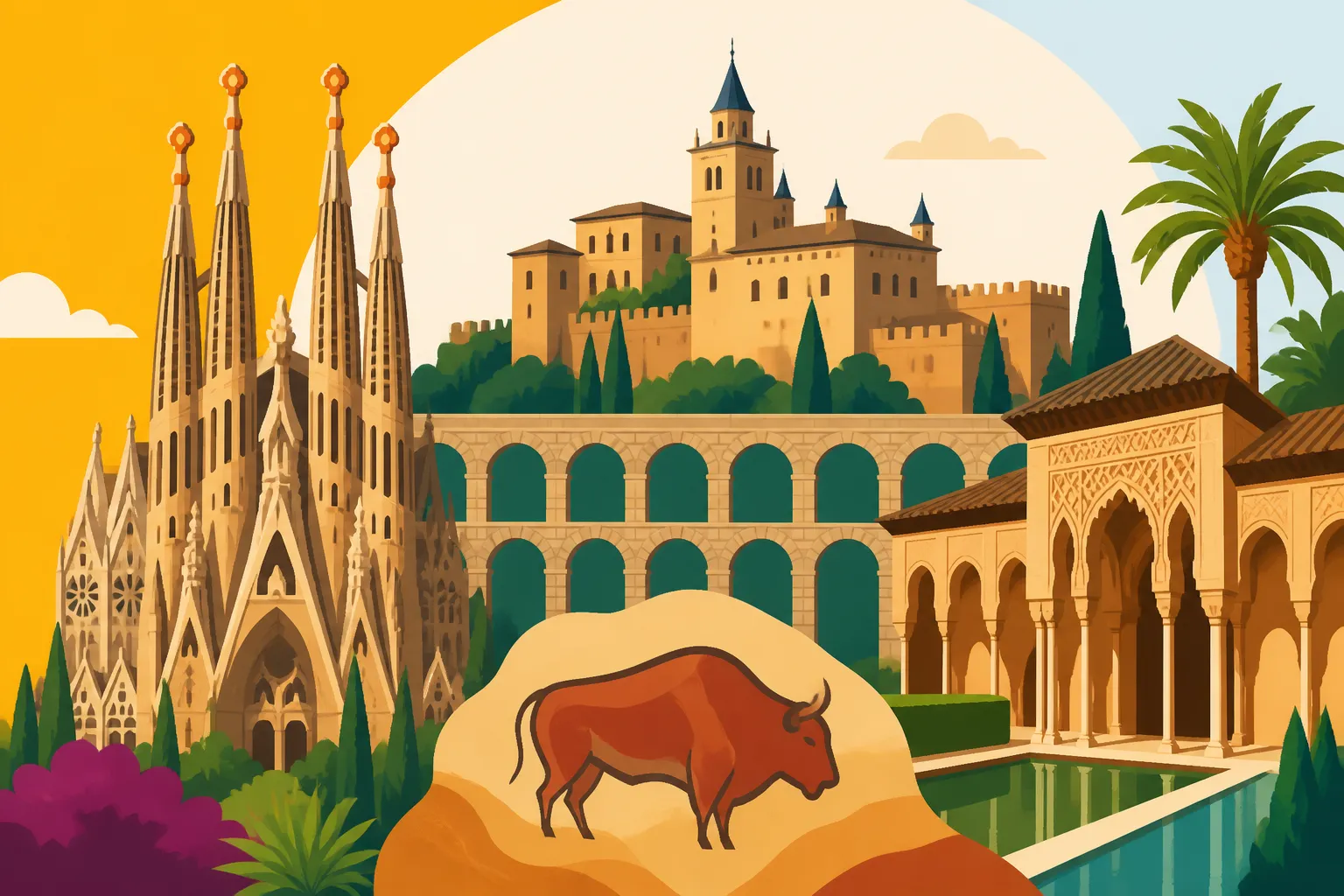
Moving into the modern era, UNESCO has recognized seven of Antoni Gaudí’s works in Barcelona as a collective World Heritage site. From the towering spires of the Sagrada Família to the undulating stone facade of Casa Milà (La Pedrera) and the whimsical mosaics of Park Güell, Gaudí’s work is a celebration of organic forms and Catalan identity.
These sites are some of the most visited in the world. I strongly recommend using GetYourGuide to book skip-the-line tickets for the Sagrada Família and Park Güell, as the queues in the summer sun can be brutal. For a broader look at how to organize your time in the city, see How to See Gaudí's Buildings in Barcelona in One Day. It’s an ambitious itinerary, but it’s doable if you use the metro efficiently.
Natural and Hidden UNESCO Gems
Not all of Spain’s heritage is built of stone. The country also boasts several natural UNESCO sites and lesser-known historical locations that offer a break from the crowded city centers. These sites often require a bit more planning but provide a much deeper connection to the landscape.
Doñana National Park and Biodiversity
Located at the mouth of the Guadalquivir River in Andalusia, Doñana is one of Europe’s most important wetlands. It’s a crucial stopover for migratory birds and one of the last strongholds of the Iberian lynx. Visiting Doñana is different from visiting a typical park; because of its protected status, most of the inner areas can only be accessed via authorized 4×4 tours.
It is a hauntingly beautiful landscape of shifting sand dunes, marshes, and pine forests. If you’re interested in this kind of "Slow Travel," check out my tips in National Parks in Spain Worth Visiting. It’s the perfect antidote to the high-energy buzz of Seville or Málaga.
Las Médulas and Roman Gold Mining
In the province of León, you’ll find Las Médulas, which looks like a Martian landscape of jagged red peaks and lush green chestnut trees. This was once the most important gold mine in the Roman Empire. The Romans used a technique called "ruina montium," where they used water pressure to literally collapse entire mountains to get to the gold.
Today, the result is a stunning, eerie landscape of caves and tunnels that you can hike through. It’s far off the beaten path, so you’ll likely need a car. Travelers are often advised to look into Renting a Car in Spain: Requirements, Insurance, and Driving Tips if they want to explore these northern interior regions, as public transport can be sparse.
The Prehistoric Rock Art of the Mediterranean Basin
This is one of the most expansive UNESCO sites, consisting of over 700 individual locations across eastern Spain. These rock shelters contain vivid paintings of hunters, honey-gatherers, and animals dating back thousands of years. Many of these sites are located in rugged canyons and require a bit of a hike to reach.
Visiting these art sites is a humbling experience. It reminds you that people have been finding inspiration in the Spanish landscape for millennia. For those who enjoy the outdoors, I’ve compiled a guide on Hiking in Spain: Popular Trails and How to Prepare that covers some of the regions where these rock art sites are located.
Practical Tips for Visiting UNESCO Sites in Spain
Before you set off on your heritage tour, there are a few "expat secrets" I’ve picked up over the years that will save you time, money, and stress. Spanish bureaucracy and social norms can be tricky, even when you're just a tourist.
Dealing with Crowds and Seasonal Timing
The "Big Three"—Granada, Seville, and Barcelona—are crowded year-round. However, if you can visit in the shoulder seasons (April-May or September-October), you’ll find much more manageable crowds and better weather. I’ve written extensively about this in When Is the Best Time of Year for a City Break in Spain?.
If you find yourself at a major site in the middle of summer, try to book the very first slot of the morning. Not only is it cooler, but the light is better for photos, and you’ll finish your visit just as the large tour groups are arriving. You can then spend the hot afternoon doing as the locals do: having a long lunch and a siesta.
Understanding Cultural Etiquette and Conservation
Many of these sites are active places of worship or fragile archaeological zones. In cathedrals, it’s important to dress respectfully—shoulders and knees should generally be covered. Visitors are sometimes turned away from the Seville Cathedral for wearing very short shorts or tank tops.
Also, be mindful of the "no flash" rules in museums and caves. The light from flashes can actually damage ancient pigments and fabrics over time. For more on the social side of things, read Spanish Customs, Etiquette, and Social Life so you don't accidentally offend someone while you're admiring the architecture.
Comparing Spain's Top UNESCO Experiences
To help you decide which sites to prioritize, I’ve put together this quick comparison table based on my personal visits and the general "vibe" of each location.
| UNESCO Site | Best For | Recommended Time | Transport Tip |
|---|---|---|---|
| The Alhambra | Moorish Art & Gardens | Full Day (6-7 hours) | Book via GetYourGuide months ahead. |
| Segovia Aqueduct | Roman Engineering | 2-3 hours | Easy train from Madrid via Omio. |
| Sagrada Família | Modernist Architecture | 3 hours | Always use the official app or Booking.com for nearby stays. |
| Córdoba Mezquita | Religious History | 3-4 hours | Visit early morning to avoid "group" congestion. |
| Santiago de Compostela | Pilgrimage & Gothic | 1-2 days | Finish your Camino here; see The Camino de Santiago: A Practical Introduction. |
| Las Médulas | Nature & Ancient Tech | 4-5 hours | Rent a car; public transport is difficult. |
Spain UNESCO World Heritage Sites Disclaimer
This guide is intended for informational and inspirational purposes for tourists and expats in Spain. While I strive to provide the most up-to-date information regarding opening times, ticketing, and transport, these details are subject to change by local authorities and UNESCO management. Always verify specific requirements and booking links on official government or monument websites before finalizing your travel plans. No commercial relationship exists with the historical sites mentioned.