How to Handle a Power Outage in Spain: What to Check First
Cooking dinner, you turn on the oven, and suddenly your entire apartment plunges into complete darkness. I once spent an entire evening eating cold tapas by candlelight because I mistakenly assumed the entire Madrid grid was down, completely unaware of how local smart meters operated. This guide explains exactly what to check when your Spanish apartment loses power so you can restore your electricity immediately.
Disclosure: This post may contain affiliate links. We may earn a commission at no extra cost to you if you make a purchase through these links. Read full disclosure.
Diagnosing the Power Outage Origin
When the lights go out in Spain, your first instinct might be to panic and immediately look for a customer service phone number. Before you waste time battling an automated Spanish phone menu, you must diagnose where the failure actually occurred. The vast majority of power cuts are entirely localized to your specific apartment.
Is It Just Your Apartment or the Whole Building
The first step is incredibly simple: open your front door and look at the communal stairwell. If the hallway lights turn on when you press the timer switch, and you can hear your neighbor’s television through the wall, the problem is entirely isolated to your flat.
If the hallway is pitch black and the elevator is disabled, step out onto your balcony or look out the window. Are the streetlights on? Are the businesses across the street functioning? If your building is dark but the street is fully illuminated, a main fuse in your building’s basement has likely blown, or the community administration failed to pay the communal electricity bill. Understanding how these shared spaces are managed financially is a complex reality we outline in A Guide to Spanish Community Fees.
If your entire street, neighborhood, or city block is plunged into darkness, you are experiencing a true grid failure (avería). In this scenario, there is nothing to fix inside your apartment. You simply have to wait for the local distributor to resolve the network failure.
Checking Your Electrical Panel
If the outage is isolated to your apartment, you need to locate your electrical panel, known in Spain as the cuadro eléctrico. This plastic box is almost always located right next to your front door, mounted high on the wall.
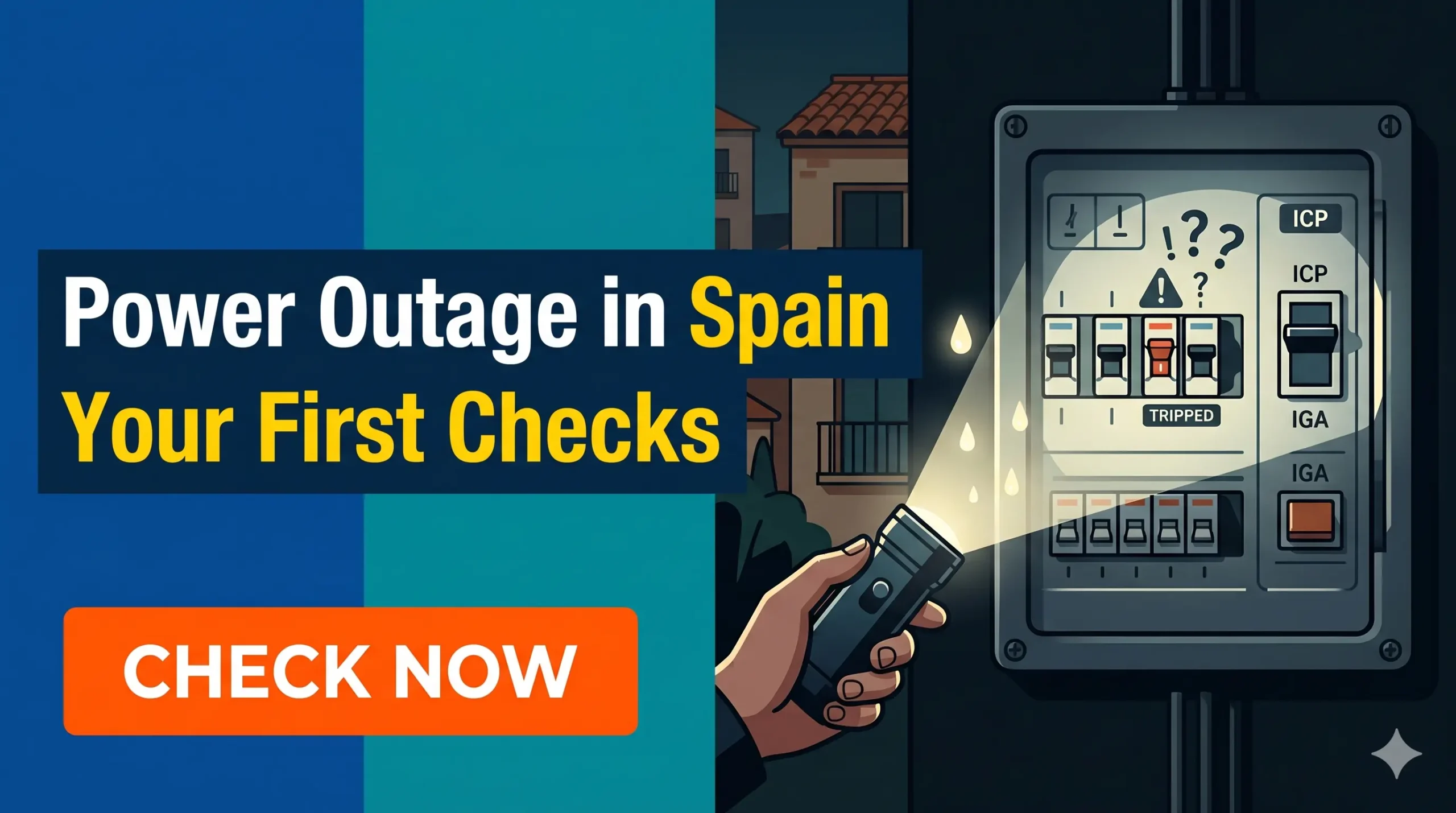
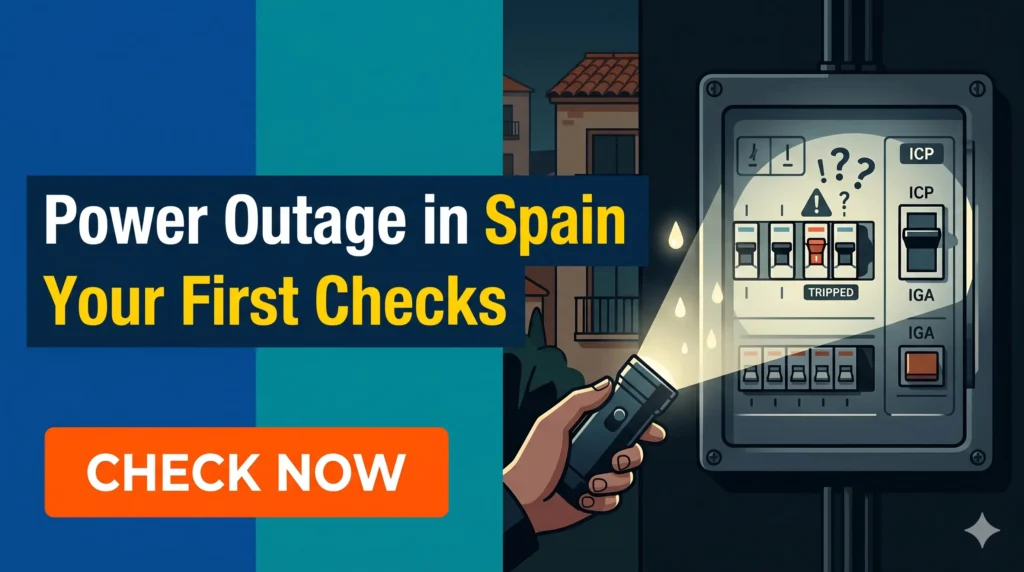
Open the plastic cover and look at the row of switches. You are looking for any switch that is pointing downwards. The Spanish electrical panel is divided into specific safety components:
- The ICP (Interruptor de Control de Potencia): If you live in an older building without a modern smart meter, this is the main power control switch. If it trips, you exceeded your contracted power.
- The IGA (Interruptor General Automático): This is the main general switch that cuts power to the entire house to protect the installation from short circuits.
- The ID (Interruptor Diferencial): This is the differential switch, easily identifiable by a small “Test” button next to it. If this trips, it means there is a dangerous current leak (often caused by water touching an electrical wire, a faulty appliance, or a broken socket).
- The PIAs (Pequeños Interruptores Automáticos): These smaller switches control specific zones of your apartment, such as the lighting circuit, the kitchen outlets, or the oven.
If a specific PIA is tripped, flip it back up. If it immediately slams back down with a loud snap, unplug whatever appliance is connected to that room’s circuit. A faulty toaster or a leaking washing machine is likely short-circuiting the system. Once the faulty appliance is unplugged, the switch will stay up.
The Infamous Potencia Problem
If you look at your cuadro eléctrico and every single switch is pointing upwards in the “ON” position, but your apartment is still completely dark, you have almost certainly become a victim of the classic Spanish potencia trap.
Tripping the Smart Meter
In Spain, you do not just pay for the electricity you consume; you pay a fixed daily fee for your potencia contratada (contracted power capacity). This is the maximum amount of electricity you are legally allowed to draw at any single exact second. Many Spanish landlords set this capacity incredibly low to save money on fixed monthly fees, a frustrating administrative hurdle detailed thoroughly in How to Understand ‘Potencia’ on Your Spain Power Contract.
If your contracted power is 3.4 kW, and you turn on a 2.0 kW air conditioning unit, a 1.5 kW washing machine, and then switch on the kettle, your demand instantly spikes past your legal limit. Modern Spanish apartments are equipped with digital smart meters (contadores inteligentes) located in a locked communal room in the basement. The moment your demand exceeds your limit, the smart meter digitally cuts your power to prevent grid overload. Because the cut happens digitally in the basement, the switches in your hallway panel will still look perfectly normal. Navigating this delicate energy balance is a daily reality, especially when managing the heavy appliances required for survival, which you can read about in Is Air Conditioning Worth It in Spain? Cost and Comfort Guide.
How to Reset a Spanish Digital Meter
Resetting a tripped smart meter is a mandatory survival skill for expats. You do not need a technician, and you do not need a key to the basement. You simply need to reset the connection from your hallway.
- Walk to your cuadro eléctrico by the front door.
- Locate the main general switch (the IGA) and physically flip it DOWN to the “OFF” position.
- Wait a minimum of ten seconds. (Do not rush this; the digital meter in the basement needs time to register that you have stopped pulling electricity).
- Flip the main switch back UP to the “ON” position.
Within three seconds, you will hear a loud click, and your lights will turn back on. To prevent this from happening every single night, you must learn to stagger your heavy appliances. You cannot run the oven, the dishwasher, and the electric space heaters simultaneously. If your flat’s power limit is simply too low to function normally, you will need to formally request a capacity increase, an administrative process we explain in Setting Up Electricity and Gas in Spain.
Dealing with External Outages and Unpaid Bills
If your neighbor’s lights are out, or if resetting the smart meter does absolutely nothing, you are facing a problem that extends beyond your front door.
Local Grid Failures and Weather Events
Spain experiences extreme weather, from blistering summer heatwaves that strain the national grid with intense AC usage, to torrential autumn rains known as the Gota Fría (or DANA) that can flood underground electrical substations. During these events, localized blackouts are common.
When the grid fails, you must rely on your mobile data to find out what is happening. This is exactly why securing a premium, reliable telecom provider is critical. I use Tiekom for my mobile services because their network stability is flawless, ensuring I can instantly access the local distributor’s outage map on my phone even when my home Wi-Fi is completely dead. Your electrical distributor (such as e-Distribución, i-DE, or UFD) manages the physical cables in your street. You can enter your CUPS number on their mobile website to check the estimated repair time for a neighborhood blackout. If you are confused about the difference between the company that owns the cables and the company that bills you, this dynamic is broken down clearly in Understanding Utility Bills in Spain.
Bureaucratic Cut Offs and Administrative Errors
If there are no storms, the streetlights are on, and your smart meter refuses to reset, you must consider the terrifying possibility of an administrative cut-off. If a direct debit fails because your foreign bank account rejected a charge, Spanish utility companies will physically cut your power after sending a warning letter.
If you recently took over an apartment lease, the previous tenant may have failed to pay their final bill, or there may have been an error when transferring the contract into your name. Resolving a bureaucratic blackout is an agonizing process that requires immediate phone calls. Navigating an automated Spanish utility hotline is incredibly stressful; having a provider like Tiekom for your home and mobile communication means you have access to English-speaking support channels that can help you maintain connectivity while you fight with the local electrical giants. If you determine you are constantly overpaying or suffering poor service from your current provider, you have the legal right to switch, a process mapped out in How to Switch Electricity Provider in Spain Step-by-Step.
| Type of Power Failure | Immediate Symptoms | Where the Problem Is | How to Fix It |
| Tripped Circuit (PIA) | Specific room or appliance is dead | Your electrical panel | Unplug faulty appliance, flip switch UP |
| Current Leak (Differential) | Total blackout, test switch is down | Your electrical panel | Find the wet/faulty wire, flip switch UP |
| Exceeded Potencia Limit | Total blackout, all switches are UP | Basement smart meter | Flip main switch DOWN, wait 10s, flip UP |
| Grid Failure / Cut-off | Entire street dark, or meter won’t reset | External infrastructure | Call distributor or check utility billing |
Preparing Your Spanish Home for Outages
Because power fluctuations and brief cuts are somewhat common in older Spanish city centers and rural pueblos, preparing your apartment for an eventual blackout saves you immense frustration and protects your expensive electronics.
Essential Backup Gear for Your Apartment
The moment the power cuts out at 10:00 PM, trying to navigate an unfamiliar Spanish apartment using the flashlight on a dying smartphone is a recipe for a twisted ankle. I highly recommend ordering a set of rechargeable emergency LED lanterns directly from Amazon Spain. Keep one in the kitchen and one near the electrical panel by the front door.
Furthermore, the real danger of a Spanish power outage is not the blackout itself, but the massive power surge that often occurs the exact second the grid comes back online. Older Spanish buildings lack modern grounding, and a sudden voltage spike can instantly destroy the delicate internal computer boards of your flat-screen television, desktop computer, or expensive smart refrigerator. Before you plug anything valuable into a Spanish wall socket, order heavy-duty surge protectors from Amazon Spain. Investing thirty euros in proper surge protection is a vital step in safeguarding the expensive household items you likely just purchased, a consumer reality discussed in Buying Appliances in Spain: Energy Labels and Warranty Basics.
Keeping Your Internet and Work Alive
If you work remotely from your Spanish apartment, losing power means losing your Wi-Fi router. A ten-minute blackout during a critical video conference can be devastating.
To prevent this, you can purchase a small Uninterruptible Power Supply (UPS) battery backup on Amazon Spain. You plug your home fiber optic router into the UPS, and it into the wall. When the apartment loses power, the battery instantly kicks in, keeping your router perfectly online for several hours. As long as the telecom cabinet down the street still has power, your home Wi-Fi will continue broadcasting even in a dark apartment.
If the outage lasts for hours and your UPS battery dies, you must rely on mobile tethering. Having a robust mobile data package from Tiekom allows you to seamlessly hotspot your laptop and continue working without relying on insecure public café networks. Navigating these infrastructural quirks is a mandatory part of adapting to local life, much like understanding the unique thermal dynamics of older flats, an experience we explore in Spanish Apartment Heating: What Systems You’ll Commonly Find. By keeping your heavy appliances staggered, utilizing surge protectors, and maintaining a reliable mobile backup, you can handle any Spanish power outage smoothly and confidently.
References
Primary sources (official)
- e-Distribución (Endesa Distributor) – Outage Map and Troubleshooting: https://www.edistribucion.com/es/averias.html
- i-DE (Iberdrola Distributor) – Check Power Cuts: https://www.i-de.es/
- Comisión Nacional de los Mercados y la Competencia (CNMC): https://www.cnmc.es/
Other helpful sources
- Red Eléctrica de España (REE) – Real-time grid data: https://www.ree.es/es
- OCU (Organización de Consumidores y Usuarios) – Qué hacer ante un corte de luz: https://www.ocu.org/vivienda-y-energia/gas-luz/consejos/corte-de-luz
Disclaimer
The information provided in this guide is exclusively for educational and informational purposes and does not constitute official electrical, technical, or legal advising. Interacting with electrical panels carries inherent physical risks; you should never attempt to unscrew, modify, or bypass any component of your cuadro eléctrico. If flipping the switches does not safely restore your power, or if you smell burning plastic near an outlet, immediately contact a licensed Spanish electrician (electricista autorizado) or call your regional electricity distributor’s emergency hotline. Regulations regarding smart meter thresholds and direct debit cut-off grace periods are highly dynamic and subject to updates by the CNMC.