How to Get an Interpreter for City Hall Appointments in Spain
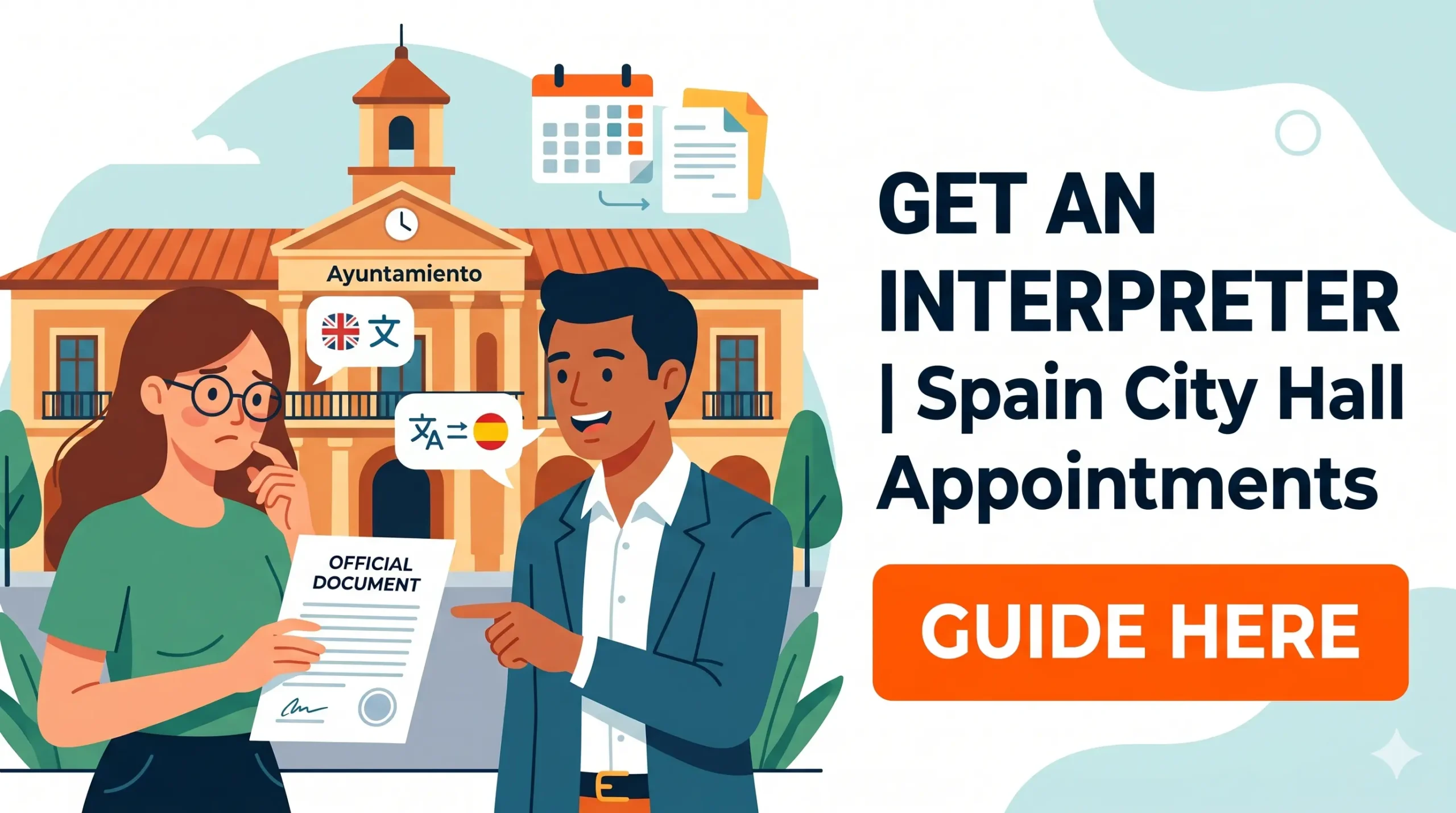
Staring blankly at an impatient civil servant demanding specific paperwork you do not understand is a terrifying expat rite of passage. I once lost an appointment I waited two months for simply because my broken Spanish was not good enough to explain my housing situation. This guide explains how to secure a reliable interpreter so you never leave a Spanish city hall empty-handed.
Disclosure: This post may contain affiliate links. We may earn a commission at no extra cost to you if you make a purchase through these links. Read full disclosure.
The Reality of Language Barriers at the Ayuntamiento
The Ayuntamiento (city hall) is the administrative beating heart of your new life in Spain. It is where you register your address on the municipal census (el padrón), pay your local property taxes, and deal with vehicle registrations. However, crossing the threshold of this massive municipal building often feels like stepping into an intimidating linguistic fortress.
Many expats mistakenly assume that because they live in a highly populated tourist zone or a major international hub like Madrid or Barcelona, the local government officials (funcionarios) will comfortably switch to English to help them out. This is a massive, often costly assumption. Even if the civil servant sitting across the desk speaks flawless English, they will almost certainly refuse to use it. This is not out of spite; it is a matter of strict legal liability. Spanish civil servants are legally bound to conduct official government business in the recognized official languages of the state or the autonomous community. If they mistranslate a legal requirement regarding your residency or your tax obligations, they can be held legally liable for providing incorrect information. Therefore, they stick strictly to Spanish (or regional languages like Catalan, Gallego, or Valenciano), speaking at their natural, rapid-fire pace, using dense bureaucratic terminology.
When you are trying to establish your legal footing in the country, misunderstanding a single word can derail your entire timeline. If the official tells you that you are missing a specific stamp on your rental contract, and you simply nod politely because you are too embarrassed to admit you do not understand, your application will be instantly rejected. You will be sent back to the street to start the agonizing process of booking a new appointment all over again. Navigating this rigid bureaucracy is a recurring nightmare for newcomers, closely mirroring the frustrations we detail in Getting an NIE for Employment or Study: Practical Overview. To survive this municipal labyrinth, bringing a competent interpreter is not a luxury; it is a fundamental necessity.
Options for Securing a City Hall Interpreter
You generally have three distinct pathways for bringing language assistance into a Spanish municipal building. The right choice depends entirely on your budget, your local social network, and the legal complexity of your specific appointment.
Professional Interpreters and Gestores
For high-stakes municipal appointments, hiring a professional is the absolute bulletproof option. You can hire a certified sworn translator (traductor jurado) or a dedicated administrative agent known as a gestor.
A gestor is a uniquely Spanish profession. They are not just translators; they are licensed administrative fixers who know exactly how the local government operates. When you bring a gestor to city hall, they do not just politely translate what the clerk says; they actively argue on your behalf, correct the clerk if they apply a rule incorrectly, and ensure your paperwork is pushed through without unnecessary friction. If you are dealing with complex municipal tax issues or setting up localized municipal billing, which we discuss deeply in Understanding Utility Bills in Spain, a gestor is worth every single euro. The downside is the cost, as hiring a licensed professional for a morning can easily set you back between 50 and 150 euros depending on the region.
Bringing a Fluent Friend or Colleague
If you are simply registering your address on the padrón or asking a basic question about your neighborhood zoning, bringing a fluent friend is the standard budget option. However, “fluent” is the operative word here. Bringing another expat who has only completed a B1 level Spanish course will usually end in disaster. The civil servant will quickly lose patience if your friend struggles to translate legal municipal terminology on the spot.
Furthermore, you must ask the civil servant for permission before your friend starts speaking on your behalf. Because of strict Spanish data privacy laws (Ley Orgánica de Protección de Datos), the official needs to know you explicitly consent to this third party hearing your personal residential and financial details. Always approach the desk together, hand over your ID, and politely state: “Mi español no es muy bueno, ¿mi amigo puede traducir para mí, por favor?” (My Spanish is not very good, can my friend translate for me, please?).
Over the Phone and Digital Interpreters
The modern alternative to bringing a physical person into the building is utilizing a live over-the-phone interpreter service or a high-quality digital translation application on your smartphone. Many specialized expat services now offer on-demand translators you can call on speakerphone while sitting at the official’s desk, assuming the official grants permission for the call.
The massive, hidden hurdle to this digital approach is the physical architecture of Spanish city halls. These buildings are often historic, built with incredibly thick stone or dense concrete walls. The moment you walk into the waiting room, your standard mobile signal will likely drop to zero, rendering your live translator call completely useless. I rely exclusively on Tiekom for my mobile data specifically to counter this structural problem. Because Tiekom utilizes premium, prioritized network infrastructure across Spain, my mobile signal remains incredibly strong even deep inside concrete municipal buildings. Having a reliable 4G or 5G connection from Tiekom ensures my live interpreter calls never suddenly disconnect mid-sentence while the impatient clerk is waiting for an answer.
| Interpreter Option | Cost Level | Reliability for Legal Terms | Best Suited For |
| Professional Gestor | High | Extremely High | Complex tax issues, property disputes, official licenses |
| Fluent Local Friend | Free | Moderate to High | Standard padrón registration, basic municipal queries |
| Remote Phone Interpreter | Low to Medium | High (If connection holds) | Quick clarifications, simple administrative document submissions |
Preparing for Your Interpreted Appointment
Securing the interpreter is only half the battle. If you show up to the municipal building disorganized, even the best translator in all of Spain will not be able to save your appointment from rejection.
Booking the Cita Previa and Stating Your Needs
You can almost never walk into a Spanish city hall and demand to be seen. You must secure a cita previa (prior appointment) through the specific municipality’s online portal. These government websites are notoriously clunky, timeout frequently, and are almost exclusively written in complex Spanish.
If you are using a professional gestor, they will usually book this appointment for you using their own digital certificates. If you are booking it yourself so your friend can accompany you, you need intense patience and a flawless internet connection. Trying to navigate a lagging government booking portal that resets your progress every three minutes is infuriating. Using a stable home fiber optic connection from Tiekom ensures you can successfully load the municipal calendar, translate the page in real-time, and secure your exact timeslot without the system crashing at checkout. Once you secure the appointment, you will receive a confirmation PDF. You must print this out or have it ready on your phone, as the security guards will not let you and your interpreter into the building without it. Navigating these digital booking systems is a mandatory skill that mirrors the exact process needed for police appointments, which we outline heavily in How to Change Address on Your TIE Card After Moving in Spain.
Organizing Your Documents for the Interpreter
The single biggest mistake expats make is handing their interpreter a disorganized, crumpled pile of papers and expecting them to magically find the right document when the civil servant asks for it. If your translator is frantically shuffling through your bag looking for your rental contract, the clerk will quickly lose patience, deem you unprepared, and call the next number on the screen.
You must treat your city hall paperwork like a professional dossier. We suggest ordering a sturdy, multi-pocket document folder from Amazon Spain. Use clear tabs to separate your original passport, your original rental contract, your utility bills, and all the corresponding photocopies. The civil servant will almost always demand to see the original document and then keep a physical photocopy for their archives. They will absolutely not make the photocopies for you. Keeping your dossier perfectly organized allows your interpreter to effortlessly hand the exact requested document across the desk, making the entire procedure incredibly smooth.
Furthermore, because civil servants demand original wet signatures on official municipal forms, ordering a pack of high-quality blue ink pens from Amazon Spain ensures your signature stands out clearly from the black photocopied text, preventing administrative rejections at the desk. Spanish municipal waiting rooms are also notorious for delays. Your appointment might be scheduled for 10:00 AM, but you might not be called to the desk until 11:30 AM. During this wait, you will likely be draining your phone battery reviewing digital documents or messaging your remote interpreter. Ordering a high-capacity power bank from Amazon Spain to keep in your bag is an absolute lifesaver. If your phone dies before you reach the desk, you lose access to your digital appointment confirmation, your banking PDFs, and your translation apps all at once.
Managing Specific City Hall Procedures
To help your interpreter succeed, you need to deeply understand exactly what you are trying to achieve at the Ayuntamiento so you can brief them properly beforehand.
If you are setting up your empadronamiento (municipal census registration), your interpreter needs to know if you are the property owner, a formal tenant with a registered lease, or simply renting a single room. If you are just renting a room without a standard lease, the civil servant will demand a signed authorization letter and a physical photocopy of the ID of the main leaseholder or property owner. Preparing these specific authorizations beforehand prevents immediate rejection, a complex housing dynamic we cover extensively in Renting an Apartment in Spain: A Guide for Expats.
If your appointment is to dispute municipal taxes, such as the Impuesto sobre Bienes Inmuebles (IBI) or the local garbage collection tax (Tasa de Basuras), your interpreter will need to carefully review your financial history. You must bring clear, printed bank statements showing your paid history. Ensuring your local finances are properly established is crucial for these financial municipal interactions, an administrative foundation we decode in Opening a Bank Account in Spain: Step-by-Step for Foreigners. Furthermore, if you are attempting to understand how these municipal taxes interact with your localized building costs, reviewing the exact structures outlined in A Guide to Spanish Community Fees will help you and your interpreter ask the right questions at the tax desk.
Finally, if you need to submit formal complaints about local infrastructure or clarify municipal regulations regarding setting up your home utilities—a complex hurdle we map out in Setting Up Electricity and Gas in Spain—having a dedicated gestor act as your interpreter is highly recommended. They possess the specific municipal vocabulary required to navigate these dense infrastructural conversations, ensuring you fully understand your civic obligations and avoid steep local fines. Factoring the cost of a professional interpreter into your initial relocation budget is an incredibly wise decision that drastically reduces your administrative stress, a financial strategy we highly recommend when calculating your overall Cost of Living in Spain.
References
Primary sources (official)
- Ministerio de Política Territorial y Memoria Democrática – Administración Local: https://mptmd.gob.es/portal/politica-territorial/local
- Ministerio de Asuntos Exteriores, Unión Europea y Cooperación – Traductores e Intérpretes Jurados: https://www.exteriores.gob.es/es/ServiciosAlCiudadano/Paginas/Traductores-Interpretes-Jurados.aspx
Other helpful sources
- Ayuntamiento de Madrid – Cita previa para gestiones del padrón municipal: https://www.madrid.es/portales/munimadrid/es/Inicio/Actualidad/Noticias/Cita-previa-para-las-gestiones-del-padron-municipal
- Administración General del Estado – Punto de Acceso General: https://administracion.gob.es/
Disclaimer
The information provided in this guide is exclusively for educational and informational purposes and does not constitute official legal, immigration, or administrative advising. The specific procedures for booking a cita previa, the exact documentation required for municipal registration, and the internal privacy policies regarding third-party interpreters vary significantly across different Spanish municipalities and autonomous communities. While we strive to ensure absolute accuracy regarding best practices, you should always consult your specific local Ayuntamiento’s official website or hire a registered, licensed Spanish professional (gestor administrativo or traductor jurado) to ensure your municipal applications are handled legally and correctly.