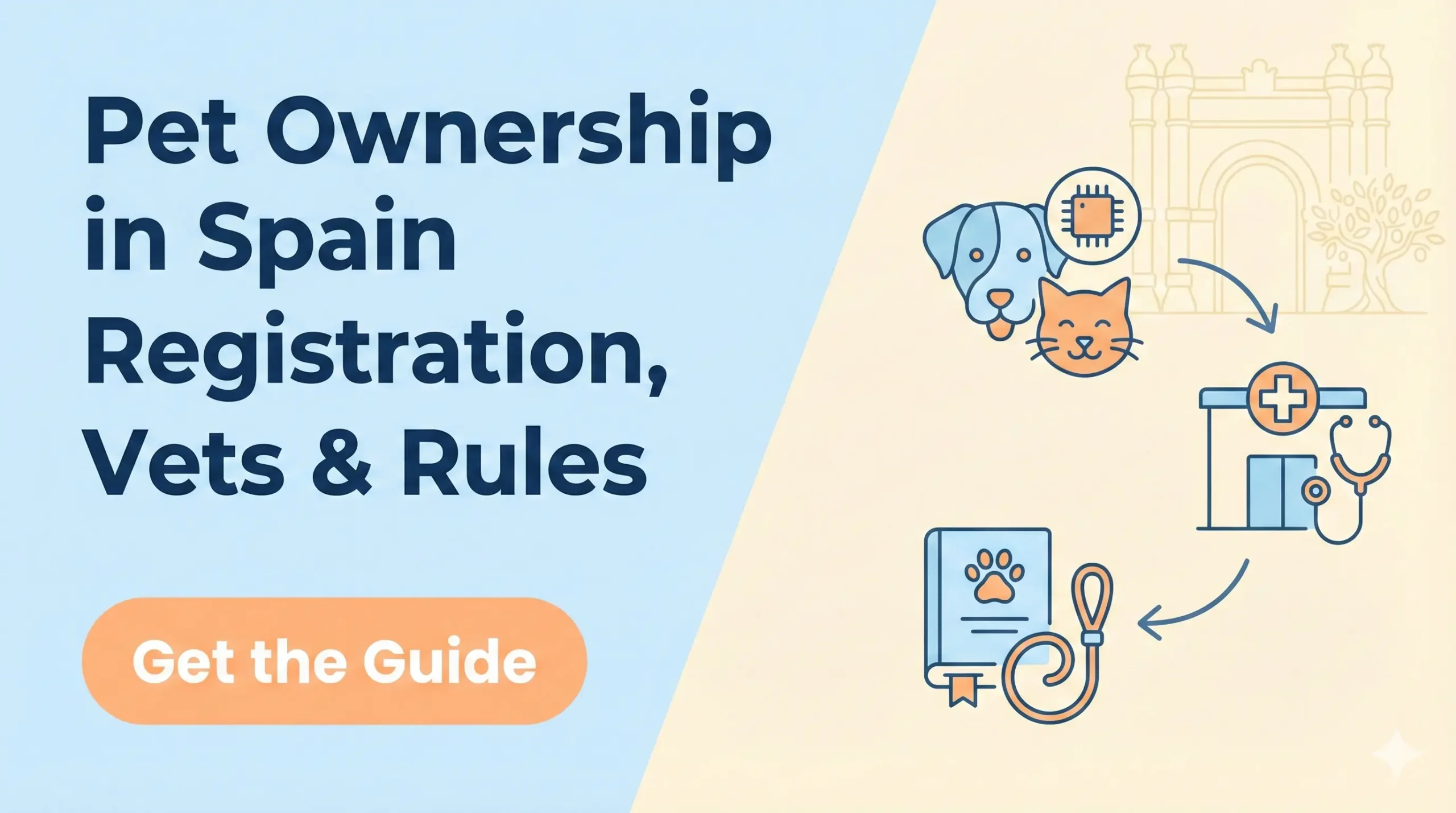
Pet Ownership in Spain: Registration, Vet Visits, and Rules
Discover everything you need to know about pet ownership in Spain, from navigating the strict 2023 Animal Welfare Law and mandatory dog insurance to understanding veterinary costs, microchip registration, and daily etiquette for living with your furry companion.
Disclosure: This post may contain affiliate links. We may earn a commission at no extra cost to you if you make a purchase through these links. Read full disclosure.
1. The 2023 Animal Welfare Law: What You Need to Know
The 2023 Ley de Bienestar Animal completely overhauled pet ownership in Spain. While some of the more nuanced regulations are still being finalized by regional governments, the core tenets of the law are actively enforced. If you are bringing a pet to Spain, you must adhere to the following strict rules:
- Zero Abandonment and Euthanasia Limits: The law strictly prohibits the abandonment of any animal. Furthermore, euthanasia is now strictly regulated and can only be performed by a licensed veterinarian for justified, irremediable medical reasons to prevent suffering. You cannot put a healthy animal down for financial or behavioral reasons.
- Time Limits on Solitude: You can no longer leave your pets unattended indefinitely. Dogs cannot be left alone for more than 24 consecutive hours. For cats, ferrets, and other small pets, the maximum limit is three days (72 hours).
- Banned Living Conditions: It is strictly illegal to keep pets permanently on terraces, balconies, roof terraces, in basements, or tied up in courtyards. Dogs cannot be tethered outside a supermarket while you shop, nor can they be left unattended inside a vehicle, especially given the lethal heat of the Spanish summer.
- The Positive List (Listado Positivo): Spain is implementing a “positive list” of animals that are legally allowed to be kept as pets. While dogs, cats, and ferrets are obviously included, many exotic animals (such as certain reptiles, primates, and exotic birds) are now banned from domestic ownership to protect native biodiversity and public safety.
- Breeding and Sales: The sale of dogs, cats, and ferrets in retail pet shops is now banned. You can only purchase these animals directly from officially licensed and registered breeders. The law heavily encourages adoption from recognized shelters (protectoras).
2. Bringing Your Pet to Spain: The Import Rules
Before you can register your pet in Spain, you have to get them across the border. The regulations depend entirely on where you are traveling from. If you are managing multiple aspects of your relocation, be sure to incorporate these pet timelines into your broader Moving to Spain: Essential Relocation Checklist.
Entering from an EU Country
If you are moving from within the European Union, the process is streamlined. Your pet must have an EU Pet Passport issued by an authorized veterinarian. The animal must be microchipped (with a 15-digit ISO-compliant chip) and have a valid rabies vaccination administered at least 21 days prior to travel.
Entering from a Non-EU Country (USA, UK, Canada)
Since Brexit, pets arriving from the UK are treated under the same strict “Third Country” rules as those from North America or Australia.
- Animal Health Certificate (AHC): Non-EU pets cannot use their domestic pet passports to enter Spain. You must obtain an Animal Health Certificate (or a USDA-endorsed certificate in the US) issued by an official veterinarian within 10 days of your arrival in Spain.
- Microchip and Rabies: The pet must be microchipped before the rabies vaccination is administered. The rabies vaccine must be at least 21 days old.
- Age Limits: Because the rabies vaccine cannot be administered until a puppy or kitten is 12 weeks old, and you must wait 21 days after the shot, the absolute minimum age for a pet to enter Spain from a non-EU country is 15 weeks. Spain does not grant exceptions for unweaned or unvaccinated puppies.
- Travel Limits: You are permitted to bring a maximum of five pets for non-commercial purposes. If you bring more, you will be subject to complex commercial import regulations.
3. Registration and Microchipping in Spain
Once your pet’s paws touch Spanish soil, your administrative duties begin. Just as you must register yourself with the local authorities, your pet must also become a documented resident.
The Autonomous Community Registries
Spain is highly decentralized, and pet registries are managed at the regional level (Autonomous Communities) rather than nationally.
Within your first few weeks in Spain, you must take your pet to a local Spanish veterinarian. The vet will scan your pet’s international microchip and register the 15-digit code, along with your contact information and Spanish address, into the regional database (for example, the AIAC in Catalonia or the RIAC in Madrid).
Crucial Note: If you move from Madrid to Valencia, you must visit a Valencian vet to transfer your pet’s registration to the new regional database. Failing to update this information means that if your dog gets lost, the local authorities will not be able to find your current phone number when they scan the chip.
The Municipal Census (Padrón Municipal)
In addition to the veterinary registry, many local town halls (ayuntamientos) require you to register your dog on the municipal pet census. This is completely separate from your personal residency registration, though you must have your own paperwork in order first. You can familiarize yourself with this process through our guide on Spanish Bureaucracy for Daily Life: Padrón, IDs, and Local Services.
The Rise of Dog DNA Registries
Be prepared for local variations. An increasing number of Spanish municipalities (such as Malaga and parts of Valencia) have introduced mandatory DNA registries for dogs. You are required to pay a local vet to take a saliva swab of your dog. The town hall uses this DNA database to identify and fine owners who fail to clean up their dog’s feces from the pavement.
4. Mandatory Requirements for Dog Owners
The 2023 law places specific, heavy burdens on dog owners to ensure public safety and animal welfare.
Civil Liability Insurance (Seguro de Responsabilidad Civil)
Historically, liability insurance was only mandatory for owners of Potentially Dangerous Dogs (PPP). Under the new law, civil liability insurance is mandatory for ALL dogs, regardless of their breed, size, or mix.
You must hold a policy that covers any physical or material damage your dog might cause to third parties (for example, if your dog runs into the street and causes a cyclist to crash). The coverage limit must be sufficient to handle severe legal claims. You must carry proof of this insurance; police can request it during routine stops in the park.
The Mandatory Training Course
To promote responsible ownership, the Spanish government has mandated that all dog owners complete a specialized training course. This is a free, online module designed to ensure you understand the basic behavioral, financial, and physical needs of a canine. While the technical rollout of this platform faced initial delays, it is a legal requirement you must complete to maintain your pet’s legal status.
Potentially Dangerous Dogs (PPP)
Despite rumors that the new law would abolish breed-specific legislation, the regulations surrounding Perros Potencialmente Peligrosos (PPP) remain strictly in force. Breeds such as Pit Bull Terriers, Staffordshire Bull Terriers, Rottweilers, and Dogo Argentinos face severe restrictions.
If you own a PPP breed, you must:
- Obtain a specialized municipal license, which requires passing a psychological and physical aptitude test yourself.
- Provide a clear criminal background check.
- Ensure the dog wears a homologated muzzle and is kept on a non-extendable leash of less than two meters at all times in public.
- Only walk one PPP dog per adult at a time.
5. Specific Rules for Cats and Other Pets
Felines and smaller pets are not exempt from the new legal framework.
Mandatory Microchipping for Cats and Ferrets
It is now legally required for all domestic cats and ferrets to be microchipped, just like dogs. This applies even to indoor cats that never leave your apartment.
Mandatory Sterilization for Cats
To combat the severe problem of feral cat colonies across the country, the 2023 law mandates the sterilization of all cats before they reach six months of age. The only exception to this rule is for cats owned by individuals officially registered as professional breeders in the national registry. If you adopt a kitten, you are legally bound to have it spayed or neutered.
6. Veterinary Care and Regional Health Risks
The quality of veterinary care in Spain is exceptional. Clinics (clínicas veterinarias) are abundant, and many vets in expat-heavy coastal areas speak fluent English. Compared to the United States or the United Kingdom, veterinary prices in Spain are remarkably affordable.
However, the warm Mediterranean climate harbors specific parasites and diseases that may be completely foreign to expats from northern latitudes. You must be proactive in protecting your pet.
The Threat of Leishmaniasis
This is arguably the greatest health threat to dogs in Spain. Leishmaniasis is a severe, potentially fatal disease transmitted by the bite of the Phlebotomus sandfly, which is highly active from May to October, particularly at dawn and dusk.
- Prevention: Standard flea and tick treatments do not stop the sandfly. You must equip your dog with a specialized repellent collar (like Scalibor or Seresto) or use specific spot-on treatments. Many vets also highly recommend the Leishmaniasis vaccine, coupled with an annual blood test.
The Processionary Caterpillar (Oruga Procesionaria)
During the early spring (February to April), pine forests across Spain become battlegrounds. The pine processionary caterpillar descends from the trees in long, nose-to-tail lines. These insects are covered in highly toxic, urticating hairs. If a curious dog sniffs, licks, or eats one of these caterpillars, it can cause severe necrosis of the tongue, asphyxiation, and death within hours. You must remain hyper-vigilant when walking your dog near pine trees in the spring.
Average Veterinary Costs in Spain
To help you budget for your pet’s healthcare alongside your other living expenses—which you can review in our Cost of Living in Spain: A Complete Breakdown—here is a table of average veterinary costs.
| Veterinary Service | Estimated Cost (EUR) | Notes |
| Standard Consultation | €30 – €50 | Emergency or after-hours visits will double this fee. |
| Annual Polyvalent Vaccine | €30 – €45 | Covers Distemper, Parvovirus, Hepatitis, etc. |
| Rabies Vaccine | €25 – €35 | Mandatory in most, but not all, Spanish regions. |
| Microchipping & Registry | €35 – €50 | Includes the physical chip and the RIAC paperwork. |
| Leishmaniasis Annual Test | €25 – €40 | Highly recommended before starting preventative vaccines. |
| Spay / Neuter (Cat) | €80 – €150 | Varies heavily by gender (females are more expensive). |
| Spay / Neuter (Dog) | €150 – €300 | Varies significantly based on the weight of the dog. |
7. Pet Insurance in Spain: Liability vs. Health
Given the new legal mandates, pet insurance is a topic every expat must address immediately upon arrival.
Mandatory Civil Liability Insurance
As mentioned, this is no longer optional for dogs. When purchasing this policy, ensure the coverage limits meet your local municipality’s minimums (often starting at €100,000 to €300,000 of coverage). This policy is purely to protect others from your dog; it does not pay your vet bills if your dog gets sick.
Voluntary Pet Health Insurance
While veterinary costs are lower in Spain than in the US, major surgeries or chronic illnesses like Leishmaniasis can easily run into thousands of euros. Pet health insurance operates on a reimbursement model or a co-pay model.
- In-Network (Cuadro Médico): Many insurers (like Sanitas or Mapfre) have a network of affiliated clinics. If you use their vets, routine checkups might be free, and surgeries are heavily discounted.
- Reimbursement: You use any vet you prefer, pay the bill upfront, and the insurance company reimburses you a percentage (typically 80% to 100%) minus any deductibles.If you are currently researching coverage for yourself and your family, it is wise to bundle your policies. Learn more about navigating the local market in our guide to Health Insurance for Spain Visas: Coverage Rules and Policy Checklist.
8. Daily Life and Etiquette: Walking, Renting, and Transport
Living harmoniously with your pet in Spain requires adopting local etiquette. The Spanish public is generally very tolerant of dogs, but municipal wardens are quick to issue fines for anti-social behavior.
Street Etiquette: Poop and Urine
Picking up your dog’s feces is a universal law, but Spain has taken street cleanliness a step further. In almost all major cities, it is mandatory to carry a bottle of water (often mixed with a few drops of white vinegar or pet-safe soap) when walking your dog. You are legally required to squirt this water over your dog’s urine to dilute it and protect building facades, lampposts, and sidewalks from corrosive odors. Failing to carry this water bottle can result in on-the-spot fines of €100 to €300.
Finding a Pet-Friendly Rental
This is arguably the most challenging aspect of pet ownership for an expat. Spanish landlords are notoriously reluctant to rent to pet owners. Property listings on major sites like Idealista will often explicitly state “No se admiten mascotas” (Pets not allowed). You must be prepared to negotiate, offer a higher security deposit, or create a “pet resume” to prove your animal is well-behaved.
Public Transport
The rules for traveling with your pet vary significantly by the mode of transport and the city.
- Trains (Renfe): Small dogs, cats, and ferrets weighing under 10kg can travel on AVE (high-speed) and long-distance trains, provided they remain inside an enclosed carrier. Recently, Renfe launched a pilot program allowing dogs weighing up to 40kg on select AVE routes, provided they wear a muzzle and are tethered to a specific seat.
- Metro and Buses: In Madrid and Barcelona, dogs are permitted on the Metro outside of peak rush hours, but they must be muzzled and on a short leash. Municipal buses are generally much stricter, usually only allowing small pets in secure carriers. Plan your cross-country trips carefully by reviewing our guide on Public Transport in Spain: Trains, Buses, and Metro.
Beaches and Parks
While the image of your dog bounding freely across a Mediterranean beach is idyllic, the reality is highly regulated. During the high summer season (typically June to September), dogs are strictly banned from almost all public bathing beaches to maintain sanitary standards.
However, many coastal municipalities have designated specific “Dog Beaches” (Playas para Perros), which are clearly signposted and open year-round. Inland, most Spanish cities have excellent enclosed dog parks (pipicanes or zonas de esparcimiento canino) where your dog can legally run off-leash and socialize.
Conclusion
Bringing your pet to Spain is a wonderful decision that will infinitely enrich your expat experience. The country’s sociable outdoor culture, abundance of sunny terraces, and high-quality veterinary care make it a fantastic place for animals.
However, the passage of the 2023 Animal Welfare Law signals that the Spanish government is taking animal welfare and public safety more seriously than ever before. By ensuring your pet is legally microchipped and registered in your specific autonomous community, securing your mandatory civil liability insurance, and familiarizing yourself with local health risks like Leishmaniasis and processionary caterpillars, you protect both your pet and yourself. Respect the local etiquette, keep that water bottle handy during walks, and you and your companion will seamlessly integrate into the beautiful rhythm of Spanish life.
References
Primary sources (official)
- Boletín Oficial del Estado (BOE) – Ley 7/2023 de Bienestar Animal: https://www.boe.es/buscar/act.php?id=BOE-A-2023-7936
- Ministerio de Agricultura, Pesca y Alimentación (Pet Travel Regulations): https://www.mapa.gob.es/en/ganaderia/temas/comercio-exterior-ganadero/desplazamiento-animales-compania/
- Dirección General de Derechos de los Animales: https://www.mdsocialesa2030.gob.es/derechos-animales/
Other helpful sources
- REIAC (Red Española de Identificación de Animales de Compañía): https://www.reiac.es/
- Renfe Official Pet Travel Policy: https://www.renfe.com/es/en/travel/prepare-your-trip/pets
Disclaimer
The information provided in this article is for educational and informational purposes only and does not constitute formal legal or veterinary advice. The specific applications of the 2023 Ley de Bienestar Animal, regional microchip registry requirements, and municipal bylaws are subject to ongoing updates and local enforcement variations. We strongly recommend consulting with a licensed Spanish veterinarian and your local town hall (Ayuntamiento) for the most current regulations affecting your specific breed and area of residence.