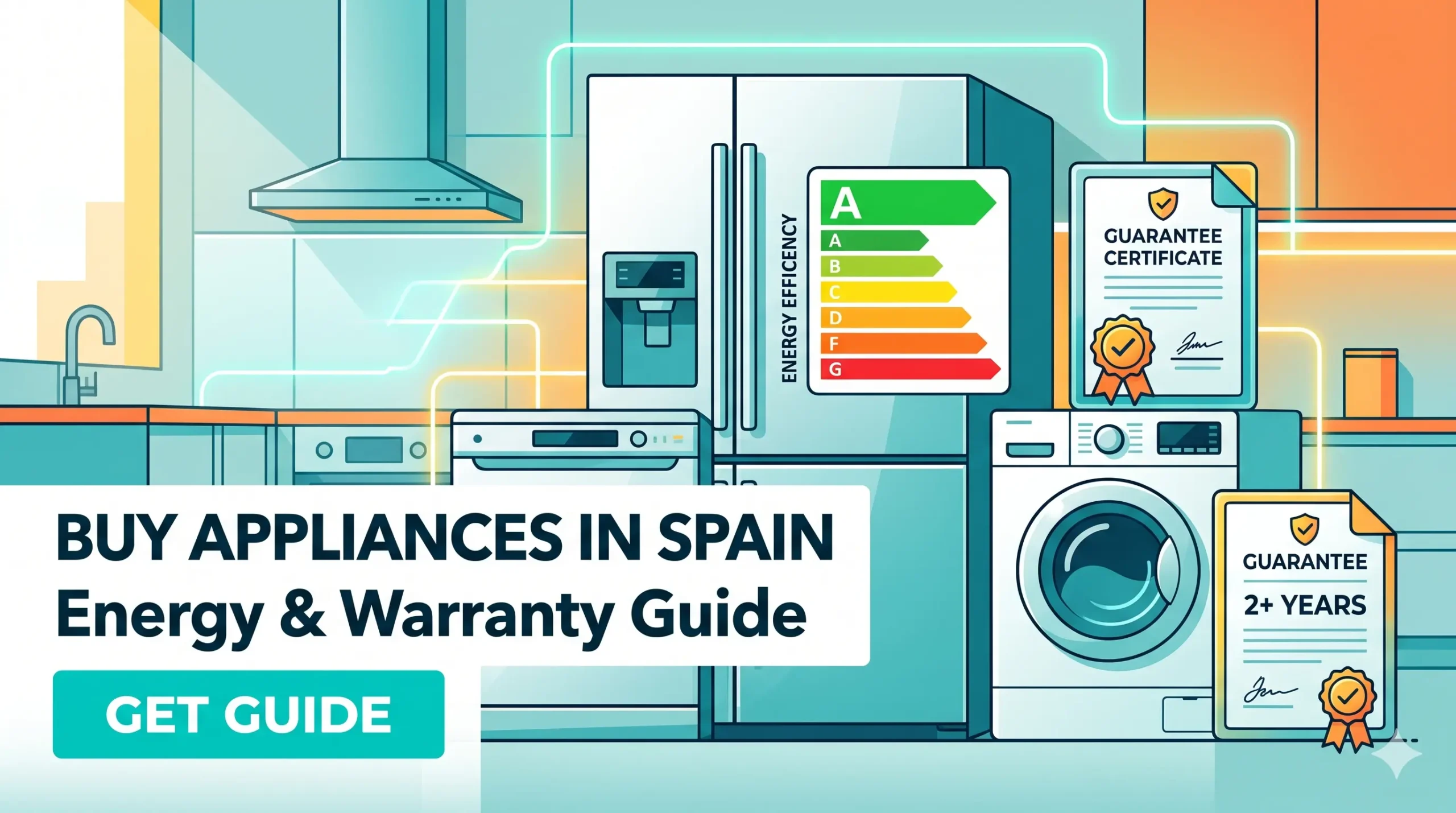
Buying Appliances in Spain: Energy Labels and Warranty Basics
Standing in a Spanish appliance store trying to decipher why a modern refrigerator has a harsh “C” energy rating while the salesman refuses to explain the delivery fees is incredibly frustrating. I once bought a washing machine that broke after thirteen months, completely unaware of my legal rights. This guide decodes Spain’s energy labels and powerful warranty laws so you can buy with confidence.
Disclosure: This post may contain affiliate links. We may earn a commission at no extra cost to you if you make a purchase through these links. Read full disclosure.
Decoding the New Spanish Energy Labels
The Shift from Plus Signs to the A to G Scale
When expats arrive in Spain and start shopping for a new dishwasher or oven, they often expect to see the familiar “A+++” rating plastered across the front of the most expensive models. However, in March 2021, the European Union and the Spanish government fundamentally overhauled the entire energy efficiency rating system. The old system had become mathematically ridiculous; because technology had advanced so rapidly, almost every appliance on the market was clustered in the A+, A++, or A+++ categories, rendering the lower letters entirely obsolete and confusing consumers.
To solve this, the scale was completely recalibrated back to a strict A to G system, stripping away the confusing plus signs. The new scale is intentionally ruthless. An appliance that previously boasted an impressive A+++ rating under the old rules might now be downgraded to a modest “C” or “D” on the modern Spanish label. This does not mean the appliance suddenly became less efficient or is going to drain your wallet; it simply means the government raised the bar to leave room for future technological innovations.
Understanding this recalibration is absolutely crucial so you do not panic when you cannot find a single “A” rated refrigerator in the store. Currently, very few appliances on the market actually qualify for the new A class. When outfitting your new flat—a process fraught with hidden expenses as detailed in Renting an Apartment in Spain: A Guide for Expats—aiming for a solid C or D rating on the new scale is a perfectly acceptable and highly efficient choice that will keep your domestic utility expenses well within your projected Cost of Living in Spain.
Using the EPREL QR Code System
Beyond the simple letter grade, the new Spanish energy labels feature a mandatory QR code printed clearly in the top right corner. This is an incredibly powerful tool for consumers who want to look past the marketing jargon. Scanning this code takes you directly to the European Product Registry for Energy Labelling (EPREL) database. Here, you can view the exact technical specifications of the appliance, including its precise annual energy consumption in kilowatt-hours, its water consumption per cycle, and its certified noise emission levels measured in decibels.
Accessing this database in real-time is the best way to verify if a salesperson is actually telling you the truth about a machine’s efficiency. However, when you are standing deep inside a massive concrete retail store like El Corte Inglés or MediaMarkt, your mobile signal will often drop completely. Relying on a premium mobile data provider like Tiekom ensures you always have a strong, fast connection, allowing you to seamlessly scan QR codes and read the EPREL database without awkwardly wandering toward the front doors to find a signal.
Paying close attention to the specific kilowatt-hour consumption data on the EPREL site is not just about saving the environment; it is a vital step in managing your domestic infrastructure. If you buy a massive, power-hungry induction oven without checking its peak wattage draw, you run the risk of constantly tripping your apartment’s main breaker. Matching your appliance’s energy demands to your legal electrical limits is a fundamental strategy we explain comprehensively in How to Understand ‘Potencia’ on Your Spain Power Contract.
| Feature | Old Energy Label System | New Energy Label System |
| Grading Scale | A+++ to D | Strict A to G |
| Top Tier Realities | Heavily saturated with A+++ | Very few products achieve an A |
| QR Code Integration | None | Mandatory linking to EPREL database |
| Icons & Metrics | Basic pictograms | Highly detailed noise, water, and capacity data |
Navigating the Three Year Consumer Warranty Law
Your Legal Rights Under the New Guarantee
One of the greatest advantages of living in Spain is the robust blanket of consumer protection laws, which were significantly upgraded recently. On January 1, 2022, Spain enacted a massive modification to the General Law for the Defense of Consumers and Users. The most critical change for expats to understand is that the mandatory legal guarantee on all new consumer goods—including household appliances—was extended from two years to three full years.
This three-year warranty is non-negotiable and legally binding on the seller, regardless of what the store clerk tells you or what the brand’s own promotional materials claim. Furthermore, the new law drastically shifted the burden of proof in favor of the consumer. If your newly purchased washing machine or refrigerator breaks down or displays a technical fault at any point during the first two years of ownership, the Spanish government automatically legally assumes that it is a manufacturing defect.
Because the defect is automatically assumed to be the manufacturer’s fault, the store is legally obligated to either repair the appliance completely free of charge, replace it with a brand new unit, or issue a refund if a repair is impossible. You do not have to hire an independent technician to prove that you didn’t break it. If you are investing heavily in climate control to survive the brutal summers—a financial decision analyzed in Is Air Conditioning Worth It in Spain? Cost and Comfort Guide—knowing that your expensive new split-unit is fully covered against mechanical failure for 36 months provides immense peace of mind.
Spare Parts and the Right to Repair
The 2022 legal updates did not just extend the warranty timeframe; they also aggressively tackled the issue of planned obsolescence through a newly enforced right to repair mandate. Under the current Spanish framework, appliance manufacturers are legally required to manufacture and maintain an active stock of spare parts for their products for a minimum of ten years after a specific model ceases production. This is a massive leap from the previous five-year requirement.
This ten-year rule guarantees that if the digital display on your oven burns out or the rubber seal on your washing machine degrades in year five, the manufacturer cannot simply tell you that the part is discontinued and force you to buy a brand new machine. They must supply the part to authorized repair technicians. This significantly extends the lifespan of your heavy investments and protects you from predatory upgrade cycles.
To take full advantage of these incredible consumer protections, you must retain your original purchase receipt or digital invoice. Thermal paper receipts from physical Spanish retailers notoriously fade completely blank within a few months, leaving you without proof of purchase. This is exactly why I strongly prefer to buy my heavy appliances through Amazon Spain. By purchasing through Amazon Spain, your detailed, timestamped digital invoice is permanently saved in your account history. If your dishwasher pump fails two and a half years later, you can instantly download the PDF invoice from Amazon Spain to prove your warranty validity to the manufacturer, completely bypassing the nightmare of trying to decipher a faded paper receipt.
Purchasing Logistics and Delivery Headaches
Navigating Local Retailers vs E commerce
Buying an appliance in Spain is only half the battle; getting a hundred-kilogram washing machine up to a fourth-floor apartment that lacks a modern elevator is where the real stress begins. If you buy from a traditional local Spanish retailer, the sticker price rarely includes delivery or installation. Once you reach the register, you are often hit with a barrage of confusing, tiered delivery fees based on your exact postal code and the physical layout of your building’s stairwell.
Negotiating these complex logistical delivery terms in a noisy store when your Spanish vocabulary is still developing can lead to disastrous misunderstandings. If the delivery men arrive and decide your staircase is too narrow, they might simply leave the appliance on the street corner and drive away. To avoid this localized friction, expats routinely turn to Amazon Spain for their major household purchases. The checkout interface clearly outlines specific delivery windows and room-of-choice installation options in your native language, ensuring you know exactly what logistical services you are paying for upfront without any aggressive upsells or hidden delivery exclusions.
Furthermore, many modern appliances you purchase today are classified as smart devices, requiring an initial Wi-Fi connection to download vital firmware updates or optimize their energy cycles. When setting up your new home, ensuring these smart appliances can actually reach the network without dropping the signal is crucial. Utilizing a premium, expat-friendly telecom provider like Tiekom guarantees your home fiber optic network is stable enough to keep all your new smart appliances connected seamlessly. With Tiekom providing the backbone of your digital home, you can confidently schedule your smart washing machine via your phone to run during the cheapest hours of the day, a vital tactic for managing the complex tariffs outlined in Understanding Utility Bills in Spain.
Managing Installation and Old Appliance Removal
If you are replacing an existing, broken appliance, Spanish environmental law strictly regulates how you must dispose of the old unit. You cannot drag a dead refrigerator down to the street corner and abandon it next to the standard garbage bins; doing so will result in a massive municipal fine and the intense anger of your neighbors. By law, when you purchase a new large appliance, the retailer is legally obligated to take away the old, equivalent appliance for recycling completely free of charge upon delivery.
However, third-party delivery contractors frequently attempt to avoid this heavy lifting by claiming they “don’t have room in the truck” or asking for an unofficial cash tip to haul it away. You must stand your ground and insist they fulfill their legal obligation. If you are clearing out an apartment you recently purchased and simply need to throw away multiple old appliances without buying new ones immediately, you must take matters into your own hands. You will need to learn the specific municipal protocols for legal disposal, a frustrating process clearly defined in How to Use Spain’s Recycling Punto Limpio Facilities.
Finally, when your new appliance is securely inside your apartment, you must protect it from the notoriously unstable Spanish electrical grid. Older apartment buildings frequently suffer from sudden power surges or micro-cuts that can instantly fry the delicate internal computer boards of a brand new induction stove or smart refrigerator. Before you plug anything directly into the wall, I highly recommend ordering a batch of high-quality surge protectors from Amazon Spain. Taking this simple, inexpensive preventative measure is the final, crucial step in Setting Up Electricity and Gas in Spain, ensuring your appliances survive their full three-year warranty and beyond without suffering catastrophic electrical damage.
References
Primary sources official
- Boletín Oficial del Estado (BOE) – Ley General para la Defensa de los Consumidores y Usuarios (Warranty updates): https://www.boe.es/buscar/act.php?id=BOE-A-2007-20555
- European Commission – EU Energy Labelling Requirements: https://europa.eu/youreurope/business/product-requirements/labels-markings/energy-labels/index_en.htm
Other helpful sources
- European Product Registry for Energy Labelling (EPREL) Database: https://eprel.ec.europa.eu/
- Organización de Consumidores y Usuarios (OCU) – Appliance Warranty Guide: https://www.ocu.org/consumo-familia/derechos-consumidor/consejos/garantias
Disclaimer
The information provided in this guide is exclusively for educational and informational purposes and does not constitute official legal or consumer protection advising. Spanish consumer rights, the enforcement of the three-year legal guarantee, and specific municipal regulations regarding the disposal of old appliances (RAEE) are subject to periodic updates. While we strive to ensure absolute accuracy regarding best practices for purchasing and protecting your investments, you should always thoroughly read the fine print of your specific retailer’s delivery policies, retain all original digital or physical invoices, and consult official consumer protection agencies (such as the OMIC) if you believe a manufacturer is unlawfully denying a valid warranty claim.