How to Understand ‘Potencia’ on Your Spain Power Contract
Cooking dinner and doing laundry simultaneously shouldn’t plunge your entire apartment into darkness, yet this happens to expats in Spain every day. I spent my first month constantly resetting the breaker box in the dark because my flat’s power capacity was disastrously low. This guide explains what your contracted power actually means, how it inflates your bill, and how to permanently fix it.
Disclosure: This post may contain affiliate links. We may earn a commission at no extra cost to you if you make a purchase through these links. Read full disclosure.
What Exactly is Potencia Contratada
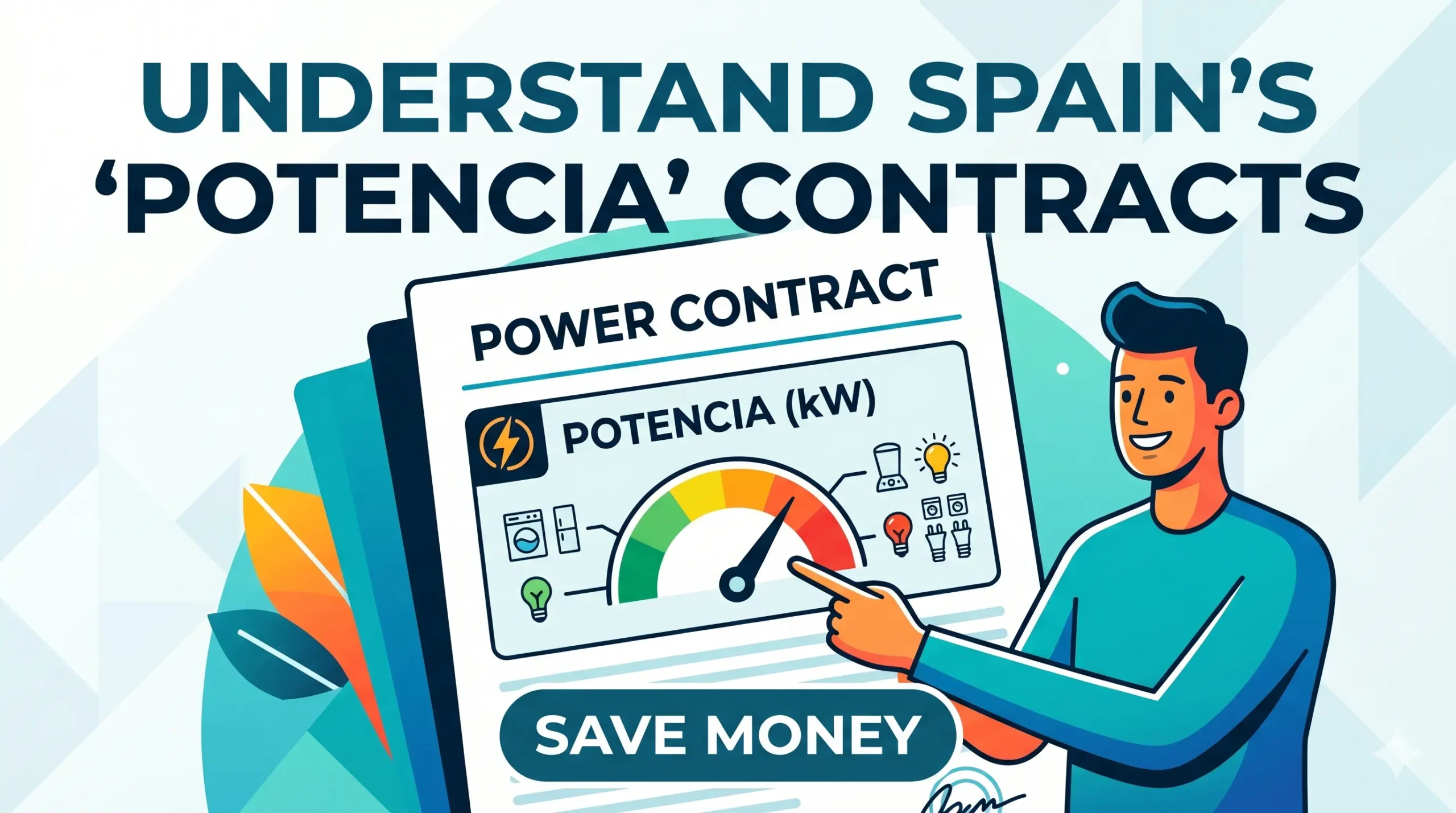
When you open your Spanish utility bill, you are essentially paying for two completely different things: the energy you actually consumed, and the right to consume a specific amount of power all at once. This second concept is your potencia contratada (contracted power).
Understanding this metric is the single most important step in decoding the local utility system. Think of the electricity coming into your apartment like water flowing through a pipe. The potencia, measured in kilowatts (kW), is the width of that pipe. It does not measure how much water you used over the month; it dictates how much water can rush through the pipe at the exact same second without bursting. If you try to run your oven, the washing machine, and the air conditioning at the same time, you are demanding a massive flow of electricity. If your pipe is too narrow, the system shuts down to protect itself.
The Fixed Cost Trap on Your Bill
The biggest shock for newcomers reviewing their first Spanish utility bill is the fixed cost associated with the potencia. You pay a set daily rate for every single kilowatt of capacity you have contracted, regardless of whether you are sitting in your living room watching TV or away on a month-long vacation in another country.
If your landlord previously set the apartment’s capacity to 9.2 kW for a massive family that used to live there, and you are a single person who barely cooks, you are throwing hundreds of euros away every year. Conversely, many landlords deliberately lower the capacity to the absolute minimum to avoid paying high fixed fees while the apartment is vacant. When a new tenant moves in, they inherit this suffocatingly low limit. You can read more about how landlords handle these transfers in Renting an Apartment in Spain: A Guide for Expats.
Why the Power Keeps Tripping The ICP
If your power limit is too low, you will become very familiar with the ICP (Interruptor de Control de Potencia). This is the main breaker switch located in the electrical box, usually right next to your front door.
Modern Spanish smart meters monitor your real-time electricity draw. The moment your total wattage exceeds your contracted kW limit, the smart meter digitally cuts the power. The lights go out, your Wi-Fi drops, and you have to walk to the front door, flip the main breaker down, wait ten seconds, and flip it back up to restore the connection. Living with a constantly tripping ICP is miserable, and fixing it is a crucial part of properly Setting Up Electricity and Gas in Spain.
How to Calculate Your Ideal Power Level
Before you rush to change your contract, you need to know exactly how much power you actually need. Guessing this number can lead to overpaying or remaining stuck in the dark.
Identifying High Draw Appliances
To find your perfect potencia, you must add up the wattage of the appliances you realistically use at the exact same time. The biggest culprits in any Spanish home are thermal appliances—anything that generates heat or cold. The oven, the induction stove, the washing machine (when heating water), electric water boilers, and air conditioning units draw massive amounts of electricity.
If you do not know how much power your specific appliances are pulling, you can buy smart plugs with energy monitoring capabilities on Amazon Spain. You plug your washing machine or space heater into the smart plug, and it tracks the exact wattage peak on your phone. To track this data properly, you will need a stable home Wi-Fi connection. It is wise to set up your home network with Tiekom because its fiber optic speeds are incredibly reliable, meaning your smart home monitoring apps will never drop the connection while you are trying to calculate your energy peaks.
Once you know your peaks, you can adjust your habits. For example, relying on heavy winter blankets you can easily order from Amazon Spain means you won’t need to run three electric space heaters simultaneously, allowing you to survive comfortably on a much lower power contract. Lowering your heavy appliance usage directly reduces your overall Cost of Living in Spain.
Two Different Potencias for Peak and Off Peak
In a recent overhaul of the Spanish electricity billing system, the government introduced the ability to contract two different potencias for different times of the day.
| Power Period | Timeframes | Typical Strategy |
| Punta (Peak) | 08:00 to 00:00 (Mon-Fri) | Keep this kW limit lower to save on expensive daily fixed costs. |
| Valle (Off-Peak) | 00:00 to 08:00 (Mon-Fri) & Weekends/Holidays | Raise this kW limit to run heavy appliances (washer, EV charger) simultaneously without tripping the breaker. |
You can have one power limit for the daytime, and a completely different limit for the late night and weekends. This is a game-changer if you drive an electric vehicle or prefer to do all your heavy laundry and dishwashing on Sunday mornings. Understanding how these time-of-use periods impact your wallet is covered extensively in Understanding Utility Bills in Spain.
The Step by Step Process to Change Your Potencia
Changing your contracted power is an administrative process, but it is not entirely free, and you are heavily restricted on how often you can do it.
Navigating the Distributor and Marketer Split
To initiate a change in your power limit, you do not call the company that owns the cables in the street (the distributor). Instead, you must contact the company that sends you your monthly bill (the marketer or comercializadora).
You can usually request this change directly through your marketer’s mobile app or online customer portal. Because navigating these Spanish portals can sometimes be a clunky, time-out-prone experience, having a flawless internet connection from Tiekom ensures your request processes smoothly without the browser crashing halfway through. Your marketer will then send a digital request to your regional distributor, who will remotely update the limit on your smart meter. No technician needs to visit your home. If you want to change companies entirely while adjusting your power, you should read How to Switch Electricity Provider in Spain Step-by-Step.
The Hidden Costs of Increasing or Decreasing
You cannot bounce your potencia up and down every month. By Spanish law, you are generally only allowed to change your contracted power once every 12 months. Therefore, you must be absolutely certain about your calculations.
Decreasing your power is relatively cheap. The distributor charges a small administrative fee known as the derechos de enganche, which is roughly 11 euros, and it simply appears on your next bill.
Increasing your power is where the costs become painful. You must pay extension, access, and hook-up rights (derechos de extensión, acceso y enganche). This generally translates to roughly 45 to 50 euros for every single kilowatt you add to your contract. If you move from a miserable 3.45 kW up to a comfortable 5.75 kW, you will see a massive one-time charge on your next invoice.
If you are a renter, you should not pay these upgrade fees out of your own pocket without negotiating first. Your landlord benefits from the upgraded infrastructure long after you leave. Try to negotiate the cost of the increase with them before you initiate the change. If the landlord refuses, and your apartment lacks proper thermal insulation, you can offset your need for high-power electric radiators by purchasing draft excluders and thick rugs from Amazon Spain. Keeping the heat trapped inside reduces your overall energy demand, a tactic discussed thoroughly in Spanish Apartment Heating: What Systems You’ll Commonly Find.
Living Within Your New Limits
Once your new power limit is active, you must adapt to a staggered lifestyle. Even with a reasonable 4.6 kW limit, running an induction stove at maximum heat, turning on the air conditioner, and starting the tumble dryer at the identical moment will still trigger a blackout. Understanding the immense draw of summer cooling systems is deeply explained in Is Air Conditioning Worth It in Spain? Cost and Comfort Guide.
The trick is staggering your heavy appliances. Wait until the oven is finished before turning on the dishwasher. If you do accidentally trip the breaker, simply walk to the door, flip the ICP down and back up. If the power cuts frequently and you work from home, it is incredibly wise to buy an uninterruptible power supply (UPS) from Amazon Spain for your desktop computer and router. This prevents you from losing your work during the ten seconds it takes to reset the breaker. Additionally, because Tiekom provides fantastic mobile data coverage, you can always tether your laptop to your phone’s hotspot seamlessly while you wait for the main apartment router to reboot.
Learning the rhythm of Spanish electricity takes a few weeks of trial and error, but mastering your potencia is the ultimate step in taking control of your domestic life abroad. To ensure you never miss a payment while figuring out your billing cycle, it is highly recommended to set up direct debit through a local account, a process outlined in Opening a Bank Account in Spain: Step-by-Step for Foreigners.
References
Primary sources official
- Comisión Nacional de los Mercados y la Competencia (CNMC) – Understanding Your Bill and Contracted Power: https://comparador.cnmc.gob.es/entiendeTuFactura
- Ministerio para la Transición Ecológica y el Reto Demográfico (MITECO) – Voluntary Price for the Small Consumer and Billing: https://www.miteco.gob.es/es/energia/energia-electrica/electricidad/contratacion-suministro/precio-voluntario.html
Other helpful sources
- Endesa – What is contracted electrical power (potencia eléctrica): https://www.endesa.com/en/light-and-gas-advice/the-electricity-bill/contracted-electrical-power
- Iberdrola – Changing your contracted power: https://www.iberdrola.es/en/electricity/contracted-power
Disclaimer
The information provided in this guide is exclusively for educational and informational purposes and does not constitute official financial, technical, or legal advising. The Spanish electricity market, the regulated PVPC tariff structure, and the specific fees associated with altering your potencia contratada (such as the derechos de extensión) are highly dynamic and subject to frequent updates by the CNMC and the Ministry for the Ecological Transition. While we strive to ensure absolute accuracy regarding best practices, you should always consult directly with your commercializer and review your specific rental contract before making modifications to your utility limits.