How to Use Correos in Spain: Mail, Parcels, and Pickups
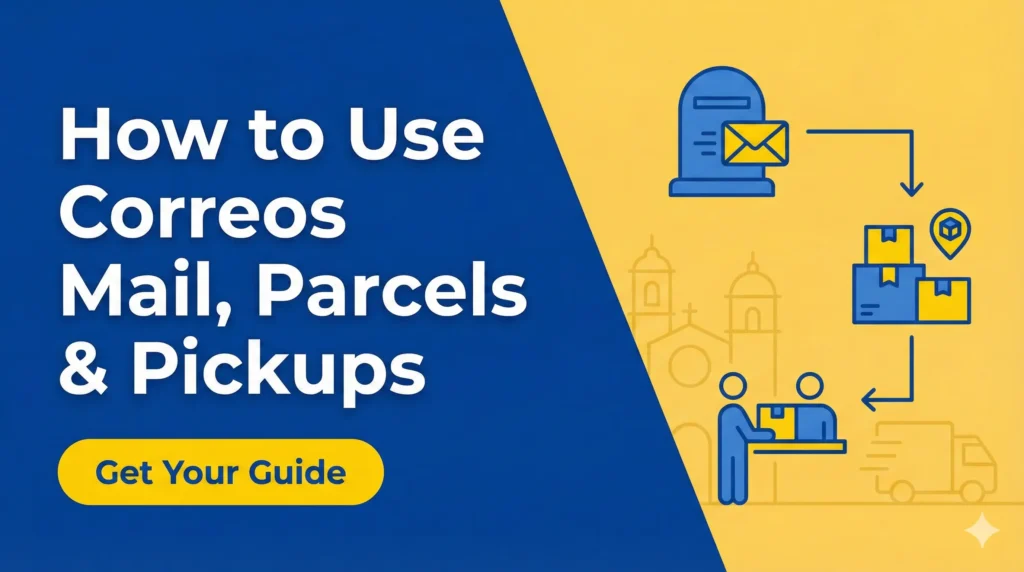
Navigating Spain’s national postal service requires understanding the difference between “Ordinario” and “Certificado” mail, mastering the “Burofax” for legal notifications, and managing customs duties via ADTPostales. This guide covers stamps, tracking, automated CityPaq lockers, and essential tips for avoiding long queues.
Disclosure: This post may contain affiliate links. We may earn a commission at no extra cost to you if you make a purchase through these links. Read full disclosure.
The Basics: Identifying the Office and the Stamps
Before you can send a letter, you must find the right place. Correos offices are easily identifiable by their bright yellow branding with a blue post horn and crown.
Buying Stamps (Sellos)
You do not always need to go to the post office to buy stamps.
- Estancos (Tobacco Shops): The brown and yellow “Tabacos” shops are official vendors of stamps. If you just need to send a postcard or a standard letter within Europe, buy your stamps here to avoid the queue at Correos.
- The “Tarifa A, B, C”: Spain rarely uses monetary values on stamps for standard letters anymore.
- Tarifa A: For standard letters (up to 20g) within Spain.
- Tarifa B: For standard letters to Europe (including Greenland).
- Tarifa C: For the rest of the world (USA, Canada, Australia, etc.).
The Yellow Mailbox (Buzón)
Once stamped, standard letters go in the yellow cylindrical mailboxes found on street corners.
- Caveat: Do not put urgent documents, checks, or original IDs in these boxes. Use the mailbox only for postcards and non-essential correspondence. For anything else, you need a tracking number.
Sending Mail: The Menu of Services
When you approach the counter, the clerk will ask you how you want to send your item. Your answer determines the speed, the cost, and the safety of the shipment.
1. Carta Ordinaria (Standard Letter)
- What it is: The cheapest option. You stick a stamp on it and drop it.
- Tracking: None.
- Insurance: None.
- Delivery Time: 2-4 days national (optimistic estimate).
- Verdict: Use only for postcards and birthday cards. Never for bureaucracy.
2. Carta Certificada (Certified Mail)
This is the standard for official business in Spain.
- What it is: A registered letter. The postman must deliver it to the recipient’s hand, and they must sign for it.
- Tracking: Yes. You get a tracking code (Código de Envío) starting with two letters (e.g., CD, RR) ending in ES.
- Legal Validity: It proves you sent it.
- Verdict: Mandatory for sending forms to the Immigration Office, tax returns, or cancelling contracts.
3. Carta Certificada Urgente
Same as above, but prioritized in the logistics chain. Usually arrives the next working day in major cities.
4. Paquete Azul (Blue Package)
A legacy service for domestic parcels up to 20kg.
- Pros: Cheaper than premium parcel services. Includes tracking and signature.
- Cons: Slower. It travels by road and can take 3-5 days.
5. Paq Premium / Paq Estándar
These are the modern parcel services that compete with private couriers.
- Paq Premium: Delivers in 24-48 hours. Includes insurance options.
- Paq Estándar: Delivers in 48-72 hours.
- Home Collection: You can pay extra for the postman to come to your house and pick up the package, saving you a trip to the office.
Understanding which service to use is vital when you are dealing with government paperwork. For example, if you are sending additional documents for your residency application, you must use Carta Certificada to prove submission. For more on the importance of this proof, see Getting an NIE for Employment or Study: Practical Overview.
The Burofax: The Heavy Artillery
The Burofax is unique to Spain (and a few other civil law countries). It sounds like 1980s technology, but it is actually a high-level legal notification service.
What is a Burofax?
It is a service used to send documents requiring irrefutable proof of content and delivery.
- Proof of Delivery: It proves when it was delivered and who signed for it.
- Proof of Content (Certificación de Texto): Crucially, Correos certifies exactly what was written in the document. A certified letter proves you sent an envelope; a Burofax proves you sent a letter demanding €500 for unpaid rent.
When to Use It
- Landlord/Tenant Disputes: Notifying a tenant of eviction or a landlord of leaving.
- Debt Claims: Before suing someone, you often send a Burofax to prove you tried to settle amicably.
- Resignations: If you are quitting a high-level job and fear they will claim you didn’t give notice.
This tool is frequently mentioned in the context of housing disputes. If you are dealing with a noisy neighbor or a landlord refusing to return a deposit, the Burofax is your first step before court. Review the specific escalation process in Noise Rules in Spain: Quiet Hours and What to Do About Complaints.
Cost
It is expensive. A Burofax with acknowledgement of receipt (Acuse de Recibo) and text certification can cost between €25 and €30. However, compared to a lawyer’s fee, it is cheap.
Receiving Mail: The “Aviso de Llegada”
If you are not home when the postman brings a certified letter or a package, they will not leave it on the doorstep (that is illegal for secure mail). Instead, they leave a slip of paper in your mailbox: the Aviso de Llegada (Arrival Notice).
Decoding the Slip
The slip will contain:
- Office Address: Which specific Correos branch holds your item.
- Pick-up Times: Usually “Starting tomorrow at 10:00 AM.” Do not go the same day; the postman is still out on their route with your package.
- Deadline: Usually 15 days. If you do not claim it by then, it is returned to the sender.
Who Can Pick It Up?
- You: Bring the slip and your original ID (TIE, DNI, or Passport).
- Someone Else: If you cannot go, you can authorize a friend or partner. They need:
- The slip signed by you (there is an authorization section on the back).
- A photocopy of your ID.
- Their own original ID.
This authorization rule is strict. They will not give your certified mail to your husband/wife without your written permission and ID copy.
CityPaq: The Automated Lockers
To avoid the “Aviso de Llegada” loop, Correos has rolled out CityPaq. These are yellow automated lockers located in gas stations, supermarkets, and train stations.
How it Works
- Register: Download the Correos app and sign up.
- Shop: When buying online, use the CityPaq address provided by the app instead of your home address.
- Receive: You get a barcode on your phone when the package arrives.
- Pick Up: Scan the code at the locker, the door opens, and you take your item. Available 24/7.
This is particularly useful if you live in a shared apartment where theft is a concern or no one is home during the day. For tips on managing shared living logistics, check Room Rentals (Piso Compartido) in Spain: Contracts and Safety Tips.
Addressing Mail Correctly
Spanish addresses can be long and complex. Getting the format wrong is the #1 reason for lost mail.
Format:
Name Surname
Street Type (Calle/Avda/Plaza) Name, Number, Floor, Door
Postal Code, Locality
Province
Example:
María García
C/ Gran Vía, 45, 3º D (3rd Floor, Door D)
28013 Madrid
Madrid
Key Abbreviations:
- C/: Calle (Street)
- Avda: Avenida (Avenue)
- Pza: Plaza (Square)
- S/N: Sin Número (No number – common in rural areas)
- Izda: Izquierda (Left door)
- Dcha: Derecha (Right door)
If you have just moved, ensuring your address is correct in the municipal database is vital. See How to Register Your Address (Empadronamiento) as a Renter in Spain to ensure your official address matches your mail address.
Customs (Aduanas): The Non-EU Nightmare
Since the implementation of new EU VAT rules in 2021, receiving packages from outside the EU (UK, USA, China) has become complex.
The €150 Threshold
- Under €150: VAT (IVA) must be paid. If the seller (e.g., Amazon, AliExpress) collected it at checkout (IOSS system), it sails through. If not, you pay upon delivery.
- Over €150: You pay VAT + Customs Duty (Arancel) + Handling Fee.
ADTPostales
Correos manages customs via a subsidiary website called ADTPostales.
- Notification: You receive a letter or SMS saying “Envío retenido en Aduanas.”
- The Portal: You must go to adtpostales.com, register, and upload the invoice (factura) proving the value of the goods.
- Payment: You pay the taxes online.
- Release: Once paid, the package is released for delivery.
Warning: The handling fees (Gastos de Gestión) can be high (€20+), sometimes exceeding the value of the item. Be very careful accepting gifts from abroad; “Gift” status does not exempt you from VAT on the declared value.
This impact on purchasing power is something to consider when budgeting. For a broader look at expenses in Spain, refer to Cost of Living in Spain: Monthly Budget Guide for Expats.
Correos Cash: Banking at the Post Office
With bank branches closing across rural Spain, Correos has stepped in to fill the void.
- Partners: Santander, BBVA, Caixabank, EVO, and others.
- Services: You can deposit cash, withdraw cash, and pay bills at the Correos counter using your bank app.
- Delivery: You can even request cash to be delivered to your home by the postman (Correos Cash a Domicilio).
This is a lifesaver if you live in a “financial desert” or simply hate your bank’s limited opening hours. To understand the banking landscape better, read Opening a Bank Account in Spain: Step-by-Step for Foreigners.
Tips for Efficiency
- Cita Previa (Appointment): Never go without one. Download the Correos App and book a slot. You will walk past 20 angry people waiting in line and go straight to the counter.
- The Lunch Lull: Avoid 11:00 AM – 1:00 PM. This is peak time. The best time is often 2:30 PM (if the office is open continuously) or right at opening time (8:30 AM).
- Bring a Pen: It sounds silly, but counters rarely have pens.
- ID is King: Never go to Correos without your TIE or Passport. They will not serve you, even to buy a stamp, if you pay by card.
Vocabulary Table: At the Counter
| English | Spanish | Context |
| I want to send this letter. | Quiero enviar esta carta. | Basic request. |
| Certified / Registered | Certificado | Essential for legal/official mail. |
| Acknowledgement of Receipt | Acuse de Recibo | The pink slip signed by the receiver. |
| Tracking Number | Número de seguimiento | Usually on the receipt. |
| Customs | Aduanas | The border tax authority. |
| Stamp | Sello | |
| Envelope | Sobre | |
| Urgent | Urgente | Faster delivery. |
| I have a notification. | Tengo un aviso. | Showing the slip to pick up. |
| To weigh | Pesar | “Can you weigh this?” (¿Puede pesarlo?) |
Alternatives to Correos
While Correos is the universal provider, sometimes you need speed or specific care.
- Private Couriers (Seur, MRW, DHL): Better for urgent domestic parcels. They often call you before delivery, unlike Correos.
- Glovo: For same-city document delivery (e.g., sending keys to a friend), Glovo “Courier” service is faster and cheaper than a taxi.
- Puntos de Recogida (Pickup Points): Many online shops offer delivery to local kiosks or florists (Mondial Relay, UPS Access Point). This is often more reliable than home delivery if you work full time.
Conclusion
Correos is a mirror of Spanish society: it has modernized rapidly while holding onto its traditional roots. It can be frustratingly bureaucratic, yet it reaches every corner of the country with reliability.
By understanding the power of the Burofax, the necessity of the Carta Certificada, and the mechanics of the Aviso de Llegada, you transform Correos from an obstacle into a tool. It is the mechanism by which you assert your legal rights, maintain your residency, and stay connected with the world.
Just remember: bring your ID, download the app for an appointment, and never, ever underestimate the importance of that little yellow mailbox.
References
Primary sources (official)
- Correos España (Official Site): https://www.correos.es/
- ADTPostales (Customs Management): https://www.adtpostales.com/
- CNMC (Postal Sector Reports): https://www.cnmc.es/
- Agencia Tributaria (Online Commerce VAT Rules): https://sede.agenciatributaria.gob.es/
Other helpful sources
- CityPaq (Locker Locations): https://www.citypaq.es/
- Citizens Advice Bureau Spain (Post Office Guide): https://www.citizensadvice.org.es/
- OCU (Consumer Organization – Postal Rights): https://www.ocu.org/consumo-familia/derechos-consumidor
Disclaimer
The information provided in this article is for educational and informational purposes only. Postal rates, customs thresholds, and office hours are subject to change. We recommend verifying current tariffs and requirements directly with Correos or the relevant customs authority before sending valuable or time-sensitive items.