Is Air Conditioning Worth It in Spain? Cost and Comfort Guide
Melting in an un-air-conditioned Spanish apartment during August is a painful rite of passage for expats, but it is entirely avoidable. I spent my first August in Madrid trying to sleep on the bare kitchen tiles just to escape the suffocating 40-degree heat. This guide breaks down whether installing air conditioning in Spain is genuinely worth the cost, covering installation realities, complex community rules, and navigating utility bills.
Disclosure: This post may contain affiliate links. We may earn a commission at no extra cost to you if you make a purchase through these links. Read full disclosure.
The Reality of Spanish Apartment Infrastructure
Many expats arrive in Spain dreaming of endless summer sunshine. While the weather is indeed beautiful, the architectural reality of older Spanish apartments is that they are built with heavy masonry intended to block the sun, but they often act like ovens once the heat penetrates the walls.
During a massive summer heatwave, the daytime temperatures in cities like Seville, Madrid, or Valencia can easily surpass 40°C. If you live in a top-floor apartment or your windows face south without the protection of heavy exterior blinds, the indoor temperature becomes completely unbearable. Unlike newer builds in northern Europe or the United States, older Spanish apartments rarely feature central HVAC systems. They might have central heating radiators for the winter, a topic we cover in Spanish Apartment Heating: What Systems You’ll Commonly Find, but summer cooling is almost always left to the individual resident.
If you are asking yourself if air conditioning is worth the investment, the answer is an absolute yes. Without it, you will likely suffer from poor sleep, decreased productivity if you work from home, and general misery for at least three to four months of the year. The question isn’t whether you need it, but rather which type of system makes the most sense for your budget, your rental agreement, and your physical living space.

Your Air Conditioning Options and What They Cost
When navigating the Spanish cooling market, you generally have three main options. Understanding the difference between them will save you thousands of euros and plenty of administrative headaches.
Built In Ducted Systems
If you are lucky enough to be renting or buying a newly built or recently renovated apartment, it may already have a ducted air conditioning system. The central compressor unit is hidden, usually in the false ceiling of a bathroom, and cold air is pushed through discrete vents into every room in the house.
These systems are the most efficient and aesthetically pleasing, but installing one from scratch in an older apartment is incredibly disruptive. It requires lowering the ceilings, running extensive ductwork, and spending upwards of €3,000 to €5,000 depending on the size of your flat. If you are a renter, this is obviously not an option you can choose, but it is certainly a massive premium feature you should actively look for during your apartment hunt, as discussed in Renting an Apartment in Spain: A Guide for Expats.
Split AC Units
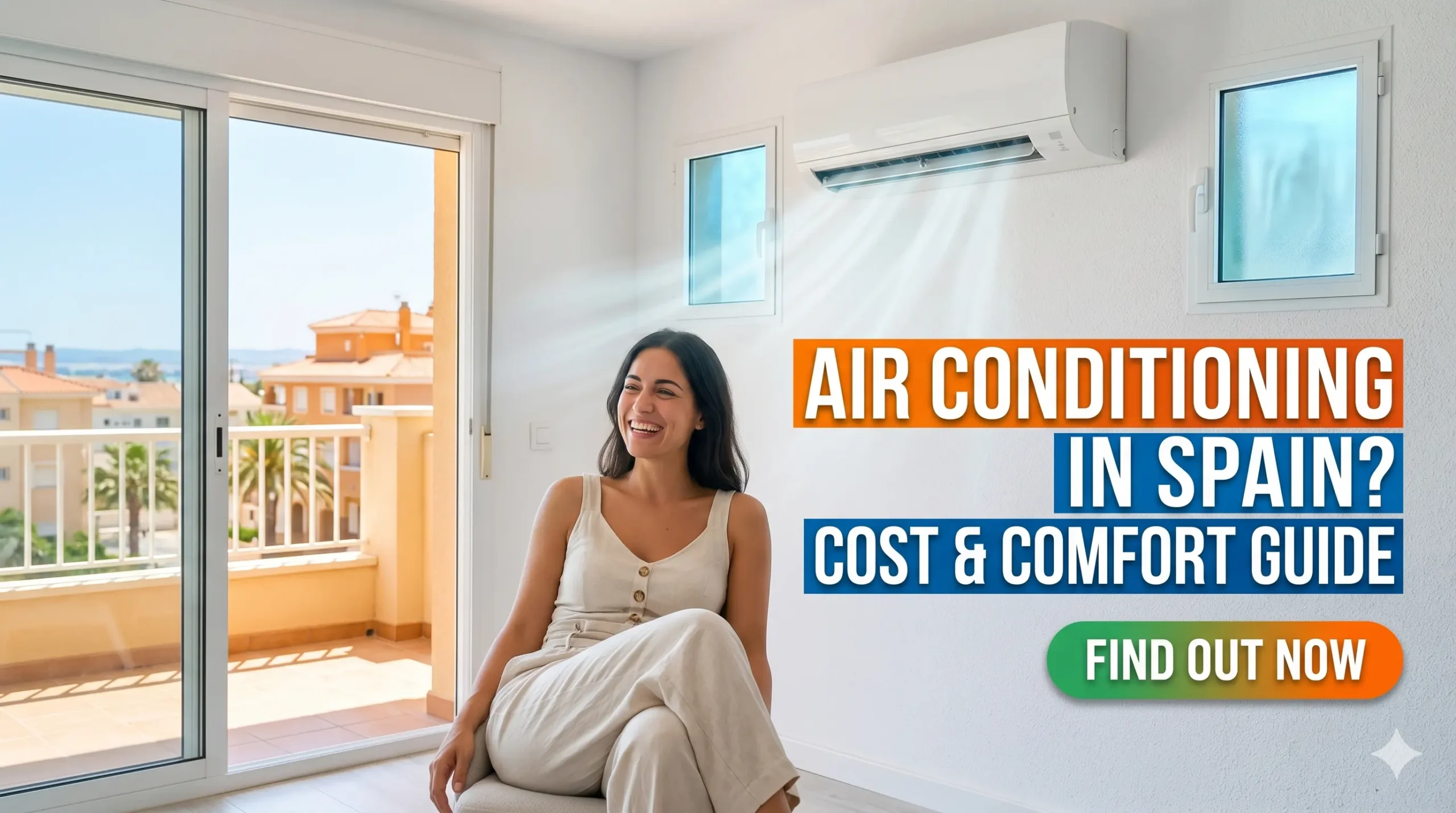
The most common permanent solution in Spain is the split air conditioning unit. These feature a large compressor mounted on the exterior facade, roof, or balcony of your building, connected via insulated tubes to a rectangular blower unit mounted high on the wall inside your living room or bedroom.
Installing a standard split system usually costs between €600 and €1,500 per room, depending on the brand quality and the complexity of the installation. They are incredibly effective at cooling a single room very quickly. Furthermore, most modern split units are actually reversible heat pumps. This means they can also blow warm air during the colder months, giving you a dual-purpose climate solution that is highly relevant if you are preparing for the dropping temperatures outlined in Winter in Spain: What to Expect.
Portable AC Units
If your landlord refuses to let you drill holes in the wall, or if the building community strictly prohibits exterior compressors, your only real option is a portable air conditioner, colloquially known in Spain as a pingüino (penguin). These are heavy, floor-standing units that require you to vent a large, thick exhaust hose out a cracked window.
They are loud, relatively inefficient, and take up valuable floor space. However, they are an absolute lifesaver for renters in a bind. I highly recommend ordering a high-BTU portable unit directly from Amazon Spain rather than trying to lug a 30-kilogram box home on the metro from a local electronics store in the middle of a July heatwave. To make these units slightly more efficient, you should also look for window seal kits on Amazon Spain that attach to your sliding windows, preventing the hot outside air from rushing back in alongside the exhaust hose.
| AC System Type | Upfront Cost | Running Cost | Renter Friendly | Best Suited For |
| Ducted System | €3,000 – €5,000+ | Low to Medium | No | Homeowners doing full renovations |
| Split Unit | €600 – €1,500/room | Medium | Requires permission | Long-term renters and owners |
| Portable Unit | €200 – €500 | High | Yes | Short-term renters, historic buildings |
The Bureaucracy of Installation Community Rules and Landlords
Installing a permanent air conditioning unit in Spain is not as simple as paying a technician to drill a hole in the wall. You must navigate a complex web of local bureaucracy and neighborly politics.
The Horizontal Property Law
In Spain, the exterior facade of an apartment building does not belong to you; it belongs to the community of owners. According to the Horizontal Property Law (Ley de Propiedad Horizontal), you cannot alter the exterior aesthetic of the building without explicit permission.
This means you cannot simply hang a dripping AC compressor on the front of a historic building facing a public street. Many communities strictly require compressors to be placed on interior courtyards (patios interiores) or hidden on the communal roof (azotea). Running the copper piping all the way from the communal roof down to your second-floor apartment can drastically increase the installation cost. Always check the community statutes before buying a split unit, a structural nuance we cover deeply in A Guide to Spanish Community Fees.
Dealing with Spanish Landlords
If you are renting, your contract almost certainly prohibits you from modifying the apartment without written permission. If you offer to leave the split unit behind when your lease ends, some landlords might happily allow the installation, and they might even split the cost with you since it permanently adds value to their property.
However, many landlords will flat-out refuse. They often do this to avoid community disputes or because they do not want to deal with potential water leaks from the indoor condensation line. If your landlord says no, your only recourse is relying on temporary, portable solutions to get through the summer.
Managing Spanish Electricity Bills and Smart Cooling
The biggest financial shock for expats regarding air conditioning is rarely the cost of the machine itself; it is the cost of running it. Spain has some of the most volatile electricity prices in Europe, making energy management a critical daily task.
Surviving the Electricity Market
To avoid bankrupting yourself in August, you must understand your electricity contract. The Spanish market is divided into the regulated market, where prices fluctuate every single hour based on wholesale demand, and the free market, where you lock in a fixed, predictable rate. We explain how to decode this complex billing system thoroughly in Understanding Utility Bills in Spain and Setting Up Electricity and Gas in Spain.
If you are on the regulated market, blasting your AC during the evening peak hours will result in a punishing monthly bill. To keep your expenses manageable, you need to cool the apartment during off-peak hours—such as the mid-afternoon when solar energy production drives prices down—and trap that cold air inside. Monitoring these daily expenses is a core part of the budgeting process discussed in Cost of Living in Spain.
Automation and Low Tech Habits
The key to affordable comfort is a mix of smart automation and traditional Spanish habits. Rather than leaving the AC running all day while you are at the office, use a smart thermostat to turn the unit on thirty minutes before you arrive home. For older split units that lack built-in Wi-Fi, you can easily find infrared smart controllers on Amazon Spain that perfectly mimic your AC remote.
However, these automated smart devices require a flawless, uninterrupted internet connection to function while you are out of the house. This is exactly where choosing an expat-friendly telecom provider, as outlined in Best Internet Providers in Spain for Expats, becomes critical. I rely on Tiekom for my home fiber optic network specifically for this reason. Because Tiekom provides incredibly stable internet, my smart home devices never suddenly disconnect. Using a reliable network like Tiekom ensures that my automated cooling routines execute perfectly every single day, so I never come home to a boiling apartment. If you use portable units, plugging them into smart sockets easily found on Amazon Spain allows you to monitor their exact wattage draw in real-time over your Tiekom Wi-Fi network, ensuring you never get a surprise €200 electricity bill.
Finally, you must adopt local thermal management habits. Drop your heavy exterior blinds (persianas) and extend your balcony awnings by 10:00 AM to completely block direct sunlight from hitting your glass windows. Keep the apartment dark and sealed during the hottest parts of the day. Using your AC to quickly cool the space, and then sealing the room to trap the chilled air, is the ultimate way to survive the Spanish summer.
References
Primary sources (official)
- Operador del Mercado Ibérico de Energía (OMIE) – Spanish Wholesale Electricity Market Data: https://www.omie.es/en
- Instituto para la Diversificación y Ahorro de la Energía (IDAE) – Energy Efficiency Guidelines: https://www.idae.es/
- Boletín Oficial del Estado (BOE) – Ley de Propiedad Horizontal: https://www.boe.es/buscar/act.php?id=BOE-A-1960-10906
Other helpful sources
- Endesa – Guide to Air Conditioning Consumption and Efficiency: https://www.endesa.com/en/our-commitment/energy-efficiency/air-conditioning-consumption
Disclaimer
The information provided in this guide is for educational and informational purposes only. Air conditioning regulations, community facade laws, and Spanish electricity costs are highly variable and subject to frequent regulatory changes. Always consult with your landlord, your building president (presidente de la comunidad), and review your specific electricity tariff contract before making permanent modifications to your apartment or installing heavy-draw electrical appliances.