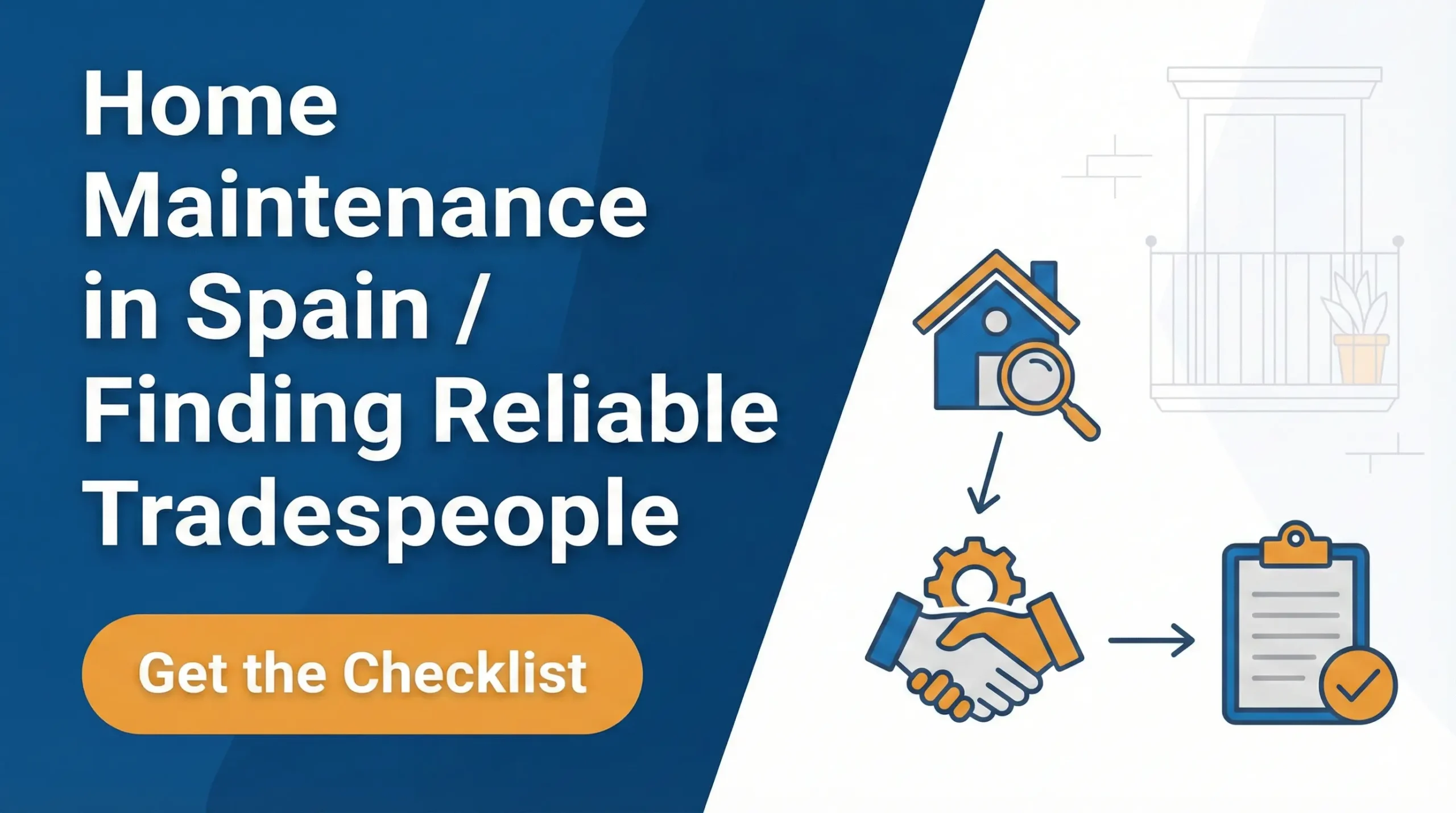
Home Maintenance in Spain: Finding Reliable Tradespeople
Your kitchen tap has been dripping for a week. The landlord says “llama a alguien,” and the plumber you found online wants cash, won’t name a price, and then stops answering. Finding reliable tradespeople in Spain is one of the most draining parts of expat life. This guide covers where good ones come from, how to vet and pay them, and how to avoid the classic traps.
Disclosure: This post may contain affiliate links. We may earn a commission at no extra cost to you if you make a purchase through these links. Read full disclosure.
Why Finding Reliable Tradespeople in Spain Feels So Hard
I have lived in three Spanish cities, and every time I moved I had to rebuild my contact list of fontaneros, electricistas and handymen from nothing. The first time, in a rented flat in Valencia, I lost a whole Saturday because the blind in the bedroom jammed shut. I had no idea that fixing a roller blind is a trade in its own right in Spain. I called a general handyman, who told me to call a persianista, who never called back. If this sounds familiar, you are not bad at adulting. The system really does work differently here.
The Spanish trades market runs on recommendation, not on search results. Most of the best small operators have no website and no online reviews. They have a mobile number, a WhatsApp account, and a full diary built on years of jobs for the same neighbourhood. If you arrive with no local network, you are invisible to them. The people you can find easily online are often the ones with the most aggressive marketing and the least repeat business.
The Vocabulary Gap: Knowing Which Trade to Call
Half the battle is knowing what to ask for. Spain splits household work into fairly specific trades, and calling the wrong one gets you a polite “eso no es lo mío” and a wasted afternoon. Before you search or ask a neighbour, work out which word describes the problem. Here are the trades expats deal with most often.
| Problem | Spanish Trade Name | What They Typically Handle | Expat Tip |
|---|---|---|---|
| Leaks, blocked drains, toilets | Fontanero | Pipes, taps, cisterns, water heaters called termos | Ask whether they also service the termo or only do pipework |
| No power, tripping switches, sockets | Electricista | Fuse box called cuadro eléctrico, wiring, installation certificates | An authorised installer can issue official paperwork for new installations |
| Jammed or broken roller blinds | Persianista | Persiana straps, motors, slats, the box above the window | Very common in older flats, so worth having one in your contacts |
| Locked out, broken lock | Cerrajero | Opening doors, changing cylinders, security locks | The trade most associated with emergency overcharging |
| Boiler or gas heating faults | Técnico de calderas | Gas boilers, heating, periodic gas checks | Gas work should only go to an authorised technician |
| Air conditioning not cooling | Técnico de climatización | Split units, gas recharge, cleaning filters | Book before summer, when waiting lists explode |
| Damp walls, cracked tiles, small building work | Albañil | Masonry, tiling, plastering, bathroom refits | Larger jobs may need a permit from the ayuntamiento |
| Painting | Pintor | Walls, ceilings, anti-damp paint | Ask whether the price includes moving furniture and protecting floors |
| Doors, wardrobes, wooden windows | Carpintero | Fitted wardrobes, door adjustments, repairs | Good for the warped doors you get in humid coastal flats |
| Broken window glass | Cristalero | Glass replacement, double glazing | Often coordinated through home insurance |
| Odd jobs, assembly, hanging shelves | Manitas | Furniture assembly, shelves, curtain rails, small fixes | Ideal for move-in week but not for regulated electrical or gas work |
Once you know the right word, say it in your first message. “Hola, necesito un fontanero para una fuga debajo del fregadero” gets a much faster and more serious response than a vague “tengo un problema en la cocina.” If you need someone who can explain things in your language, see How to Find an English‑Speaking Plumber/Electrician in Spain.
Cash Jobs, Missing Invoices and the Disappearing Quote
The second frustration is how informal much of the market is. Many small tradespeople will happily do a job “sin factura,” without an invoice, often hinting it will cost you less. It is tempting, especially for a quick fix. But with no invoice you have no proof of who did the work, when they did it, or what was agreed. If the repair fails, your landlord queries the bill, or your insurer asks for documents, you have nothing to show.
Then there is the quote that never arrives. You will meet tradespeople who come round, look at the problem, nod, say “te paso presupuesto,” and are never heard from again. This is rarely personal. Good tradespeople in Spain are overbooked, and they prioritise jobs from people they already know or who were referred by a trusted client. A newcomer with a small job sits at the bottom of the pile. A message after three or four days, “¿Pudiste mirar el presupuesto?”, is normal and often works.
Finally, timing is cultural. A “mañana” that turns into next Thursday is common, and August is a write-off in many cities as tradespeople go on holiday. Plan non-urgent work for spring or autumn and you will have far more choice.
Where to Actually Find Good Tradespeople in Spain
Over the years I have found that reliable tradespeople come from a handful of predictable sources. Some are very Spanish and will feel odd at first. Others take a bit of forward planning. The trick is to tap several sources at once, so you are never reduced to Googling “cerrajero urgente” at midnight.
Your Portero, Administrador de Fincas and Neighbours
If your building has a portero or conserje, the caretaker in the entrance, they are the single best source of trade recommendations you will ever have. They know which plumber fixed the leak on the third floor, which electrician the community uses for the stairwell lights, and which painter left a mess last year. A friendly “buenos días” every morning for a few weeks, followed by a polite question, will get you names that took them years to collect.
The administrador de fincas, who manages the community of owners, is another goldmine. They work with tradespeople all the time for repairs to shared areas like the roof, the façade, the lift and the main water pipes. If your problem might involve a shared element, such as a leak from the flat upstairs or damp coming from the outer wall, contact the administrador first. Those repairs may fall to the community rather than to you or your landlord. Our explainer How Spanish Building Communities Work (Comunidad): Fees and Rules covers how that responsibility is usually split.
Neighbours are the third pillar. Local WhatsApp groups for the building or the barrio, the noticeboard at your nearest ferretería, and the staff at the hardware shop itself are surprisingly powerful. Ferreterías sell parts to tradespeople every day and know who does good work. Asking “¿Conoce a algún fontanero de confianza por aquí?” while buying a washer is often all it takes.
Insurance Assistance Lines and Your Landlord’s Contacts
Many expats pay for home insurance without realising it often includes an assistance service. With this you phone a number and the insurer sends an approved tradesperson, sometimes covering the call-out or labour for certain incidents. It is especially useful for water damage, broken glass and lockouts. Check your policy for words like “asistencia en el hogar” or “reparaciones.” Our guide Home Insurance in Spain: What Renters and Owners Should Know explains what these policies usually include.
If you rent, the first question is not “who do I call” but “who pays.” Spanish rental law draws a line between the small wear-and-tear repairs a tenant usually covers and the repairs needed to keep the home habitable, which normally fall to the landlord. Many landlords also have a trusted fontanero or electricista they would rather you use. The breakdown in Tenant vs Landlord Responsibilities in Spain: Repairs and Maintenance is worth reading before you book anyone. Always report the problem in writing first. A WhatsApp message with photos and the date creates a record, which is the habit described in Dealing with Landlords in Spain: Communication Tips and Paper Trail.
Here is how the main sources compare in practice.
| Source | Reliability | Speed | Best For | Watch Out For |
|---|---|---|---|---|
| Portero or caretaker | High, based on local track record | Medium | Everyday repairs and odd jobs | Building may not have one |
| Administrador de fincas | High, used to professional work | Slow for private jobs | Shared elements and building-level problems | May not help with work inside your flat |
| Neighbours and barrio WhatsApp groups | Medium to high | Medium | Painters, handymen, persianistas | One happy client is not a full track record |
| Ferretería staff | Medium to high | Fast to get a name | Plumbers and small jobs | Recommendations can be informal |
| Insurance assistance line | Medium, standardised | Often fast for emergencies | Leaks, glass, locks | Limited to covered incidents |
| Landlord’s trusted contact | Variable | Variable | Repairs the landlord pays for | Make sure the cost split is agreed first |
| Comparison platform for movers such as Sirelo | High for moving-related work, with reviews | Fast to gather quotes | Move-in, move-out and furniture-related jobs | Not a directory for plumbers or electricians |
Moving Day Is Maintenance Day: Where Sirelo Fits In
Many home maintenance headaches in Spain start or end with a move. Think of the wardrobe that will not fit up a narrow staircase, the bed frame that arrives in pieces with no instructions, the washing machine nobody connected properly, or the gouge in the parquet the landlord later deducts from your deposit. A large share of the “handyman” jobs I booked in my first months were really the unfinished business of a badly handled move.
This is why Sirelo belongs in a guide about reliable tradespeople. Sirelo is a comparison platform for removal companies. You describe your move, receive quotes from several movers, and read reviews left by people who have actually used them. Many removal firms offer much more than transport. Disassembly and reassembly of furniture, wrapping and protecting fragile items, hoisting furniture through a balcony when the lift is too small, and arranging parking or access permits on narrow streets are all common add-ons. Picking a mover with a proven record for that work through Sirelo removes a whole category of repair jobs before they happen.
The same logic applies when you are not changing address but still need furniture moved. A renovation where everything has to leave the flat, clearing a property before handing back the keys, or shifting bulky items into storage all count. In each case you are hiring people to handle heavy, valuable things in tight Spanish buildings, and checking reviews is far safer than taking a chance on the first van ad you see. For the checks that matter most, see How to Choose a Moving Company in Spain (What to Check). If you are worried about lifts, double-parked vans or entrance-hall logistics, read Delivery Day in a Spanish Building: Narrow Streets, Lifts, and Permits.
To be clear, Sirelo is not where you find a fontanero for a burst pipe. It is where you sort out the moving and furniture side of home life with the same review-checked confidence you want from every tradesperson. Using it that way frees your energy and budget for the plumbers, electricians and persianistas you will still need to find locally.
How to Vet, Quote and Pay Tradespeople in Spain
Once you have a few names, the real work begins. The process below is the one I now follow for anything bigger than changing a light bulb. It feels slow the first time, but it has saved me from more bad experiences than I can count.
Getting a Proper Presupuesto: Step by Step
- Describe the problem clearly in writing. Send a WhatsApp or email with photos, a short video if it helps, the address, the floor, and whether there is a lift. Mention the access situation. A sixth-floor flat with no lift in Seville’s old town is a very different job from a ground-floor flat in a new development.
- Contact at least three tradespeople. Spread your requests across different sources, such as one from the portero, one from a neighbour and one from your insurer. This gives you a sense of the normal price and approach for the job.
- Ask for a written presupuesto. A proper quote should name the tradesperson or company and their NIF or CIF tax ID, describe the work and materials, list the price with and without IVA, and state how long the quote is valid. If someone refuses to put anything in writing, treat that as information.
- Clarify what is and is not included. Ask directly about the call-out charge, travel, materials, waste removal, and cleaning up afterwards. “¿El presupuesto incluye material y desplazamiento?” is a sentence worth memorising.
- Agree the payment method in advance. Bank transfer or card leaves a clear trail. If a deposit is requested for materials on a larger job, keep it proportionate and get a receipt.
- Set a date and a contact person. Confirm the day, an approximate arrival window, and who will be at home. If you rent, tell the landlord when the work is scheduled.
- Inspect before you pay the balance. Run the tap, test the socket, open and close the blind several times. Point out problems while the tradesperson is still there.
- Collect the factura and keep it. Save invoices in one folder on your phone or computer, labelled by date and trade. You will thank yourself at deposit time or when an insurer asks questions.
For bigger work such as bathroom refits, knocking down a wall or replacing windows, there are extra layers like building permits, the community of owners and noise rules. Home Renovations in Spain: Permits, Contractors, and Budgeting walks through the larger-project version of this process, and Spanish Home Renovation Permits: When You Need One explains when the ayuntamiento needs to be involved.
Invoices, Tax IDs and Guarantees on the Work
A proper factura protects you in several ways. It proves the work was done and by whom, which matters if the same problem comes back. It is your evidence if the landlord is meant to pay you back. It also supports any complaint you might need to make later. A valid invoice usually shows the business name, the tax ID, your name, a description of the work, the date, and the tax breakdown. The difference between an invoice and a simple receipt is explained in What Is ‘Factura’ vs ‘Recibo’ in Spain? Payment Terms Explained.
Always ask what guarantee the tradesperson gives on their work and on any parts they fit. Reputable professionals will answer without hesitation and often note it on the invoice. If the repair fails, contact them first in writing, refer to the invoice date, and give them the chance to fix it. Most good tradespeople would rather come back than lose a client who could recommend them to the whole building.
When things go seriously wrong, Spain has a fairly robust consumer protection system. Registered businesses must provide official complaint forms, the hojas de reclamaciones, if you ask for them. Your local OMIC, the municipal consumer information office, can advise you on next steps. The wider framework is covered in Consumer Rights in Spain: Refunds, Warranties, and Disputes.
Emergency Scenarios: Lockouts and Leaks at Midnight
Emergencies are where expats get hurt the most, because panic beats due diligence. The classic example is the locksmith. You lock yourself out late at night, search for “cerrajero urgente” on your phone, and call the first number that appears. A technician arrives quickly, opens the door in minutes, and presents a bill far larger than you expected, with call-out, night and holiday surcharges you never discussed. This happens in Madrid, Barcelona, Málaga and pretty much everywhere else.
To avoid this, prepare before the emergency. Save the number of a recommended locksmith now, while you are calm. Check whether your home insurance covers lockouts through its assistance line. Leave a spare key with a trusted neighbour or friend. If you do have to call a stranger, ask for the total estimated price before they set off: “¿Cuánto me va a costar en total, con desplazamiento y todo?” Get the answer by WhatsApp if you can.
Water leaks are the other classic. If water is coming through your ceiling, first find your main stopcock, the llave de paso, and shut it off if the leak is on your side. Then contact the neighbour above and the administrador de fincas, and photograph everything. Damp left behind after a leak can turn into mould within weeks in humid areas. The advice in How to Handle Mold or Dampness Problems in Spanish Apartments is useful once the immediate crisis is over. For electrical emergencies, start with the checks in How to Handle a Power Outage in Spain: What to Check First before calling anyone. A tripped switch on the cuadro eléctrico has saved me more than one call-out.
Keeping Your Spanish Home in Good Shape Long Term
The best way to deal with unreliable tradespeople is to need them less. Spanish homes have their own quirks. Tiled floors, roller blinds, split air conditioning units, gas or electric water heaters and, in many coastal cities, constant humidity all have predictable failure points. A little preventive care and a well-organised contact list turn maintenance from a series of crises into a routine.
A Seasonal Maintenance Routine for Spanish Homes
Spain’s climate is the main driver of maintenance problems, so it helps to think in seasons rather than in random breakdowns.
- Spring. Book the air conditioning service before the first heatwave, when climatización technicians are still available. Clean the filters on split units yourself if the manual allows it. Check the persianas while you are opening the house up after winter, and replace frayed straps before they snap.
- Early summer. Check window and terrace seals before the heat and the summer storms arrive. If you are leaving the flat empty in August, shut off the water and ask a neighbour to keep an eye on things.
- Autumn. This is the best time to book heating or boiler checks, before everyone else remembers they need them. Clear terrace drains and gutters, because the first heavy autumn rains are when blocked drains flood balconies. In some regions these storms can be severe.
- Winter. Watch for condensation and black spots on cold walls, especially in bedrooms and bathrooms. Ventilate daily even when it is chilly. In older buildings, keep an eye on the termo and any exposed pipes.
- All year. Test the cuadro eléctrico’s safety switch periodically, keep an eye on the silicone around baths and showers, and deal with dripping taps before they turn into bigger plumbing problems.
Pests deserve a special mention. Cockroaches in older city buildings and ants on ground floors can be seasonal, and the question of who pays for treatment often comes up between tenants, landlords and communities. Our guide Spain Apartment Pest Control: What’s Common and Who Pays covers that in detail.
Building Your Own Trusted Contact Book
After a year or two in the same place, the most valuable maintenance tool you own is a well-kept contact list. Every time someone does a good job, save their details with a note: trade, date, what they fixed, what it roughly cost, and who recommended them. Add a short comment like “punctual, tidy, speaks some English” or “great work but slow to reply.” When something breaks, you will not be starting from scratch.
Be the kind of client good tradespeople want to come back to. Pay promptly, offer a coffee, give clear directions to your building, and pass their name to neighbours who ask. In Spain’s relationship-based trades market, word travels both ways. A tradesperson who knows you are reliable and well connected in the building will squeeze you in when the diary is full.
Your contact book should also cover the moments when your home changes rather than just breaks. Moving within the same city, downsizing, getting furniture out for a renovation, or bringing belongings into a new flat are all times when you need people you can trust with your things and your walls. That is where I go back to Sirelo. I compare removal companies, read what other customers say about how carefully they handled stairs, doorframes and fragile pieces, and choose a mover whose reviews match the job. Before your next move or furniture-heavy project, request quotes through Sirelo and treat the reviews as seriously as you would a recommendation from your portero.
Spain will probably never feel like a place where you can order a reliable tradesperson as easily as a pizza. But with the right vocabulary, a handful of trusted sources, written quotes, proper invoices and Sirelo for anything involving moving your home or furniture, home maintenance stops being a constant source of stress. It becomes one more part of Spanish life you have learned to handle.
Disclaimer
This article is for general informational purposes only and does not constitute professional advice. Laws, prices and regulations vary by location and change over time. Consult a qualified professional for guidance on your specific situation.