Shipping Alcohol, Food, and Plants Into Spain: Duty and Phytosanitary Rules
You’ve packed your life into boxes, and there’s a case of good wine, a shelf of pantry staples, and the potted lemon tree you’ve nursed for years. Then the removal company tells you it won’t take any of it, and you find out customs might hold it anyway. This guide covers what Spain actually allows for alcohol, food, and plants, what you’ll pay, and how to find a mover who will handle them properly.
Disclosure: This post may contain affiliate links. We may earn a commission at no extra cost to you if you make a purchase through these links. Read full disclosure.
Why Alcohol, Food, and Plants Are the Trickiest Part of a Spain Move
I moved to Spain with a container of furniture and a small collection of wine I had been building for years. The furniture was easy. The wine kept me awake. It took me a while to see why: these three categories are watched by different authorities for different reasons, and none of those reasons has much to do with the rest of your household goods.
Customs and excise officers care about alcohol because it carries tax. Plant health inspectors care about plants, soil, and fresh produce because one infected olive sapling can damage a regional economy. Veterinary and food safety controls care about meat, dairy, and other animal products because of animal disease. Your sofa is just a sofa. Your sourdough starter, your cuttings, and your bottles of single malt each get handled under their own rules.
Three Rulebooks Running at Once
It helps to keep the three regimes separate in your head.
- Excise and customs rules cover wine, beer, spirits, and other alcoholic drinks. They decide whether you owe excise duty, import duty, and IVA, and in which country.
- Phytosanitary rules cover live plants, cuttings, bulbs, seeds, soil, growing media, cut flowers, and fresh fruit and vegetables. They decide whether your plants need a health certificate, an inspection, or are banned outright.
- Sanitary and food rules cover meat, dairy, fish, eggs, honey, and other products of animal origin, plus some processed foods. They decide whether your food can enter at all.
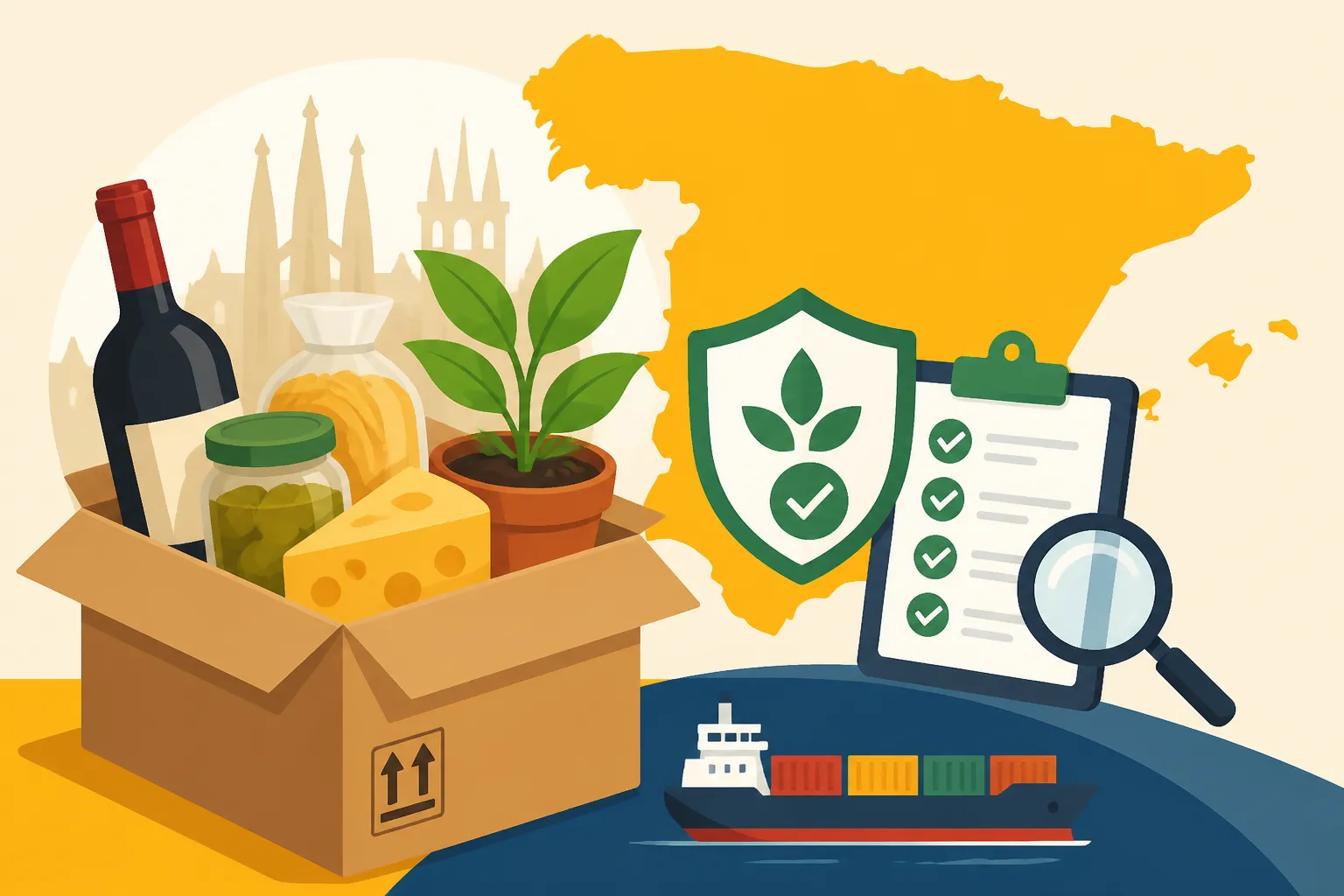
One box of “kitchen stuff” can trigger all three. A hamper with a bottle of port, a jar of honey, a wedge of cheese, and a bag of seed potatoes is a customs headache wrapped in ribbon.
Where You Are Moving From Changes Everything
The biggest single factor is whether your goods start inside or outside the European Union. A move from France, Germany, or the Netherlands is a movement of goods inside the single market: no customs border, no import duty, and plant and food rules mostly harmonised across EU countries. A move from the UK, the US, Canada, Australia, or anywhere else outside the EU means your shipment crosses an external EU border and is treated as an import.
That split is the backbone of the whole topic, and EU vs Non-EU Moves to Spain: Why Customs Treats Them Completely Differently goes into it in full. For this article, keep one point in mind: the duty relief you may get on household goods when you change residence does not extend to alcohol, and it does nothing to relax plant and food controls.
The Spanish Territories With Their Own Rules
Spain is not one uniform customs territory, and this catches many relocating families. The Canary Islands sit outside the EU VAT and excise area, so goods moving there, even from mainland Spain, go through a customs declaration. The Canaries also run a stricter plant health regime of their own to protect their agriculture, which means plants and some produce from the mainland are controlled too. Ceuta and Melilla have their own special status as well.
If you are moving to Tenerife, Gran Canaria, Lanzarote, or Fuerteventura, read every rule below as “and possibly stricter”. When I helped a friend move from Madrid to Las Palmas, her mover had to prepare a customs declaration for a domestic move, and her collection of succulents never made the trip.
Shipping Alcohol Into Spain: Duty, Excise, and Mover Policies
Alcohol is the category where real money is at stake, and where the rules change most depending on who physically carries the bottles.
Alcohol on an EU-to-Spain Move
Within the EU, the general principle for excise goods bought for your own use is that duty is paid in the country where you bought them, as long as you transport them yourself. If you drive from Lyon to Valencia with wine in the boot that you bought and paid tax on in France, you are usually in straightforward territory, provided the quantity looks like personal consumption and not resale.
The nuance that matters for movers is the phrase “transport them yourself”. When a third party, such as a removal company, carries excise goods for you, the destination country’s excise rules can apply. In plain terms, a large wine collection travelling in a removal truck is not automatically treated the same as a few cases in your own car. Customs looks at quantity, type of drink, whether the goods are clearly personal, and how they are moving.
My practical advice for EU moves:
- Separate your alcohol into “what I can carry in my own car” and “what would need to go with the mover”.
- If the second pile is small, simply take it yourself.
- If you have a genuine collection, ask your removal company whether they have moved excise goods into Spain before and how they handled the paperwork.
- For anything substantial, ask the mover or a customs agent whether Spanish excise formalities are needed before you load it.
Alcohol on a Non-EU-to-Spain Move
For moves from outside the EU, the picture is simpler and harsher. The transfer-of-residence relief that lets you bring household goods into Spain without paying import duty excludes alcoholic products. Your furniture, books, and kitchenware may enter duty-free, but your wine, whisky, and gin are treated as taxable imports.
That means alcohol in your container can attract import duty, Spanish excise, and IVA on top. Spirits draw heavier excise than wine, so a cabinet of fine whisky can end up costing more to land than you expect. The goods must also be declared accurately. Burying bottles inside a box labelled “books” is how a routine clearance turns into a full container inspection, with delays and storage charges at the port.
For the paperwork that does cover the rest of your household goods, see Cambio de Residencia Exemption: The Paperwork That Waives Import Duty. If you are coming from Britain, Moving to Spain from the UK After Brexit: Customs, Costs, and ToR Relief walks through how that relief works on the UK route specifically.
What Removal Companies Will and Won’t Carry
Even when the law allows it, many movers won’t. Plenty of international removal firms refuse alcohol outright, others take only sealed, unopened bottles, and some accept wine but not spirits. The reasons are practical: breakage, leaks that ruin other people’s belongings in groupage loads, insurance exclusions, and the extra customs work.
This is where I tell everyone to use Sirelo before signing anything. Sirelo is a comparison platform for removal companies: you describe your move once, receive quotes from several international movers, and read reviews from people who have used them. The useful part for alcohol is that you can put the question in front of several firms at once instead of discovering a refusal on packing day. When I helped a couple relocating from Chicago to Seville, the first mover they had spoken to directly simply would not touch their wine. Through Sirelo they found two firms that handled wine regularly, with proper crating and declaration.
When you contact movers through Sirelo, ask each of them:
- Do you carry alcohol on international moves to Spain, and is it limited to sealed bottles?
- Do you prepare the customs declaration for excise goods, or must I hire a separate agent?
- Is alcohol covered by your transit insurance, and on what valuation basis?
- For a sea container, is temperature an issue on this route and season?
That last question matters more than people expect. A container crossing the Atlantic and then sitting at the Port of Valencia or Algeciras in July can get hot enough to cook fine wine. Climate-controlled transport costs more, and only some movers offer it. On insurance, look at Moving Insurance for Shipments to Spain: Coverage, Valuation, and Claims before you assume your bottles are covered.
Shipping Food Into Spain: What Survives the Journey
Food is the category where I recommend the most ruthless decluttering. Most of it is cheap to replace in Spain, and the rules, combined with mover policies, make shipping it more trouble than it is worth.
Food From Another EU Country
Moving within the EU, food circulates freely in legal terms. You can bring your pantry from Belgium or Italy into Spain without a customs border. In practice, your mover is the limit. Almost no removal company will take perishable food, frozen goods, or anything open, because of spoilage, pests, and smell in shared loads.
What usually works for EU moves:
- Sealed, shelf-stable dry goods such as pasta, rice, tea, coffee, spices, and tinned food, if your mover agrees.
- Commercially packaged items in their original packaging, not decanted jars.
- Small quantities that are clearly for your own household.
What usually does not work:
- Anything refrigerated or frozen.
- Opened packets, flour, grains, and dried fruit, which attract pantry moths and weevils.
- Liquids in glass that could break and soak other belongings.
Food From Outside the EU
From outside the EU, the rules tighten sharply. Products of animal origin, including meat, meat products, milk, and dairy products such as cheese, are generally not allowed into the EU in personal consignments from most non-EU countries. The narrow exceptions mostly cover things like powdered infant milk and special foods required for medical reasons, in limited amounts and properly packaged. Fish, eggs, and honey come with their own restrictions.
Fresh fruit and vegetables from non-EU countries are plant products, so they fall under phytosanitary rules and generally need a phytosanitary certificate. A handful of tropical fruits, such as bananas, pineapples, coconuts, dates, and durians, are exempt. For a household move, the honest advice is simpler: don’t ship fresh produce at all.
I watched a family from Texas lose a carefully packed box of specialty sauces, jerky, and baking mixes during clearance at Valencia. The sauces were probably fine. The jerky was not, and its presence meant the whole box was set aside for inspection while the rest of the container waited. For the full list of goods that get confiscated during clearance, see Prohibited and Restricted Items in a Move to Spain: What Gets Seized.
Medically Necessary and Special-Diet Foods
If your household depends on specific foods for medical reasons, such as a particular infant formula, a metabolic diet product, or gluten-free staples you can’t live without, don’t just pack them in the container. Carry essential supplies in your luggage with any supporting documentation from a doctor, and check which equivalents you can buy locally once you arrive. Supplements raise their own questions about ingredients and quantities, and Shipping Medication and Supplements to Spain: Quantity Limits and Prescriptions covers those separately.
Spanish supermarkets and pharmacies stock a much wider range of special-diet products than many newcomers expect, especially in larger cities. Shipping a year’s supply of anything is rarely necessary.
Shipping Plants Into Spain: Phytosanitary Rules You Cannot Ignore
Plants are where emotion and regulation collide hardest. People get attached to them. Plant health authorities, meanwhile, treat them as a potential source of pests and diseases that could devastate Spanish olive groves, almond orchards, citrus farms, and vineyards.
Plants From Outside the EU
Live plants, cuttings, bulbs, seeds, and similar plant material coming into the EU from a non-EU country generally need a phytosanitary certificate issued by the plant protection authority in the country of origin. The certificate confirms the plant was inspected and found free of regulated pests. Some plants are banned from entering the EU at all, and soil and growing media from outside the EU are heavily restricted.
On arrival, consignments that need checks are inspected at designated border control posts, the Puestos de Control Fronterizo, found at major entry points such as the ports of Valencia, Algeciras, and Barcelona and at large airports including Madrid-Barajas. Plant health inspection in Spain falls under the Ministerio de Agricultura, Pesca y Alimentación. A plant that arrives without the right certificate, or with signs of pests, can be destroyed or sent back at your expense.
If you are determined to bring a plant from outside the EU, the sequence looks like this:
- Check whether the species may enter the EU at all, as some genera are prohibited outright.
- Contact the plant protection authority in your home country and ask how to get a phytosanitary certificate for export to the EU.
- Remove all soil, and repot in sterile, approved growing media if the rules allow it, or ship bare-root if that is required.
- Arrange the inspection close to departure, because certificates are tied to the condition of the plant when it ships.
- Confirm with your mover that they accept live plants, which most international movers do not for sea freight.
- Plan for the plant to arrive through a designated entry point where it can be inspected.
In my experience, that process makes sense for something with real sentimental or botanical value. For an ordinary houseplant, it rarely does.
Plants Moving Within the EU and Inside Spain
Inside the EU, there is no customs border for plants, but plant health rules still apply. Professional nurseries and growers moving certain plants must issue plant passports. As a private individual moving your own few houseplants, you face fewer formalities, but you are still bound by the rules on regulated pests.
Spain has a specific and serious concern: Xylella fastidiosa, a bacterium that attacks olive trees, almond trees, oleanders, rosemary, lavender, and many other Mediterranean plants. Parts of Spain, including the Balearic Islands and areas of the province of Alicante, have been designated as demarcated zones, with restrictions on moving host plants out of them. Red palm weevil is another headache for palm owners along the Mediterranean coast.
Moving within Spain doesn’t exempt you either. If you are relocating from Mallorca to the mainland and want to bring your potted olive tree, check the current restrictions for host plants leaving the Balearics first. If you are heading for the Canary Islands, expect strict controls on plants and plant products arriving even from the Spanish mainland.
Should You Bring the Plants at All?
Here is a frank pros and cons list I have shared with many friends.
Pros of bringing your plants:
- Sentimental value, especially for heirloom plants or ones grown from a parent’s cuttings.
- Rare species or cultivars that are hard to find in Spain.
- Continuity, since a familiar plant can make a new flat feel like home.
Cons of bringing your plants:
- Phytosanitary certificates, inspections, and the risk of destruction for non-EU moves.
- Most movers refuse live plants, especially in sea containers, where weeks in the dark kill them anyway.
- Spain’s climate may not suit plants from cooler or wetter places.
- Spanish garden centres and weekly markets sell excellent Mediterranean plants that thrive locally.
My own compromise was to give my plants to neighbours, carry a few seeds of a favourite tomato variety bought commercially within the EU, and rebuild my terrace garden from Spanish nurseries. For working out what will thrive on a Spanish balcony or patio, Gardens, Terraces, and Outdoor Space in Spanish Homes is a good place to start.
Comparing the Rules Side by Side
This table pulls the main rules together so you can sort your boxes quickly.
| Item | Moving From an EU Country | Moving From a Non-EU Country | Typical Mover Policy |
|---|---|---|---|
| Sealed wine and beer | Generally fine if clearly personal and you carry it yourself; destination excise can apply if a mover carries it | Not covered by transfer-of-residence relief; import duty, excise, and IVA may apply | Some accept sealed bottles, many refuse |
| Spirits | Same principle as wine, with more scrutiny of larger quantities | Taxable import with heavier excise than wine | Often refused or accepted only sealed |
| Sealed dry goods and tins | Free movement legally | Generally allowed if not of animal origin and clearly labelled | Some accept, many prefer you don’t |
| Meat, dairy, and animal products | Free movement legally | Generally prohibited, with narrow exceptions | Almost always refused |
| Fresh fruit and vegetables | Free movement, with pest rules applying | Phytosanitary certificate needed, except a few exempt fruits | Refused |
| Live plants and cuttings | Plant health rules apply, with extra care for Xylella hosts | Phytosanitary certificate and inspection; some species banned | Mostly refused, especially for sea freight |
| Soil and growing media | Discouraged, can carry pests | Heavily restricted or prohibited | Refused |
| Moves to the Canary Islands | Customs declaration needed even from the mainland; stricter plant rules | Customs declaration and stricter plant rules | Varies by mover |
Choosing a Mover Who Can Handle the Exceptions
The table shows how often the binding constraint is not the law but the mover. That’s why comparing several removal companies matters so much for these goods. A firm that does mostly European groupage may refuse every bottle, while another that specialises in transatlantic container moves may crate wine routinely and handle the excise paperwork.
Sirelo makes that comparison practical. Fill in your move details once, mention in your request that you have alcohol and possibly plants, and see which companies respond with a clear policy. Reading the reviews on Sirelo also tells you how movers behave when customs gets complicated: whether they communicated during an inspection, or vanished and left the customer to deal with the port alone.
When comparing quotes, look closely at how each firm prices customs clearance, inspection fees, and port storage if a container is held. Those lines are where a cheap quote becomes an expensive move, and Comparing International Removal Quotes for Spain: Line Items That Hide Costs shows which lines to scrutinise.
A Real-World Scenario From Start to Finish
Consider Hannah and Mark, moving from Boston to a village outside Málaga with a 20ft container, a modest wine collection, a pantry full of American baking supplies, and a beloved fiddle-leaf fig.
- They listed their move on Sirelo and stated clearly that they had wine to ship and wanted climate-sensitive handling.
- Of the movers who replied, they shortlisted two that confirmed they carried sealed wine and prepared customs paperwork for alcohol.
- They accepted that the wine would be taxed on import, since transfer-of-residence relief does not cover alcohol, and asked the chosen mover to estimate the clearance process.
- They gave away anything perishable, kept a few sealed packets of specialty baking ingredients, and labelled them accurately on the inventory.
- They gave the fig to a friend, because the phytosanitary process and weeks in a dark container made shipping it pointless.
- They booked the move for spring, so the container wouldn’t bake on the quay at Algeciras in midsummer.
The container cleared with the wine declared, the pantry box passed without fuss, and nothing was destroyed. It wasn’t free, but there were no surprises, and that’s about the best result you can hope for in a Spanish customs clearance.
Timing Your Shipment Around These Rules
These items need lead time. Phytosanitary certificates have to line up with the shipping date, alcohol declarations need an accurate inventory, and you need to know your mover’s policy before you start packing. Fold these decisions into your wider timeline. An International Move to Spain: The 12-Week Planning Calendar gives you a framework, and I’d settle the alcohol, food, and plant questions in the first few weeks, not during the final packing rush.
If your belongings will sit in storage before delivery, remember that food and plants do not belong in a storage unit either. Storage While You Relocate: Home-Country Units vs Spanish Trasteros covers what to expect if your container can’t go straight to your new home.
Spain has rewarded every bit of patience I have put into it, and that includes the bureaucracy. Start by comparing movers on Sirelo, ask them the awkward questions about wine and plants early, and you’ll arrive with your collection intact and your nerves in better shape than mine were.
Disclaimer
This article is for general informational purposes only and does not constitute professional advice. Laws, prices and regulations vary by location and change over time. Consult a qualified professional for guidance on your specific situation.