Getting Internet Installed in Spain: Typical Timelines and Documents
Moving into your new Spanish apartment only to realize you cannot get Wi-Fi installed because you lack a local ID card is a nightmare. I spent my first two weeks in Madrid working from loud coffee shops because the local telecom giant flatly refused my passport. This guide breaks down exact internet installation timelines and the required paperwork to get connected.
Disclosure: This post may contain affiliate links. We may earn a commission at no extra cost to you if you make a purchase through these links. Read full disclosure.
The Documentation Roadblock
The Infamous NIE Requirement
Most expats assume that renting a flat and showing a passport is enough to get home internet installed. This is the first major administrative wall you will hit. Traditional Spanish telecom giants—like Movistar, Orange, and Vodafone—operate on rigid, outdated computer systems that simply do not accept a passport number for a post-paid fiber optic contract. They demand a Foreigner Identity Number (NIE) or a physical TIE card to process your application.
The reality of the Spanish immigration system is that securing an appointment to get your NIE can take weeks or even months, depending on the province. This puts you in an agonizing state of limbo. You have the keys to your new apartment, but you cannot set up a basic internet connection to work remotely or stream television because you are waiting on a police station appointment. I remember begging a store clerk to just take my deposit, only to be told the software literally could not proceed without the specific letter-number-letter format of an official NIE.
This massive gap in the market is exactly why specialized providers exist. If you need to get connected immediately and are stuck in the residency backlog, reaching out to Tiekom is the most efficient workaround. They specifically cater to the expat community and allow you to set up your home broadband contract using just your foreign passport. Bypassing this single bureaucratic hurdle saves you weeks of stress and prevents the terrible experience of trying to work from the floor of a crowded local café. Understanding exactly how long the official ID process takes is a reality we outline deeply in Getting an NIE for Employment or Study: Practical Overview.
Spanish Bank Accounts and IBANs
Once you clear the identification hurdle, the legacy telecom companies throw a second massive roadblock at you: payment methods. In Spain, utility and telecom contracts are paid almost exclusively via a direct debit mandate known as a domiciliación bancaria. The telecom company automatically pulls the funds from your bank account on a specific day each month.
While European SEPA laws technically state that any European IBAN should be accepted across borders, the reality on the ground is completely different. Many Spanish telecom billing systems will automatically reject a German, French, or British IBAN. They will insist that you provide an account number starting with “ES” (Spain). Setting up a local bank account as a brand-new arrival without your physical residency card is another notoriously difficult task, which we map out step-by-step in Opening a Bank Account in Spain: Step-by-Step for Foreigners.
If you do not have a Spanish bank account yet, you are effectively blocked from getting traditional home internet. This is another scenario where relying on an expat-friendly provider like Tiekom is a lifesaver. They understand that newcomers do not instantly possess an “ES” bank account, so they accept international credit cards and foreign SEPA accounts. Getting your utilities set up using your existing foreign financial infrastructure gives you the breathing room to deal with local banking at your own pace. Discovering which companies actually cater to foreigners is covered heavily in Best Internet Providers in Spain for Expats.
Understanding Installation Timelines
The Waiting Game and Scheduling
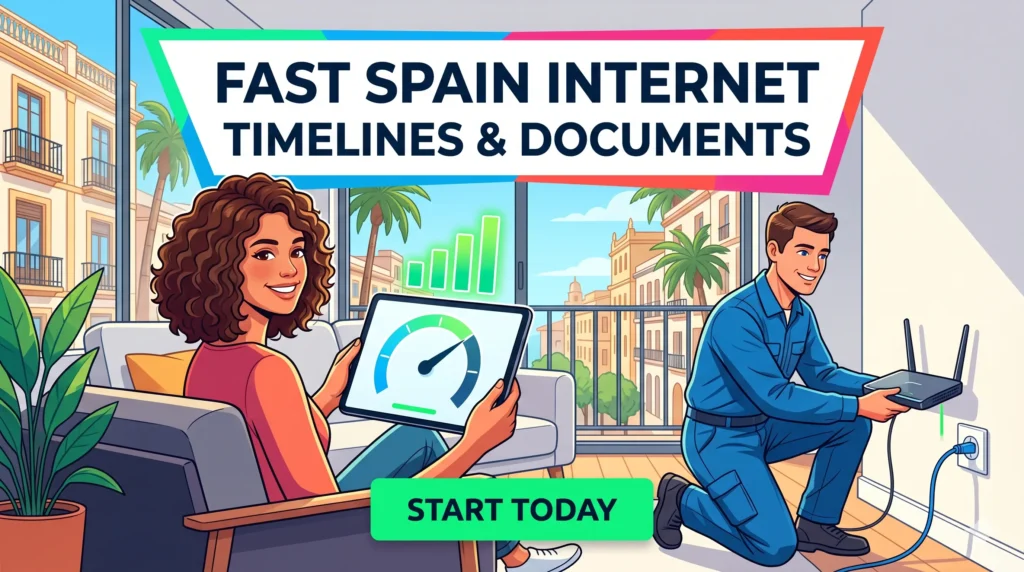
Even if you miraculously possess an NIE and a Spanish bank account on day one, the internet does not turn on immediately. Unlike some countries where you can self-install a modem the day you move in, Spanish internet almost always requires a physical technician visit to connect your apartment to the building’s main fiber terminal.
The gap between signing the contract and the technician actually knocking on your door is typically between three and fifteen business days. You will be assigned a scheduling window, which is culturally quite flexible. Do not be surprised if your text message says the technician will arrive “between 9:00 AM and 2:00 PM.” You must physically be in the apartment during this entire window. If you run down to the corner store for five minutes and the technician arrives, they will leave, and you will be pushed to the back of the queue, adding another week to your timeline.
Furthermore, if the technician discovers that the main telecommunications box in the basement is full or damaged, they cannot fix it on the spot. They have to submit a ticket to the main infrastructure owner, and your installation will be paused indefinitely while they await repairs. This agonizing waiting period is a recurring theme when setting up any home service in this country, a frustration closely mirrored when Setting Up Electricity and Gas in Spain.
Fiber Optic vs ADSL Realities
The silver lining to this bureaucratic nightmare is that once the internet is actually installed, the quality is world-class. Spain has aggressively rolled out fibra óptica (FTTH – Fiber to the Home) across the entire country. In almost any mid-to-large city, you will easily get symmetrical gigabit speeds.
However, if you are moving to a romantic, isolated finca in the Andalusian countryside or a small historic village in the mountains, fiber might not have reached you yet. In these rural zones, you might be forced to rely on outdated ADSL copper lines, which are slow and weather-dependent. The alternative is setting up a fixed 4G/5G wireless router or looking into satellite internet.
| Connection Type | Average Speeds | Typical Installation Timeline | Best Suited For |
| Fiber Optic (Fibra) | 300 Mbps to 1 Gbps | 3 to 15 business days | City centers, modern apartments, remote workers |
| ADSL (Copper) | 10 Mbps to 20 Mbps | 7 to 20 business days | Rural homes awaiting fiber expansion |
| 4G / 5G Home Router | 50 Mbps to 150 Mbps | 1 to 3 days (Self-install) | Temporary housing, rural areas with cell service |
| Satellite | 30 Mbps to 100 Mbps | 2 to 4 weeks | Isolated properties completely off the grid |
Surviving the Waiting Period
Mobile Tethering and Portable Routers
If you are working remotely, you cannot simply go offline for two weeks while waiting for the fiber optic technician. Bridging this connection gap requires an immediate, temporary strategy. The most common mistake is assuming you can just tether your laptop to your foreign mobile phone. If you are roaming on a foreign SIM card, your provider will likely throttle your data speeds or cut you off entirely after a few gigabytes.
The best immediate solution is to buy an unlocked, portable 4G router. I highly recommend ordering a reliable mobile router from Amazon Spain and having it delivered to an Amazon locker near your new apartment before you even get the keys. Once you have the hardware, you can walk into a local mobile shop with your passport and buy a cheap, prepaid Spanish SIM card loaded with massive amounts of data. You can pop the SIM into the router, and instantly have a private Wi-Fi network to keep your laptops and smart TVs connected.
Securing this initial, temporary connection is crucial, and the process of getting that first prepaid card is detailed in Best Way to Get a SIM Card in Spain as a New Arrival. Monitoring these bridging costs is important, as buying temporary data packages can quickly impact your monthly budget, which you should be tracking alongside your other Cost of Living in Spain expenses.
Extending Your Wi-Fi Signal
Once the glorious day arrives and the technician finally installs your fiber optic router, you will encounter a unique architectural challenge. Spanish apartments are built to stay cool in the summer, meaning the interior walls are often made of thick, solid brick and dense concrete.
The technician will almost always drill the entry hole and place the router directly next to your front door or in the living room nearest the street. Because of the concrete walls, that blazing fast gigabit Wi-Fi signal will likely degrade to a crawl by the time it reaches your back bedroom or home office. Your video calls will buffer, and your frustration will return.
To solve this, do not call your internet provider to complain; they guarantee the speed to the router, not through your walls. Instead, you need to invest in a mesh Wi-Fi network or powerline adapters. Ordering a dual-band mesh Wi-Fi system from Amazon Spain completely transformed my apartment’s dead zones. You plug one node into the main router and place the satellite nodes down the hallway to bounce the signal around the concrete corners. If you are a heavy gamer or have a dedicated home office, buying a 10-meter flat ethernet cable from Amazon Spain and running it along the baseboards is the absolute cheapest, most reliable way to guarantee perfect speeds.
Preparing for Moving Day and Beyond
Coordinating with Your Landlord
When the installation day arrives, the technician will often need to run a cable from the communal telecommunications box in your building’s stairwell directly into your apartment. This almost always requires drilling a hole through the wall above your front door or alongside your window frames.
If you are renting, it is absolutely critical that you get written permission from your landlord before allowing a technician to drill into the property. Most landlords are perfectly fine with it, as installing modern fiber increases the value of their rental. However, if you let a technician drill a messy hole through a historic wooden door frame without asking, you will definitely lose your security deposit. Navigating these landlord dynamics and understanding your tenant rights is a core focus of Renting an Apartment in Spain: A Guide for Expats. Furthermore, if your internet contract is going to be billed alongside your community fees by the landlord, knowing how to read the paperwork is essential, a skill taught in Understanding Utility Bills in Spain.
Contract Traps to Avoid
Finally, before you sign any telecommunications agreement, you must look for the dreaded permanencia (lock-in period). Traditional Spanish providers will often offer “free installation” or a “discounted first three months” in exchange for a mandatory 12, 18, or 24-month commitment.
If you decide to move apartments or leave Spain before that commitment ends, they will hit you with hundreds of euros in penalty fees. Escaping these contracts is notoriously difficult and requires sending certified legal mail, a nightmare process we explore in How to Cancel a Spanish Mobile Plan Without Extra Fees. This is yet another reason why utilizing an expat-oriented service like Tiekom is highly recommended. They understand that expats have transient lifestyles and generally offer much more flexible terms without the draconian penalty clauses of the legacy giants, allowing you to move or pause your life without facing financial ruin.
References
Primary sources (official)
- Comisión Nacional de los Mercados y la Competencia (CNMC) – Telecommunications Regulator: https://www.cnmc.es/en/sectores-que-regulamos/telecomunicaciones
- Ministerio para la Transformación Digital y de la Función Pública: https://digital.gob.es/
Other helpful sources
- Red.es – Public Corporate Entity for Digitalization in Spain: https://www.red.es/es/sobre-nosotros/quienes-somos
- European Union – Telecommunications and Internet Consumer Rights: https://europa.eu/youreurope/citizens/consumers/internet-telecoms/index_en.htm
Disclaimer
The information provided in this guide is exclusively for educational and informational purposes and does not constitute official legal or consumer protection advice. Spanish telecommunications regulations, data privacy laws regarding ID requirements, and specific provider requirements for post-paid contracts are highly dynamic and subject to frequent updates by the CNMC. While we strive to ensure absolute accuracy regarding best practices, you should always thoroughly read the terms and conditions of any telecommunications contract, confirm the permanencia (lock-in) clauses, and verify the accepted identification documentation directly with the commercializer before signing agreements or drilling holes in a rental property.