How Spanish Building Communities Work (Comunidad): Fees and Rules
Living in a Spanish apartment involves navigating the Comunidad de Propietarios, a legal entity governing shared spaces. This guide explains community fees, the dreaded “derramas” (extra costs), the mandatory role of the President, and the “Horizontal Property Act” rules every owner and tenant must follow.
Disclosure: This post may contain affiliate links. We may earn a commission at no extra cost to you if you make a purchase through these links. Read full disclosure.
What is a Comunidad de Propietarios?
A Comunidad de Propietarios is a legal entity formed by the owners of all the properties within a building or urbanization. It is not a company, but it functions like a mini-government.
The Legal Framework: Horizontal Property
Spain distinguishes between “Vertical Property” (one person owns the whole building) and “Horizontal Property” (different people own different flats).
- Private Elements: Your apartment, your storage unit (trastero), and your parking space. You own these 100%.
- Common Elements: The roof, the façade, the stairs, the elevator, the pool, the gardens, and the structural pillars. You own a percentage of these.
This percentage is crucial. It is called the Cuota de Participación (Participation Quota). It determines your voting power and, more importantly, how much you pay.
Who Runs It?
The Community is run by the owners themselves, usually assisted by a professional administrator. Decisions are made in the Junta de Propietarios (Owners’ Meeting). If you are a tenant, you generally have no voice and no vote, though you are subject to the rules they decide.
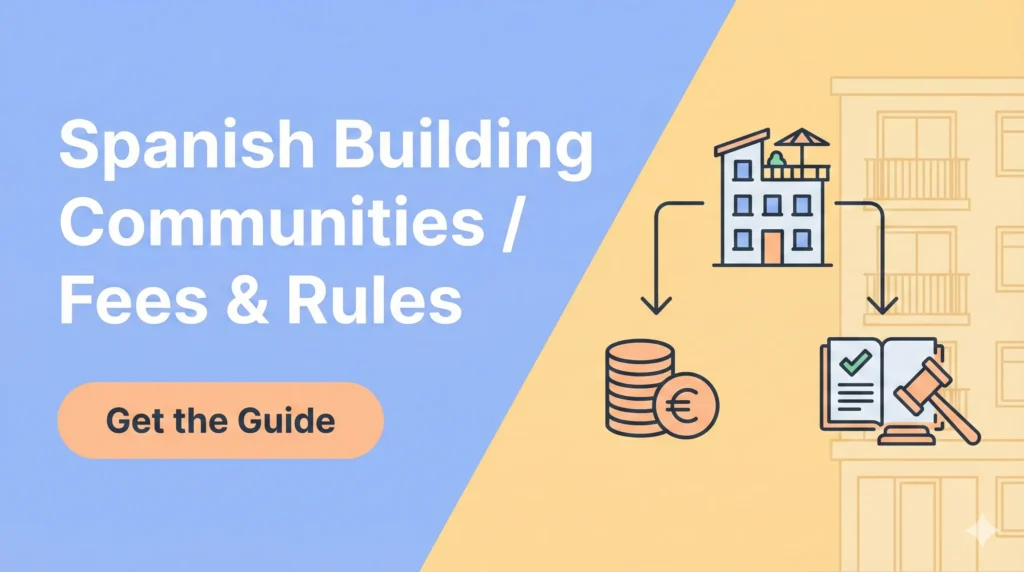
The Cost of Community: Gastos de Comunidad
The most immediate impact of the Comunidad on your wallet is the monthly fee.
Regular Fees (Cuotas Ordinarias)
These cover the day-to-day running of the building.
- Cleaning: Hallways, stairs, and garages.
- Utilities: Electricity for the elevator and lights; water for the garden/pool.
- Maintenance: Elevator servicing (mandatory monthly checks), pool chemicals, gardening.
- Insurance: The building’s insurance policy (distinct from your private home insurance).
- Payroll: If the building has a Portero (doorman) or Conserje (concierge), their salary and social security are the biggest expense.
How much is it?
It varies wildly.
- Basic Walk-up (no elevator): €30 – €50 / month.
- Standard Apartment (elevator): €60 – €100 / month.
- Luxury Urbanization (pool, gym, 24h security): €200 – €500+ / month.
Before signing a lease or buying a property, you must ask exactly what this fee is. For renters, this cost is sometimes included in the rent price, but sometimes charged separately. To understand how to budget for this alongside other housing costs, refer to our Cost of Living in Spain: Monthly Budget Guide for Expats.
The Calculation: Coefficient vs. Equality
Legally, fees are calculated based on your Coefficient (share of ownership).
- Scenario: You own a 200m² penthouse. Your neighbor owns a 50m² studio.
- Result: You pay 4x more community fees than your neighbor, even though you both use the elevator equally.
Exception: Some communities vote to share certain expenses (like cleaning) equally (a partes iguales) regardless of size, but this must be written in the statutes.
The Dreaded “Derrama” (Extraordinary Expenses)
This is the financial trap. A Derrama is an extra fee voted on for a specific project.
- Examples: Fixing a leaking roof, painting the façade, installing a new elevator, or upgrading to LED lighting.
- The Shock: You might buy an apartment thinking the fee is €50, only to find out there is a Derrama of €200/month for the next 24 months to pay for façade restoration.
- Legal Obligation: If the Junta votes for a necessary repair (e.g., structural safety or accessibility for disabled residents), you must pay the Derrama, even if you voted against it.
The Key Players: President and Administrator
Unlike in some countries where being on the “Condo Board” is a choice for busybodies, in Spain, it is often a conscription.
El Presidente (The President)
The President is the legal representative of the Community. They sign contracts, authorize payments, and sue non-payers.
- Selection: The post is mandatory. It usually rotates from door to door every year.
- Can you refuse? Generally, no. You can only be excused by a judge for valid reasons (advanced age, serious illness, living abroad). “I don’t have time” is not a valid excuse.
- Liability: If the President acts negligently (e.g., ignores a termite infestation that destroys the roof), they can be held personally liable.
El Administrador de Fincas (The Property Administrator)
Because the laws are complex and Presidents are amateurs, most communities hire a professional Administrador.
- Role: They issue the bills, chase debtors, manage the bank account, and ensure the building complies with regulations (LPH).
- Importance: A good administrator saves you money. A bad one can let debts pile up.
- Cost: Their fee is part of the community expenses.
If you are a landlord, the Administrator is your best friend for resolving issues without getting personally involved. For tenants, however, the Administrator will usually refuse to talk to you directly, referring you back to your landlord. This hierarchy is important when dealing with repairs; see Tenant vs Landlord Responsibilities in Spain: Repairs and Maintenance to know who you should actually be calling.
Community Rules: Estatutos vs. Normas
Not all rules are created equal. In Spain, there is a hierarchy of regulations governing what you can do in your home.
1. The Statutes (Estatutos)
These are the constitutional laws of the building, registered in the Property Registry (Registro de la Propiedad).
- Content: They define the usage of units (e.g., “Commercial activity is forbidden in apartments,” which blocks Airbnb). They define how fees are split.
- Changing them: Very difficult. It usually requires unanimity (100% of owners voting yes).
- Relevance: You should read these before buying to ensure you can do what you plan (e.g., turn the office into a flat).
2. Internal Rules (Normas de Régimen Interno)
These are the “house rules” regarding coexistence.
- Content: Pool opening hours, noise curfews, whether dogs are allowed in the elevator, where you can hang laundry.
- Changing them: Easy. Requires a simple majority vote in the annual meeting.
- Enforcement: These rules regulate daily friction. For example, if the rules say “No hanging towels on the terrace railing,” the President can demand you remove them.
Common Prohibitions
- Aesthetics: You cannot change the “aesthetic configuration” of the building. This means you cannot glaze your balcony, install an AC unit on the façade, or paint your window frames a different color without community permission.
- Business: Some communities ban offices or clinics to reduce foot traffic.
- Holiday Rentals: Since 2019, communities can ban Tourist Apartments with a 3/5 majority vote (no longer unanimity).
The Annual General Meeting (La Junta)
Once a year, the owners gather for the Junta General Ordinaria. This is where the budget is approved and the gossip flies.
The Agenda (Orden del Día)
You will receive a notification by mail. It usually includes:
- Review of the previous year’s accounts.
- Approval of the next year’s budget.
- Renewal of the President/Administrator.
- Ruegos y Preguntas (Requests and Questions): The open floor section where neighbors complain about noise, smells, or the doorman’s attitude.
Voting Rights
- Who votes? Only owners. Tenants cannot vote.
- The Double Majority: For many decisions, you need a majority of votes (people) AND a majority of coefficients (ownership %). This prevents 10 owners of tiny studios from outvoting 1 owner of a huge penthouse on financial matters.
- Debtors: If you owe community fees (moroso), you can attend the meeting but you cannot vote.
Representation
If you cannot attend (e.g., you are a non-resident owner), you can give your proxy (representación) to another owner or the administrator. You just sign the form included in the convocation letter.
Managing Conflict: Noise, Pets, and Morosos
Community living is a contact sport. Conflicts are inevitable.
Noise and Nuisance (Actividades Molestas)
Spain is loud, but there are limits.
- The Law: The LPH allows the community to take legal action against a neighbor engaging in “annoying, unhealthy, harmful, dangerous, or illicit” activities.
- The Process: The President sends a formal warning (requerimiento). If the neighbor ignores it, the Community can vote to sue. A judge can order the cessation of activity and even ban the owner from using their own apartment for up to 3 years.
- Renters: If a tenant is the problem (e.g., constant parties), the Community can sue to terminate the rental contract and evict them.
This is particularly relevant for those in shared accommodation where noise disputes are frequent. For tips on managing these dynamics from a tenant perspective, review Room Rentals (Piso Compartido) in Spain: Contracts and Safety Tips.
Delinquent Payers (Morosos)
In almost every building, there is someone who doesn’t pay.
- Public Shaming: The law requires the list of debtors to be included in the Meeting Minutes sent to everyone. Your name and debt amount will be visible to all neighbors.
- Legal Action: The Proceso Monitorio allows communities to fast-track debt collection through the courts. The debt attaches to the property. If you buy a flat with debts, you become responsible for the current year + the 3 previous years of unpaid fees.
Alterations and Works
You want to knock down a wall or close your terrace.
- Inside: You can modify the interior as long as it doesn’t affect the safety of the building. However, you usually need a municipal license (Licencia de Obra).
- Outside: Touching the façade, changing the front door style, or enclosing a balcony requires Community Authorization. If you do it without asking, they can force you to demolish it at your expense years later.
Buying Property: The Community Due Diligence
If you are purchasing a home, the Comunidad should be a major part of your background check.
1. Request the Certificate of Debt
By law, the seller must provide a certificate from the Administrator stating they are up to date with payments. Do not sign the deed (Escritura) without this.
2. Read the Minutes (Actas)
Ask the seller for the minutes of the last 2 or 3 General Meetings. This document is a goldmine. It will reveal:
- Upcoming Derramas: Is the roof about to collapse? Is there a €10,000 elevator assessment approved for next year?
- Morosos: Is 30% of the building not paying? If so, the solvent owners (you) will have to cover the gap in the budget until the courts collect the debt.
- Social Atmosphere: Are the meetings full of insults and lawsuits? That is a red flag for a toxic living environment.
3. Check the Reserve Fund (Fondo de Reserva)
The Community is legally required to hold a reserve fund (minimum 10% of the annual budget) for emergencies. If the fund is empty, any emergency will result in an immediate derrama for you.
Ensuring the property is insurable is also part of this diligence. While the Community has insurance for the building, it does not cover your private interior. Understanding where the Community policy ends and yours begins is vital; check Home Insurance in Spain: What Renters and Owners Should Know for clarity.
Renting: The Tenant’s Perspective
As a renter, you are not a member of the Community, but you live within it.
Access to Common Areas
- Pool/Gym: Your landlord transfers their right of use to you. They cannot use the gym while they rent the flat to you. You should receive the keys/fobs.
- Voting: You cannot vote. However, if the community discusses changing the heating system (which affects your bills), you can ask your landlord to vote a certain way, though they aren’t obligated to listen.
Paying the Fees
- Who pays? The LPH says the owner is liable to the Community. However, the LAU (Rental Law) allows the landlord to pass this cost to the tenant if it is agreed in the contract.
- The Clause: Check your lease. If it says “Gastos de comunidad a cargo del arrendatario” (Community expenses paid by tenant), you must pay.
- The Price Cap: If you agree to pay, ensure the amount is specified. If the fees go up (due to a Derrama), you might argue that derramas (which improve the property value) are for the owner, while ordinary expenses are for the tenant. This distinction should be clear in the contract.
For more on what clauses to look for to protect yourself from unfair fee hikes, consult Renting in Spain: Contracts, Deposits, and Tenant Rights.
Energy Efficiency and the Future (2026 Trends)
Spanish communities are currently undergoing a green revolution, driven by EU Next Generation funds and new laws.
Solar Panels
The installation of collective solar panels on the roof is booming.
- Voting: It no longer requires unanimity. A simple majority can approve it.
- Sharing: The energy generated is shared among the neighbors (Autoconsumo colectivo), reducing individual electricity bills.
Electric Vehicle (EV) Chargers
If you have a parking space in the community garage:
- Your Right: You do not need the community’s permission to install a charger for your private use.
- Notification: You only need to inform the President/Administrator in writing before installation.
- Cost: You pay for the installation and the electricity connection (usually running a cable from your own meter).
This shift toward electrification is changing how utilities are managed. For more on setting up your personal connections within this framework, see Utilities Setup in Spain: Electricity, Gas, and Water Basics.
Comparison Table: Owner vs. Tenant in the Community
| Feature | Owner (Landlord) | Tenant (Renter) |
| Legal Status | Member of the Community | Third Party Resident |
| Voting Rights | Yes (Voice and Vote) | No (Neither) |
| Paying Fees | Liable to the Community | Liable to Landlord (if in contract) |
| Paying Derramas | Liable (Capital improvement) | Generally No (unless specific clause) |
| President Role | Mandatory obligation | Cannot be President |
| Using Pool/Gym | Loses right if renting out | Gains right of use |
| Complaints | Can sue Community | Must complain via Landlord |
Conclusion
The Comunidad de Propietarios is a microcosm of Spanish society: bureaucratic, social, occasionally chaotic, but ultimately functional. It is a system that relies on collective responsibility.
For an expat owner, the key is engagement. Read the minutes, attend the meetings (even if you need a translator), and understand where your money is going. Ignoring the Community allows others to make decisions that devalue your asset or inflate your costs.
For a tenant, the key is compliance and clarity. Know the rules so you don’t get fined, and ensure your rental contract protects you from paying for the building’s new roof.
Whether you view it as a necessary evil or a way to bond with neighbors, the Comunidad is your home’s government. Learn its laws, and you will sleep much sounder in your Spanish apartment.
References
Primary sources (official)
- Boletín Oficial del Estado (Ley de Propiedad Horizontal): https://www.boe.es/buscar/act.php?id=BOE-A-1960-10906
- Ministry of Transport, Mobility and Urban Agenda (Housing Rights): https://www.mitma.gob.es/
- College of Property Administrators (CGCAFE): https://www.cgcafe.org/
Other helpful sources
- OCU (Organization of Consumers and Users – Community Fees): https://www.ocu.org/vivienda-y-energia/comunidades-de-propietarios
- Idealista News (Legal Advice on Communities): https://www.idealista.com/news/inmobiliario/comunidades-de-propietarios
- Citizens Advice Bureau Spain (Horizontal Property Act in English): https://www.citizensadvice.org.es/
Disclaimer
The information provided in this article is for educational and informational purposes only and does not constitute legal advice. The Horizontal Property Act is complex and subject to interpretation by local courts. Disputes regarding community fees, alterations, or bylaws should be discussed with a qualified ‘Administrador de Fincas’ or a lawyer specializing in property law.