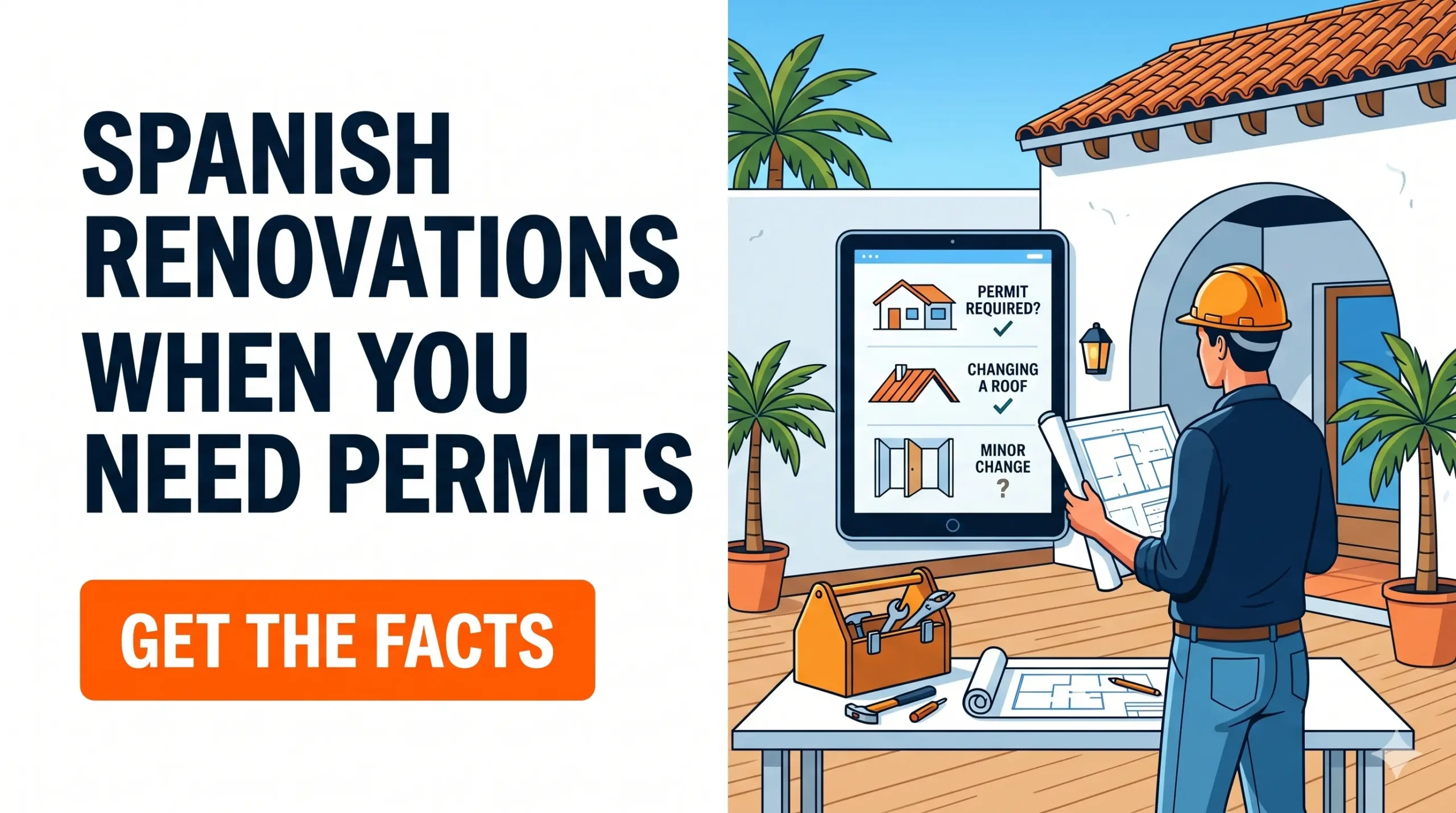
Spanish Home Renovation Permits: When You Need One
Opening my front door to find a local police officer issuing a heavy fine because I remodeled my bathroom without municipal approval is a terrifying expat initiation. I assumed replacing shower tiles was basic DIY, completely ignorant of strict local building laws. This guide decodes exactly when you need a Spanish renovation permit so you can upgrade your home legally.
Disclosure: This post may contain affiliate links. We may earn a commission at no extra cost to you if you make a purchase through these links. Read full disclosure.
The Reality of Spanish Construction Law
Many foreigners arrive in Spain accustomed to highly relaxed zoning laws in their home countries. In places like the US or the UK, minor internal renovations often fall under “permitted development,” allowing you to knock down non-load-bearing walls or upgrade your kitchen without ever talking to the local government. In Spain, this assumption is dangerous.
Erasing the Do It Yourself Mindset
In Spain, the local town hall, known as the ayuntamiento, heavily monitors and regulates almost every physical alteration made to residential properties. Town halls employ dedicated urban inspectors whose sole job is to spot unauthorized dumpsters (cubas de escombros) sitting on the street or listen for the unmistakable screech of tile saws. If you are caught renovating without the proper paperwork, the local police will shut down your site, issue massive financial penalties, and potentially force you to demolish your hard work and restore the property to its original state at your own expense.
This level of regulation shocks many expats who just want to update a tired, 1970s apartment. Understanding the rigid line between what requires a license and what requires simple notification is just as critical to your budget as understanding your overall Cost of Living in Spain. If you are moving to a coastal area, you must also contend with the Ley de Costas (Coastal Law), which imposes even stricter limitations on what you can build near the shoreline to protect the maritime terrestrial public domain.
Community of Owners Restrictions
Even if you successfully secure a permit from the local government, you are not entirely in the clear. If you live in an apartment building, you are bound by the horizontal property laws and the internal rules of your Comunidad de Propietarios (Community of Owners).
You cannot alter anything that affects the structural integrity of the building, the communal pipes, or the aesthetic of the exterior facade without explicit, voted permission from your neighbors. If you want to enclose your balcony with glass curtains or install a split-unit air conditioner on the exterior wall—a necessity we discuss in Is Air Conditioning Worth It in Spain? Cost and Comfort Guide—you must get community approval first. Navigating these neighborhood politics and understanding your shared obligations is a complex reality we outline deeply in A Guide to Spanish Community Fees.
Furthermore, you are legally required to manage the intense noise and debris your builders generate. If your crew leaves a thick layer of brick dust in the communal elevator or runs a jackhammer during the sacred afternoon resting hours, your neighbors will immediately call the police. You can learn exactly how to manage these specific social expectations in How to Deal With Building Renovations Noise in Spain.
Deciphering Permit Types Mayor vs Menor
Spain generally divides residential building licenses into two distinct categories based on the technical complexity, budget, and structural impact of the project.
Licencia de Obra Mayor Major Works
A Licencia de Obra Mayor is required for any project that alters the footprint, volume, or structural integrity of a building. This includes building an extension, adding a new floor, changing the use of a property from commercial to residential, or knocking down load-bearing walls (muros de carga).
This is a highly complex, expensive, and bureaucratic process. You cannot apply for this permit on your own; Spanish law requires you to hire a licensed architect (arquitecto) registered with the official architectural college to draft and sign a comprehensive technical project. The town hall’s urban planning department will meticulously review these blueprints to ensure they comply with local zoning laws and the national building code (Código Técnico de la Edificación).
Because the town hall must individually evaluate these complex architectural plans, the approval timeline can be agonizingly slow. In small villages, you might get approval in a month. In major cities like Barcelona or Madrid, waiting three to six months for an Obra Mayor license is standard. Factoring this delay into your relocation timeline is critical, especially when coordinating overlapping rental leases, a logistical nightmare detailed in Renting an Apartment in Spain: A Guide for Expats.
Licencia de Obra Menor Minor Works
For standard home upgrades, you will generally apply for a Licencia de Obra Menor (Minor Works License). This covers non-structural interior changes like replacing floors, updating plumbing and electrical wiring, remodeling a kitchen, or changing interior, non-load-bearing partition walls.
Historically, obtaining an Obra Menor still required waiting weeks for town hall approval. However, many progressive municipalities have recently replaced the formal minor license with a Declaración Responsable or Comunicado Previo (Responsible Declaration). This is a massive administrative relief. Instead of asking for permission and waiting, you simply submit a formal document declaring exactly what you are going to do, proving you have paid the necessary municipal taxes, and stating that the work complies with all local regulations. Once you submit the Declaración Responsable online, you can legally start the renovation immediately or within a few days, depending on the specific town hall’s rules.
| Project Type | Permit Required | Architect Needed | Approval Timeline |
| Painting walls, simple repairs | None / Notification | No | Immediate |
| New kitchen, replacing floors | Obra Menor / Declaración | Usually No | Immediate to 2 weeks |
| Moving non-load-bearing walls | Obra Menor | Sometimes (for layout changes) | 1 to 4 weeks |
| Knocking down structural walls | Obra Mayor | Yes (Mandatory) | 3 to 6+ months |
| Building a new pool or extension | Obra Mayor | Yes (Mandatory) | 3 to 6+ months |
Navigating the Application Process and Costs
Renovation permits are not free. The local town hall uses these licenses as a primary source of municipal tax revenue, and you must budget for these administrative fees before you swing a sledgehammer.
Taxes and the ICIO
When you apply for a renovation permit, you must pay two distinct fees. First is the Tasa Urbanística (Urban Planning Fee), which covers the administrative cost of the town hall processing your paperwork.
Second, and far more expensive, is the Impuesto sobre Construcciones, Instalaciones y Obras (ICIO). This is a direct tax levied on the actual cost of the construction. The ICIO rate varies by municipality but generally ranges from 2% to 4% of your declared Presupuesto de Ejecución Material (Material Execution Budget). If your architect states that your home extension will cost 50,000 euros in materials and labor, you could easily owe the town hall an additional 2,000 euros just in ICIO taxes. You must pay this tax upfront when you submit the application.
Managing Documentation and Timelines
To successfully apply for these permits, you will interact heavily with the Sede Electrónica (Electronic Headquarters) of your local town hall. Spanish bureaucracy has aggressively digitized in recent years, meaning you are expected to upload all your architectural PDFs, identity documents, and digital tax receipts through a clunky government web portal.
To access these portals, you must have a valid digital certificate (Certificado Digital), a secure electronic identity file that proves who you are to the Spanish government. If you are struggling to understand how to establish your digital identity, setting up your foundational legal status is covered in Getting an NIE for Employment or Study: Practical Overview.
Because uploading massive, high-resolution architectural blueprints requires a stable, uninterrupted connection, attempting to submit a complex Obra Mayor application over a weak public Wi-Fi network will inevitably result in the portal timing out, forcing you to restart the entire hour-long process. I rely exclusively on Tiekom for my home broadband because their fiber optic connection is famously stable, ensuring my massive document uploads to the town hall servers never fail mid-transfer. Once the permit is approved, you will likely need to coordinate closely with utility companies to safely shut off the mains before rewiring your flat, an infrastructural process we detail in Setting Up Electricity and Gas in Spain.
Surviving the Red Tape Essential Tips for Expats
Handling Spanish contractors, architects, and municipal civil servants simultaneously requires immense organization and a solid communication strategy.
Hiring the Right Professionals
The absolute best way to survive a Spanish renovation is to hire a comprehensive project manager (jefe de obra) or rely entirely on your licensed architect to handle the municipal bureaucracy. A seasoned local architect will know exactly which specific clerk at the town hall processes the Obra Mayor applications and will understand the unwritten local quirks required to get the file approved faster.
When your contractors actually begin work, they will need constant direction, and you will need to source specific finishing materials. Because navigating massive Spanish hardware stores like Leroy Merlin can be overwhelming when you lack the specific Spanish DIY vocabulary, many expats prefer to order specialized tools, heavy-duty protective floor coverings, and modern fixtures directly through Amazon Spain. Utilizing Amazon Spain ensures you get exactly what you need delivered directly to your chaotic worksite with clear, translated product descriptions, saving you hours of frustrating miscommunication at local supply depots.
Staying Connected During the Chaos
If you are renovating a property you haven’t moved into yet, you will be managing the project remotely. Your contractors will inevitably discover hidden problems—like a burst pipe behind a wall—and will need to video call you immediately to authorize emergency changes to the budget.
If your unfinished apartment lacks a permanent internet line, coordinating these real-time crises is incredibly stressful. Many expats solve this by setting up a portable 4G or 5G router to provide a dedicated Wi-Fi network for the active construction site. Having a robust, high-capacity mobile data plan from Tiekom allows you to securely tether your laptop on-site, instantly review updated CAD drawings sent by your architect, and approve sudden bank transfers to your contractors without dropping the connection. Securing a reliable telecommunications partner that understands expat needs is a critical step we highlight in Best Internet Providers in Spain for Expats. By treating the permit process with absolute respect, organizing your digital documentation flawlessly, and relying on local licensed professionals, you can successfully transform your Spanish property without running afoul of the law.
References
Primary sources (official)
- Ministerio de Vivienda y Agenda Urbana – Código Técnico de la Edificación (CTE): https://www.codigotecnico.org/
- Ayuntamiento de Madrid – Solicitud de licencias y declaraciones responsables: https://sede.madrid.es/portal/site/tramites
- Boletín Oficial del Estado (BOE) – Ley de Suelo y Rehabilitación Urbana: https://www.boe.es/buscar/act.php?id=BOE-A-2015-11723
Other helpful sources
- Consejo Superior de los Colegios de Arquitectos de España (CSCAE): https://www.cscae.com/
- OCU (Organización de Consumidores y Usuarios) – Licencias de obras: cuándo son necesarias: https://www.ocu.org/fincas-y-casas/gestion/obras-y-mantenimiento/consejos/licencias-obras
Disclaimer
The information provided in this guide is exclusively for educational and informational purposes and does not constitute official legal, architectural, or urban planning advising. The strict requirements differentiating an Obra Mayor from an Obra Menor, the exact calculation of the ICIO tax, and the availability of the Declaración Responsable fast-track process are highly dynamic and set entirely by the specific local town hall (ayuntamiento) governing your property. You should never commence demolition or structural alterations in Spain without the direct, independent counsel of a licensed Spanish architect (arquitecto) or technical architect (aparejador) who can formally verify the zoning laws and secure the necessary municipal permits on your behalf.