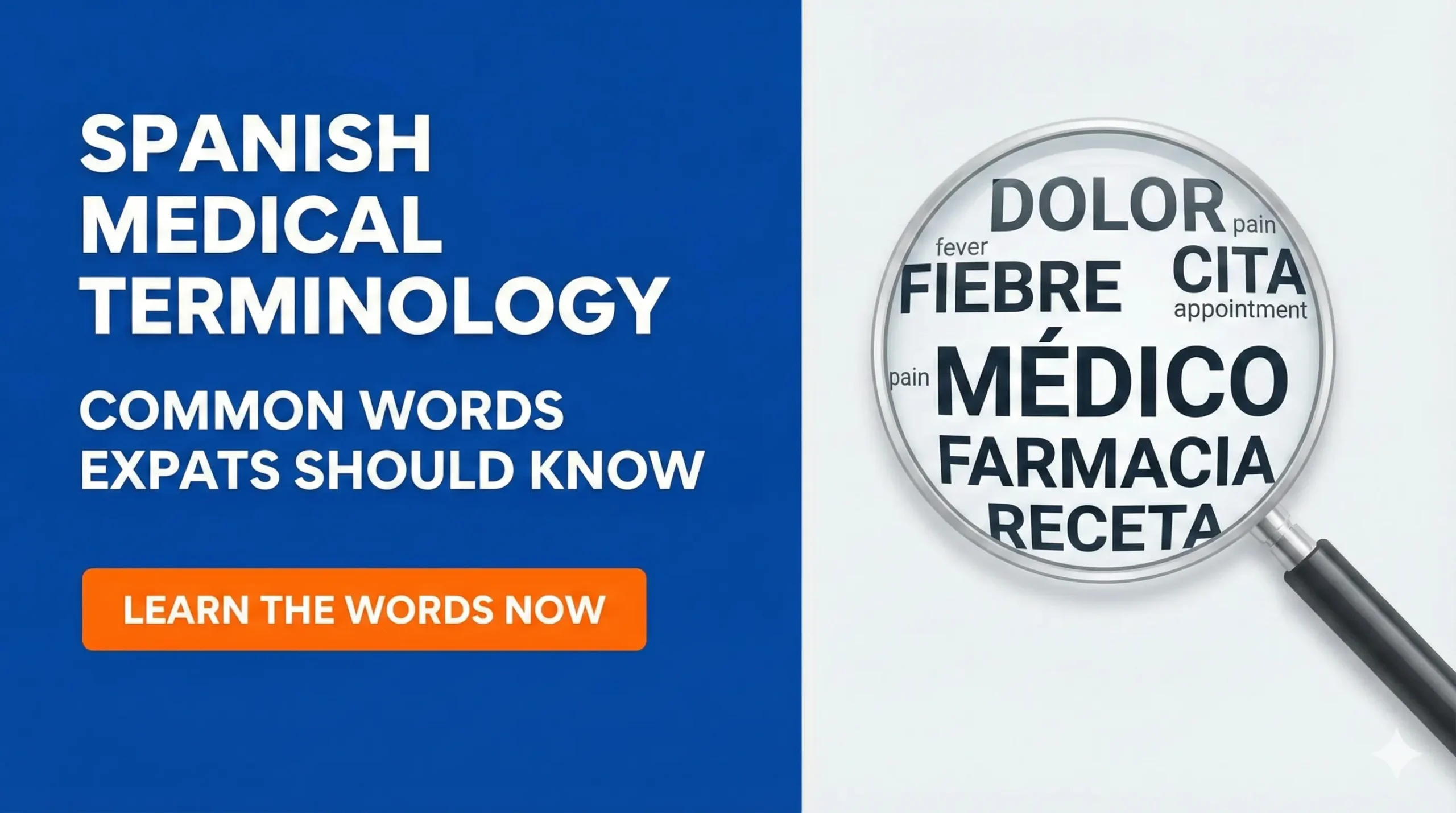
Spanish Medical Terminology: Common Words Expats Should Know
Disclosure: This article contains affiliate links. If you buy through them, we may earn a commission at no extra cost to you. Read our full disclosure.
Navigating healthcare in a foreign country is challenging, especially when language barriers are involved. This comprehensive guide covers essential Spanish medical terminology, from describing symptoms and body parts to booking appointments and speaking with pharmacists, ensuring you receive the best possible care.
Scheduling Appointments and Medical Administration
Before you even see a doctor, you must navigate the administrative side of the Spanish healthcare system. This often involves speaking with receptionists or using online portals where the language is entirely in Spanish. Understanding basic administrative vocabulary will make registering and checking in significantly less stressful.
When you arrive at a clinic or call to make an appointment, the staff will ask for your personal details and the reason for your visit. It is highly recommended to have your identification and health cards ready. If you are trying to understand how the booking systems operate before making the call, you might want to review our guide on How to Book GP Appointments in Spain: Apps, Phones, and Walk-ins.
Here is a table of essential administrative and scheduling vocabulary.
| English Term | Spanish Translation | Context or Usage Example |
| Appointment | La cita | “Quiero pedir una cita médica.” (I want to request a medical appointment.) |
| Doctor | El médico / La médica | Used interchangeably with “doctor/doctora.” |
| Nurse | El enfermero / La enfermera | The person who will often do your initial intake. |
| Waiting room | La sala de espera | “Tome asiento en la sala de espera.” (Take a seat in the waiting room.) |
| Health card | La tarjeta sanitaria | Your public health system identification card. |
| Private insurance | El seguro privado | “Tengo seguro privado con Sanitas.” (I have private insurance with Sanitas.) |
| ID Card / Passport | El DNI / El pasaporte | Required for verifying your identity. |
| Medical history | El historial médico | “Necesitamos actualizar su historial médico.” (We need to update your medical history.) |
| Prescription | La receta | The document needed to collect medication at the pharmacy. |
| Copayment | El copago | The small fee you might pay if you use certain private insurance plans. |
Essential Anatomy and Body Parts
To tell a doctor what is wrong, you first need to be able to point to where it hurts and name the body part. Spanish anatomy vocabulary is relatively straightforward, but pronunciation is key to ensuring you are understood.
When speaking about your body parts in Spanish, it is important to note a cultural and grammatical difference: Spanish speakers typically use the definite article (the) rather than the possessive pronoun (my) when referring to their own body parts. For example, instead of saying “mi cabeza” (my head), you would say “la cabeza” (the head).
Here is a comprehensive list of major body parts to help you pinpoint your ailments.
| English | Spanish | English | Spanish |
| Head | La cabeza | Neck | El cuello |
| Eye / Eyes | El ojo / Los ojos | Shoulder | El hombro |
| Ear / Ears | La oreja / Las orejas | Arm | El brazo |
| Nose | La nariz | Hand | La mano |
| Mouth | La boca | Finger / Fingers | El dedo / Los dedos |
| Throat | La garganta | Chest | El pecho |
| Tooth / Teeth | El diente / Los dientes | Back | La espalda |
| Stomach | El estómago | Leg | La pierna |
| Abdomen / Belly | La barriga | Knee | La rodilla |
| Muscle | El músculo | Foot / Feet | El pie / Los pies |
| Bone | El hueso | Skin | La piel |
| Joint | La articulación | Heart | El corazón |
| Lungs | Los pulmones | Liver | El hígado |
Expressing Pain and Discomfort
Describing pain in Spanish requires understanding a specific verb structure. The most common verb used to express pain is “doler” (to hurt). This verb functions similarly to “gustar” (to like). It conjugates based on the body part that hurts, not the person who is experiencing the pain.
If a single body part hurts, use “duele”. If multiple body parts hurt, use “duelen”. You must also use an indirect object pronoun (me, te, le, nos, os, les) to indicate who is experiencing the pain.
- Me duele la cabeza. (My head hurts. / The head hurts me.)
- Me duelen las piernas. (My legs hurt. / The legs hurt me.)
- Le duele el estómago. (His/Her stomach hurts.)
If you want to describe the intensity or type of pain, you can add adjectives or adverbs:
- Me duele mucho. (It hurts a lot.)
- Tengo un dolor agudo. (I have a sharp pain.)
- Tengo un dolor punzante. (I have a stabbing pain.)
- Tengo un dolor sordo. (I have a dull ache.)
If you need to express that something is sensitive to the touch, you can say, “Está sensible” (It is sensitive).
Describing Common Symptoms and Illnesses
Beyond localized pain, you will need to describe your overall symptoms. In Spanish, symptoms are usually expressed using the verb “tener” (to have) or “estar” (to be).
For example, you “have” a fever (tener fiebre), but you “are” dizzy (estar mareado/a). Getting this correct helps the doctor understand your condition accurately. If you are trying to describe a preventative need rather than a symptom, you can learn more about general maintenance by reading about Routine Health Checkups in Spain: What’s Typical for Adults.
Below is a table of common symptoms categorized by the verb you should use.
| English Symptom | Spanish Translation | Verb to Use | Example Sentence |
| Fever | La fiebre | Tener | “Tengo mucha fiebre desde ayer.” (I have had a high fever since yesterday.) |
| Cough | La tos | Tener | “Tengo una tos seca.” (I have a dry cough.) |
| Cold | El resfriado | Tener | “Tengo un resfriado fuerte.” (I have a bad cold.) |
| Flu | La gripe | Tener | “Creo que tengo la gripe.” (I think I have the flu.) |
| Nausea | Las náuseas | Tener | “Tengo náuseas después de comer.” (I have nausea after eating.) |
| Diarrhea | La diarrea | Tener | “Tengo diarrea y dolor de barriga.” (I have diarrhea and a stomachache.) |
| Dizziness | El mareo | Estar | “Estoy mareado/a.” (I am dizzy.) |
| Fatigue / Tiredness | El cansancio | Estar | “Estoy muy cansado/a.” (I am very tired.) |
| Shortness of breath | La falta de aire | Tener | “Tengo falta de aire al caminar.” (I have shortness of breath when walking.) |
| Swelling | La hinchazón | Estar | “Mi tobillo está hinchado.” (My ankle is swollen.) |
| Rash | El sarpullido | Tener | “Tengo un sarpullido en el brazo.” (I have a rash on my arm.) |
| Vomiting | Los vómitos | Tener / Verbo | “Tengo vómitos” or “He vomitado.” (I have vomiting / I have vomited.) |
Describing Duration and Onset
A doctor will always ask how long you have been experiencing these symptoms. Knowing how to express time is vital.
- “¿Desde cuándo le duele?” (Since when has it hurt?)
- “Desde ayer.” (Since yesterday.)
- “Hace dos días.” (For two days / Two days ago.)
- “Desde esta mañana.” (Since this morning.)
- “Ha empeorado hoy.” (It has gotten worse today.)
Navigating the Pharmacy
In Spain, the pharmacy (la farmacia) is often the first line of defense for minor ailments. Pharmacists are highly trained and can dispense advice and certain medications over the counter. However, the rules regarding what requires a prescription are strictly enforced. If you want a deep dive into how to manage your medications in Spain, we recommend reviewing Pharmacies in Spain: Prescriptions, Over-the-Counter Meds, and Practical Tips.
When visiting a pharmacy, you will need specific vocabulary to communicate your needs clearly.
| English Term | Spanish Translation |
| Pharmacy | La farmacia |
| Pharmacist | El farmacéutico / La farmacéutica |
| Pills / Tablets | Las pastillas / Los comprimidos |
| Capsules | Las cápsulas |
| Syrup | El jarabe |
| Ointment / Cream | La pomada / La crema |
| Drops | Las gotas |
| Painkiller | El analgésico |
| Anti-inflammatory | El antiinflamatorio |
| Antibiotic | El antibiótico |
| Side effects | Los efectos secundarios |
| Over-the-counter | Sin receta |
| Empty stomach | En ayunas |
Useful Pharmacy Phrases
- “Necesito algo para el dolor de cabeza.” (I need something for a headache.)
- “Tengo una receta de mi médico.” (I have a prescription from my doctor.)
- “¿Con qué frecuencia debo tomar esto?” (How often should I take this?)
- “¿Debe tomarse con comida?” (Should it be taken with food?)
- “¿Venden esto sin receta?” (Do you sell this without a prescription?)
Medical Specialists and Departments
If your condition is beyond the scope of a general practitioner, you will be referred to a specialist. The public healthcare system utilizes a strict referral system, while private insurance often allows you to book specialists directly. To understand the administrative side of this process, look at our overview of Seeing a Specialist in Spain: Referral Process Explained.
Knowing the names of the different medical departments and specialists will help you navigate hospital corridors and insurance directories.
| English Specialist | Spanish Specialist | Spanish Department |
| General Practitioner | El médico de cabecera | Medicina General |
| Cardiologist | El cardiólogo / La cardióloga | Cardiología |
| Dermatologist | El dermatólogo / La dermatóloga | Dermatología |
| Gynecologist | El ginecólogo / La ginecóloga | Ginecología |
| Pediatrician | El pediatra / La pediatra | Pediatría |
| Traumatologist | El traumatólogo / La traumatóloga | Traumatología |
| Ophthalmologist | El oftalmólogo / La oftalmóloga | Oftalmología |
| Neurologist | El neurólogo / La neuróloga | Neurología |
| Psychiatrist | El psiquiatra / La psiquiatra | Psiquiatría |
| Urologist | El urólogo / La uróloga | Urología |
| Gastroenterologist | El digestivo (common term) | Aparato Digestivo |
Navigating Medical Tests and Procedures
Doctors rely on tests to confirm diagnoses. When a doctor orders tests, they will hand you a form called a “volante.” You will take this volante to the corresponding department or laboratory to have the test performed.
Understanding what is being ordered will reduce your anxiety and help you prepare appropriately (for example, knowing if you need to fast before a blood test).
| English Test/Procedure | Spanish Translation | Context / Instructions |
| Blood test | El análisis de sangre | Often requires fasting: “Tiene que venir en ayunas.” |
| Urine test | El análisis de orina | You will be given a small cup: “Un bote para la orina.” |
| X-ray | La radiografía (or ‘placa’) | “Vamos a hacerle una placa del pecho.” (We are going to do a chest x-ray.) |
| MRI | La resonancia magnética | “Quítese todo lo metálico.” (Take off anything metallic.) |
| Ultrasound | La ecografía | Used for pregnancy, abdominal checks, etc. |
| CT Scan | El TAC | Tomografía Axial Computarizada. |
| Electrocardiogram (ECG) | El electrocardiograma | “Relájese y respire normal.” (Relax and breathe normally.) |
| Blood pressure | La presión arterial / La tensión | “Le voy a tomar la tensión.” (I am going to take your blood pressure.) |
| Injection | La inyección / El pinchazo | “Va a sentir un pequeño pinchazo.” (You will feel a small pinch.) |
| Stitches | Los puntos | “Necesita tres puntos.” (You need three stitches.) |
Emergencies and the Hospital
In the event of a severe medical issue, you need to act quickly. Knowing the difference between local urgent care clinics and major hospital emergency rooms is crucial. To ensure you make the right choice in a high-stress situation, read our comprehensive guide on Urgent Care vs Emergency Room in Spain: When to Use Each.
When you arrive at an emergency room (Urgencias), you will go through triage. You must be able to communicate the severity of your condition immediately.
Critical Emergency Vocabulary
- Help! – ¡Ayuda! or ¡Socorro!
- Call an ambulance! – ¡Llame a una ambulancia!
- I need a doctor urgently. – Necesito un médico urgentemente.
- It is an emergency. – Es una emergencia.
- He/She is unconscious. – Está inconsciente.
- He/She is not breathing. – No respira.
- He/She is bleeding heavily. – Está sangrando mucho.
- I think I am having a heart attack. – Creo que estoy sufriendo un infarto.
- I am having an allergic reaction. – Estoy teniendo una reacción alérgica.
- I am diabetic / asthmatic. – Soy diabético/a / asmático/a.
Important Note on Allergies
If you have severe medical allergies, you must memorize how to state them clearly.
- “Soy alérgico/a a la penicilina.” (I am allergic to penicillin.)
- “Tengo alergia a los frutos secos.” (I am allergic to nuts.)
- “Llevo un EpiPen.” (I carry an EpiPen.)
Dental and Vision Care
Dental and vision care are largely privatized in Spain. Even if you rely on the public healthcare system for your general health, you will likely visit private clinics for your teeth and eyes.
Dental Vocabulary (El Dentista)
- Toothache – El dolor de muelas
- Cavity – La caries
- Filling – El empaste
- Extraction – La extracción / Sacar una muela
- Cleaning – La limpieza dental
- Gums – Las encías
- Root canal – La endodoncia
Vision Vocabulary (El Oculista / La Óptica)
- Glasses – Las gafas
- Contact lenses – Las lentillas
- Eye exam – La revisión de la vista
- Nearsighted / Farsighted – Miope / Hipermétrope
- Prescription (for glasses) – La graduación
Communicating Bureaucracy and Health Insurance
The paperwork involved in Spanish healthcare can be as complex as the medical terminology itself. Ensuring you have the right documentation is vital. If you are newly arrived and need to get into the public system, our step-by-step guide on How to Get a Spanish Health Card (Tarjeta Sanitaria): Step-by-Step is an essential read.
Here are a few terms you will encounter when dealing with the administrative side of your health:
- Dar de alta: To register in the system, or to be discharged from the hospital. (Context is key here!)
- Dar de baja: To be signed off work due to illness (sick leave). “Necesito la baja médica.”
- El volante: A referral slip given by a doctor for a specialist or a test.
- El consentimiento informado: Informed consent form. You must sign this before surgeries or invasive procedures.
- El certificado médico: A medical certificate, often required for exchanging driver’s licenses or specific job applications.
Practical Tips for Your Medical Appointment
Learning the vocabulary is a massive step forward, but implementing it in a sterile, intimidating medical environment is another challenge. Here are a few practical strategies to ensure your appointment goes smoothly.
Write It Down Before You Go
When you are nervous, you are likely to forget words you studied just hours earlier. Write down your symptoms, how long they have been occurring, and any questions you have on a piece of paper or in your phone. Handing this to the doctor is perfectly acceptable and ensures nothing gets lost in translation.
Ask Them to Slow Down
Spanish is spoken at a famously rapid pace. Do not be afraid to halt the conversation if you are losing the thread.
- “Por favor, ¿puede hablar más despacio?” (Please, can you speak more slowly?)
- “No entiendo, ¿puede repetirlo?” (I don’t understand, can you repeat it?)
- “¿Puede escribírmelo, por favor?” (Can you write it down for me, please?)
Use Technology Wisely
Medical professionals in Spain are pragmatic. If there is a massive language barrier regarding a complex diagnosis, many doctors will happily use Google Translate or DeepL on their computer screens to bridge the gap. Have a translation app ready on your phone just in case.
Bring an Advocate
If you are facing a serious diagnosis or a complex procedure, do not go alone. Bring a bilingual friend, family member, or hire a medical translator. Having a second set of ears to catch nuances and ask follow-up questions provides immense peace of mind.
Conclusion
Mastering Spanish medical terminology is one of the most empowering things you can do as an expat. It transforms you from a passive participant in your healthcare into an active, informed patient. While you do not need to speak with the fluency of a medical textbook, understanding the core vocabulary for body parts, symptoms, and administrative procedures will significantly reduce the anxiety associated with falling ill abroad.
Keep this guide bookmarked on your phone, practice the pronunciation, and remember that Spanish healthcare professionals are dedicated to helping you heal, regardless of the language barrier. Your effort to communicate in their language will always be met with appreciation and respect.
References
Primary sources (official)
- Ministerio de Sanidad (Spanish Ministry of Health): https://www.sanidad.gob.es/
- Seguridad Social (Social Security Portal): https://www.seg-social.es/
Other helpful sources
- Real Academia Nacional de Medicina de España (National Royal Academy of Medicine): https://www.ranm.es/
- Cervantes Institute (Medical Spanish Resources): https://www.cervantes.es/
Disclaimer
The information provided in this article is for educational and language-learning purposes only and does not constitute formal medical advice. If you are experiencing a medical emergency, please dial 112 immediately. Always consult with a licensed healthcare professional for medical diagnoses, treatment plans, and professional care. Do not delay seeking medical attention due to language barriers.