Routine Health Checkups in Spain: What’s Typical for Adults
Adjusting to Spanish healthcare means rethinking preventative medicine. This guide explains how adult health checkups work in Spain, detailing the public system’s targeted cancer screenings, mandatory employer-provided medical exams, and comprehensive private physicals to help you proactively manage your health abroad.
Disclosure: This post may contain affiliate links. We may earn a commission at no extra cost to you if you make a purchase through these links. Read full disclosure.
Public vs. Private: Two Different Philosophies
To understand preventative care in Spain, you must first recognize the dual nature of the country’s healthcare landscape.
The public healthcare system is designed to be highly efficient and accessible to the entire population. Because it is a publicly funded entity, it avoids “over-medicalization.” Public health officials in Spain follow strict epidemiological guidelines that suggest annual, untargeted physicals for young, asymptomatic adults do not significantly improve long-term health outcomes and place an unnecessary burden on medical resources. Instead, the public system utilizes a “targeted screening” approach. They proactively invite citizens to participate in specific tests—like mammograms or colon cancer screenings—only when they reach the statistically relevant age bracket. For a broader look at how these two sectors interact, you can review our guide on the Spain Healthcare System for Expats: Public vs Private.
Conversely, the private healthcare sector in Spain operates more like a traditional service industry. If you hold a private health insurance policy, preventative care is often a major selling point. Many private insurers actively encourage policyholders to book an annual chequeo médico (medical checkup). In the private sector, you have the freedom to request comprehensive blood panels, cardiology workups, and preventative ultrasounds every single year, regardless of whether you have underlying symptoms.
The Workplace Health Check: Reconocimiento Médico Laboral
One of the most robust forms of preventative healthcare for adults in Spain is actually provided through the workplace. If you are legally employed by a Spanish company, you will encounter the Prevención de Riesgos Laborales (Occupational Risk Prevention) laws.
Under Spanish labor law, employers are obligated to offer their employees a free, annual health checkup. This is typically outsourced to a Mutua—a private mutual insurance company that manages workplace accidents and occupational health.
What to Expect During a Workplace Checkup
This annual checkup is entirely voluntary for the employee (unless your specific job carries extreme physical risks, like construction or heavy machinery operation), but it is highly recommended that you accept it. It serves as an excellent, free baseline physical.
The standard reconocimiento médico usually takes about an hour and includes:
- A detailed medical questionnaire: Covering your family history, lifestyle habits, and any current discomfort.
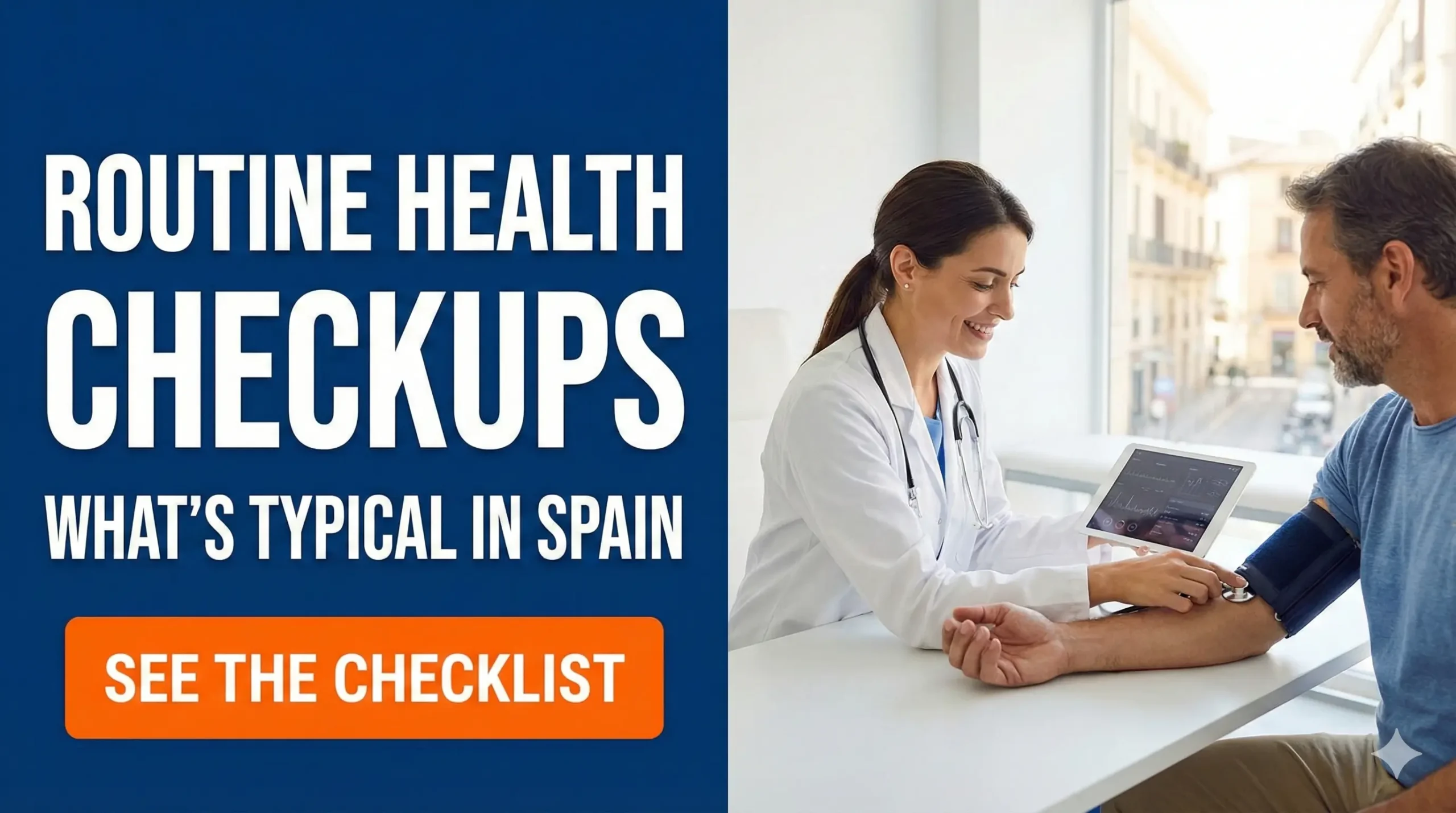
- Basic Vitals: Blood pressure, heart rate, and body mass index (BMI) calculations.
- Vision and Hearing Tests: Basic audiometry and optometry screenings to ensure your senses are sharp.
- Spirometry: A breathing test to measure lung capacity and function.
- Electrocardiogram (EKG): To check the electrical activity of your heart.
- Laboratory Tests: A comprehensive blood and urine test checking your cholesterol, blood sugar, liver function, and kidney function.
A few weeks after your appointment, you will receive a confidential medical report detailing your results. Your employer never sees your specific medical data; they only receive a certificate stating whether you are “Apto” (Fit) or “No Apto” (Unfit) for your specific job role. To learn more about your rights on the job, consult our overview of Workplace Health & Safety in Spain: What Employees Should Know.
Standard Preventative Screenings by Age
If you are not employed by a Spanish company, or if you are self-employed (autónomo), you will need to manage your own preventative care. Even without a formal “annual physical,” your primary care doctor (médico de cabecera) will monitor specific health markers when you visit them for other issues.
Here is a breakdown of the typical routine health monitoring you can expect as a healthy adult in Spain.
Vitals and Metabolic Monitoring
When you visit your public health center (Centro de Salud), the nurse or doctor will typically update your basic vitals.
- Blood Pressure: Hypertension is a silent killer, and Spanish doctors aim to check your blood pressure at least once every couple of years if you are under 40, and annually if you are over 40.
- Cholesterol and Lipid Profiles: General guidelines suggest testing cholesterol levels starting around age 40 for men and 45 for women, or earlier if you have a family history of heart disease or obesity.
- Blood Sugar (Glucose): Fasting blood glucose tests are used to screen for Type 2 Diabetes. This is usually initiated around age 45, repeated every three years, or done earlier for overweight individuals.
Adult Checkup Guidelines Table
| Health Marker / Screening | Typical Age to Begin | Frequency of Screening | Public System Approach |
| Blood Pressure | 18+ | Every 1-3 years | Checked during any routine GP visit. |
| Cholesterol (Lipids) | 40 (Men) / 45 (Women) | Every 3-5 years | Ordered via a standard blood test by your GP. |
| Blood Sugar (Diabetes) | 45+ | Every 3 years | Ordered via a standard blood test by your GP. |
| Dental Exam | All ages | Annually | Not covered by public health for adults; requires private dentist. |
| Vision/Eye Exam | All ages | Every 1-2 years | Basic checks via GP; comprehensive checks require private optometrist. |
National Cancer Screening Programs (Cribados)
Where the Spanish public healthcare system truly shines is in its organized, population-based cancer screening programs. These programs are proactive; you do not need to ask for them. When you reach the target age, your regional health authority will actively invite you to participate.
Breast Cancer Screening (Cáncer de Mama)
Breast cancer screening in Spain is a highly organized, free population-based program. The target demographic is women aged 50 to 69.
When you turn 50, you will receive a formal letter in the mail (a carta de invitación) from your regional health department. This letter will assign you a specific date and time to visit a local hospital, clinic, or specialized mobile screening unit for a mammogram. The program consists of a biennial mammogram (one every two years). In some autonomous communities, such as Navarra and Valencia, the screening program begins even earlier, starting at age 45.
If the mammogram results are clear, you will receive a letter confirming your good health and stating that you will be called again in two years. If there is a suspicious finding, the hospital will call you directly to schedule an immediate follow-up ultrasound or biopsy.
Cervical Cancer Screening (Cáncer de Cérvix)
Cervical cancer screening is offered to all women residing in Spain between the ages of 25 and 65.
The screening protocols were updated recently to reflect the latest scientific evidence regarding the Human Papillomavirus (HPV). Since 2019, the Spanish guidelines recommend that women aged 25 to 34 undergo a standard cytological screening (a Pap smear) every three years. For women aged 35 to 65, the protocol shifts to high-risk HPV testing, which is administered every five years.
These tests are typically performed by your assigned public midwife (matrona) or a gynecologist at your local health center or women’s health clinic. To understand how to book these specific appointments and manage your reproductive health, read our guide on Women’s Health Services in Spain: Contraception and Checkups.
Colorectal Cancer Screening (Cáncer Colorrectal)
Colorectal cancer is one of the most common cancers in Europe, and early detection drastically improves survival rates. Spain operates a robust screening program aimed at both men and women between the ages of 50 and 69.
Like the breast cancer program, you will receive a letter in the mail when you become eligible. The screening is conducted every two years. However, you do not go to a clinic for the initial test. The letter will contain instructions on how to pick up a Fecal Occult Blood Test (FOBT) kit from your local pharmacy. You perform the simple test at home and return the sample to your health center. If the test detects microscopic traces of blood, you will be fast-tracked for a diagnostic colonoscopy at your local public hospital.
Prostate Cancer Screening
Unlike breast or colon cancer, there is no blanket, population-wide mail-out program for prostate cancer screening in the Spanish public system. The European medical community is somewhat divided on the efficacy of untargeted PSA (Prostate-Specific Antigen) blood tests due to the risk of overdiagnosis.
In the Spanish public system, prostate screening is generally handled on an individual, symptomatic basis. If a man over the age of 50 expresses concern, experiences urinary symptoms, or has a strong family history of prostate cancer, the primary care doctor will order a PSA test and a urology consultation. However, in the private sector, annual PSA tests and urology exams are a standard part of any male executive checkup.
How to Request a General Checkup in the Public System
If you are relatively young, healthy, and not yet eligible for the national cancer screening programs, you might still want a basic checkup just to ensure your cholesterol or thyroid levels are normal. While you cannot explicitly book an “annual physical” in the public system app, you can advocate for your own health.
Step 1: Book an Appointment with your GP
You must first schedule an appointment with your assigned médico de cabecera (general practitioner). You can do this via your region’s official health app, by calling the clinic, or by walking up to the reception desk.
Step 2: The Consultation
When you sit down with the doctor, explain that you have not had your blood checked in a few years and would like a general overview of your health. You can say, “Me gustaría hacerme un análisis de sangre general por prevención” (I would like to get a general blood test for preventative reasons). If you are struggling with the language barrier, it is highly recommended to review our vocabulary guide on Spanish Medical Terminology: Common Words Expats Should Know before your visit.
Most doctors are highly accommodating. If you explain your family history—for example, a history of high cholesterol or thyroid issues—they will gladly issue a volante (a referral/order form) for a blood test.
Step 3: The Blood Extraction (Extracción)
Blood tests are not usually done at the exact moment of your doctor’s appointment. You will take the volante to the reception desk to book a slot for the extracción (extraction). These appointments are almost exclusively scheduled in the early morning (between 8:00 AM and 10:00 AM) because you must arrive en ayunas (fasting).
A few days after the blood draw, you will have a follow-up appointment (often a simple phone call) with your doctor to review the results. To ensure a smooth experience during these administrative steps, read our advice on Finding Doctors in Spain: Appointments, Referrals, and Language Tips.
The Private “Chequeo Médico” (Executive Physical)
For expats who want the traditional, highly thorough annual physical experience, the Spanish private healthcare sector is the answer. If you hold a comprehensive private health insurance policy (such as Sanitas, Adeslas, or DKV), preventative checkups are actively encouraged and usually fully covered.
In the private sector, this is known as a chequeo médico. Many premium private hospitals have dedicated “Preventative Medicine” departments where you can complete an extensive array of tests in a single morning.
What Does a Private Checkup Include?
A standard private chequeo for adults often goes far beyond the basic public system offerings. It typically includes:
- Consultation with an Internist: A detailed review of your medical history and a full physical examination.
- Extensive Laboratory Analysis: A broad-spectrum blood and urine test checking vitamins (like Vitamin D or B12), hormones, advanced lipid panels, and tumor markers.
- Cardiology Assessment: A resting EKG, and often an echocardiogram or a cardiac stress test on a treadmill for adults over 40.
- Radiology and Imaging: A preventative abdominal ultrasound to check the liver, kidneys, and pancreas. For smokers, it might include a chest X-ray.
- Specialist Consultations: Women will typically have a same-day appointment with a private gynecologist for a pelvic ultrasound, Pap smear, and manual breast exam. Men will see a urologist for a prostate exam and ultrasound.
At the end of the morning, you are often provided with a complimentary breakfast in the hospital cafeteria while you wait for the final compiled report. You then sit down with the lead physician, who explains every metric in detail and provides a personalized wellness plan.
Paying Out of Pocket
Even if you do not have private health insurance, you can still purchase an executive chequeo out of pocket at almost any major private hospital in Spain. The cost for a comprehensive half-day physical typically ranges from €300 to €800, depending on the number of advanced imaging tests included. For a clearer picture of what medical services cost outside the public system, review our breakdown of Health Costs in Spain: Typical Co-Pays and Out-of-Pocket Fees.
Conclusion
Navigating adult preventative care in Spain requires adapting to a slightly different medical mindset. The Spanish public healthcare system operates on the principle of treating illness efficiently while deploying powerful, targeted screening tools—like the proactive breast and colon cancer programs—only when statistically appropriate.
For the everyday expat, this means taking a bit more personal responsibility for your health baseline. If you are employed locally, take full advantage of your annual workplace medical exam. If you are in the public system, do not hesitate to ask your primary care doctor for a preventative blood test every few years. And if you prefer the deep, comprehensive dive of a full executive physical, the private sector offers world-class facilities to meet your needs. By understanding the rhythms of Spanish preventative care, you can ensure a long, healthy, and vibrant life in your new Mediterranean home.
References
Primary sources (official)
- Ministerio de Sanidad (Ministry of Health – Cancer Screening Guidelines): https://www.sanidad.gob.es/
- Instituto Nacional de Seguridad y Salud en el Trabajo (Occupational Health Guidelines): https://www.insst.es/
Other helpful sources
- Eurostat (Breast cancer screening rates across the EU): https://ec.europa.eu/eurostat/
- European Society of Gynaecological Oncology (Cervical Cancer Guidelines): https://www.esgo.org/
- Asociación Española Contra el Cáncer (Spanish Association Against Cancer): https://www.contraelcancer.es/
Disclaimer
The information provided in this article is for general informational and educational purposes only and does not constitute formal medical advice. Healthcare regulations, cancer screening age brackets, and preventative protocols in Spain can vary by autonomous community and are subject to change by national health authorities. Always consult with a licensed primary care physician or your local Spanish health center regarding your personal medical history and preventative care schedule.