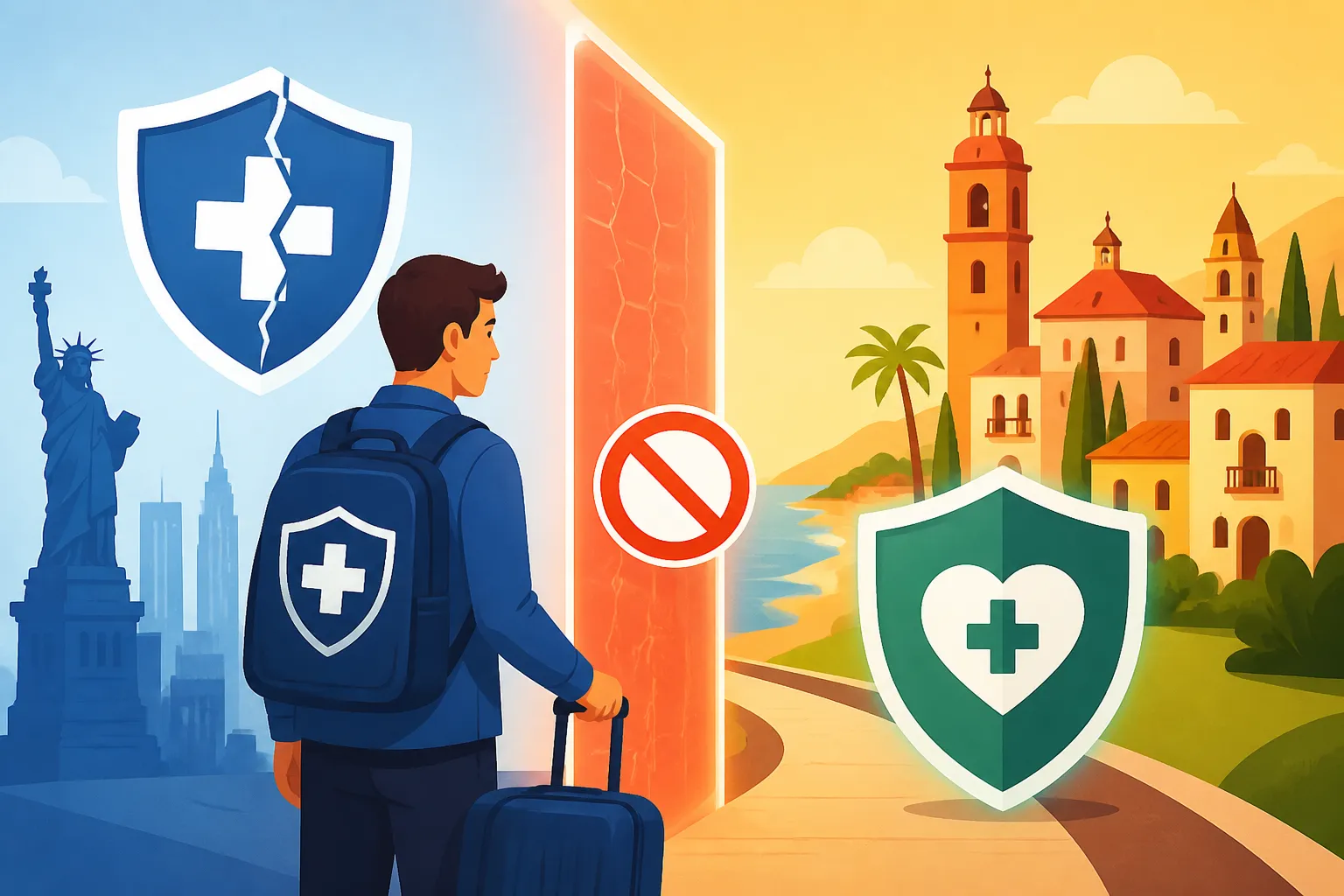
Insurance for Americans Moving to Spain: Why US Plans Stop at the Border
One of the biggest eye-openers for Americans dreaming of a life in Spain is the cold, hard truth about healthcare: your trusty US health insurance plan? It’s pretty much useless once you cross the Atlantic. It's a rude awakening, I know, but this guide is here to walk you through why your American policy won't cut it and, more importantly, what you absolutely need to do to secure proper coverage, especially if you're applying for a visa.
Disclosure: This post may contain affiliate links. We may earn a commission at no extra cost to you if you make a purchase through these links. Read full disclosure.
The Harsh Reality: Why Your US Health Insurance Won't Work in Spain
Let's be blunt: that excellent health insurance policy you have back in the States, whether it's through your employer or a private plan, is almost certainly not going to cover you adequately when you move to Spain. Countless hopeful expats arrive, only to realize their American plans offer little to no meaningful coverage here, often leaving them in a panic when visa applications get rejected or unexpected medical needs arise. It’s a frustrating hurdle, but it’s a universal one for us Americans.
Geographic Limitations and Policy Fine Print
The primary reason your US health insurance is a no-go in Spain boils down to simple geography and contractual fine print. Most American health insurance policies are designed to operate within the United States. They have networks of doctors, hospitals, and clinics that are physically located in the US, and their agreements with healthcare providers simply don't extend beyond national borders.
You might think, "But my plan says it covers emergencies abroad!" And yes, some do offer limited emergency coverage for international travel. However, there's a world of difference between "emergency travel coverage" and "comprehensive health insurance for a long-term resident." Travel insurance is typically designed for short, unforeseen incidents – a sudden appendicitis, a broken bone from a fall – and often only covers stabilization and repatriation, not ongoing care, chronic conditions, or routine check-ups. Moreover, these plans almost always explicitly exclude coverage once you establish residency in another country. Once you're living here, even if it's just on a long-term visa, you're no longer considered a "traveler" in the eyes of most US insurers. That clause in your policy about "usual and customary charges" will apply to US rates, not Spanish ones, and claims can be a nightmare to process from overseas, often requiring you to pay upfront and then battle for reimbursement later, if at all.
The Public Healthcare System Barrier and Visa Requirements
Another critical point for Americans moving to Spain is that you can't just arrive and expect to jump straight into Spain's excellent public healthcare system, the Sistema Nacional de Salud. Unlike many EU citizens who can register relatively easily, non-EU citizens like us typically need to qualify for public healthcare through employment (paying into the Social Security system) or by becoming a permanent resident. For most initially, this isn't an option.
This is where the visa requirements come into play, and they are non-negotiable. Whether you're applying for a Spain Digital Nomad Visa: Requirements, Documents, and Timeline, a Spain Non-Lucrative Visa: Financial Proof, Insurance, and FAQs, or a student visa, the Spanish government requires you to demonstrate comprehensive private health insurance coverage for the entire duration of your initial visa period. This isn't just a suggestion; it's a make-or-break item for your application. If your insurance doesn't meet their specific criteria, your visa will be denied. It’s an infuriating bureaucratic hoop, but it’s one we all have to jump through.
The Myth of "Travel Insurance" as a Long-Term Solution
Many Americans make this mistake, and it’s a costly one. They purchase a cheap travel insurance policy, thinking it will satisfy the Spanish visa requirements. While these plans might offer some basic medical coverage for a trip, they are absolutely not the same as a comprehensive private health insurance policy for residency purposes.
Spanish consulates and immigration offices are very clear about what they need: an insurance policy that provides coverage equivalent to Spain's public healthcare system. This means it must be fully comprehensive, with no deductibles, no co-payments, and no exclusions for common treatments or pre-existing conditions. Most basic travel insurance policies have high deductibles, significant co-pays, and often strict limits on what they cover, especially for ongoing care. Their repatriation and emergency evacuation cover may also fall short of what Spanish visas require. Trying to pass off a travel policy as residency insurance is a surefire way to get your visa application rejected, wasting valuable time and money. It's much safer to invest in a purpose-built international health insurance like SafetyWing that understands the needs of expats and the strict demands of Spanish visas from the start.
Understanding Spain's Healthcare Landscape for Expats
Alright, so your US plan is out. Now what? It's time to understand how healthcare actually works here in Spain, because it's probably quite different from what you're used to. Spain has a fantastic dual system: a robust public option and a growing private sector. For us expats, especially in the early days, understanding both is key.
Public Healthcare (Sistema Nacional de Salud): Eligibility and Access
Spain boasts one of the best public healthcare systems in the world, the Sistema Nacional de Salud. It's known for its high quality of care, comprehensive coverage, and accessibility once you're in. Services range from GP visits at your local centro de salud to specialist consultations, hospital stays, and even prescriptions with reduced co-payments. Many expats swear by it once they become eligible.
However, as a non-EU citizen initially moving here, you generally cannot access it immediately. Eligibility for the public system typically comes through:
- Employment: If you have a work contract and are contributing to the Spanish Social Security system (Seguridad Social), you and your registered dependents automatically gain access. This is the most common route for many working expats.
- Self-Employment (Autónomo): Similarly, if you register as a self-employed individual and pay your monthly autónomo contributions, you're in.
- Residency through specific agreements: In some regions, if you've been a legal resident for a certain period (usually one year) and don't qualify via work, you might be able to apply for the Convenio Especial, a pay-in scheme. However, this varies by region and isn't typically an option for new arrivals.
- Pensioners: If you're a pensioner from an EU country, the UK, or another country with a bilateral agreement, you often have access.
For everyone else, especially those on a Non-Lucrative Visa or a Digital Nomad Visa, public healthcare isn't an option for your first year or two. This is why Health Insurance in Spain: Options for Residents, Students, and Families is so crucial from day one. You'll need private coverage to bridge that gap until you might become eligible for public healthcare down the line.
Private Healthcare: The Expat Go-To, Especially for Visas
Given the eligibility restrictions for public healthcare, private health insurance becomes the absolute cornerstone of your move to Spain. In fact, for most non-EU visa applications, it's a mandatory requirement. This isn't necessarily a bad thing, as Spain has a thriving private healthcare sector with excellent facilities, often shorter waiting times, and the added benefit of potentially finding English-speaking doctors more easily.
Private insurance plans come in various forms, from basic hospital-only coverage to comprehensive policies that mirror the public system. When seeking a visa, you must choose a comprehensive plan. These plans cover everything from general practitioner visits, specialists, diagnostics, hospitalizations, surgeries, and even dental care (though often limited or requiring an add-on). Many private insurers also offer telemedicine services and apps, which can be incredibly convenient, especially when you're still settling in. Providers like SafetyWing offer robust international private plans that are specifically designed with the expat journey in mind, making sure you meet all the demanding visa criteria without breaking the bank.
The Importance of Comprehensive Coverage
I cannot stress this enough: for a Spanish visa, "comprehensive" isn't a suggestion, it's a strict mandate. The Spanish consulates are incredibly particular. They want to see a policy that leaves no room for doubt that you won't become a burden on their state healthcare system. This means your private insurance must essentially mirror the coverage of the Spanish public system.
What does that really mean? It means your policy needs to cover all general medical, specialist, surgical, and hospitalization costs. It means no co-payments (where you pay a portion of each visit or treatment) and no deductibles (an amount you have to pay out-of-pocket before insurance kicks in). These are deal-breakers for visa applications. If your policy even hints at these, your visa will likely be rejected. Furthermore, coverage for urgent care, emergencies, and even things like psychiatric care and physiotherapy are often expected. Beyond just satisfying the visa, having genuinely comprehensive coverage gives you peace of mind. Knowing that a sudden illness, an accident, or even just routine blood tests won't leave you with a hefty bill is invaluable when you're navigating life in a new country. This is where a truly international and flexible provider like SafetyWing shines, as their Nomad Insurance is designed to be comprehensive and meet these rigorous visa requirements.
Essential Requirements for Your Spanish Health Insurance Policy
Let's dive into the nitty-gritty of what the Spanish authorities look for in your insurance policy. This isn't just about having any insurance; it's about having the right insurance. Skipping these details could mean visa rejection and a lot of headaches.
Visa-Specific Demands: No Co-Pays, No Deductibles
This is often the trickiest part for Americans, as so many US plans are built around co-pays and deductibles. When applying for almost any long-term Spanish visa (especially the Non-Lucrative and Digital Nomad visas), your private health insurance policy must be full coverage with zero co-payments and zero deductibles.
Why is this so critical? The Spanish government wants absolute assurance that you will have free access to healthcare, just as if you were in their public system, without any out-of-pocket costs at the point of service. If your policy requires you to pay €10 for a doctor's visit or €500 before your insurance starts paying, it will be rejected. Applicants whose plans are otherwise decent often get denied because of these exact clauses. You need to scrutinize the terms and conditions of any policy you consider. Look for language that explicitly states "sin copagos" (without co-payments) and "sin deducibles" (without deductibles). Many local Spanish insurers offer "sin copago" plans specifically for expats seeking visas. International options, like SafetyWing, are also excellent because they typically understand these global nuances and build their policies to be compliant for a variety of visa requirements. This means less stress for you, knowing your plan ticks all the boxes.
Repatriation and Emergency Evacuation Clauses
Another non-negotiable requirement for most long-term Spanish visas is that your health insurance policy must include coverage for repatriation of remains and emergency medical evacuation. This is a somber but essential aspect of the coverage.
Repatriation of remains means that, in the unfortunate event of your death in Spain, the cost of transporting your body back to your home country (or a chosen location) will be covered. Emergency medical evacuation covers the cost of transporting you, if medically necessary, to the nearest suitable medical facility or even back to your home country for specialized treatment if it's not available in Spain. While these might sound like extreme scenarios, they are standard expectations for visa applications to ensure that the Spanish state won't bear these costs. Many standard travel insurance policies include this, but as we discussed, travel insurance isn't sufficient for long-term residency. Your comprehensive private health insurance must explicitly state these coverages within its terms. Always double-check this specific wording in the policy documents you submit with your visa application.
Annual Renewal and Continuity of Coverage
When you're dealing with long-term residency, the Spanish authorities are looking for stability and continuity. Your health insurance policy must be renewable annually and clearly indicate that it provides continuous coverage for the duration of your visa period and subsequent renewals. They don't want a one-off policy that expires with no clear path forward.
This means you need a plan that offers a solid commitment beyond just the first year. Many international private insurance plans are designed for this very purpose, automatically renewing (as long as you pay your premiums, of course) and providing the ongoing proof of coverage you'll need for future residency renewals. This is particularly important because when you renew your TIE (residency card), you’ll often need to show updated proof of insurance that meets the same rigorous standards as your initial application. Look for policies that explicitly state their renewable nature and ideally, offer multi-year options or clear renewal processes. The ease of renewing your insurance with a provider like SafetyWing means one less bureaucratic headache each year, letting you focus on enjoying your life in Spain.
Navigating Your Options: Choosing the Right Provider
So, you know what you need. Now, who do you get it from? This can feel overwhelming, with so many options out there. Let's break down the main types of providers and what to look for when Choosing a Private Health Insurer in Spain: What to Compare.
International Health Insurance: The Gold Standard for Mobility
For many Americans moving to Spain, especially those who envision potentially moving to other countries in the future or who travel frequently, an international health insurance plan is often the best fit. These plans are specifically designed for expats and global nomads. They offer a broad network of medical providers worldwide, which can be a huge advantage if you’re planning trips back to the US or to other parts of Europe.
The key benefits of international plans include:
- Global Coverage: You're covered not just in Spain, but often in your home country (for brief visits) and other countries, giving you immense flexibility.
- English-Speaking Support: Many international providers have multilingual customer service and direct billing with a wide network of English-speaking doctors and hospitals, which is a massive relief when you’re navigating a new healthcare system.
- Visa Compliance: Reputable international insurers are well-versed in the specific requirements for various long-term visas, including Spain's, and can provide the necessary documentation that clearly states "no deductibles, no co-pays, repatriation, and emergency evacuation."
- Continuity: These plans are built for long-term expat life, making renewals and continuity of coverage straightforward.
One popular and highly regarded international option for this flexibility and comprehensive coverage is SafetyWing. Their Nomad Insurance is designed with digital nomads and long-term travelers in mind, often meeting visa requirements for countries like Spain, while also offering robust coverage and the convenience of online management. It's a fantastic choice if you want to ensure you're covered no matter where your expat journey takes you.
Local Spanish Private Insurers: What to Consider
Alternatively, you could opt for a local Spanish private health insurer. Spain has several large, well-established companies that offer excellent services. Names like Sanitas, Adeslas, DKV, and AXA are prominent players in the market. Many expats use them successfully.
Here’s what to consider:
- Network: Local insurers have extensive networks of doctors, clinics, and hospitals within Spain. This means direct billing is very common, and you often won't have to pay upfront for services within their network.
- Price: Sometimes, local plans can be slightly more competitive on price, especially for very basic comprehensive coverage if your needs are strictly Spain-focused.
- Language: While many will have some English-speaking support, the primary language of communication and documentation will be Spanish. You might need to rely on Medical Interpreters in Spain: Where to Find Help or your own Spanish skills, which can be daunting, particularly in a stressful medical situation.
- Visa Compliance: These companies are intimately familiar with Spanish visa requirements and often offer specific plans tailored to expats, explicitly stating "sin copagos y sin deducibles."
The downside can sometimes be the lack of coverage outside of Spain (or very limited emergency coverage) and potentially slower customer service if you don't speak Spanish fluently. If you decide to go this route, make sure the policy you choose is clearly marketed as 'para visado' or 'para extranjeros' and explicitly confirms the no co-pay/no deductible clauses.
Comparing Features: Network, Language, and Digital Tools
When you're comparing policies, whether international or local, don't just look at the price. There are several other crucial features that will impact your day-to-day experience and peace of mind. This is where you really need to dive into How to Compare Private Health Plans: Deductibles, Co‑Pays, Networks.
Let's use a quick comparison table to help you organize your thoughts:
| Feature | Local Spanish Insurer (e.g., Sanitas) | International Insurer (e.g., SafetyWing) |
|---|---|---|
| Visa Compliance | High – often specific expat visa plans | High – generally designed for global expat needs |
| No Co-pays/Deductibles | Available, but must be specified for visa | Generally standard for comprehensive plans |
| Network | Strong within Spain, often direct billing | Global network, direct billing in many countries/hospitals |
| Language Support | Primarily Spanish, some English support | Multilingual, strong English support |
| Global Coverage | Limited/emergency only outside Spain | Extensive, often including brief home country visits |
| Digital Tools | Apps for booking, records (often Spanish) | User-friendly apps, online portals (often English) |
| Pre-existing Conditions | Can be restrictive, waiting periods apply | Varies, can be more flexible or have clear policies |
| Customer Service | Varies, can be more localized | Often 24/7 global support |
| When evaluating, think about your priorities: |
- Ease of Use: How easy is it to book appointments, access your policy documents, or get support? Is there a good app?
- Language: How comfortable are you dealing with medical and insurance matters in Spanish? If not fluent, prioritize English-speaking services.
- Network Size: Does the insurer have a good network in the specific region of Spain you're moving to? This is important for finding doctors and specialists without excessive travel.
- Flexibility: Do you plan on traveling frequently outside Spain? An international plan like SafetyWing will offer superior coverage and peace of mind in those situations.
- Reputation: Check expat forums and reviews. Word of mouth from other expats is invaluable.
Making the Switch: Practical Steps and Common Pitfalls
Once you've chosen your provider, the next step is actually getting the insurance and navigating the application process. This involves some strategic timing and awareness of common hurdles.
Timing Your Application and Overlapping Coverage
Timing is everything, especially when your visa application hinges on it. You should apply for and secure your Spanish-compliant private health insurance before you submit your visa application. Many consulates require you to have the policy document and proof of payment in hand as part of your initial submission. Do not wait until your visa is approved; that's too late.
A practical tip: it's often wise to have a slight overlap between your old US insurance (if it provides any minimal travel coverage) and your new Spanish-compliant plan. This ensures you're never without coverage during the transition period. For example, if you plan to move on October 1st, aim for your new Spanish policy to start mid-September. This way, if there are any unforeseen delays in your travel or visa approval, you're still covered. Providers like SafetyWing often allow for flexible start dates, which helps manage this overlap seamlessly. Remember, having your policy in place well in advance alleviates a huge source of stress during an already intense relocation process.
Understanding Pre-Existing Conditions and Waiting Periods
This is a big one, and it's where many expats get caught out. When you apply for private health insurance in Spain, whether local or international, you will almost certainly be asked about any pre-existing medical conditions. This includes chronic illnesses, past surgeries, or ongoing treatments. Be completely honest and thorough in your declaration.
The insurer will then assess your medical history. They might:
- Accept you with full coverage: If your conditions are minor or well-managed.
- Exclude certain conditions: They might cover everything else but refuse to cover anything related to your pre-existing condition.
- Impose a higher premium: To account for the increased risk.
- Apply a waiting period (carencia): This is a period (e.g., 3-6 months) during which you cannot claim for certain treatments, even if they are covered by your policy, to prevent people from signing up just for an immediate, expensive procedure. For example, a routine surgery might have a 6-month waiting period. Crucially, for visa purposes, any such waiting periods for essential services must be waived or non-existent. Your visa-compliant policy needs to offer immediate, full coverage for general and emergency care.
- Reject your application: In rare cases, for severe or multiple complex conditions.
It's vital to check the specific policy terms regarding pre-existing conditions and waiting periods. For visa applications, you need a policy that offers immediate, full coverage without waiting periods for general medical services and emergencies. While some policies might have waiting periods for elective surgeries or maternity care, these shouldn't apply to basic and emergency care for visa approval. It's often best to secure a policy, like SafetyWing's, that is clear about these terms and designed to meet immediate visa needs, especially regarding the absence of carencias for urgent care. Remember, Does Spain's Public Healthcare Cover Pre-Existing Conditions? is a different question than private coverage, so be careful not to confuse the two.
What to Do When Your US Plan Expires
Once your new Spanish-compliant private health insurance is active and you're settled, you'll likely need to cancel your old US plan. This is often an emotional step, severing another tie to your home country, but it's a practical and necessary one.
Before you cancel, make sure of a few things:
- New policy is fully active: Don't cancel your US plan until you have confirmed that your new Spanish policy is active, you have all your documents, and you understand how to use it.
- Outstanding claims: Ensure any pending claims with your US insurer are fully processed and resolved.
- Prescription refills: If you rely on specific medications, make sure you have enough to last until you can get established with a doctor in Spain and get new prescriptions issued here. Remember that the Prescription System in Spain: How ePrescriptions Work might be different.
- Proof of prior coverage: Keep records of your US insurance for future reference, especially if you ever return to the US or need to prove continuous coverage history.
It’s a big step, but it marks your full transition to living like a local. With a reliable international private health insurer like SafetyWing, you can be confident that you’re well-protected and fully compliant with Spanish residency requirements, allowing you to embrace your new life in Spain with one less worry.
Disclaimer
Please remember that I am an expat sharing my experiences and research, not a licensed financial or legal advisor. While I strive to provide accurate and up-to-date information, visa regulations, healthcare policies, and insurance requirements in Spain can change. Always consult official Spanish consulate websites, immigration authorities, and qualified insurance professionals or legal advisors for personalized advice regarding your specific situation and visa application. The information provided here is for general guidance and informational purposes only.