Urgent Care vs Emergency Room in Spain: When to Use Each
Navigating immediate medical care in Spain can be confusing, especially since locals use the word urgencias for both urgent care clinics and hospital emergency rooms. This guide explains where to go based on your symptoms, how the triage system works, and what documents to bring.
Disclosure: This post may contain affiliate links. We may earn a commission at no extra cost to you if you make a purchase through these links. Read full disclosure.
The Language Barrier: Understanding the Word “Urgencias”
The first and most significant hurdle for expats navigating Spanish healthcare is vocabulary. In the United States, you might say, “I am going to Urgent Care for this sprained ankle,” or “We need to go to the ER for this chest pain.” The destination is explicitly clear based on the severity of the condition.
In Spain, the word used for both scenarios is exactly the same: Urgencias.
If you ask a Spanish neighbor where to go for a minor burn, they will tell you to go to urgencias. If you ask them where to go for a suspected heart attack, they will also tell you to go to urgencias. This is because the Spanish healthcare system categorizes any unscheduled, immediate medical need as an emergency, but they split these services across different types of facilities.
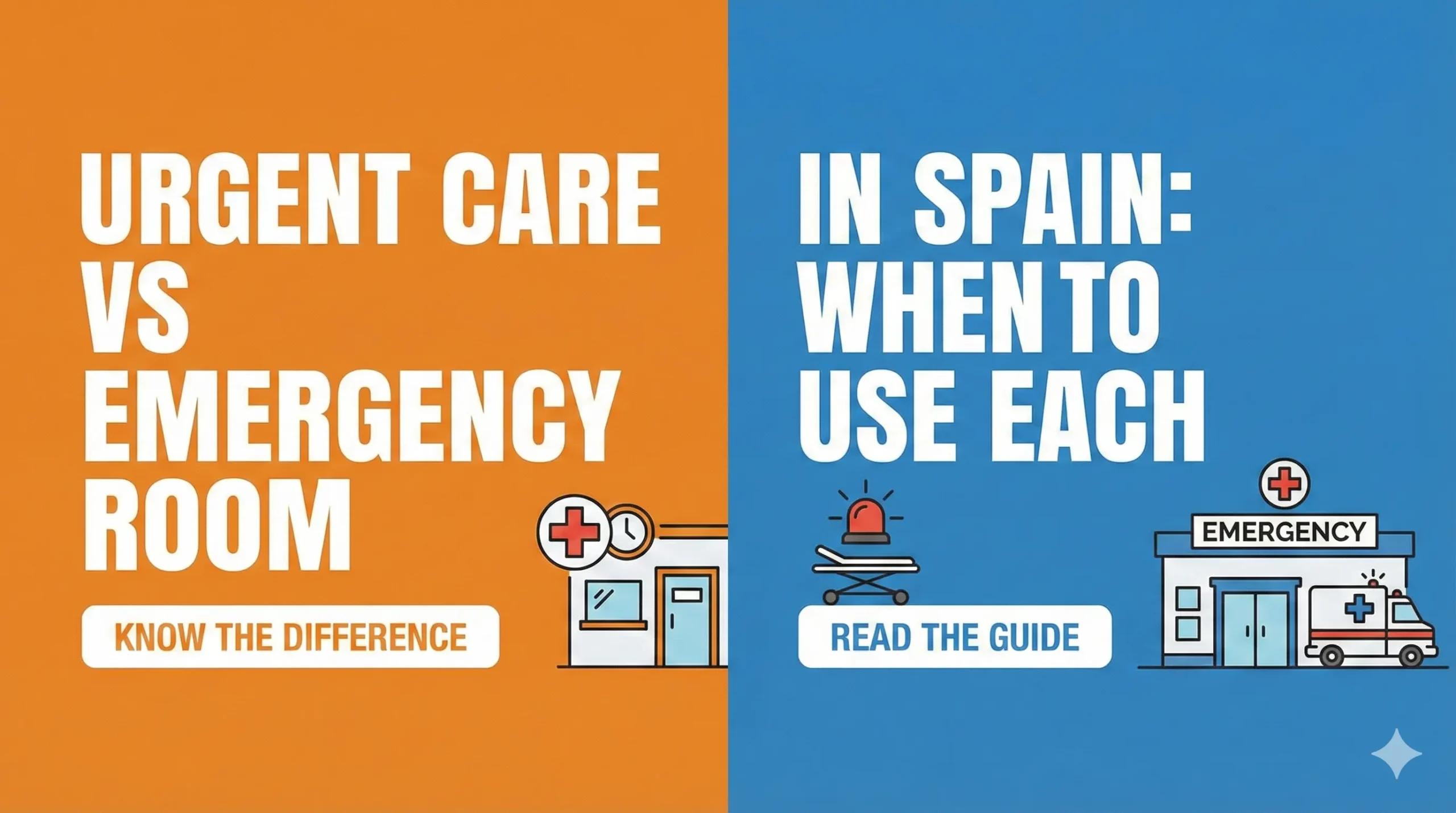
To navigate this successfully, you must understand the two distinct levels of urgencias:
- Urgencias de Atención Primaria: This is the equivalent of an Urgent Care center or an after-hours clinic. It is usually located within a local community health center.
- Urgencias Hospitalarias: This is the equivalent of a full-scale Hospital Emergency Room, equipped for major traumas, surgeries, and life-threatening crises.
Understanding which type of urgencias to visit is the key to receiving prompt, appropriate care without clogging up the critical care infrastructure. For a broader overview of how immediate care fits into the national framework, you can read our foundational guide on Emergency Healthcare in Spain: 112, Urgent Care, and What to Expect.

When to Use Urgent Care (Urgencias de Atención Primaria)
Urgent care in Spain is primarily handled at the community level. Almost every neighborhood or town has a local health center, which serves as the hub for family doctors and pediatricians.
During normal business hours (typically from 8:00 AM to 8:00 PM or 9:00 PM), these centers have a dedicated doctor on duty to handle unscheduled, urgent visits. Outside of these hours, on weekends, and on public holidays, specific health centers transform into Continuous Attention Points. Depending on the autonomous community you live in, these might be referred to as PAC (Punto de Atención Continuada), SUAP (Servicio de Urgencias de Atención Primaria), or simply Urgencias del Centro de Salud.
What Conditions Are Treated Here?
You should go to your local primary urgent care center for conditions that require immediate medical attention within 24 hours but are not immediately life-threatening. These are ailments you would typically see your family doctor for, but cannot wait for a scheduled appointment.
Common reasons to visit a primary urgent care center include:
- High fever that does not respond to over-the-counter medication (especially in adults; infants with high fevers may be directed to a hospital).
- Minor cuts that may require a few stitches but are not bleeding profusely.
- Sprains, strains, and minor joint injuries where you can still bear some weight.
- Suspected urinary tract infections (UTIs) or severe bladder discomfort.
- Mild to moderate allergic reactions (e.g., localized rash, hives without breathing difficulty).
- Ear infections, severe sore throats, or sinus infections.
- Gastrointestinal issues like persistent vomiting or diarrhea without signs of severe dehydration.
- Minor burns from cooking or sun exposure.
The Patient Experience
Visiting a primary urgent care clinic is generally straightforward. You walk in, present your public health card at the admissions desk, and take a seat. Because these centers deal with lower-acuity issues, they operate on a much smaller scale than hospitals. If you need to establish yourself in this system first, review our guide detailing What Is a ‘Centro de Salud’ in Spain and How Do You Register?.
The wait times at a Centro de Salud are almost always significantly shorter than at a hospital. You might wait anywhere from twenty minutes to two hours, depending on the season (flu season brings longer waits) and the time of day. The attending physician will evaluate you, provide a prescription if necessary, and either send you home or, if they determine your condition is more serious than initially thought, arrange for an ambulance to transfer you to the nearest hospital.
When to Use the Hospital Emergency Room (Urgencias Hospitalarias)
The hospital emergency room is the heavy artillery of the Spanish healthcare system. These departments are attached to major regional hospitals and are fully equipped with advanced diagnostic imaging (MRI, CT scanners), fully staffed surgical theaters, intensive care units (ICUs), and a wide array of specialized physicians on call 24 hours a day.
Hospital emergency rooms are designed to save lives, stabilize critical traumas, and intervene in rapidly deteriorating medical situations. They are not designed to treat minor inconveniences.
What Conditions Are Treated Here?
You should proceed directly to a hospital emergency room—or call an ambulance—if you or someone else is experiencing a condition that threatens life, limb, or permanent disability.
Critical reasons to visit a hospital ER include:
- Signs of a heart attack: severe chest pain, pressure, pain radiating to the arm or jaw, accompanied by shortness of breath or sweating.
- Signs of a stroke: sudden numbness or weakness in the face, arm, or leg (especially on one side of the body), sudden confusion, trouble speaking, or sudden severe headache.
- Severe difficulty breathing, choking, or extreme asthma attacks.
- Major trauma: car accidents, falls from a significant height, or severe head injuries accompanied by loss of consciousness or vomiting.
- Uncontrolled, heavy bleeding that does not stop with ten minutes of direct pressure.
- Obvious fractures where the bone is protruding, the limb is deformed, or you cannot bear any weight whatsoever.
- Severe, sudden, and unbearable abdominal pain (which could indicate appendicitis or a ruptured organ).
- Seizures lasting longer than a few minutes or in someone who has never had a seizure before.
- Poisoning or intentional drug overdoses.
The Reality of Hospital Wait Times
If you go to a Spanish hospital emergency room with a non-life-threatening condition (like a mild sore throat or a bruised toe), you will not be turned away. The Spanish public health system guarantees care to everyone. However, you will be pushed to the very bottom of the priority list. It is not uncommon for patients with minor ailments to wait six, eight, or even twelve hours in a hospital waiting room while doctors attend to heart attacks and car accident victims.
Quick Reference Comparison Table
To help you make a fast decision in a stressful moment, here is a practical comparison table outlining common symptoms and the most appropriate facility to visit.
| Symptom / Injury | Recommended Facility | Expected Action / Wait Time |
| Severe chest pain, numbness in arm | Hospital ER (or Call 112) | Immediate medical intervention. Life-saving protocols activated. |
| Suspected UTI, painful urination | Urgent Care (Centro de Salud) | Usually seen within 1-2 hours. Urine test and antibiotics prescribed. |
| Deep cut from chopping vegetables | Urgent Care (Centro de Salud) | Seen relatively quickly for cleaning and basic sutures. |
| Car accident, neck pain, dizziness | Hospital ER | High priority. Requires X-rays, CT scans, and trauma evaluation. |
| Child with 38.5°C (101°F) fever | Urgent Care (Centro de Salud) | Pediatrician on call will evaluate. Short to moderate wait. |
| Sudden, worst headache of your life | Hospital ER (or Call 112) | High priority. Neurological evaluation needed immediately. |
| Sprained ankle, swollen but walkable | Urgent Care (Centro de Salud) | Moderate wait. Bandaged and advised on rest and ice. |
Understanding the Triage System in Spanish Hospitals
When you walk into a hospital emergency room in Spain, you do not see a doctor based on who arrived first. Instead, the system operates on a strict medical triage protocol, most commonly the Manchester Triage System.
Understanding this system is crucial for managing your expectations. When you arrive, you will first see a triage nurse. They will ask you about your symptoms, take your vital signs (blood pressure, temperature, oxygen saturation), and assign you a color code that dictates your priority level.
- Level 1 (Red – Resuscitation): Immediate, life-threatening emergency. The patient is taken straight into the resuscitation room. (e.g., cardiac arrest, massive hemorrhage). Wait time: 0 minutes.
- Level 2 (Orange – Emergency): Very severe condition that could rapidly deteriorate and threaten life or organ function. (e.g., severe chest pain, stroke symptoms). Target wait time to see a doctor: Under 10 to 15 minutes.
- Level 3 (Yellow – Urgent): Significant medical issue requiring multiple resources or tests, but the patient’s vital signs are currently stable. (e.g., severe abdominal pain, complex fractures). Target wait time: Up to 60 minutes, though often longer in busy public hospitals.
- Level 4 (Green – Standard): Minor injuries or illnesses that require a doctor’s evaluation but are not threatening. (e.g., minor cuts, simple sprains, mild allergic reactions). Wait time: Can easily be 2 to 4 hours.
- Level 5 (Blue – Non-Urgent): Routine issues that should ideally be handled by a primary care physician. (e.g., chronic back pain acting up, mild cold symptoms). Wait time: Up to 4 to 6 hours or longer.
If you are assigned a green or blue code at a hospital, you must arm yourself with patience. You will watch dozens of people who arrived after you be taken back to see a doctor before you. This is not a malfunction of the system; it means the system is working correctly by prioritizing those who are in critical danger.
Public vs. Private Emergency Care
Your strategy for accessing emergency care will also depend heavily on your insurance status. The Spanish healthcare landscape is dual-track, offering both a robust public system and a thriving private sector.
The Public System (Sanidad Pública)
If you are a resident contributing to social security, a pensioner, or an EU citizen holding a European Health Insurance Card (EHIC), you have free access to the public emergency system. Public hospitals are generally massive, highly equipped, and feature the absolute best critical care and trauma units in the country. If you suffer a catastrophic emergency, you want to be in a public hospital. However, public ER waiting rooms are notoriously crowded, and the facilities can sometimes feel utilitarian.
The Private System (Sanidad Privada)
If you hold private health insurance (such as Sanitas, Adeslas, or DKV)—which is often a requirement for expats on certain visas—you have the option to visit the emergency room of a private hospital within your insurer’s network.
Private emergency rooms are generally much quieter, cleaner, and boast significantly shorter wait times. You might be seen by a doctor within twenty minutes for a minor issue that would take five hours in the public system. Private hospitals also tend to have a higher concentration of English-speaking staff.
However, there is a crucial caveat. While private hospitals are excellent for standard emergencies, complex fractures, and severe illnesses, not all private facilities are equipped to handle massive, multi-system traumas (like a severe multi-car pileup). In extreme, life-or-death trauma situations, even private ambulances will often bypass private clinics and take the patient directly to the main regional public hospital. To weigh the ongoing pros and cons of these two sectors, we recommend reading our breakdown of the Spain Healthcare System for Expats: Public vs Private.
What to Bring to the Emergency Room
When an emergency strikes, grabbing paperwork is likely the last thing on your mind. However, arriving at the admissions desk without the proper documentation can cause administrative headaches. Try to keep a dedicated folder or a secure digital file on your phone with the following essentials:
- Identification: Your passport, TIE (foreigner identity card), or DNI.
- Health Card: If using the public system, bring your regional SIP card (Tarjeta Sanitaria) or your European Health Insurance Card (EHIC).
- Private Insurance Card: If you are going to a private hospital, your physical or digital insurance card is mandatory.
- Medical History: A brief list of any chronic conditions, previous major surgeries, and a complete list of medications you are currently taking, including dosages.
- Allergies: A clearly written list of any drug allergies (e.g., Penicillin, Ibuprofen).
- Phone Charger: Given the potential for long wait times, a dead phone can leave you unable to contact loved ones or translate medical terms.
For a more comprehensive look at preparing for a hospital visit, including overnight stays, review our article on What to Bring to a Hospital in Spain: Practical Packing List.
Calling an Ambulance: The 112 System
If the situation is so severe that you cannot safely transport the patient to the hospital yourself, you must call an ambulance. The universal emergency number in Spain—and across the entire European Union—is 112.
The 112 operators are highly trained to dispatch the appropriate emergency service (police, fire, or medical). When you call, you can request an English-speaking operator. The dispatcher will ask you a series of questions to determine the severity of the situation.
Depending on your answers, they may send a Basic Life Support (Soporte Vital Básico) ambulance, which is staffed by paramedics, or an Advanced Life Support (UVI Móvil) ambulance, which includes a doctor and a specialized nurse onboard. In some cases, if the dispatcher determines your issue is not critical, they may simply advise you to take a taxi to the nearest urgent care center. For a detailed look at how this dispatch process works, read our guide on Ambulances in Spain: What Happens When You Call 112.
Navigating the Language Barrier in an Emergency
Communication is critical in a medical setting. While you will often find doctors who speak some English in major cities, coastal tourist areas, and private hospitals, you should never assume that the triage nurse or the attending physician will be fluent in your native language.
If your Spanish is basic, do not let this deter you from seeking care. Medical professionals are accustomed to dealing with tourists and expats.
- Use Technology: Do not hesitate to use translation apps like Google Translate or DeepL on your phone. Many doctors will actually initiate this themselves to ensure clear communication regarding symptoms and prescriptions.
- Bring an Advocate: If possible, bring a bilingual friend or neighbor with you. Having someone who can calmly translate while you are in pain is invaluable.
- Learn the Basics: Familiarizing yourself with basic anatomical terms and symptom descriptions before an emergency happens can save vital minutes. You can start building your vocabulary with our list of Spanish Medical Terminology: Common Words Expats Should Know.
Conclusion
Understanding the difference between primary urgent care and hospital emergency rooms in Spain is a vital skill for any expat. By recognizing that the local Centro de Salud is perfectly equipped for minor injuries, fevers, and sudden infections, you can save yourself hours of waiting in a chaotic hospital waiting room. Reserve the hospital urgencias for true medical crises, severe traumas, and life-threatening events.
By respecting the triage system, carrying your proper documentation, and knowing when to dial 112, you ensure that you and your family will receive the world-class medical care Spain is famous for, exactly when you need it most.
References
Primary sources (official)
- Ministerio de Sanidad (Spanish Ministry of Health): https://www.sanidad.gob.es/
- Seguridad Social (Social Security Portal): https://www.seg-social.es/
- 112 Emergency Services Portal Spain: https://www.112.es/
Other helpful sources
- Citizens Advice Bureau Spain (Healthcare Guides): https://www.citizensadvice.org.es/
- UK Government Official Guide to Healthcare in Spain: https://www.gov.uk/guidance/healthcare-in-spain
Disclaimer
The information provided in this article is for general informational and educational purposes only and does not constitute formal medical or legal advice. Healthcare infrastructure, triage protocols, and local clinic hours can vary significantly by autonomous community and individual facility. Always consult with a licensed healthcare professional or call the 112 emergency services immediately if you are experiencing a severe medical emergency. Do not delay seeking medical care based on information read online.