How to Get a Spanish Health Card Tarjeta Sanitaria Step-by-Step
Securing your Spanish health card is essential for accessing Spain’s world-class public healthcare system. This comprehensive guide walks you through the entire bureaucratic process, from registering your local address and obtaining Social Security numbers to visiting your primary care clinic.
Disclosure: This post may contain affiliate links. We may earn a commission at no extra cost to you if you make a purchase through these links. Read full disclosure.
Understanding Eligibility for Public Healthcare
Before you begin collecting documents and booking appointments, you must determine if you actually qualify for free public healthcare in Spain. The Spanish system is a contribution-based system, meaning access is primarily granted to those who pay into the national Social Security fund, alongside a few protected categories.
You are generally eligible for a Tarjeta Sanitaria if you fall into one of the following categories:
- Employed Workers: If you are legally employed by a Spanish company, your employer is legally obligated to register you with Social Security and deduct monthly contributions from your paycheck.
- Self-Employed Professionals: If you are registered as a freelancer in Spain, you pay a mandatory monthly quota to the Social Security system, which guarantees your health coverage.
- State Pensioners: If you receive a Spanish state pension, or if you receive a state pension from another European Union country and hold an S1 form, you are covered.
- Pregnant Women and Minors: Pregnant women and all children under the age of eighteen residing in Spain have the right to healthcare, regardless of their nationality or the legal residency status of their parents.
- Dependents: Spouses and children of an eligible worker can be attached to the primary earner’s Social Security profile as beneficiaries.
If you are residing in Spain on a non-lucrative visa or a student visa, you are typically required to hold comprehensive private health insurance, as you are not actively contributing to the public system. To understand how your specific immigration status impacts your eligibility, you should review our resource on Securing Your NIE Number for Employment.
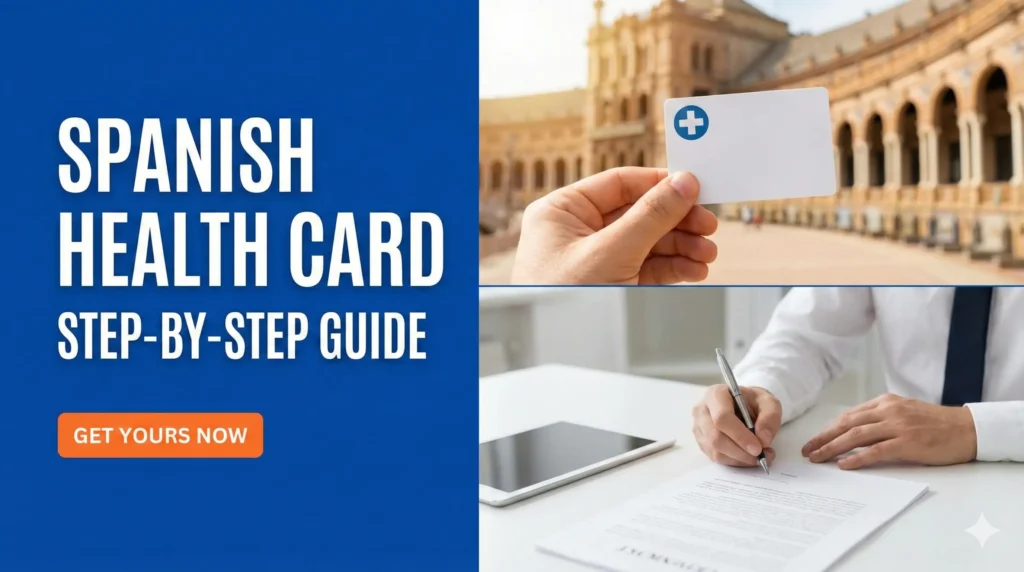
The Four Crucial Steps to Obtaining Your Tarjeta Sanitaria
The process of getting your health card must be completed in a very specific order. You cannot skip steps, as each government agency requires the stamped paperwork from the previous agency to proceed.
Step One Registering Your Address at the Town Hall
Your journey begins at your local town hall. The Spanish healthcare system is highly decentralized, managed independently by the seventeen Autonomous Communities (such as Andalusia, Catalonia, and Madrid). To be assigned to a local health clinic, you must prove to the regional government exactly where you live.
You do this by obtaining a Certificate of Empadronamiento, commonly referred to as the Padrón. This is an official census document that registers your physical address with the local municipality.
To get your Padrón certificate, you must book an appointment at your local town hall office. You will generally need to bring:
- Your original passport and a photocopy.
- Your Foreigner Identification Number certificate or your physical residency card.
- Proof of address. This is usually your original, signed rental contract (which must be for a duration of more than six months) and a recent utility bill in your name. If you purchased a home, you must bring the property deed.
The town hall will issue your Padrón certificate on the spot. It is vital to note that for many bureaucratic processes in Spain, including healthcare registration, a Padrón certificate is only considered valid if it was issued within the last ninety days. If you need assistance navigating the housing market to secure a valid lease, explore our guide on Finding Long-Term Rentals in Spain: Best Websites and Strategies.
Step Two Obtaining Your Social Security Number
Once you have proof of your address, your next step is to enter the national Social Security system. If you have just signed an employment contract, your company’s Human Resources department will often complete this step on your behalf. However, if you are setting up as a freelancer or your employer requires you to do it yourself, you must interact with the General Treasury of Social Security.
You must apply for a Número de Afiliación a la Seguridad Social. This is a unique, lifetime number that tracks your labor history and your financial contributions to the state welfare system.
The Application Process
To apply for your Social Security number in person, you must book an appointment at the nearest office of the General Treasury of Social Security. The system for booking these appointments can be notoriously difficult to navigate. If you are struggling with the digital booking portal, refer to our troubleshooting tips in Navigating the Cita Previa System in Spain.
For your appointment, you must bring:
- Your passport.
- Your NIE or residency card.
- Your valid Padrón certificate.
- A completed TA.1 form. This form is the official application for affiliation with the Social Security system. It must be filled out in Spanish and signed in black or blue ink.
- Your employment contract or proof of your freelance registration.
If you possess a Digital Certificate or the Cl@ve PIN system, you can bypass the in-person appointment entirely and submit the TA.1 form online through the Social Security electronic headquarters. The digital system will generate your affiliation number immediately in a downloadable PDF format. For a deeper dive into how these contributions impact your overall financial picture, read Working in Spain: Payslips, Social Security, and Benefits Explained.
Step Three Registering Your Right to Healthcare
This step is where the majority of expatriates make a critical error. Having a Social Security number is not the same thing as having the explicit right to use public healthcare. You must formally activate your healthcare entitlement.
While the General Treasury handles the collection of your money, a completely different branch of the government handles your benefits. You must register with the National Institute of Social Security to obtain your Documento Acreditativo del Derecho a la Asistencia Sanitaria. This document is the golden ticket; it officially proves that you are entitled to medical care.
Submitting the Request
Just like the previous step, you can complete this process online if you have a Digital Certificate. Through the “Tu Seguridad Social” portal, you can register as an insured person, and the system will instantly generate the entitlement certificate.
If you must do this in person, you will need to book another appointment. You will bring your passport, NIE, Padrón, and your newly acquired Social Security number document. The clerk will verify that you are actively contributing to the system and issue a paper certificate stating your right to health assistance.
Step Four Visiting Your Local Health Clinic
With your Padrón certificate proving where you live, and your entitlement document proving you have the right to care, you are finally ready to interact with the medical system itself.
In Spain, your primary point of access to the public health network is your neighborhood health clinic, known as the Centro de Salud or CAP. You cannot simply choose any clinic in the city; you must register at the specific clinic that is assigned to your residential zip code.
The Registration Appointment
You do not usually need an appointment to register at the clinic; you simply walk up to the administrative reception desk. You must present the holy trinity of Spanish bureaucratic documents:
- Your passport and NIE/Residency Card.
- Your Padrón certificate (issued within the last three months).
- Your Documento Acreditativo from the National Institute of Social Security.
The administrative staff will enter your details into the regional health database. At this exact moment, two very important things will happen.
First, you will be assigned a specific general practitioner, known as a médico de cabecera. In the Spanish public system, you must always see this assigned doctor first for any non-emergency medical issue. They act as the gatekeeper, providing initial diagnoses and issuing referrals if you need to see a specialist at a hospital, such as a cardiologist or a dermatologist.
Second, the staff will order your physical Tarjeta Sanitaria. Because the cards are printed centrally, they are not handed to you on the spot. The clinic will issue you a temporary paper printout containing your new regional health identification number. You can use this paper immediately to book medical appointments and pick up subsidized prescriptions at the pharmacy. The physical plastic card will be mailed to your home address, usually arriving within two to four weeks.
To better understand how to utilize your assigned doctor and navigate specialist referrals, review our comprehensive overview of Understanding the Spanish Public Healthcare System.
Registering Dependents and Beneficiaries
If you are the primary earner in your household, your unemployed spouse and your dependent children do not need to secure their own employment to get a health card. They can be registered as beneficiaries under your Social Security profile.
To do this, you must return to Step Three. When you apply for your entitlement document at the National Institute of Social Security, you will submit an additional form to add beneficiaries.
You must provide robust documentation to prove your relationship. For a spouse, this means an original marriage certificate. For children, you must present their birth certificates. If these documents were issued outside of Spain, they must generally be officially translated into Spanish by a sworn translator and bear the Hague Apostille stamp to be considered legally valid. Once the Social Security office approves the beneficiaries, they will issue entitlement documents for each family member, and you can take those documents to the local health clinic to order their individual health cards. For specific guidance regarding pediatric care and child wellness checkups, consult Women’s and Family Health in Spain: Maternity, Pediatrics, and Screening.
Understanding Your Tarjeta Sanitaria
When your plastic card arrives in the mail, it is important to understand the information printed on it. While the visual design varies wildly depending on which Autonomous Community you live in—a card issued in Madrid looks entirely different from a card issued in the Basque Country—the core data remains standard.
- Personal Details: Your full name and your national identity number or NIE.
- CIP or CIPA Number: This is your Personal Identification Code. This unique number is what you will use to log into regional health apps, book appointments online, and identify yourself at the pharmacy.
- TSS Code: This code identifies the specific type of Social Security entitlement you hold (e.g., active worker, pensioner, or beneficiary).
- Doctor Information: Depending on the region, the name of your assigned primary care doctor and their consultation room number may be printed directly on the card.
You must carry this card with you whenever you interact with the medical system. Pharmacies require you to insert the card into their chip readers to access your electronic prescriptions and apply the state subsidies to the cost of your medications.
The Convenio Especial Alternative Access
What happens if you are a foreign resident in Spain but you do not work, do not receive a European state pension, and therefore do not qualify for free public healthcare?
Historically, you would be forced to rely entirely on private health insurance. However, the Spanish government offers a unique pay-in scheme known as the Convenio Especial. This agreement allows individuals who have been legally registered as residents in Spain for a minimum of one continuous year to pay a flat monthly fee to access the public healthcare network.
As of 2026, the standard monthly fee is roughly sixty euros for individuals under the age of sixty-five, and approximately one hundred and fifty-seven euros for individuals aged sixty-five and older.
The Convenio Especial provides exactly the same medical treatment, emergency care, and hospital access as a standard contributing worker receives. The only major difference is that the Convenio Especial does not cover the heavy subsidies for prescription medications at the pharmacy; you must pay the full retail price for your drugs.
Using Your Card Outside of Spain
Your Spanish Tarjeta Sanitaria is valid for medical treatment exclusively within Spanish territory. If you plan to travel for a vacation or a short business trip to another country within the European Union, the European Economic Area, or Switzerland, your domestic card will not cover you.
To ensure you have medical coverage while traveling, you must apply for the European Health Insurance Card. If you are an active contributor to the Spanish Social Security system, you can request this card online through the Social Security portal, and it will be mailed to your Spanish address. The European card grants you access to state-provided healthcare in the destination country under the same conditions and at the same cost as people insured in that country.
Public vs. Private Healthcare A Quick Comparison
While the Spanish public healthcare system is phenomenal, it is not without its drawbacks, primarily concerning wait times for non-urgent specialist appointments and elective surgeries. For this reason, many expatriates choose to maintain private health insurance alongside their public Tarjeta Sanitaria.
To help you evaluate whether you should rely solely on your newly acquired health card or supplement it with private coverage, consider the following comparison:
| Feature | Public Healthcare (Tarjeta Sanitaria) | Private Health Insurance |
| Cost | Free at the point of use (funded via taxes/Social Security). | Monthly premiums (ranging from €50 to €150+). |
| Primary Care Access | Must see assigned doctor; appointments usually within days. | Can book directly with any general practitioner in network. |
| Specialist Access | Requires a referral from your primary care doctor; wait lists apply. | Direct access without referrals; rapid appointment scheduling. |
| Emergency Care | World-class trauma centers; immediate priority triage. | Excellent facilities, often faster intake for minor emergencies. |
| Language | Staff predominantly speak only Spanish. | High availability of English-speaking doctors and staff. |
| Prescriptions | Medications are heavily subsidized at the pharmacy. | Prescriptions are generally paid out-of-pocket at full price. |
If you decide that a hybrid approach is best for your family’s peace of mind, ensure you research the specific waiting periods and copayment structures involved by reading Choosing the Right Private Health Insurance in Spain.
Conclusion
Obtaining your Tarjeta Sanitaria is a defining moment in your expatriate journey. It represents your official integration into one of the most robust and respected social welfare systems in the world.
While the bureaucratic pathway—from the town hall Padrón to the Treasury of Social Security, and finally to the administrative desk of your local clinic—requires patience and meticulous document preparation, the reward is unparalleled. Armed with your Spanish health card, you gain the security of knowing that whether you face a minor seasonal illness or a major medical emergency, you and your family are fully protected by a world-class healthcare network. Prepare your paperwork diligently, follow the sequential steps outlined in this guide, and step into your new life in Spain with absolute confidence and peace of mind.
References
Primary sources (official)
- Ministerio de Sanidad (Spanish Ministry of Health): https://www.sanidad.gob.es/
- Seguridad Social (Social Security Electronic Headquarters): https://sede.seg-social.gob.es/
- Tu Seguridad Social (Healthcare Entitlement Portal): https://tu.seg-social.gob.es/
Other helpful sources
- Expatica (Healthcare in Spain: A Guide for Expats): https://www.expatica.com/es/healthcare/healthcare-basics/healthcare-in-spain-101467/
- Age in Spain (How to get the Tarjeta Sanitaria): https://www.ageinspain.org/post/how-to-get-tarjeta-sanitaria-health-card
Disclaimer
The information provided in this article is for educational and informational purposes only and does not constitute formal legal, immigration, or medical advice. Bureaucratic processes, required documentation for Social Security affiliation, and regional healthcare administration rules are subject to frequent legislative updates by the Spanish government and individual Autonomous Communities. We strongly recommend consulting official government portals or engaging a certified Spanish administrative manager (Gestor) to verify the current requirements before initiating your healthcare registration process.