Pharmacies in Spain: Opening Hours and Night Pharmacies (Farmacia de Guardia)
Discover everything you need to know about Spanish pharmacy hours, including traditional siesta closures, continuous schedules, and how to locate an on-call night pharmacy for late-night or weekend medical emergencies in your local neighborhood.
Disclosure: This post may contain affiliate links. We may earn a commission at no extra cost to you if you make a purchase through these links. Read full disclosure.
The Iconic Green Cross
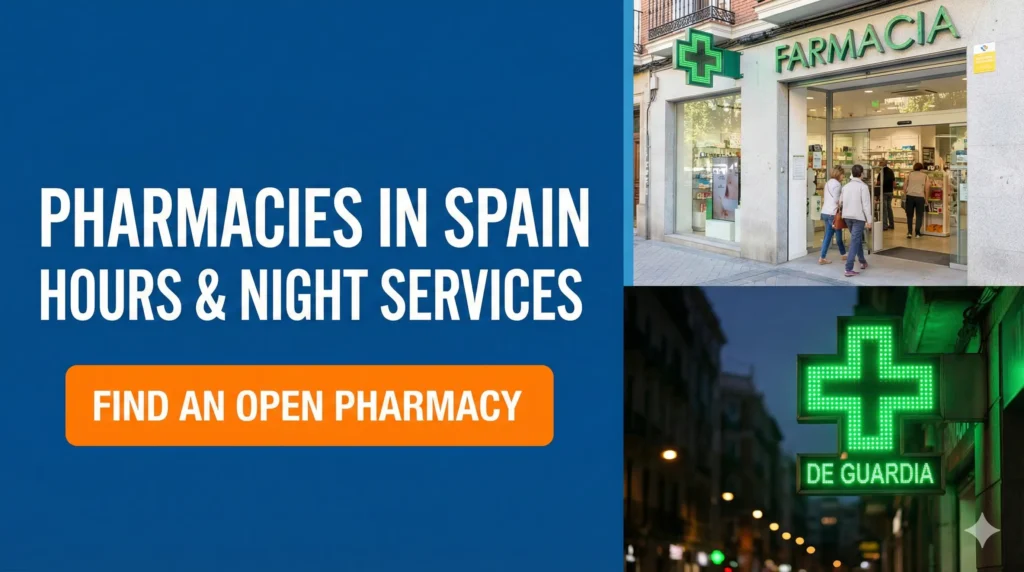
Before delving into the schedules, it is important to know how to identify a legitimate pharmacy in Spain. No matter where you are in the country—from the bustling avenues of Madrid to the quietest cobblestone streets of a rural Andalusian village—you will always be able to spot a pharmacy by its universally recognized symbol: the illuminated green cross.
These large green crosses protrude from the facades of the buildings. When the pharmacy is open and operating, the cross will typically flash, rotate, or display alternating patterns. Many of these digital crosses also double as community information boards, displaying the current time, the local temperature, and the date. If you see the green cross fully illuminated, you can confidently walk in for assistance.
However, you must be careful not to confuse a traditional pharmacy with a para-pharmacy. A para-pharmacy often features a blue cross or a modified green logo. While these stores are excellent for purchasing vitamins, herbal supplements, specialized skincare products, baby formula, and orthopedic supports, they are strictly prohibited from selling any actual medicine. If you have a headache, a fever, or a prescription from your doctor, a para-pharmacy cannot help you. You can read more about what is and is not available without a doctor’s intervention in our guide on Over-the-Counter Medicines in Spain: What You Can Buy Without a Prescription.
Standard Spanish Pharmacy Hours
The standard operating hours of a Spanish pharmacy reflect the traditional rhythms of the country’s daily life. While multinational retail chains and large supermarkets have largely abandoned the midday closure, many independent businesses, including pharmacies, still adhere to the classic split shift.
A typical neighborhood pharmacy will open its doors in the morning, usually around 9:30 AM. They will operate steadily through the morning rush until 1:30 PM or 2:00 PM. At this point, the pharmacy will close its doors, pull down the metal security shutters, and the staff will go home for lunch and the traditional midday rest.
The pharmacy will remain closed for several hours during the hottest part of the afternoon. They typically reopen at 5:00 PM and remain operational until 8:00 PM or 8:30 PM.
This split schedule can be incredibly frustrating for expats who are accustomed to running errands during their lunch break. If you leave your office at 2:00 PM hoping to pick up a prescription, you will likely be met with a closed metal grate. It requires a slight adjustment in your daily planning to ensure you visit the pharmacy during the active morning or evening windows. If you are still learning the local vocabulary to communicate during these visits, consider reviewing our list of Spanish Medical Terminology: Common Words Expats Should Know.
The Shift Toward Continuous Hours
While the traditional split schedule is still the norm in smaller towns, suburbs, and residential neighborhoods, the landscape is rapidly changing in major metropolitan areas and busy commercial districts.
To cater to modern working schedules and the demands of city life, many pharmacies have adopted a continuous schedule. These establishments are usually identifiable by a large sign in the window reading “Farmacia 12 Horas” or “Abierto 12 Horas.”
A twelve-hour pharmacy typically opens at 9:00 AM or 9:30 AM and remains open non-stop until 9:00 PM or 9:30 PM. The staff works in rotating shifts so that the doors never close during the midday hours. For most expats living in central Madrid, Barcelona, Valencia, or Seville, finding a twelve-hour pharmacy completely eliminates the inconvenience of the traditional siesta closure.
There are also “Farmacia 24 Horas” locations, which operate continuously day and night, 365 days a year. However, these are relatively rare and are usually only found in the absolute center of major cities or immediately adjacent to large public hospitals.
Understanding the On Call Pharmacy System
Because health emergencies do not adhere to a convenient schedule, Spanish law dictates that citizens must have access to pharmaceutical services twenty-four hours a day, seven days a week, including all Sundays and public holidays.
To fulfill this legal and ethical obligation without forcing every single pharmacist to work overnight, the official College of Pharmacists in each province organizes a highly structured rotation system. This system is known as the Farmacia de Guardia.
A Farmacia de Guardia translates directly to a “duty pharmacy” or an “on-call pharmacy.” Under this system, pharmacies in a given municipality or district take turns staying open through the night, over the weekend, and during local or national holidays. When all the other regular pharmacies in the neighborhood lock their doors at 8:30 PM, the designated on-call pharmacy assumes the responsibility of serving the entire area until the following morning.
The rotation ensures that the burden of the night shift is shared equally among local businesses while guaranteeing that residents are never too far from emergency medication. In a large city district, there might be two or three pharmacies on guard on any given night. In a smaller town or rural area, there will typically be just one, and residents of neighboring villages may have to drive to that specific location. To plan ahead for your off-day needs, you can review our advice on What to Do If You Need Care on a Weekend in Spain.
How to Locate an On Call Pharmacy
Imagine it is 2:00 AM on a Tuesday, or 3:00 PM on a Sunday, and you desperately need medication for a sudden fever or an allergic reaction. You walk to your usual neighborhood pharmacy, only to find it completely shut down and dark. How do you find the one that is open?
The Spanish system has a brilliant, analog failsafe built into its design. By law, every single pharmacy must display a printed list of the current Farmacias de Guardia in their immediate vicinity. This list is almost always taped to the inside of the glass door or displayed in a prominent, illuminated box on the exterior wall.
If you arrive at a closed pharmacy, simply walk up to the door and look for the paper titled “Farmacias de Guardia.” This document will list the exact dates, the names, the addresses, and usually a small printed map directing you to the pharmacies that are currently on duty.
Digital Tools and Online Searches
While the paper on the door is foolproof, you do not necessarily need to leave your house to find the nearest open location. The digital infrastructure surrounding Spanish healthcare is excellent.
You can easily locate the nearest on-call pharmacy by visiting the official website of your province’s College of Pharmacists. Alternatively, a simple Google search for “Farmacia de guardia cerca de mi” or “Farmacia de guardia [Name of your town]” will instantly pull up the daily rotation schedule. Many local town halls also publish the monthly rotation calendar on their official websites and social media pages. If the situation is more severe than a simple pharmacy run can fix, ensure you know your options by reading about Emergency Healthcare in Spain: 112, Urgent Care, and What to Expect.
Visiting a Night Pharmacy
Visiting an on-call pharmacy at three in the morning is a slightly different experience than a casual afternoon visit. Depending on the location and the specific security protocols of the business, you might not actually be allowed inside the store.
For security reasons, especially in large cities, the main doors of the pharmacy are often locked during the late-night hours. Instead, you will find a small, reinforced glass window or a metal drawer built into the storefront or the front door. Next to this window, there will be a doorbell, usually labeled “Timbre” or “Guardia.”
You must ring the bell and wait. Sometimes, the pharmacist is in the back room organizing stock, or in smaller towns, they might actually be sleeping in a designated rest area upstairs. Once they approach the window, you will conduct your transaction entirely through the security glass. You pass your prescription, health card, and payment through the sliding metal drawer, and the pharmacist passes your medication back to you.
It is important to remember that the night shift is primarily designed for urgent medical needs. While the pharmacist will not refuse to sell you non-urgent items, it is generally considered poor etiquette to ring the night bell at 4:00 AM to buy a tube of lip balm or a premium anti-aging face cream. The service is there to dispense antibiotics, emergency painkillers, infant fever medication, and urgently needed prescription refills.
Surcharges for After Hours Services
One of the most frequently asked questions by expats is whether medication costs more during the night shift. The answer is nuanced and depends on the specific circumstances of your visit.
The retail price of the actual medication in Spain is strictly regulated by the government and cannot be arbitrarily inflated by the pharmacy. A box of paracetamol costs exactly the same at 3:00 PM as it does at 3:00 AM.
However, there is a legal framework that allows the on-call pharmacy to apply a small service surcharge for dispensing medication outside of normal business hours. This fee is generally quite low, often ranging between one and three euros per transaction, not per item.
Crucially, this surcharge is typically waived if you are presenting a valid, urgent prescription from a doctor. If you have just left the hospital emergency room with an urgent electronic prescription for antibiotics, the public healthcare system usually absorbs the after-hours fee. If you are showing up simply to buy over-the-counter cough syrup because you cannot sleep, you will likely be asked to pay the small supplemental charge for the convenience of the night service. To understand exactly how these public digital prescriptions are processed, look at our breakdown on the Prescription System in Spain: How ePrescriptions Work.
Sundays and Public Holidays
Spain is a country that deeply values its public holidays and days of rest. On Sundays and “Red Days” (national or regional public holidays), almost all standard commerce grinds to a halt. Supermarkets, clothing stores, and banks will be firmly closed.
Traditional pharmacies also close on these days. However, the exact same rotation system used for the night shift applies to Sundays and holidays. The designated Farmacia de Guardia will open its doors at 9:30 AM on Sunday morning and remain open for a full twenty-four hours until Monday morning.
During the daytime hours on a Sunday or a public holiday, the on-call pharmacy will operate like a normal store. The front doors will be unlocked, you can browse the aisles for para-pharmacy items, and the staff will assist you over the main counter. It is only when night falls that they transition to the security window protocol.
Because there are fewer pharmacies open on a Sunday, you should expect longer lines at the ones that are on duty. It is not uncommon to see a line of five or six people waiting outside a Farmacia de Guardia on a Sunday morning, particularly during the winter cold and flu season.
Comparing Pharmacy Operating Models
To help clarify the different schedules you will encounter, the following table breaks down the typical operating hours, the primary purpose of the facility, and how to visually identify them from the street.
| Pharmacy Type | Typical Operating Hours | Primary Purpose | How to Identify |
| Traditional Farmacia | 9:30 AM – 2:00 PM & 5:00 PM – 8:30 PM | Routine health needs, standard prescription refills, and chronic medication. | Standard storefront, flashing green cross. Closes for the afternoon siesta. |
| Farmacia 12 Horas | 9:30 AM – 9:30 PM (Continuous) | Convenience for working professionals, allowing access during the afternoon. | A prominent “12 Horas” sign or banner displayed on the facade. |
| Farmacia 24 Horas | 24 Hours a day, 365 days a year | Round-the-clock availability for all needs. Very rare outside major city centers. | A prominent “24 Horas” sign. Doors remain open day and night. |
| Farmacia de Guardia | Overnight, Sundays, and Public Holidays | Emergency and urgent medication access when regular locations are closed. | Listed on the paper taped to the door of your local closed pharmacy. |
Essential Vocabulary for Your Pharmacy Visit
When visiting a Spanish pharmacy, especially late at night when you might be stressed or unwell, knowing a few key phrases can significantly smooth the transaction. Most pharmacists in major cities speak some English, but it is never guaranteed.
Here is a quick reference guide to help you communicate your needs effectively:
- I am looking for the on-call pharmacy. – Estoy buscando la farmacia de guardia.
- I need something for a fever/pain. – Necesito algo para la fiebre/el dolor.
- I have an electronic prescription. – Tengo una receta electrónica.
- My child is sick. – Mi hijo/hija está enfermo/a.
- Do I need a prescription for this? – ¿Necesito receta para esto?
- Please ring the bell. – Por favor, toque el timbre. (You will often see this written next to the night window).
For a broader understanding of how to manage your health and interact with these highly trained professionals, we recommend exploring our comprehensive overview on Pharmacies in Spain: Prescriptions, Over-the-Counter Meds, and Practical Tips.
Conclusion
The Spanish pharmacy system is a perfect reflection of the country’s broader approach to healthcare: highly regulated, community-focused, and deeply committed to ensuring universal access to care.
While the traditional siesta closures require a bit of logistical adaptation for newly arrived expats, the Farmacia de Guardia system provides an incredibly reliable safety net. By familiarizing yourself with the flashing green crosses, learning how to read the duty schedules posted on the doors, and understanding the etiquette of the night window, you can rest easy knowing that essential medication and expert medical advice are always available in Spain, regardless of the time or the day of the week.
References
Primary sources (official)
- Ministerio de Sanidad (Spanish Ministry of Health): https://www.sanidad.gob.es/
- Consejo General de Colegios Oficiales de Farmacéuticos: https://www.farmaceuticos.com/
Other helpful sources
- Citizens Advice Bureau Spain (Healthcare Guides for Expats): https://www.citizensadvice.org.es/
- UK Government Official Guide to Healthcare in Spain: https://www.gov.uk/guidance/healthcare-in-spain
Disclaimer
The information provided in this article is for general informational and educational purposes only and does not constitute formal medical or legal advice. Pharmacy operating hours, local rotation schedules, and after-hours surcharges vary significantly by autonomous community and municipality. Always consult your local College of Pharmacists or regional health authority for the most accurate and up-to-date schedules in your specific area. In the event of a severe or life-threatening medical emergency, do not go to a pharmacy; dial 112 immediately.