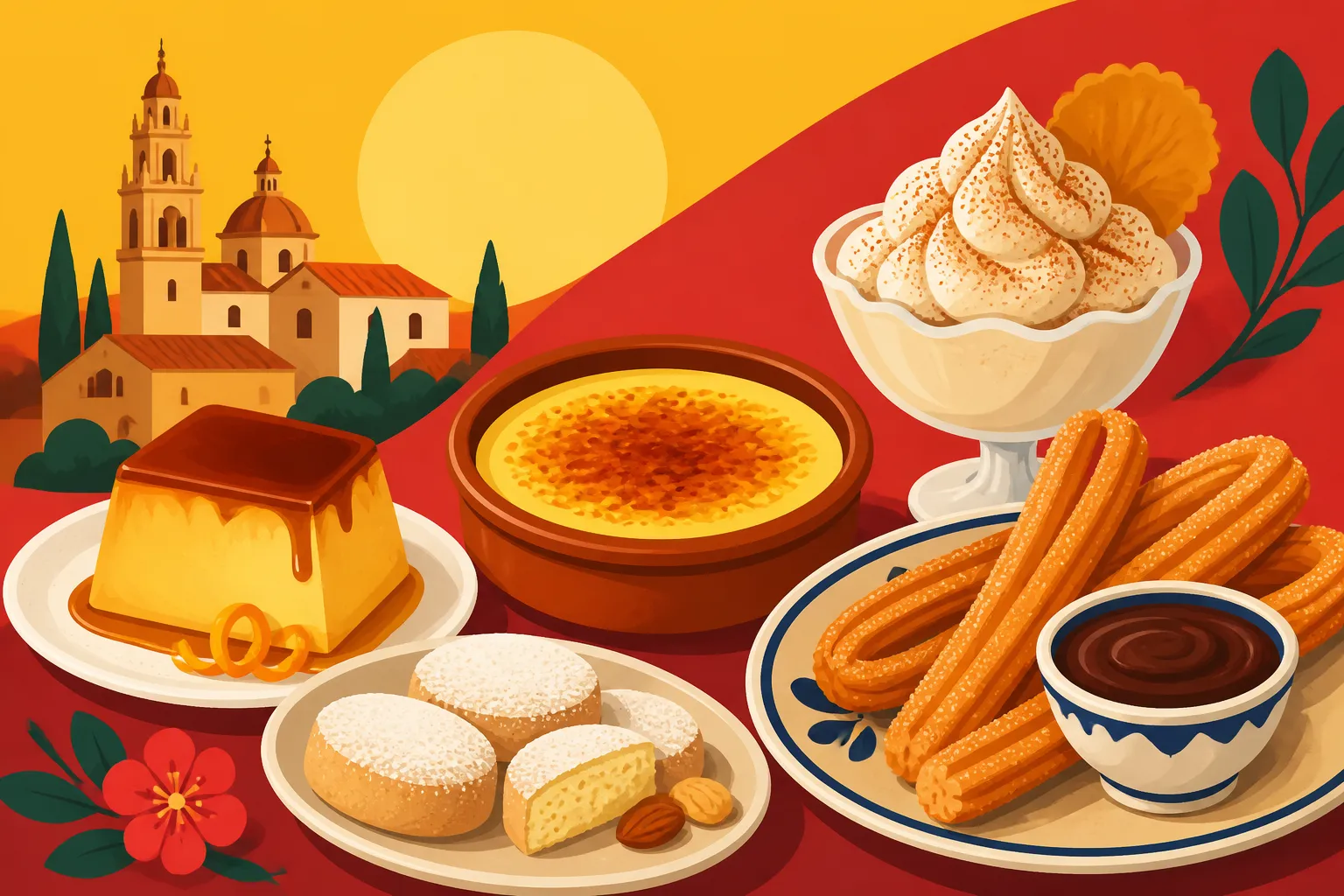
Spanish Desserts and Sweet Treats to Try
Most visitors arrive in Spain with a checklist dominated by savory tapas and local wines, only to find themselves completely overwhelmed when standing before a local pastry shop window. I remember my first week in Madrid, staring at a tray of "Saint's Bones" and wondering if I had accidentally walked into a medical museum rather than a bakery. This guide breaks down the complex world of Spanish desserts, ensuring you never miss out on the sugar-fueled heart of Spanish culture.
Disclosure: This post may contain affiliate links. We may earn a commission at no extra cost to you if you make a purchase through these links. Read full disclosure.
The Cultural Significance of the Spanish Sweet Tooth
In Spain, sugar is not merely a post-dinner afterthought; it is a historical narrative baked into the very fabric of daily life. To understand Spanish sweets, you have to look back at the centuries of Moorish rule that shaped the Iberian Peninsula. The Arab influence brought ingredients that are now considered quintessentially Spanish: almonds, honey, cinnamon, and citrus zest. Before the arrival of the Moors, Roman-influenced desserts were largely based on wine and cheese, but the introduction of sophisticated irrigation and new crops transformed the landscape of the Spanish palate.
The rhythm of the day also dictates when and how you enjoy these treats. Unlike in many Northern European or North American cultures where dessert is a heavy finale to a meal, in Spain, the most significant sugar intake often happens during the "merienda." This mid-afternoon snack, usually taken between 5:00 PM and 7:00 PM, is a sacred social hour. It bridges the massive gap between a late lunch and an even later dinner. If you want to experience this like a local, you should check out Spanish Meal Times and Dining Etiquette Explained to see how a simple pastry fits into the broader social calendar.
Furthermore, many of the most iconic Spanish sweets are tied to the liturgical calendar. Spain remains a deeply traditional country where specific dates on the calendar are inextricably linked to specific flavors. Whether it is the fried dough of Lent or the almond pastes of Christmas, eating the right sweet at the right time is a point of national pride. To navigate these dates effectively, keep an eye on Festivals, Fiestas, and Public Holidays in Spain so you know exactly when the bakeries will be stocking their seasonal specialties.
The Arabic Legacy in Spanish Sweets
The Moorish influence is most visible in the extensive use of marzipan and almond-based pastries, particularly in the southern regions and central plains. Ingredients like saffron, aniseed, and sesame seeds—all staples of North African and Middle Eastern confectionery—are the backbone of the Spanish "pastelería." These ingredients were chosen not just for their flavor, but for their ability to withstand the intense Spanish heat. Honey, in particular, acted as a natural preservative, allowing sweets to be kept for weeks without spoiling.
When you bite into a "Pestiño" or a piece of "Alfajor," you are tasting a recipe that has likely changed very little in five hundred years. The complexity of these flavors often surprises newcomers who expect the simple chocolate-and-vanilla profile of Western desserts. Instead, you get a profile that is floral, nutty, and deeply aromatic. It is wise for travelers to look into Spanish Food and Drink: A Practical Culture Guide to get a better handle on these flavor profiles before they dive headfirst into a tasting tour.
Convent Sweets: Spain’s Hidden Dessert Tradition
One of the most unique aspects of Spanish confectionery is the "dulces de convento" or convent sweets. For centuries, cloistered nuns have supported their communities by baking traditional recipes, often using surplus egg yolks left over from the wine-fining process (where egg whites were used to clarify wine). These sweets were traditionally sold through a "torno"—a wooden revolving door that allowed the nuns to remain unseen while conducting transactions with the public.
Today, you can still find these "secret" bakeries in cities like Toledo, Seville, and Madrid. Searching for these convents is a bit of a treasure hunt. You ring a small bell at a nondescript door, a voice says "Ave María Purísima," and you reply "Sin pecado concebida." You then place your money on the rotating shelf, and a box of hand-made almond cookies or egg-yolk "yemas" appears. It is a hauntingly beautiful experience that connects you to the medieval heart of Spain. If you are staying in a historic area, perhaps booked through Booking.com, ask your host where the nearest convent bakery is located.
Iconic Fried Doughs and Breakfast Delights
If there is one thing Spaniards have mastered, it is the art of frying dough. While many countries have versions of the doughnut, Spain has elevated fried treats to a morning ritual. You will see people from all walks of life—businessmen in suits, construction workers, and grandmothers—huddled around a marble counter at 8:00 AM, dipping golden ridges of dough into cups of chocolate so thick the spoon can almost stand upright.
Fried doughs in Spain are not just for breakfast, though. They are the ultimate "after-party" food. In many cities, the churrerías are busiest at 6:00 AM when the nightclubs close. There is something incredibly grounding about a fresh churro after a night of dancing. This is a side of the culture that is best explored by knowing Spanish Tapas Culture: How to Order and Where to Go, as the rules of social engagement at a churro stand are very similar to those at a busy tapas bar.
Churros and Porras: Beyond the Tourist Traps
Most tourists know what a churro is, but few understand the distinction between a "Churro" and a "Porra." A churro is thin, star-shaped, and usually looped or knotted. It is crunchy on the outside and slightly doughy on the inside. A porra, on the other hand, is much thicker, airier, and uses a bit of baking soda or more yeast to create a hollow, light texture. In Madrid, the porra is king. It is more substantial and soaks up the chocolate like a sponge.
When ordering, don't look for the places with giant plastic churros outside. Look for the "Churrería" or "Tejeringo" (in the south) that has a large vat of bubbling oil visible from the window and a line of locals holding plastic bags. The chocolate served with them, known as chocolate a la taza, is not a drink in the traditional sense; it is a dipping sauce. It is made with high-fat cocoa and a touch of cornstarch to give it that signature velvet consistency. If you find yourself in the capital, How to Find Authentic Restaurants in Spain (Not Tourist Traps) can help you steer clear of the frozen, pre-made versions often sold in the main squares.
Pestiños and Buñuelos: Seasonal Fried Treasures
While churros are available year-round, other fried delights are strictly seasonal. "Pestiños" are the stars of Christmas and Easter in Andalusia. They are small squares of dough flavored with sesame and anise, folded into a "bow" shape, fried, and then drenched in honey or sugar. They are crunchy, sticky, and incredibly addictive. I’ve spent many a Holy Week in Seville tracking down the best pestiños, often finding that the smallest, most unassuming neighborhood bars have the secret family recipe that beats any commercial bakery.
"Buñuelos" are another must-try, particularly during the Fallas festival in Valencia or All Saints' Day. These are essentially fritters, often flavored with pumpkin (buñuelos de calabaza) or filled with cream. They are light, airy balls of dough that are dusted in sugar. In Valencia, you can find them being fried on street corners in massive iron cauldrons. The smell of frying buñuelos and hot chocolate is the olfactory hallmark of a Spanish spring. To make sure you’re in the right city at the right time to try these, using Omio to book your high-speed train tickets between regions like Madrid, Valencia, and Seville is the most efficient way to follow the "sugar trail."
Creamy Classics and Custard-Based Masterpieces
Spain has a deep-seated love for egg-based desserts. This likely stems from the historical abundance of eggs in monastery and convent life. From the simple "flan" to the more complex "tocino de cielo," the texture of a Spanish dessert is often silky, smooth, and incredibly rich. If you are a fan of custard, you have arrived in paradise.
These desserts are the standard "postre" offered in a menú del día. While many restaurants will offer fruit or yogurt, the "postre casero" (homemade dessert) is almost always a custard variant. When you are looking for a place to eat, always check the chalkboard outside for the words "natillas" or "crema catalana." These are the hallmarks of a kitchen that still takes its dessert menu seriously.
Crema Catalana vs. Flan: The Great Texture Debate
"Crema Catalana" is often compared to the French Crème Brûlée, but locals will quickly tell you they are not the same. While the French version is baked in a water bath and uses cream, the Spanish version is made on the stovetop with milk and thickened with egg yolks and cornstarch. It is flavored with cinnamon and lemon zest rather than vanilla. The defining feature is the "burnt" sugar crust on top, which is traditionally achieved using a hot iron spiral.
"Flan," however, is the undisputed king of the Spanish household. A classic flan is a vanilla egg custard baked with a layer of clear caramel sauce on the bottom. When flipped over, the caramel runs down the sides, creating a beautiful, self-saucing masterpiece. Variations include "flan de castaña" (chestnut) or "flan de queso" (cheese flan). If you are visiting the Northeast, be sure to read Barcelona for First-Time Visitors: What to See and Skip to find the best spots for an authentic Crema Catalana in the Gothic Quarter.
Natillas and Arroz con Leche: Comfort in a Bowl
"Natillas" is essentially a thinner, pourable custard, usually served in a bowl with a single "Maria" biscuit floating on top and a generous dusting of cinnamon. It is the ultimate comfort food for Spaniards. It isn't fancy, but when made with high-quality farm eggs and fresh milk, it is sublime. It’s the kind of dessert that reminds every Spaniard of their grandmother’s kitchen.
Then there is "Arroz con Leche," or rice pudding. Forget the clumpy, dry versions you might have had elsewhere. Spanish rice pudding is cooked slowly for hours until the rice almost dissolves into a thick, creamy porridge. In Asturias, they take this very seriously, often adding a caramelized sugar crust to the top, similar to a Crema Catalana. It’s a heavy, satisfying end to a meal, especially after a long day of exploring Galicia and Green Spain: A Traveler's Introduction, where the dairy is some of the best in the country.
| Dessert Name | Primary Region | Main Ingredients | Best Time to Eat |
|---|---|---|---|
| Churros | Nationwide | Flour, Water, Salt, Oil | Breakfast / Late Night |
| Crema Catalana | Catalonia | Milk, Egg Yolks, Cinnamon | Year-round |
| Tarta de Santiago | Galicia | Almonds, Sugar, Eggs | After a hike/Pilgrimage |
| Turrón | Alicante/Jijona | Almonds, Honey, Egg White | Christmas Season |
| Torrijas | Madrid/Central | Bread, Milk, Honey/Sugar | Easter (Semana Santa) |
| Ensaimada | Mallorca | Flour, Lard, Powdered Sugar | Breakfast / Merienda |
Almond-Based Sweets and Regional Specialties
Almonds are the gold standard of Spanish confectionery. Spain is one of the world’s largest producers of almonds, and they find their way into everything from cakes to candies. Because they are calorie-dense and have a long shelf life, almond sweets were historically the perfect food for travelers and soldiers. Today, they remain the most common souvenir for visitors to take home.
If you find yourself traveling between regions, you will notice that the almond treats change character. In the north, they are often dense and cake-like. In the south, they are more reminiscent of Middle Eastern "halva" or nut pastes. Using a platform like Omio to navigate between these regions allows you to see this culinary evolution in real-time.
Turrón: The King of Spanish Christmas
You cannot talk about Spanish sweets without mentioning "Turrón." This nougat is the center of the Spanish table during the holidays. There are two primary types: "Turrón de Jijona" (soft) and "Turrón de Alicante" (hard). The soft version is a smooth, oily paste made from ground toasted almonds and honey, while the hard version is a brittle white nougat packed with whole roasted almonds.
While it is traditionally a Christmas treat, specialized shops in cities like Madrid and Barcelona sell it year-round. Modern "Turrón de autor" has also become popular, featuring flavors like gin and tonic, chocolate with sea salt, or even cheesecake. If you want to dive deeper into these holiday habits, check out Christmas and Three Kings in Spain: Traditions Explained. To truly experience the source, a trip to the town of Jijona is worth the effort, where the air literally smells like toasted honey in December.
Tarta de Santiago: A Galician Pilgrimage for the Palate
Hailing from Santiago de Compostela, this almond cake is easily recognized by the powdered sugar stencil of the Cross of Saint James on top. What makes the "Tarta de Santiago" special is that it is naturally gluten-free (though always check for cross-contamination in bakeries), as it uses only ground almonds, eggs, and sugar. It is moist, dense, and heavily scented with lemon zest and occasionally a splash of Galician orujo (a potent local spirit).
For pilgrims finishing the Camino de Santiago, eating a slice of this cake is a rite of passage. It provides the quick energy needed after weeks of walking. Even if you aren't a pilgrim, finding a small bakery in the winding granite streets of Santiago is a must. You can often find these bakeries listed on GetYourGuide food tours, which provide a great way to taste your way through the city's history without getting lost in the backstreets.
Practical Tips for Finding the Best Treats
Finding the best sweets in Spain requires a bit of "insider" knowledge. You have to know where to look and, more importantly, what time to look. The best pastelerías often look like jewelry stores, with meticulously arranged window displays. However, don't ignore the humble panadería (bread bakery) or the confitería (confectionery). Each has its own specialty.
Another thing to remember is that "service" in a traditional Spanish pastry shop can be brisk. It is often helpful to know a few phrases or to have a visual guide ready on your phone. If you are worried about the language barrier, Spanish Coffee Culture: How to Order Like a Local provides a great foundation for the kind of vocabulary you will need in any cafe setting.
Pastelerías vs. Panaderías: Knowing Where to Shop
A Panadería is primarily a bread shop. While they will have some sweets like croissants or "napolitanas" (chocolate-filled pastries), their focus is on the daily loaf. If you want high-end cakes, delicate puff pastries, or regional specialties, you need a Pastelería. These shops are often historic institutions, some dating back to the 1800s.
When you enter a Pastelería, you will often see two sections: one for "pasteles individuales" (small, individual-sized treats) and another for "tartas" (whole cakes). If you are looking for a quick snack, point to the "miniaturas" or "pastas de té"—small butter cookies that are sold by weight. This is a great way to try five or six different things without committing to a giant slice of cake. For those planning a dedicated food trip, Booking.com can help you find boutique hotels located right above these historic pastry quarters.
Navigating Seasonal Sweets and Local Festivals
As mentioned, many Spanish sweets are only available for a few weeks a year. If you visit in November, you will see "Huesos de Santo" (Saint's Bones)—marzipan tubes filled with sweet egg yolk. In January, the windows are filled with "Roscón de Reyes," a brioche ring decorated with candied fruits. If you miss the window, you simply won't find them until next year.
To get the most out of your trip, I highly recommend booking a specialized food tour through GetYourGuide. These guides know the seasonal calendar intimately and can take you to the workshops where these items are still made by hand. They can also explain the hidden meanings behind the sweets—like the "bean" and the "king" hidden inside the Roscón de Reyes, which determine who pays for the cake and who gets to wear the cardboard crown. This level of cultural context turns a simple snack into a memorable experience.
For more information on the broader culinary landscape, be sure to check out Spanish Regional Dishes Every Visitor Should Try. Whether you are in the snowy peaks of the Pyrenees or the sun-drenched coast of the Costa del Sol, there is always a local sweet waiting to be discovered.
Disclaimer
This guide is intended for informational and cultural exploration purposes only. While we strive to provide accurate and up-to-date information regarding Spanish culinary traditions and locations, recipes and availability may vary by region and season. Always check with local vendors for specific ingredients if you have food allergies or dietary restrictions. Any bookings made through third-party platforms mentioned are subject to their respective terms and conditions.