Festivals, Fiestas, and Public Holidays in Spain
You wake up on a Tuesday morning, head to the local supermarket for milk, and find the metal shutters bolted shut. The streets are eerily quiet, and you realize with a sinking heart that it is yet another local holiday you didn't mark on your calendar. I’ve spent years navigating the labyrinth of Spanish calendars, once even showing up to a closed immigration office after a three-hour train ride. This guide will ensure you never get caught out by the delightful, yet often confusing, world of Spanish celebrations.
Disclosure: This post may contain affiliate links. We may earn a commission at no extra cost to you if you make a purchase through these links. Read full disclosure.
Understanding the Spanish Holiday Calendar
Navigating the holiday schedule in Spain is a rite of passage for any newcomer. Unlike many countries where holidays are fixed and predictable, Spain operates on a tiered system: national, regional, and municipal. This means that while the whole country might celebrate Christmas, only Madrid might celebrate San Isidro, and only a specific neighborhood might shut down for its own patron saint. Understanding these layers is the first step toward integrated living.
National vs Regional Holidays
Every year, the Spanish government releases a schedule of national holidays, but the various autonomous communities have the power to swap certain dates or add their own. This results in a patchwork of closures that can vary wildly as you cross regional borders. For instance, while most of Spain celebrates All Saints' Day, some regions might have an additional day off for their specific regional "day," such as the Dia de Andalucía or the Diada in Catalonia.
When you are planning your year, it is vital to consult the Festivals, Fiestas, and Public Holidays in Spain list early. I remember my first year in Valencia; I assumed that because Madrid was working, Valencia would be too. I was wrong, and I ended up sitting on a park bench for four hours waiting for a meeting that was never going to happen. You must learn to check your specific "comunidad" calendar, which is usually published in the BOE (Official State Gazette) or your local town hall's website.
The impact on daily life is significant. On national holidays, almost everything closes—banks, post offices, and major retailers. On regional holidays, the closures are more localized. If you live on the border of two regions, like between Madrid and Castilla-La Mancha, you might find yourself driving fifteen minutes to the next town just to find an open pharmacy. It’s a logistical dance that requires foresight and a bit of a sense of humor.
The Concept of the Puente
The "puente" (bridge) is a cultural phenomenon that every expat must master. If a holiday falls on a Thursday, many Spaniards will take the Friday off as well to create a four-day weekend. Businesses often operate with "skeleton" crews during these times, and some smaller mom-and-pop shops might simply close for the duration. It is a time for family, travel, and complete relaxation, but for the unprepared expat, it can be a week of frustration.
During a puente, the cities often empty out as locals head to the coast or the mountains. Conversely, if you are in a tourist-heavy area, you will see a massive influx of domestic travelers. This is when platforms like Omio become essential for checking if there are any seats left on the high-speed trains, as they sell out weeks in advance.
Planning your errands around these bridges is crucial. If you need a "cita previa" (appointment) for your residency or a driver's license exchange, do not expect to find one during a week with a major holiday. The bureaucracy slows to a crawl, and the staff who are working are often overwhelmed. Check the guide on Spanish Holidays and Public Closures: Planning Errands in 2026 to see how to navigate these quiet periods effectively.
Planning Around Business Closures
In Spain, the "Sunday law" often extends to holidays, meaning large supermarkets are legally required to close. While smaller "alimentación" shops (often run by immigrant families) stay open, they have limited stock. If you’re hosting a dinner party on a holiday, you need to buy your fresh meat and fish at least two days prior. I’ve learned the hard way that a "holiday" in Spain means a total cessation of normal commerce in many sectors.
Restaurants and bars are the big exception. Most stay open because holidays are when they make the most money. However, they will be packed. If you haven't used Booking.com or a similar service to secure a table or a nearby room for a festival weekend, you might find yourself eating a soggy sandwich from a petrol station. The social rhythm of Spain dictates that holidays are for eating out with the extended family, often in groups of twelve or more.
To stay ahead, I recommend downloading a local "laboral" calendar app for your specific city. These apps send notifications a day before a holiday. It sounds simple, but when you are busy working or studying, these reminders are lifesavers. You can also find more details on How to Plan Travel Around Spanish Public Holidays to ensure your vacation doesn't coincide with a total shutdown of the services you need.
Major National Fiestas and Traditions
Spain’s national holidays are deeply rooted in religious tradition and historical milestones. Even if you aren't religious, the cultural weight of these events is undeniable. They dictate the flow of the seasons and provide the framework for the Spanish year.
Semana Santa (Holy Week)
Semana Santa is perhaps the most visually stunning and emotionally charged week in the Spanish calendar. Occurring in the week leading up to Easter, it features massive processions where "pasos" (elaborate floats with religious statues) are carried through narrow streets on the shoulders of "costaleros." The atmosphere is a mix of somber mourning and festive community spirit. In cities like Seville and Málaga, the air is thick with the scent of incense and orange blossoms.
As a foreigner, the first time you see the "nazarenos" with their pointed hoods, it can be jarring. However, it’s important to understand the deep historical context—these hoods represent penance and have no relation to the groups they might resemble in other countries. Watching a procession at 2:00 AM in a silent, darkened street is an experience that stays with you forever. If you want to witness this without being crushed by the millions of tourists who descend on Andalusia, check out How to Experience Semana Santa Without the Biggest Crowds.
Logistically, Semana Santa is a challenge. Many streets are blocked off for hours, making bus travel impossible. If you are staying in a city center, expect noise until the early hours of the morning. It is a fantastic time to book a walking tour through GetYourGuide to find the best vantage points that aren't blocked by police cordons. The week is also a major Public Holidays in Spain period, so expect school closures and disrupted services.
Christmas and Three Kings Day
Christmas in Spain is a marathon, not a sprint. It begins with the "Lotería de Navidad" on December 22nd and doesn't truly end until January 6th. While December 25th is a holiday, the real star of the show for Spanish children is "Los Reyes Magos" (The Three Kings). On the evening of January 5th, every town holds a "Cabalgata," a massive parade where the Kings throw tons of sweets into the crowds.
The morning of January 6th is when children open their gifts. As an expat, you’ll notice that the "Roscón de Reyes," a circular cake with a hidden toy and bean inside, is ubiquitous. If you find the toy, you are the king; if you find the bean, you pay for the cake. It’s a lovely tradition that brings families together, but it also means that January 6th is a total shutdown day. You can learn more about the specifics of this day in our guide on What Happens in Spain on Three Kings Day (Reyes)?.
During this period, the "bridge" holidays are frequent. Many people take the entire time between Christmas and New Year's off. If you are traveling during this time, keep in mind that December 24th and December 31st are not official holidays, but almost everything closes by 2:00 PM so people can go home for a massive family dinner. If you need to know more about what stays open, see What Closes During Spanish Holidays and Long Weekends?.
Constitution Day and Immaculate Conception
Falling on December 6th and 8th respectively, these two holidays often form the mother of all "puentes." Because they are so close together, many people take the 7th off, creating a five-day break. This is traditionally when Spanish families put up their Christmas decorations and when the ski season in the Pyrenees or Sierra Nevada kicks off.
For the expat, this is a dangerous time for administrative tasks. I once spent an entire week trying to get a simple document signed, only to be told "vuelva usted mañana" (come back tomorrow) because the specific clerk was on a bridge. It is a week of low productivity across the country. If you are a remote worker or freelancer, it is best to front-load your work before December 6th so you can also enjoy the downtime.
Travel during this bridge is also notoriously expensive. Hotels on Booking.com will have their prices spiked, and trains via Omio will be packed with students heading home. It is a great time to explore your local neighborhood rather than trying to cross the country. The streets are often beautifully lit with "luces de Navidad," and the "mercadillos" (Christmas markets) are in full swing.
Iconic Regional Festivals You Can't Miss
Beyond the national holidays, Spain is famous for its regional "macro-festivals." These are events that draw international crowds and transform entire cities for a week or more. They are loud, chaotic, and utterly brilliant if you know how to handle them.
Las Fallas in Valencia
Imagine a city where for five days, firecrackers are set off every hour, and giant, satirical statues made of wood and papier-mâché occupy every major intersection. That is Las Fallas. It culminates on the night of March 19th (San José), when all these sculptures—some costing hundreds of thousands of euros—are burned to the ground in a spectacular "cremà."
The noise is the first thing that hits you. The "Mascletà," a daily rhythmic firecracker display at 2:00 PM, is so loud you can feel your bones vibrating. It is a celebration of spring and the neighborhood spirit. If you plan on visiting, you must book your accommodation months in advance. Many visitors find How to Enjoy Las Fallas in Valencia as a Visitor helpful for surviving the constant explosions and finding the best "buñuelos de calabaza" (pumpkin fritters) to soak up the gin and tonics.
Transport during Fallas is a nightmare. The city center is entirely pedestrianized, and the metro runs 24 hours but is standing-room only. Using GetYourGuide to find a balcony spot for the Mascletà is a popular way to see the action without being trapped in a crowd of 100,000 people. It’s a sensory overload that every expat should experience at least once, though your ears might ring for a week afterward.
La Feria de Abril in Seville
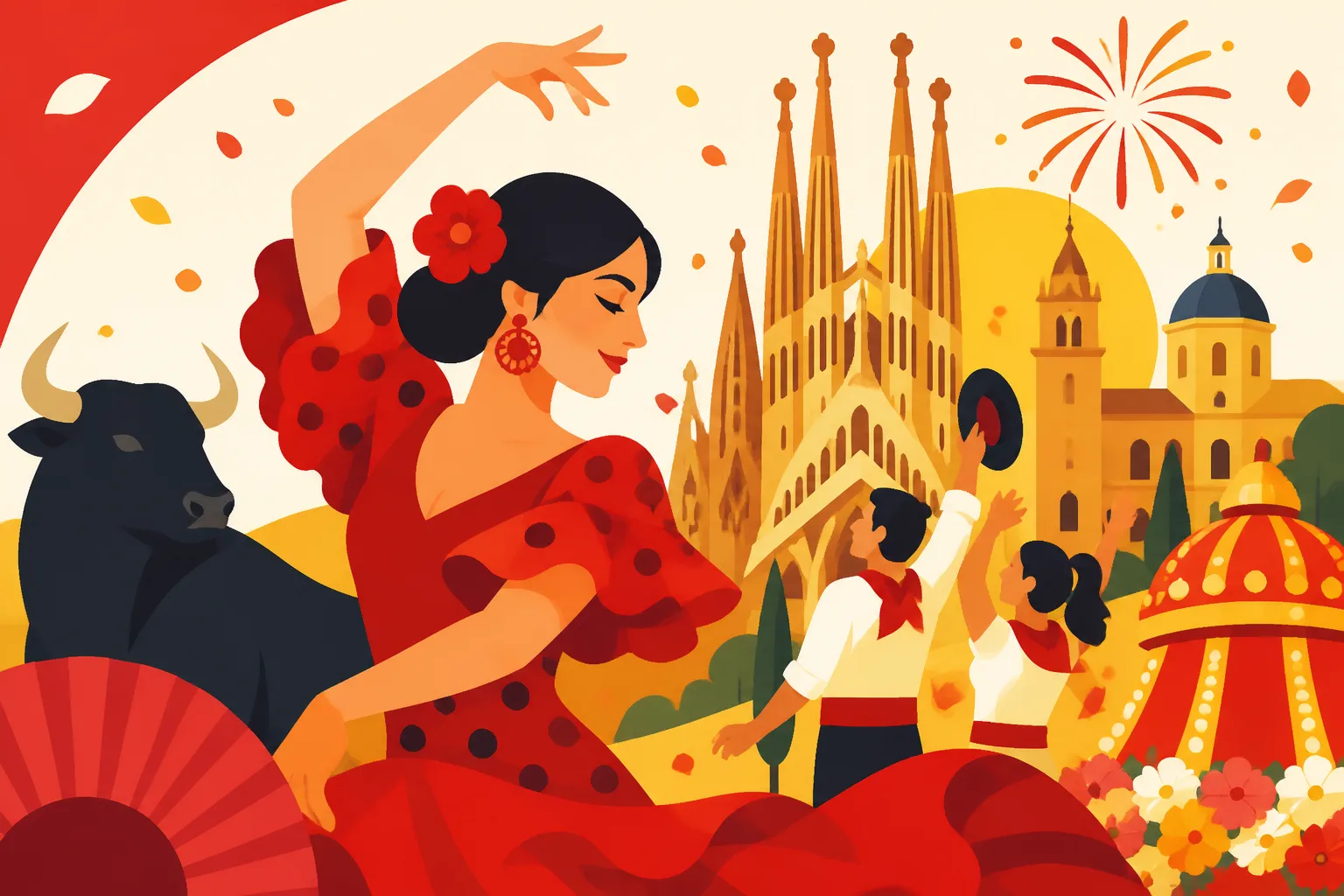
Two weeks after Semana Santa, Seville transforms again for the Feria de Abril. A massive fairground is built, covered in hundreds of "casetas" (tents). Women wear stunning "trajes de flamenca" (flamenco dresses), and the men arrive on horseback or in carriages. It is a week of dancing sevillanas, drinking "rebujito" (sherry mixed with lemon-lime soda), and eating fried fish.
The catch for foreigners is that many of the casetas are private—owned by families, clubs, or political parties—and you need an invitation to enter. However, there are several large public casetas where anyone can join the party. It is a very social, high-energy event that requires a lot of stamina. I’ve found that the best way to enjoy it is to go in the afternoon to see the horses and then stay for the lights and dancing at night.
Because the Feria dates change based on Easter, always check the calendar for the specific year. It is one of the times When Do Spain's Festivals Peak Through the Year? is a vital resource. If you aren't a fan of crowds or loud music, Seville during the Feria is a place to avoid, but for those who love culture, it is the pinnacle of Andalusian pride.
San Fermín in Pamplona
Famous worldwide for the "Running of the Bulls," San Fermín is a week-long party in July that honors the city’s patron saint. Every morning at 8:00 AM, hundreds of people run in front of six fighting bulls through the narrow streets of the old town. It is dangerous, controversial, and deeply traditional.
For the rest of the day, the city is a sea of white clothes and red scarves. The party never stops, with singing, dancing, and parades of "gigantes y cabezudos" (giants and big-heads). If you are considering running, please do your research; it is not a game, and serious injuries are common. For most, watching from a rented balcony (which you can find via GetYourGuide) is a much safer and more enjoyable way to experience the rush.
Logistically, Pamplona's population quintuples during this week. Prices for everything from a beer to a hotel room skyrocket. If you are on a budget, look for How to Find Local Fiestas Happening During Your Visit to see if there are smaller, less expensive "encierros" (bull runs) in nearby villages that offer a more authentic, less commercialized experience.
Unique and Quirky Local Traditions
Spain is full of "pueblos" (villages) that have preserved bizarre and wonderful traditions for centuries. These are often the highlights of an expat’s travel diary because they feel so tucked away from the modern world.
La Tomatina in Buñol
On the last Wednesday of August, the small town of Buñol becomes the site of the world's biggest food fight. Tons of overripe tomatoes are thrown from trucks, and for one hour, the streets run red with pulp. It’s messy, slippery, and surprisingly exhausting. It started in the 1940s as a local scuffle and has grown into a ticketed event that draws people from every corner of the globe.
Getting to Buñol is easiest from Valencia. You can book a day-trip bus through Omio or a combined ticket through GetYourGuide that includes the entry fee and a place to shower afterward. You will need old clothes that you don't mind throwing away and goggles to protect your eyes from the acidic juice. For more practical advice on surviving the chaos, see our guide on How to Get Tickets and Spots for La Tomatina.
After the "battle," the town is hosed down by fire trucks, and within two hours, the streets are cleaner than they were before the fight. It is a testament to Spanish efficiency when it comes to partying. If you decide to go, be prepared for a long day of standing in the sun and being covered in fruit—it is not for the faint of heart or those who dislike being touched by strangers.
Castells in Catalonia
In Catalonia, the tradition of "Castells" (human towers) is a breathtaking display of strength, balance, and community. Groups called "colles" compete to build the tallest and most complex human towers, sometimes reaching ten levels high. The "enxaneta," a small child, climbs to the very top and raises their hand to signify the tower is complete.
Watching this in a crowded square in Tarragona or Barcelona is a nail-biting experience. It represents the Catalan values of "força, equilibri, valor i seny" (strength, balance, courage, and common sense). There is a deep sense of trust among the participants, and the "pinya" (the base of the tower) is made up of hundreds of people who act as a human safety net.
These events usually take place during a city's "Festa Major." They are free to watch and offer a profound insight into regional identity. If you are living in Catalonia, you might even be invited to join the base of a tower during a rehearsal. It is a very welcoming tradition that prides itself on being open to everyone, regardless of age or background.
Romarías and Local Pilgrimages
A "romaría" is a short-distance pilgrimage to a local shrine or hermitage, usually involving a decorated cart, horses, and a lot of food. In Galicia and Asturias, these often take place in beautiful forest clearings and involve traditional bagpipe music and massive communal meals of octopus or grilled meats.
These are the most "real" festivals you will find. They aren't in the travel brochures, and there are no tickets. You simply turn up, often wearing the local traditional dress if you have it, and join in the dancing. It is a great way to meet your neighbors and practice your Spanish in a relaxed environment. I’ve found that the best way to find these is to look for posters in local bars or check the town hall's Facebook page.
Logistics: Traveling During Peak Fiesta Seasons
The biggest mistake you can make in Spain is trying to "wing it" during a major festival. The country’s infrastructure is excellent, but it has limits, and those limits are tested every time a major fiesta rolls around.
Booking Transport and Accommodation
During times like San Fermín or the Seville Fair, hotels on Booking.com can be fully booked a year in advance. If you are a last-minute traveler, you might end up staying two towns away and spending a fortune on taxis. My advice is to set alerts and book as soon as your dates are confirmed. Many hotels offer free cancellation, which gives you flexibility if your plans change.
For transport, Omio is a great tool for comparing train, bus, and flight options in one go. Sometimes the bus is actually better because it can get closer to the heart of a small town where the train station might be several kilometers away. Be aware that during holidays, the "horario de festivos" (holiday schedule) applies. This usually means fewer services and later start times.
If you are driving, be prepared for "Operación Salida"—the massive police operation to manage traffic as millions of people leave the cities at the same time. Expect long delays on the AP-7 (Mediterranean coast) and the A-6 (Northwest). If possible, travel on the Wednesday evening or Thursday morning of a long weekend to avoid the worst of the gridlock.
Navigating Crowds and Safety
Spanish festivals are generally very safe, but whenever you have a million people in one place, pickpockets will be present. Wear a crossbody bag and keep it in front of you. Don't carry all your cash in one place. Tourists in Spain are sometimes robbed, and many lose their wallets in the crush of a parade.
The heat is also a factor. Most summer festivals involve standing in the sun for hours. Carry water, wear a hat, and don't be afraid to take a "siesta" in the afternoon to recharge. The Spanish rhythm—partying late, sleeping in, and resting in the heat—is designed for survival. If you try to power through like you would in a cooler climate, you will burn out by day two.
| Festival Type | Primary Logistics | Recommended Booking Window |
|---|---|---|
| National Holidays | Supermarkets close; expect "puentes" | 1-2 months for travel |
| Major Regional Fiestas | High-speed trains sell out; hotels spike | 6-9 months |
| Local Village Fiestas | Public transport is limited; car is best | 2-4 weeks |
| Summer Beach Festivals | Coastal roads are jammed; parking is impossible | 3-5 months |
Tours and Guided Experiences
For complex festivals like Semana Santa or Fallas, a guide can be the difference between seeing everything and seeing nothing. GetYourGuide offers many specialized tours where locals explain the history and the "secret" spots that aren't on the map. This is particularly useful if your Spanish is still a work in progress and you want to understand the satire behind the Falla statues or the religious history of a procession.
Group tours also provide a bit of safety and structure in the chaos. They often include "skip-the-line" access to nearby monuments that remain open during the festival. For example, in Granada, you might want a guided tour of the Alhambra that is timed so you don't miss the evening festivities in the city center.
Cultural Etiquette for Foreigners at Fiestas
Participating in a Spanish fiesta is about more than just showing up; it’s about understanding the unspoken rules that keep these massive events running smoothly.
Participation vs Observation
In many cultures, festivals are things you watch. In Spain, they are things you do. If there is music, you are expected to dance (even if you're bad at it). If there is communal food, you should try it. Spaniards are incredibly proud of their traditions and love seeing foreigners take a genuine interest.
However, know your limits. Don't jump into a bull run unless you are an experienced runner. Don't try to climb a human tower unless you’ve been invited to the "pinya." Being a respectful observer is often more appreciated than being a reckless participant. If you show interest and ask questions, locals will often go out of their way to explain things to you and offer you a drink.
Dining and Socializing During Festivals
During a holiday, the concept of a "quick lunch" disappears. Expect to be at the table for three hours. The "sobremesa"—the time spent talking after the meal is finished—is the most important part of the day. Don't ask for the bill the moment you swallow your last bite of dessert; it’s considered slightly rude. Relax, order a "café solo" or a "chupito" (shot), and enjoy the conversation.
If you are invited to a "peña" (a private social club or group), bring a bottle of something or some sweets as a gift. These groups are the backbone of many local festivals, and being invited in is a high honor. It is where you will find the best food and the most authentic atmosphere.
Dress Codes and Respecting Traditions
While most festivals are casual, some have specific requirements. For the Feria de Abril, men usually wear a blazer and tie, and women wear flamenca dresses or smart evening wear. For religious processions, avoid wearing overly revealing clothing if you are standing near a church. It’s about showing respect for the gravity of the event.
In the white-clothes festivals like San Fermín or the Tomatina, there is a "uniform." If you show up in jeans and a black t-shirt to a sea of white and red, you will stand out—and not in a good way. Wearing the local colors is a simple way to show that you are part of the community and not just a "guiri" (tourist) passing through.
Seasonal Planning for Expats and Visitors
To truly master the Spanish calendar, you need to think a season ahead. Here is how I manage my year to ensure I'm always in the right place at the right time.
- Spring: This is the peak season for culture. Between Fallas, Semana Santa, and the Feria, your weekends will be full. This is the time to be in Andalusia or Valencia.
- Summer: The focus shifts to the coast and "pueblo" festivals. Every village has its "Verano Cultural." It is the best time for outdoor concerts and food festivals.
- Autumn: Harvest festivals (Vendimia) are the highlight, especially in wine regions like La Rioja or Jerez. It's also the time for All Saints' Day, which is a significant family holiday.
- Winter: Focus on Christmas, the Three Kings, and Carnival (especially in Cádiz or Tenerife). It’s a time for cozy meals and mountain escapes.
By keeping an eye on When Do Spain's Festivals Peak Through the Year? and How to Find Local Fiestas Happening During Your Visit, you can build a social life that is rich in variety and local flavor. Spain isn't just a place to live; it's a place to celebrate. The more you lean into the "fiesta" culture, the more the "siesta" bureaucracy will start to make sense.
Disclaimer
This guide is intended for informational purposes for travelers and expats in Spain. Festival dates, local holiday regulations, and public transport schedules are subject to change by national, regional, and municipal authorities. Always verify specific dates and business opening hours with official local sources or your local town hall (Ayuntamiento) before planning travel or administrative tasks. The author is not responsible for any disruptions to travel or residency applications caused by holiday closures.