Mobile Data and eSIMs for Travel in Spain
Landing at Barajas airport with a dead phone and a spinning wheel on your maps app is the ultimate initiation into Spanish life. I vividly remember my first arrival in Madrid, standing sweatily in the baggage claim, trying to remember the address of my rental because my roaming had failed. This guide solves every connectivity headache you will face as a traveler or new resident in Spain.
Disclosure: This post may contain affiliate links. We may earn a commission at no extra cost to you if you make a purchase through these links. Read full disclosure.
Navigating the Spanish Mobile Network Landscape
The Spanish telecommunications market is surprisingly competitive, but it can be a maze for anyone used to simpler systems. There is a fundamental divide you need to understand before you even set foot in a store: the difference between "prepago" (prepaid) and "contrato" (contract). For most visitors and even expats in their first month, a contract is a distant dream because it usually requires a Spanish bank account and a residency card. If you are still figuring out How to Get a Spanish NIE Number: In Spain vs Abroad, you will almost certainly be starting your journey with a prepago SIM card.
The Big Four Network Providers
In Spain, the "Big Four" own the actual infrastructure: Movistar, Vodafone, Orange, and Yoigo. Movistar is the legacy provider, much like Telefonica (its parent company). They generally have the most expansive coverage, especially if you are heading into the mountainous regions of the Picos de Europa or deep into the white villages of Andalusia. I have found that while they are sometimes the most expensive, their reliability in rural areas is unmatched. If you are planning on Traveling Around Spain: Trains, Buses, Flights, and Car Hire and taking the high-speed AVE through the middle of nowhere, Movistar often holds the signal the longest.
Vodafone and Orange are the fierce competitors. They often have the best deals for tourists, frequently offering "tourist SIMs" that include massive amounts of data and international minutes for a flat fee of 15 to 25 euros. Their shops are everywhere, from the main plazas to the smallest malls. Yoigo is the younger, "cool" sibling of the group, often offering slightly cheaper rates but with a network that sometimes relies on the other three when you get too far off the beaten path. When you are using apps like Omio to book your next regional bus, having a stable 5G connection from one of these majors makes the process seamless.
Mobile Virtual Network Operators (MVNOs)
Beyond the big four, you have the MVNOs—companies that rent space on the major networks. Brands like Digi, Simyo, Lebara, and LycaMobile are massive here. Digi, in particular, has taken the expat community by storm lately because their prices are incredibly low and they use the Movistar network. You will often see their kiosks in small convenience stores or "locutorios" (calling shops).
The beauty of these smaller providers is that they often cater specifically to international communities. If you need to call home frequently, Lebara and LycaMobile often have specialized "bons" or bundles that include hundreds of international minutes to countries outside the EU. This is a lifesaver if you are trying to coordinate with family while looking at apartments on Booking.com. Just be aware that customer service for these smaller brands is often entirely in Spanish, so you might need to brush up on Spanish Language and Everyday Communication for Visitors before trying to troubleshoot a technical issue over the phone.
The Realities of 5G and Coverage
Spain has done an incredible job rolling out 5G, particularly in the Madrid, Barcelona, and Spain's Great Cities: Explorer's Guide areas. However, "5G" doesn't always mean lightning speed. In the narrow, winding streets of the Gothic Quarter in Barcelona or the Albaicín in Granada, the thick stone walls of centuries-old buildings act like a Faraday cage. I have sat in beautiful plazas where my phone showed full bars, only to walk ten meters into a tapas bar and lose signal entirely.
When you are out exploring, you will rely on your data for everything from checking Public Transport in Spain: Cards, Discounts, and Etiquette to scanning digital tickets for the Sagrada Família on GetYourGuide. Always have a backup plan. I recommend downloading offline maps for the city you are in. It’s a trick I learned after getting hopelessly lost in the maze of Seville’s Santa Cruz neighborhood when a sudden rainstorm seemed to kill the local cell tower’s range.
The Rise of eSIMs for Travel in Spain
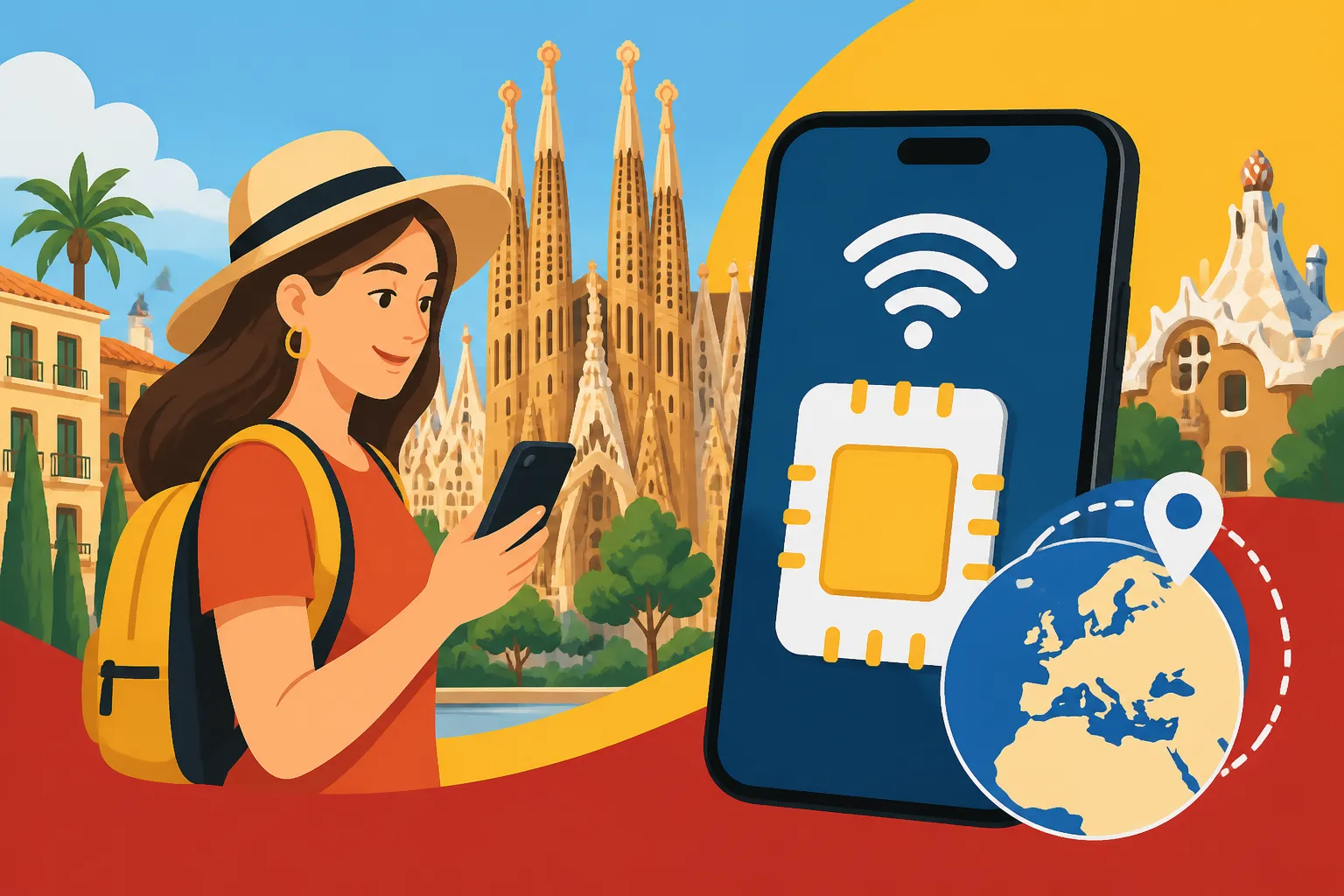
The biggest change in the last few years for travelers is the eSIM. No more hunting for a paperclip to pop your SIM tray while standing in a crowded airport. An eSIM allows you to download a data plan before you even board your flight. For many, this is the gold standard for convenience, though it comes with a few caveats that I learned the hard way during a trip through the Pyrenees.
Benefits and Compatibility
The primary benefit is immediate connectivity. You land, turn off airplane mode, and you are instantly on the grid. This allows you to call a taxi or check your check-in instructions on Booking.com without needing to find a physical store. Most modern iPhones and flagship Android devices support eSIMs now. It is essential to check if your phone is "carrier unlocked" before you buy an eSIM. If you are still paying off your phone to a provider back home, they might have locked the eSIM slot, rendering a Spanish data plan useless.
I generally suggest eSIMs for short-term visitors who don't need a local Spanish phone number. Most travel eSIMs (like those from Airalo or Holafly) are data-only. This means you can use WhatsApp, iMessage, and VOIP calls, but you won't have a "+34" number to give to a local restaurant for a reservation or to use for two-factor authentication on certain Spanish apps. If you are just here to see the sights and book tours on GetYourGuide, a data-only eSIM is usually sufficient.
International vs. Local eSIM Providers
You have two choices: international providers or local Spanish carriers. International providers are incredibly user-friendly. You buy a "Spain" package or a "Europe" package, and it just works. The downside is the cost. You might pay $20 for 5GB of data, whereas a local Spanish SIM would give you 50GB or even 100GB for the same price.
Local carriers like Orange and Movistar have started offering eSIMs to prepago customers, but it isn't always easy to get them online. Often, you still have to go into a physical store, show your passport, and they will give you a QR code to scan. If you are going through the effort of visiting a store, I personally think getting a physical SIM is often more reliable, as moving an eSIM between phones if yours breaks or gets stolen is a bureaucratic nightmare.
Activation and Troubleshooting
Activating an eSIM usually involves scanning a QR code sent to your email. One major tip: do not delete the eSIM profile if the data isn't working immediately. Often, you need to go into your settings and manually select the "APN" or ensure "Data Roaming" is turned on for that specific line. Many travelers get frustrated and delete the profile, only to realize that most eSIMs can only be installed once. If you delete it, your money is gone.
If you are traveling through rural areas, you might find that your eSIM doesn't automatically switch between the best towers. Most international eSIMs "piggyback" on one specific Spanish network (often Movistar or Orange). If that network has a dead spot in the village you are visiting, you are out of luck. This is why checking the coverage maps of the partner network is a smart move before you click buy.
Buying Physical SIM Cards on the Ground
If you want the best value and a local phone number, the physical SIM is still king in Spain. However, Spain has very strict laws regarding mobile phone registration. You cannot simply buy a SIM card from a vending machine and walk away. Every SIM must be tied to a government-verified ID.
The Registration Process (Ley 25/2007)
Under Spanish law, specifically the Ley de Conservación de Datos, every prepaid mobile line must be registered with the user's identification. When you go into a store, you must bring your original, physical passport. Most shops will not accept a photocopy or a digital image on your phone. They will scan your passport and record your details in a national database.
This process is non-negotiable. They are terrified of the heavy fines associated with unregistered lines. If you already have your TIE (identity card), that works perfectly, but for most visitors, the passport is the only valid document. This is part of the broader Spanish Bureaucracy for Daily Life: Padrón, IDs, and Local Services that every expat eventually learns to navigate.
Airport Stores vs. City Center Kiosks
You will see mobile phone stands at the arrival halls of Madrid, Barcelona, and Malaga airports. These are incredibly convenient but often charge a "convenience tax." You might find the same plan for 5 or 10 euros cheaper if you wait until you get into the city center. However, if you need to coordinate a meeting or find your hotel, that extra 5 euros is well worth it.
If you decide to wait, look for an official store (Tienda Oficial) rather than a general electronics shop. Official stores for Orange or Vodafone usually have staff who are more accustomed to dealing with foreigners and will ensure the plan is activated correctly before you leave. Be mindful of Opening Hours in Spain: What’s Different (Siesta, Holidays, Sundays). Many smaller phone shops will close between 2:00 PM and 5:00 PM for lunch, and almost all of them will be closed on Sundays. If you land on a Sunday afternoon, the airport might be your only option.
Using Locutorios for Budget Options
If you are on a tight budget or need an MVNO like Digi or Lebara, look for a "Locutorio." These are multipurpose shops often found in immigrant neighborhoods. They offer international calling, money transfers, and cheap SIM cards. While they might look a bit cluttered, they are often the most efficient places to get a SIM card.
The staff in locutorios are experts at navigating the registration systems and often speak multiple languages. Just keep an eye on your belongings, as these can be busy spots. For more on staying aware in crowded areas, check out Staying Safe in Spain: Practical Safety Tips for New Residents. I have bought many SIMs in locutorios over the years, and as long as you have your passport, it usually takes less than ten minutes.
Managing Your Data and EU Roaming
Once you have your SIM, the next hurdle is keeping it alive. Spanish prepago plans usually work on a 28-day or 30-day cycle. If you don't have enough credit on your account when the cycle ends, your data will simply stop working.
Topping Up (Recargas)
"Recargar" is the Spanish word for topping up your credit. You can do this at the official store, but you can also do it at most supermarkets (at the checkout), gas stations, and even at tobacco shops (Estancos). You just tell them your phone number and the amount you want to add.
Most providers also have apps (like Mi Orange or Mi Movistar). These are great for checking how many gigabytes you have left. I highly recommend installing the app immediately. It saves you the stress of wondering if you have enough data left to book your return train on Omio while you're standing on a platform in rural Galicia. Be aware that these apps often require a Spanish credit card for in-app top-ups. If you are using a foreign card, you might find the transaction is blocked by your bank’s fraud department or the provider’s payment gateway.
EU Roaming Rules from Spain
One of the best things about getting a Spanish SIM card is the "Roam Like at Home" policy within the European Union. If you buy a plan in Spain, you can usually use that data in France, Portugal, Italy, and other EU countries at no extra cost. This is fantastic if your trip includes a quick hop over the border to Lisbon or Biarritz.
However, there is a catch: "Fair Use" limits. Even if you have 100GB of data in Spain, your provider might only allow you to use 15GB or 20GB of that while roaming in another EU country. Always read the fine print or ask the clerk "Cuánto puedo usar en el extranjero?" (How much can I use abroad?). Also, remember that the UK and Switzerland are not in the EU. Some Spanish providers still include them in the free roaming zone, but many have started charging extra.
| Provider | Typical Tourist Offer | Network Quality | Best For |
|---|---|---|---|
| Movistar | 40GB – 100GB (Prepago) | Excellent / Widest | Rural travel and reliability |
| Vodafone | 50GB – 140GB (Big User) | Great / Fast 5G | Heavy data users and social media |
| Orange | 60GB – 150GB (Holidays) | Great / Urban | Tourists needing international minutes |
| Digi | 10GB – 100GB (Low Cost) | Excellent (Movistar) | Budget-conscious long-term stays |
| Airalo (eSIM) | 1GB – 20GB (Data Only) | Good (Various) | Short-term convenience |
Public Wi-Fi and Connectivity Security
While data is cheap, there will be times you want to use Wi-Fi, especially for heavy tasks like uploading photos of your trip or downloading a movie for the bus. Public Wi-Fi in Spain is common, but it comes with the usual security risks.
Where to Find Free Wi-Fi
Most cafes and restaurants in Spain offer free Wi-Fi. Unlike some countries where you need a local phone number to receive an SMS code, most Spanish cafes just give you a password (la contraseña). Museums and airports also offer free connections. If you are staying in a hotel or apartment booked through Booking.com, the Wi-Fi quality is usually stated in the reviews. I always check those reviews specifically because "free Wi-Fi" in a 300-year-old building often means "Wi-Fi that only works if you stand next to the door."
Many Spanish cities are also rolling out "Smart City" Wi-Fi in public plazas. These are generally slow and can be frustrating to connect to. They often require you to watch an ad or sign up for a newsletter. In my experience, it’s better to stick to your mobile data for anything important. If you find yourself in an emergency without data or Wi-Fi, knowing Emergency Numbers in Spain: 112 and When to Use It is vital.
Security and VPNs
When using public Wi-Fi in busy tourist areas like the Puerta del Sol in Madrid or the Ramblas in Barcelona, be cautious. Hackers can set up "honeypot" hotspots with names like "Free_Spain_WiFi" to intercept your data. I always use a VPN when connecting to any network that isn't my own.
This is especially important if you are accessing your banking apps or booking travel. If you are worried about digital safety, it’s worth reading up on Common Financial Scams Targeting Expats in Spain (and How to Avoid Them). A little bit of caution goes a long way. Some people have lost access to their emails because they logged in on an unsecured network at a train station while trying to find their tickets.
Dealing with Dead Zones and "Siesta" Tech Support
Spain is a land of mountains and thick stone walls. You will encounter dead zones. If you are hiking the Camino de Santiago or exploring the Alpujarras, don't expect 5G. Even in cities, old buildings with "patios interiores" (internal courtyards) often have no signal in the back rooms. If you are renting an apartment, try to find one with a router placed near a window.
Also, be prepared for the Spanish pace of life. If your SIM card stops working on a Saturday afternoon, you might not be able to get it fixed until Monday morning. Technical support lines are notoriously slow, and physical stores will have long queues during the "hora punta" (peak hour) after people get off work. Patience is the most important tool in your connectivity kit. If you find yourself frustrated, remember that a few hours offline in a beautiful Spanish plaza is exactly what a holiday is for. Use that time to learn How to Call 112 in Spain: What to Say and What Happens Next or practice some Spanish Emergency Phrases: How to Describe Symptoms Quickly just in case.
Disclaimer
This guide is for informational purposes only. Mobile network plans, prices, and regulations in Spain can change frequently. Always verify current requirements with your chosen provider or the official Spanish telecommunications authority before making a purchase. Reach out to local stores for the most up-to-date regional coverage information.