Speed Cameras in Spain: How Fines Are Notified to Residents
Opening your mailbox to find an embargo warning because you missed a speeding ticket months ago is a uniquely terrifying expat nightmare. I once had three hundred euros frozen in my bank account for a fine I never received in the mail. This guide explains how the Spanish speed camera system works, how fines are delivered, and how to avoid massive penalties.
Disclosure: This post may contain affiliate links. We may earn a commission at no extra cost to you if you make a purchase through these links. Read full disclosure.
The Spanish Speed Camera Network Explained
Spain possesses one of the most extensive and technologically advanced traffic enforcement networks in Europe. Overseen primarily by the Dirección General de Tráfico (DGT), alongside regional transit authorities in Catalonia (SCT) and the Basque Country (Trafikoa), the system is designed to catch speeding infractions with ruthless efficiency. If you are accustomed to the occasional highway patrol car in your home country, the sheer volume of automated surveillance on Spanish roads will be a severe culture shock.
Fixed Mobile and Section Cameras
The Spanish road network utilizes several distinct types of speed enforcement. Radares fijos (fixed cameras) are permanent installations usually housed in large white boxes on the side of the highway or mounted on overhead gantries. By law, the DGT must warn you of fixed cameras, so you will typically see a blue and white sign indicating radar control a few kilometers beforehand.
Radares móviles (mobile cameras) are a completely different beast. These are hidden in unmarked Guardia Civil vehicles, parked discreetly behind highway overpasses, or set up on tripods in the bushes. There is no legal requirement to warn you about mobile speed traps. Furthermore, Spain utilizes radares de tramo (section cameras). These do not measure your speed at a single point; they record your license plate when you enter a specific highway tunnel or stretch of road and again when you exit, calculating your average speed. If your average speed exceeds the limit, you are automatically fined.
To survive these section cameras, you must maintain absolute awareness of your speed over long distances. Holding your phone to check a navigation app is a heavily penalized offense. Securing a reliable, sturdy dashboard phone mount from Amazon Spain is an absolute necessity so you can keep your GPS visible without taking your eyes off the road. Because these apps rely heavily on real-time data to warn you of upcoming hazards, having a robust mobile data plan from Tiekom ensures your navigation does not suddenly drop out when you are driving through remote, mountainous stretches of the Andalusian countryside.
The DGT Margins of Error and Pegasus
Not every minor infraction triggers a flash. The DGT operates on a strict margin of error known colloquially as the “Rule of 7.” For speed limits under 100 km/h, the camera will trigger if you exceed the limit by 7 km/h (e.g., driving 57 km/h in a 50 km/h zone). For speed limits over 100 km/h, the margin is 7% (e.g., driving 128 km/h in a 120 km/h zone).
Beyond stationary cameras, expats must also be aware of the Pegasus helicopters. The DGT operates a fleet of distinctive yellow and blue helicopters equipped with military-grade cameras that can accurately measure the speed of a vehicle from a kilometer above the highway. Pegasus helicopters patrol major traffic corridors during peak holiday weekends and can issue fines automatically without ever pulling you over.
How Traffic Fines Are Officially Notified
The greatest source of anxiety for expats is not getting pulled over, but rather the silent, administrative delivery of the multa (fine). Understanding how the Spanish government considers you legally notified is the difference between paying a minor fee and facing a bank embargo.
The Certified Mail Trap
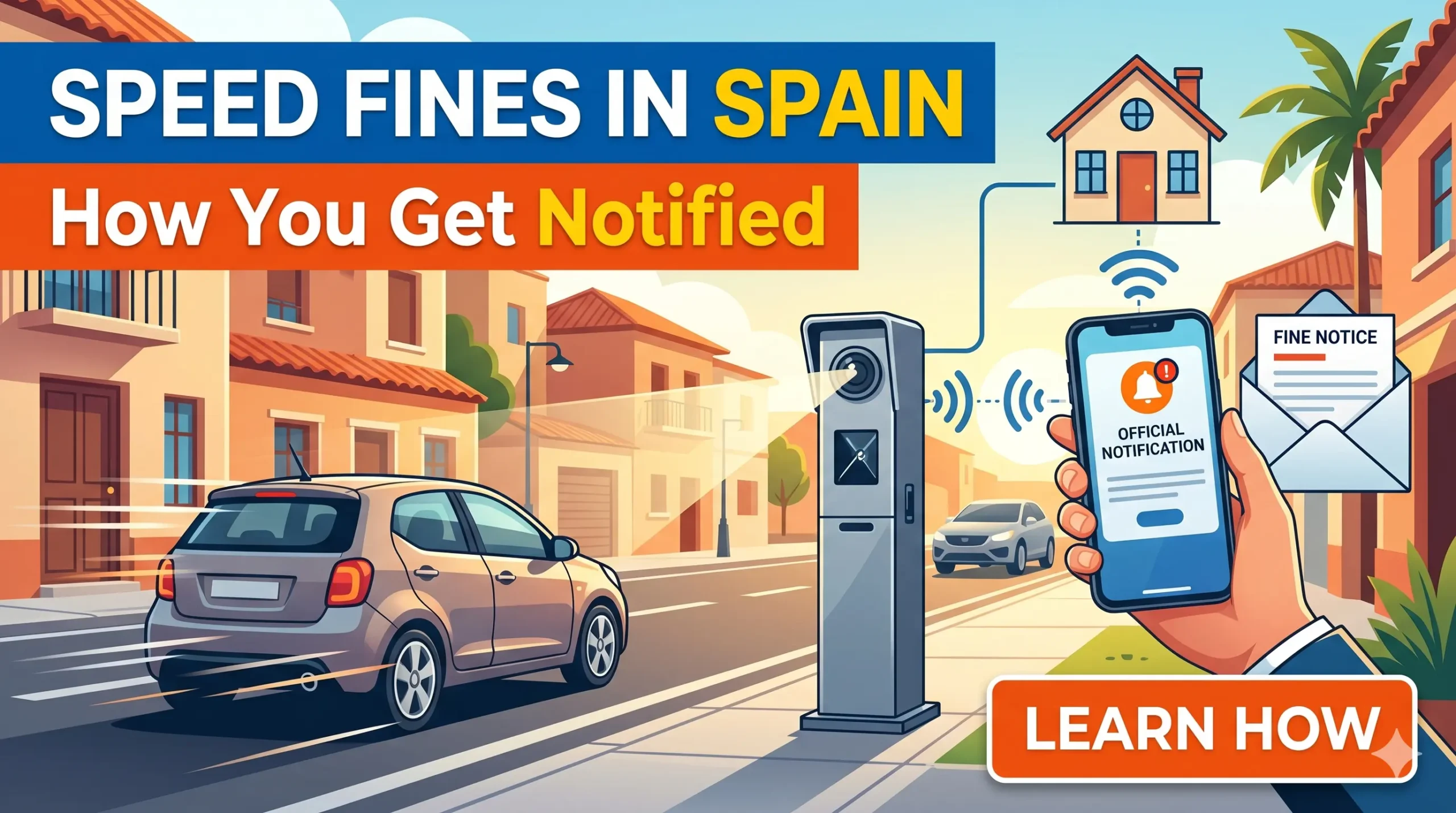
If an automated camera catches you speeding, the Guardia Civil does not pull you over. Instead, the DGT processes the infraction and sends a carta certificada (certified letter) to the address officially linked to your vehicle’s registration.
Because it is a certified letter, the postal worker cannot simply drop it in your mailbox. They must obtain a physical signature. If you are at work or not home when the mail carrier arrives, they will leave an aviso de llegada (arrival notice) slip in your mailbox. You then have a limited number of days to take that slip and your ID to the local post office to retrieve the fine. To understand the exact bureaucratic steps and opening hours required to retrieve these certified documents, you must read How Package Pickup Works at Correos Aviso ID Hours.
If you fail to pick up the certified letter from the post office, or if the DGT sends it to an old apartment address because you forgot to update your registration, the government does not simply forgive the fine. After two failed delivery attempts, the DGT publishes the fine in the TESTRA (Tablón Edictal de Sanciones de Tráfico) and the BOE (Official State Gazette). The moment it is published online, Spanish law considers you legally notified, regardless of whether you actually saw the letter. The clock starts ticking, and the late penalties begin compounding.
Digital Notifications via the DEV System
To escape the anxiety of missing a physical letter, tech-savvy expats bypass the postal system entirely by registering for the Dirección Electrónica Vial (DEV). The DEV is a secure digital mailbox specifically designed for traffic notifications. While it is mandatory for registered companies and corporate fleets, it is completely voluntary and highly recommended for private individuals.
To sign up for the DEV, you must possess a valid Spanish Digital Certificate (Certificado Digital) or Cl@ve system access. Once registered, the DGT will no longer send physical letters to your home. Instead, the moment a fine is issued, you will receive an immediate SMS text message and an email alerting you to check your secure digital mailbox.
Setting up this digital infrastructure requires a stable home internet connection, as the Spanish government authentication portals are notoriously fragile and frequently time out during the security handshake. Relying on a stable, expat-friendly fiber provider like Tiekom ensures you can authenticate your identity and finalize your DEV registration without the page crashing. By receiving notifications instantly on your phone, you completely eliminate the risk of missing a postal slip and falling victim to compounding late fees.
Paying Contesting and Identifying the Driver
When the dreaded notification finally reaches you, whether by mail or digitally, you must act quickly. The Spanish system heavily incentivizes prompt payment while punishing administrative delays.
The Pronto Pago Discount Window
The single most important concept to understand about Spanish traffic fines is the pronto pago (prompt payment) discount. If you pay the fine within 20 calendar days of receiving the official notification, the DGT grants you an automatic 50% discount. A 300-euro speeding ticket instantly becomes a 150-euro annoyance.
However, accepting this massive discount comes with a legal catch: by paying the reduced amount, you are officially admitting guilt and explicitly waiving your right to appeal or contest the fine. Unless you have undeniable, ironclad proof that your car was stolen or the camera malfunctioned, veteran expats strongly advise swallowing your pride and taking the 50% discount. Contesting a fine (presentar alegaciones) forfeits the discount, meaning if the DGT rejects your appeal months later, you will be forced to pay 100% of the original penalty.
You can easily pay the fine online through the DGT’s Sede Electrónica using a debit or credit card, or by calling the 060 hotline. Ensuring you have a functional local bank account ready to process these municipal transactions without triggering international fraud alerts is vital. To set up this infrastructure, review Opening a Bank Account in Spain as a Non-Resident. If you need to quickly move funds from your home country to cover an unexpectedly large traffic penalty, utilizing agile digital platforms over legacy banks is essential; for details, read Sending Money to/from Spain: Comparing Banks vs Transfer Services.
Identifying the Driver Bureaucracy
If the speeding infraction was caught by a rear-facing automated camera, the DGT only knows the license plate of the car, not who was actually driving. In this scenario, the first letter you receive will not be the actual fine with a payment barcode. Instead, it will be a formal requirement to identificar al conductor (identify the driver).
You are legally obligated to log into the DGT portal or fill out the physical form to declare the name, ID number, and license details of the person who was behind the wheel. If you were the driver, you simply identify yourself, and the DGT will subsequently mail the actual fine with the payment details.
If you ignore the letter requesting driver identification, the DGT will hit you with a massive secondary fine for administrative non-compliance. This secondary fine is typically double or triple the amount of the original speeding ticket, and crucially, it does not qualify for the 50% pronto pago discount. To ensure you never lose track of these critical DGT documents or your vehicle registration papers, ordering a dedicated, zip-up vehicle document organizer from Amazon Spain to keep in your glovebox is a highly recommended organizational strategy.
| Speed Excess | Fine Amount (100%) | Fine Amount (50% Discount) | Points Lost |
| Up to 20 km/h over limit | €100 | €50 | 0 |
| 21 to 30 km/h over limit | €300 | €150 | 2 |
| 31 to 40 km/h over limit | €400 | €200 | 4 |
| 41 to 50 km/h over limit | €500 | €250 | 6 |
| 51+ km/h over limit | €600 | €300 | 6 (Criminal charges possible) |
Avoiding Fines and Updating Your Details
The ultimate expat strategy is not simply learning how to pay fines quickly, but managing your legal footprint in Spain so aggressively that you never fall into an administrative trap in the first place.
Keeping Your Address Current
As mentioned, the DGT relies entirely on the address officially linked to your vehicle’s Permiso de Circulación (circulation permit). When expats move from a temporary rental to a permanent apartment, they often remember to update their municipal census (padrón) and their bank, but they completely forget to inform the traffic authorities.
Updating your address with the DGT is completely free, but it is entirely mandatory. You have exactly 15 days from the date you change your municipal residence to inform the traffic office. You can do this online using a Digital Certificate or by booking an appointment at the local Jefatura de Tráfico. This administrative alignment is not just to avoid missing fines; it is a strict legal requirement if you ever want to park your car on the street legally. To understand how your DGT address interacts with municipal parking grids, deeply review How to Get a Resident Parking Permit in Spain ZBE Zones. Furthermore, you must factor the costs of vehicle ownership and potential traffic infractions into your broader financial plan, which is detailed in Cost of Living in Spain: Budgeting for Expats.
Legal Radar Detectors versus Jammers
Many expats arrive in Spain hoping to bring their radar detectors from their home countries to avoid DGT cameras. You must understand the strict legal distinctions in Spanish law regarding these devices, as the penalties for possessing the wrong technology are catastrophic.
Inhibidores de radar (Radar jammers) are devices that actively scramble or block the police camera signals. These are highly illegal. Simply having an unconnected jammer sitting in the trunk of your car carries a devastating fine of up to 6,000 euros and a massive loss of points on your license. Detectores de radar (Active radar detectors), which passively scan police radio frequencies to warn you of mobile traps, were recently outlawed as well, carrying a 200-euro fine and a 3-point deduction.
The only devices strictly legal in Spain are Avisadores de radar (GPS warning devices). These devices do not scan for police frequencies; instead, they rely on a GPS connection and a regularly updated, publicly available database of fixed camera locations published by the DGT. You can legally purchase a dedicated avisador or a high-quality GPS dashboard unit from Amazon Spain. To ensure the device’s camera database remains accurate and constantly updated while you drive, connecting it via Bluetooth to a smartphone powered by an unlimited Tiekom mobile data plan provides total peace of mind on the road.
Managing your vehicle, your residency status, and your tax footprint requires immense administrative discipline. A frozen bank account due to an unpaid DGT fine can disrupt your ability to pay your annual taxes or manage your income. To ensure your broader fiscal profile remains completely bulletproof while living in the country, you must thoroughly evaluate Taxes in Spain: Guide for Expats and understand how the rhythms of municipal administration dictate your daily life by reviewing Spanish Work Culture: Hours, Holidays, and Workplace Etiquette.
References
Primary sources (official)
- Dirección General de Tráfico (DGT) – Paga tu multa: https://sede.dgt.gob.es/es/multas/paga-tu-multa/
- DGT – Dirección Electrónica Vial (DEV): https://sede.dgt.gob.es/es/otros-tramites/direccion-electronica-vial/
- Tablón Edictal de Sanciones de Tráfico (TESTRA): https://sede.dgt.gob.es/es/multas/testra/
Other helpful sources
- N332 – Speeding Fines in Spain (Run by Spanish Police officers for expats): https://n332.es/speeding-fines/
- Expatica – Driving and Parking in Spain: https://www.expatica.com/es/living/transportation/driving-in-spain-101461/
Disclaimer
The information provided in this article is for educational and informational purposes only and does not constitute formal legal, financial, or transit advice. Spanish traffic regulations, the precise calculation of speeding margins of error, and the legal protocols governing the Tablón Edictal Único (TEU) and TESTRA notification boards are highly complex and subject to frequent legislative updates by the Dirección General de Tráfico (DGT). Always verify your specific infraction details, payment deadlines for the pronto pago discount, and correct driver identification protocols directly through the official DGT Sede Electrónica or by consulting with a certified Spanish traffic lawyer.