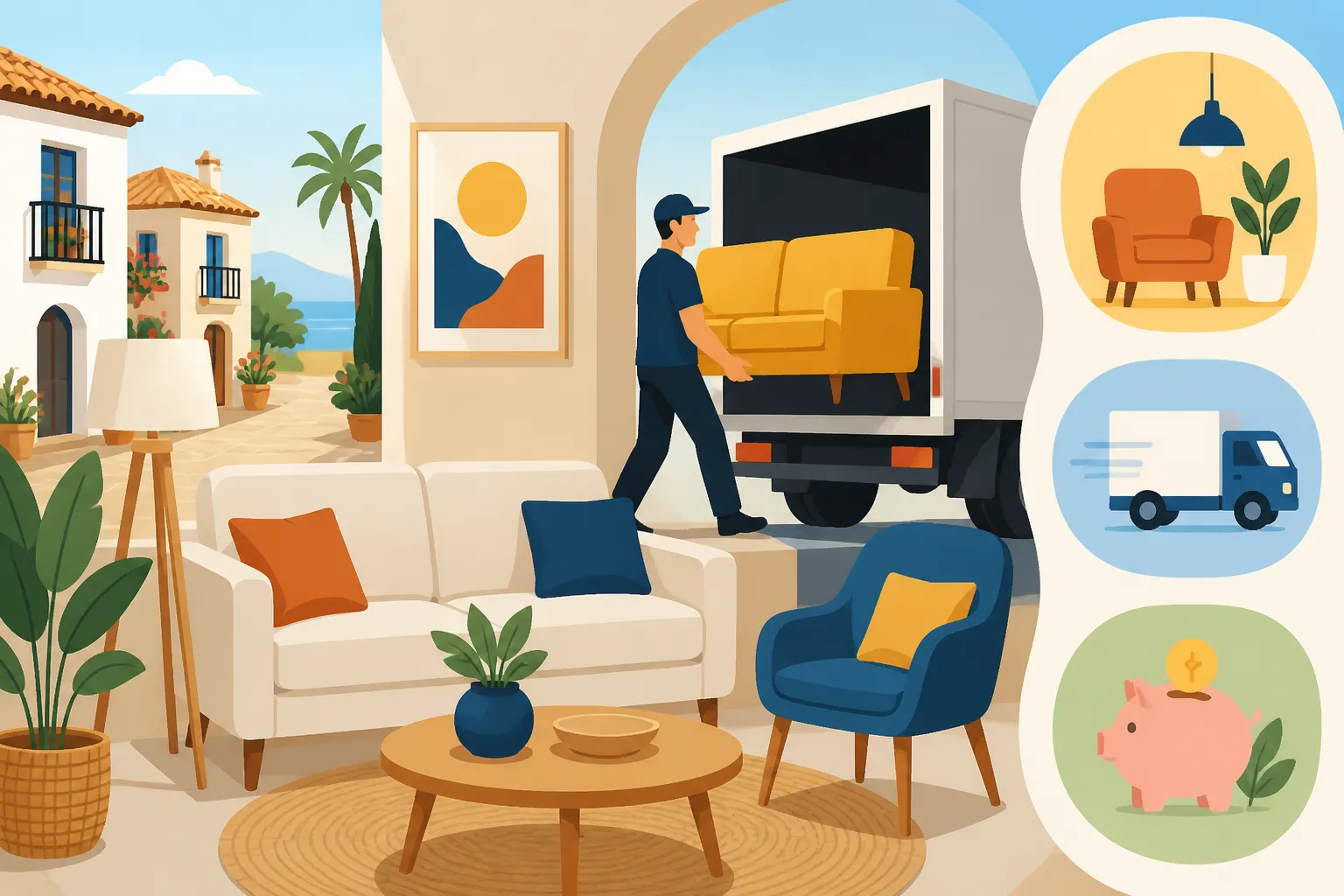
Furnishing a Home in Spain: Stores, Delivery, and Budget Tips
Most Spanish rentals fall into two categories: "amueblado" (furnished) with furniture that hasn't been updated since the 1980s, or "vacío" (empty), which often means no light fixtures, no appliances, and occasionally no kitchen sink. When I first moved into my flat in Valencia, I spent the first week eating tapas on a cardboard box because I didn't realize how long sofa deliveries actually took. This guide explains the landscape of Spanish furniture stores, handles the logistical nightmares of narrow streets, and provides a realistic budget for your new home.
Disclosure: This post may contain affiliate links. We may earn a commission at no extra cost to you if you make a purchase through these links. Read full disclosure.
The Major Furniture Retailers Across Spain
Spain has a healthy mix of massive international warehouses and smaller, more curated design shops. Depending on whether you are looking for "fast furniture" to get settled quickly or heirloom pieces that will last a decade, you need to know which stores serve which purpose. Navigating these options is often the first step in Setting Up Your Life in Spain: Utilities, Internet, and Essentials.
IKEA and the Fast-Furniture Giants
IKEA is the undisputed king of the expat move in Spain. With locations on the outskirts of every major city like Madrid, Barcelona, Malaga, and Seville, it is the most reliable way to get a bed, desk, and kitchenware in a single afternoon. The Spanish IKEA experience is very similar to what you’ll find elsewhere, but the delivery services are surprisingly robust. You can often book a delivery for the very next day if you shop in-person early enough.
Beyond the blue-and-yellow giant, you should look into Conforama. They are essentially the French version of IKEA and are widely available across the Iberian Peninsula. They tend to have more "traditional" styles and a much larger selection of appliances (white goods) like washing machines and fridges. If you are looking for something a bit more stylish and mid-range, Maisons du Monde is fantastic for decor and accent pieces, though their delivery times can be significantly longer as items often ship from France.
Local Mueblerías and Neighborhood Shops
One of the best ways to find high-quality, solid wood furniture is to visit your local "mueblería." These are often family-run businesses located in the "barrios" or in dedicated furniture industrial estates (polígonos). While the prices might be higher than the big-box stores, the quality is usually superior, and they often include delivery and assembly in the price—something you’ll pay a premium for at IKEA.
Shopping locally also helps you navigate the specific Spanish Apartment Sizes: m², Floor Numbers, and Listing Terms Explained that often confuse newcomers. A local shop owner will know exactly what kind of sofa fits through a standard Spanish doorway or how to handle the "viga" (beam) in your ceiling that makes wardrobe placement tricky. They are experts in the architecture of their own cities.
Amazon Spain and Online Convenience
For everything else—from lightbulbs and shower curtains to small kitchen appliances—Amazon Spain is an absolute lifeline. If you have a Prime account, the "One-Day" delivery is remarkably consistent, even in smaller towns. It is particularly useful for those first few days when you realize you’ve forgotten basic necessities like a trash can or a bath mat.
When ordering larger items from Amazon Spain, be cautious about the "entrega a pie de calle" (curbside delivery) policy. Many online sellers will only drop the package at the front door of your building, not bring it up to your fourth-floor apartment. If you are living alone or in a building without a lift, always check if "entrega en domicilio" (delivery into the home) is an option before clicking buy.
Mastering Delivery Logistics and Assembly
The logistics of getting a three-seater sofa into a third-floor flat in a historic center like Madrid’s Malasaña or Seville’s Santa Cruz is a logistical feat akin to a military operation. You cannot assume that because you bought it, it will simply appear in your living room. Understanding these hurdles is part of Buying Furniture and Appliances in Spain: Delivery, Warranties, Returns.
Scheduling and the "Montaje" Service
In Spain, delivery is usually a two-step process: "entrega" (delivery) and "montaje" (assembly). Unless you are a DIY enthusiast, I highly recommend paying for the assembly service. Spanish furniture instructions can be opaque, and more importantly, the assembly teams will take the massive amount of cardboard and plastic waste with them when they leave. In many Spanish cities, you can only throw out large cardboard on specific nights, and a single wardrobe’s worth of packaging can fill an entire street bin.
When scheduling, be prepared for "franjas horarias" (time windows). Unlike some countries where you get a 1-hour window, Spanish companies often give you a 4-hour or even 8-hour window. This is where having a local SIM card is vital so the driver can call you when they are "llegando" (arriving). If you haven't sorted your long-term phone plan yet, using an eSIM from a provider like Airalo can keep you connected so you don't miss that crucial "I'm outside" phone call.
The Narrow Street and Elevator Problem
If you have chosen a home in a charming, historic neighborhood, you likely have narrow streets and an even narrower staircase. Before you buy that king-sized mattress, measure your elevator and your stairwell.
Many delivery companies will charge an extra fee if they have to carry items up more than a certain number of flights of stairs if there is no "ascensor" (lift). Always be upfront with the store about your floor number and the lack of an elevator. It is much better to pay a €30 "subida" fee than to have the delivery drivers leave your new bed in the lobby because they aren't insured to carry it up the stairs.
Community Rules and Timing
Living in a "Comunidad de Vecinos" means there are rules about when you can make noise. Generally, you should avoid any furniture assembly or heavy moving during the "siesta" hours (usually 2:00 PM to 4:00 PM) and after 9:00 PM. Your neighbors will be much more welcoming if you don't start hammering an IKEA Malm bed frame together at 3:00 PM on a Saturday.
It is also worth checking if your street has access restrictions. Many city centers have "Zonas de Bajas Emisiones" (Low Emission Zones) or "Areas de Prioridad Residencial" where delivery trucks need a special permit to enter. Most professional delivery services handle this themselves, but if you are renting a van to do it yourself, you could end up with a hefty fine if you don't check the local regulations first.
Furnishing on a Budget and Second-Hand Strategies
If you are trying to keep costs down while Living in Spain as a Foreigner: Complete Housing & Daily Life Guide, the second-hand market is your best friend. Spain has a vibrant culture of "reutilización," and you can find incredible deals if you know where to look and how to negotiate.
The Second-Hand Market Powerhouses
Wallapop is the king of second-hand shopping in Spain. It is an app-based marketplace where you can find everything from vintage "Vitra" chairs to nearly-new IKEA basics. The beauty of Wallapop is the "cercanía"—you can filter by your specific neighborhood, which is essential if you don't have a car and need to carry a lamp or a small side table home on foot.
Another option is Milanuncios, which is a bit more "old school" and often used for larger furniture sets or by professional second-hand shops. For those in larger cities, Facebook Marketplace and "Expats in [City]" groups are also goldmines, especially during the summer months when many teachers and digital nomads are leaving the country and need to sell their entire apartment contents quickly. You can learn more about these platforms in our guide on Second‑Hand Shopping in Spain: Apps and Tips for Expats.
Timing Your Purchases with "Rebajas"
Spain has two main "Rebajas" (sales) seasons: the Winter sales (starting January 7th) and the Summer sales (starting July 1st). During these periods, major retailers like El Corte Inglés, Zara Home, and local furniture stores offer deep discounts, often up to 70%. If your move coincides with these dates, it is worth waiting a few weeks to buy your "big ticket" items.
Outside of these seasons, look for "Días sin IVA" (Days without VAT). Several times a year, electronics and furniture stores will offer a discount equivalent to the 21% IVA. This is the best time to buy "electrodomésticos" (appliances) like fridges or televisions. Just be aware that these sales are incredibly popular, and delivery times often skyrocket during these weeks.
Comparison of Popular Furniture Options in Spain
| Store Type | Price Range | Delivery Speed | Best For |
|---|---|---|---|
| IKEA | Low – Medium | Fast (1-3 days) | Basics, Kitchen, Small Spaces |
| Conforama | Low – Medium | Moderate (3-7 days) | Sofas, Mattresses, Appliances |
| Maisons du Monde | Medium – High | Slow (2-4 weeks) | Decor, Stylish Accent Pieces |
| Wallapop (Used) | Very Low | Instant (Pick-up) | Budgeting, Unique Vintage Finds |
| El Corte Inglés | High | Reliable | Quality, Service, Guarantees |
Essential Household Setup and the "Spanish Style"
Furnishing a home in Spain isn't just about chairs and tables; it’s about adapting to the local climate and lifestyle. There are certain things you will need here that you might not have considered in your home country. This is part of the broader How to Budget for Annual Homeowner Costs in Spain that every resident should understand.
Managing Lighting and the "Persiana" Factor
Most Spanish apartments do not come with "lámparas" (lamps/fixtures). You will likely walk into your new home and see bare wires hanging from the ceiling. You will need to visit a "ferretería" (hardware store) or a Leroy Merlin to buy basic fixtures. If you are renting, keep the cheap "obra" (construction) lightbulbs to put back when you leave so you can take your nice fixtures with you to your next home.
You also need to learn to love the "persiana." These are the heavy, external rolling shutters found on almost every Spanish window. They are essential for keeping the heat out during the summer and providing privacy. If your new home has broken persianas, make sure to read up on Renting in Spain: Contracts, Deposits, and Tenant Rights to ensure your landlord fixes them before you move in.
Mattress Sizes and Bedding
Be very careful when buying bedding! Spanish mattress sizes differ from those in the UK or the US. A standard double is often 135cm or 150cm wide. If you bring a "King" size bed from abroad, you will struggle to find "sábanas" (sheets) that fit in local stores. IKEA Spain uses European sizing, which is slightly different from the "standard" Spanish sizing used in traditional mueblerías. Always measure your mattress in centimeters before going shopping for linens.
Also, consider the "edredón" (duvet) weight. In most of Spain, you will need a very light duvet for the shoulder seasons and a heavier one for the winter, as many Spanish homes lack central heating and can get surprisingly chilly in January. "Nordicos" (duvets) are the standard here, and you can find them in various "tog" ratings or weights at stores like Primark Home or Zara Home.
White Goods and Kitchen Essentials
If your apartment is "sin electrodomésticos," you are looking at a significant upfront cost. A decent washing machine will cost between €300 and €500, and a fridge-freezer is similar. Stores like MediaMarkt or Worten are the go-to for electronics. When buying, look for the energy rating (A to G). With Spanish electricity prices being what they are, paying an extra €50 for a more efficient machine will save you a fortune in the long run.
Don't forget the "pequeño electrodoméstico" (small appliances). A "tostadora" (toaster) and a "cafetera" (coffee maker) are essentials. In Spain, the Italian-style Moka pot is the standard, but Nespresso is also incredibly popular. You can find these easily on Amazon Spain or in the household section of any large Carrefour or Alcampo supermarket.
Practical Tips for New Arrivals
The first 30 days are the most stressful. You are juggling paperwork, a new job, and trying to find a place to sit. To make this easier, you need a strategy that prioritizes immediate comfort over perfect aesthetics. Choosing the right base of operations is key, which is why many expats start by How to Choose a Neighborhood in Spain: A Practical Decision Checklist.
Temporary Housing and Furnished Options
If the thought of furnishing a whole apartment in a week is too much, consider booking a mid-term furnished rental through a platform like Spotahome. They offer verified listings that are fully furnished, allowing you to live comfortably for 3-6 months while you take your time shopping for your permanent home. This prevents "panic buying" furniture that you might regret later.
Starting in a furnished place also gives you time to understand the "orientation" of your future home. You’ll learn whether you need a heavy rug to cover cold marble floors in the winter or if you need to invest in a high-quality standing fan for a bedroom that doesn't get a cross-breeze.
Connectivity During the Move
One of the biggest frustrations in Spain is waiting for fiber internet installation, which can take anywhere from three days to two weeks. During this time, you will be heavily reliant on your mobile data to coordinate deliveries and look up assembly videos. Having a backup is strongly advisable. An Airalo eSIM can provide you with an immediate data bridge so you aren't left "offline" while waiting for your Movistar or Orange technician to show up.
Having reliable data also allows you to use translation apps in real-time when talking to delivery drivers who may not speak English. Being able to quickly translate "Can you leave it in the room on the right?" saves a lot of miming and potential confusion.
Safety and Security During the Move
While Spain is generally very safe, the moving process makes you vulnerable. Front doors are often left propped open while furniture is being carried in. Always have one person stay with the truck or the open door. For more advice on keeping your belongings secure during this hectic time, check out Staying Safe in Spain: Practical Safety Tips for New Residents.
Also, be careful with your "llaves" (keys). If you are moving into a new place, it is common practice in Spain for the tenant to change the "bombín" (lock cylinder) of the front door for extra security, as you don't know who else might have a copy of the old keys. It's a simple 10-minute DIY job that provides immense peace of mind.
Disclaimer
This guide is intended for informational purposes only. Prices, store availability, and delivery policies in Spain can change frequently and may vary significantly between autonomous communities. Always confirm specific terms, warranties, and delivery fees directly with the retailer before making a purchase. While we strive to keep this information up-to-date, we recommend consulting with local experts or legal counsel for specific residency or consumer rights issues.