Buying a Car in Spain: Paperwork, Taxes, and Registration
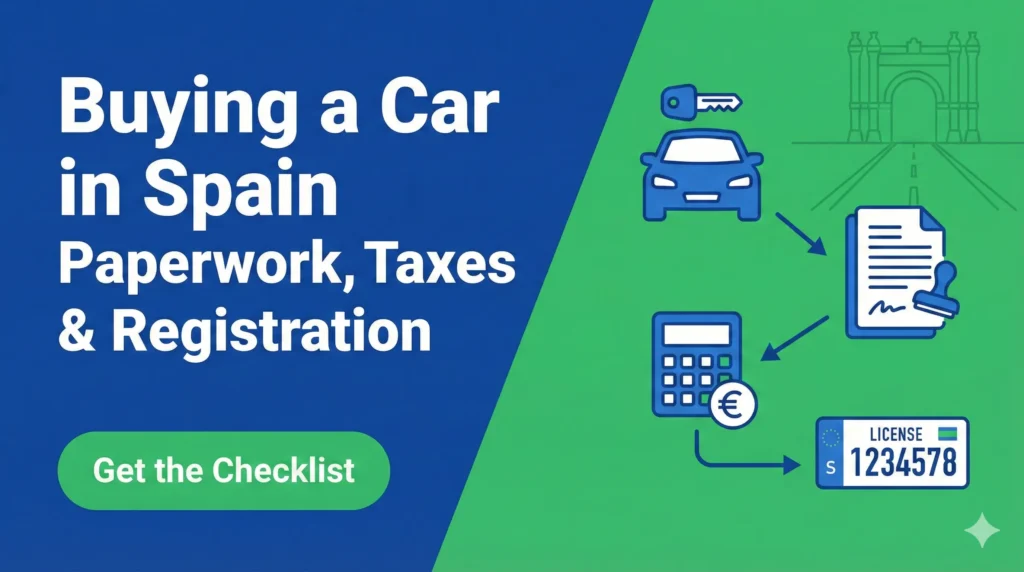
Purchasing a vehicle in Spain offers incredible freedom but involves navigating a complex web of bureaucracy. This guide explains the essential paperwork, hidden transfer taxes, DGT registration steps, and background checks needed to buy a car safely and legally.
Disclosure: This post may contain affiliate links. We may earn a commission at no extra cost to you if you make a purchase through these links. Read full disclosure.
Legal Prerequisites for Foreign Buyers
Before you start scrolling through online car portals or visiting local lots, you must ensure your administrative foundation in Spain is solid. The Spanish government requires specific documentation to link a high-value asset like a vehicle to a traceable resident.
The Foreigner Identification Number
Your absolute first requirement is the Foreigner Identification Number, commonly known as the NIE. This is your unique tax identification number in Spain. You cannot pay the necessary vehicle taxes, register the car with the traffic authorities, or sign a binding purchase contract without it. If you hold a residency card, your NIE is printed on it. If you are a non-resident who simply owns a holiday home, you must still apply for a standalone NIE certificate before purchasing a vehicle.
Official Proof of Address
The Spanish traffic authority needs to know exactly where the car will be “domiciled.” This determines which local municipality will bill you for your annual road tax. You must prove your address by providing a recent municipal census registration certificate. This document must usually be dated within the last three months to be accepted by the traffic authorities. If you have recently moved and have not yet updated your municipal records, you must complete this step first. You can find detailed instructions on securing this document in our guide covering How to Register Your Address Empadronamiento as a Renter in Spain.
A Spanish Bank Account
While it is technically possible to buy a car using a foreign account, the practical reality of Spanish commerce makes it incredibly difficult. Dealerships will want to set up direct debits for financing, and the tax agencies require you to pay transfer taxes and road taxes via recognized Spanish financial institutions. Furthermore, paying for a second-hand car often involves issuing a certified bank draft, which is easiest to obtain from a local branch. If you have not yet established your local banking presence, review our walkthrough on Setting Up a Spanish Bank Account for Rent and Bills Quick Guide to expedite the process.
Dealerships versus Private Sellers
The path you take to buy your car dictates the amount of paperwork you will personally have to handle.
Buying from a Dealership
Purchasing a new or used car from a registered professional dealership is the path of least resistance. Dealerships have direct, electronic links to the traffic authorities and tax agencies. When you buy from a professional, they act as your administrative agent. They will calculate the taxes, register the vehicle in your name, order the license plates, and hand you the keys along with the final, official documentation. You simply sign the purchase agreement, provide your identification, and pay the invoice. The peace of mind is substantial, but you will pay a premium for the service and the dealer’s profit margin.
Buying from a Private Seller
Buying a second-hand car directly from a private individual usually yields a much better price. However, the administrative burden falls squarely on your shoulders. You and the seller must draft a legal contract, pay the transfer taxes to the regional government, and formally notify the traffic authorities of the change in ownership. If you make a mistake, or if the seller disappears before the paperwork is finished, you can face significant legal headaches.
The Crucial Vehicle Background Check
If you choose the private seller route, your very first step before handing over any money must be a thorough background check on the vehicle. In Spain, debts and embargoes are attached to the asset itself, not the person. If you buy a car with unpaid fines or an active financial embargo, you inherit those problems the moment the car is registered in your name.
Requesting the Traffic Authority Report
The Directorate-General for Traffic maintains a comprehensive database of every registered vehicle in the country. You can request a detailed vehicle report online or in person at a provincial traffic office by providing the license plate number and paying a small fee of around eight euros.
This detailed report is an absolute necessity. It will reveal:
- Ownership History: How many people have owned the car, and whether it was previously used as a rental car or taxi.
- Embargoes and Seizures: Whether a bank, the tax agency, or a court has placed a financial hold on the vehicle due to the current owner’s unpaid debts. If an embargo exists, you cannot legally transfer the ownership until the debt is cleared.
- Technical Inspection Status: Whether the car has passed its mandatory safety inspections and the exact mileage recorded at each inspection, which helps prevent odometer fraud.
- Unpaid Road Taxes: Whether the current owner is up to date on their municipal road tax.
Never trust a private seller who claims the car has a clean history without verifying it yourself through this official report.
Essential Vehicle Documents
When inspecting a second-hand car, you must verify that the seller possesses the original, official documents. If any of these are missing, walk away from the sale.
The Circulation Permit
This is a green, multi-page document that serves as the vehicle’s registration certificate. It lists the license plate number, the date of first registration, and the name and address of the current legal owner. The details on this document must perfectly match the seller’s identification card.
The Technical Specifications Sheet
Often referred to as the vehicle’s “passport,” this green or blue document outlines the engineering specifications of the car, including the chassis number, engine type, tire dimensions, and approved modifications. The back of this document, or a supplementary page attached to it, will bear the stamps from every mandatory safety inspection the vehicle has undergone.
The Technical Inspection Report
In addition to the stamps on the specifications sheet, the seller should provide the most recent printed report from the safety inspection station. This report details any minor defects found during the last test.
Taxes and Associated Costs
Buying a car in Spain triggers a variety of taxes. The type of tax you pay depends entirely on whether you are buying a new car, a used car from a dealer, or a used car from a private seller.
Value Added Tax
If you buy a brand-new car from a dealership, or a used car from a professional dealer, you are subject to Value Added Tax. The standard rate in Spain is twenty-one percent, applied to the purchase price of the vehicle. For used cars sold by dealers, the tax is often applied only to the dealer’s profit margin, but it is seamlessly included in the final invoice price.
Property Transfer Tax
If you buy a used car from a private individual, Value Added Tax does not apply. Instead, you must pay the Property Transfer Tax to the regional tax authority where you reside.
This is where many buyers get confused. The tax rate varies by autonomous community, typically ranging from four percent to eight percent. More importantly, the tax is not necessarily calculated based on the price you and the seller agreed upon. The Spanish tax agency publishes an official depreciation table every year in the Official State Gazette. This table dictates the minimum legal value of every make and model of car for tax purposes. If you buy a car for two thousand euros, but the government table says the car is worth four thousand euros, you must pay the transfer tax based on the four-thousand-euro valuation.
Registration Tax
If you are buying a brand-new car, or importing a car from abroad and registering it in Spain for the first time, you must pay a Registration Tax. This is an environmental tax tiered based on the vehicle’s official carbon dioxide emissions. Zero-emission electric vehicles and highly efficient hybrids are usually exempt, while high-performance sports cars and heavy diesel SUVs can face tax rates up to fourteen point seventy-five percent of the vehicle’s value.
Municipal Road Tax
The local road tax is an annual fee levied by your town hall. The amount depends on the fiscal horsepower of the vehicle and the specific pricing policies of your municipality. By law, the person who owns the vehicle on the first of January is responsible for paying the entire year’s road tax. If you buy a car in June, the seller is technically responsible for that year’s tax, though buyers and sellers often negotiate a prorated split of this cost during the sale.
Summary of Taxes and Fees
| Type of Transaction | Applicable Taxes | Average Rate | Who Collects It |
| New Car (Dealership) | Value Added Tax & Registration Tax | 21% VAT + 0-14.75% Registration | Dealership |
| Used Car (Dealership) | Value Added Tax (on margin) | Included in price | Dealership |
| Used Car (Private Seller) | Property Transfer Tax | 4% to 8% of Official Value | Regional Tax Authority |
| All Vehicles | Annual Road Tax | Varies by municipality/engine size | Town Hall |
| Ownership Transfer Fee | Traffic Authority Processing Fee | Approx. €55 | Directorate-General for Traffic |
Step by Step Ownership Transfer
If you are brave enough to handle a private sale yourself, you must follow a strict chronological sequence to protect your legal interests.
Drafting the Purchase Contract
You and the seller must sign a formal purchase agreement. This contract must include the full names, identification numbers, and addresses of both parties. It must detail the vehicle’s make, model, license plate, and chassis number. Most importantly, it must state the exact date and time the vehicle changes hands. This timestamp is your legal shield; if the seller gets caught by a speed camera an hour before handing you the keys, the contract proves you were not the driver.
Both parties must sign every page of the contract, and you must obtain a photocopy of the seller’s identification card.
Paying the Transfer Tax
Before you can register the car, you must pay the Property Transfer Tax. You do this by filling out an official tax form, typically called Form 620 or 621, and submitting it to your regional tax office. In many regions, this can now be done online if you possess a digital certificate, allowing you to pay the tax directly from your bank account and receive an electronic receipt instantly.
The Appointment with the Traffic Authority
Armed with your purchase contract, the seller’s ID copy, the vehicle’s original documents, your own identification and proof of address, and the receipt proving you paid the transfer tax, you must visit a provincial traffic office.
You must book an appointment in advance. During the appointment, the official will process the transfer, charge you the administrative processing fee, and print a brand-new Circulation Permit bearing your name. Only at this moment is the car officially and legally yours.
The Paid Alternative Using an Agency
Because booking traffic appointments can take weeks, and navigating the regional tax portals is frustrating for non-native speakers, many expats use a specialized administrative agency. For a fee of fifty to one hundred euros, these professionals will handle the tax payments and the traffic registry updates electronically on your behalf. They issue you a provisional document that allows you to drive legally immediately while they wait for the official permit to arrive in the mail. This is often the safest and most efficient route for newcomers.
Insurance and Driving Licenses
You cannot drive your newly purchased car off the lot or away from the seller’s house without active insurance. There is no grace period for this requirement.
Before completing the purchase, you should secure insurance quotes using the vehicle’s license plate number. Once the purchase contract is signed, you can activate the policy over the phone or online. Spanish insurance companies rely heavily on centralized databases, and as a new driver in the country, you may face higher premiums initially. To understand the different tiers of coverage available and how to potentially leverage your foreign driving record for a better rate, consult our detailed breakdown on Car Insurance in Spain: Minimum Coverage and What to Compare.
Equally important is ensuring your legal right to drive the vehicle. If you have recently become a resident, the clock is ticking on the validity of your foreign driver’s license. Spain enforces strict grace periods, and failing to update your credentials can render your insurance invalid in the event of an accident. Be sure to check your legal standing by reading our guide on Exchanging a Foreign Driver License in Spain: Eligibility and Steps.
Once you are fully insured and legally licensed, it is vital to familiarize yourself with the unique etiquette and aggressive enforcement mechanisms of the Spanish highway system to avoid accumulating points on your new record. Review the essential rules of the road in Driving in Spain: Road Rules, Fines, and What Surprises Expats.
Environmental Stickers and Low Emission Zones
One final, critical piece of administration awaits you. In response to European environmental directives, Spain has implemented a rigid system of Low Emission Zones across all municipalities with populations exceeding fifty thousand residents.
To enforce these zones, the traffic authority issues color-coded environmental badges that must be displayed on the lower right corner of your vehicle’s windshield. These badges classify your car based on its European emissions standard.
- Zero Emissions Badge: A blue sticker for fully electric vehicles and long-range plug-in hybrids. These cars enjoy unrestricted access to all city centers and often benefit from free street parking.
- Eco Badge: A blue and green sticker for standard hybrids and gas-powered vehicles.
- Label C: A green sticker for modern combustion engine cars, including gasoline cars registered after 2006 and diesel cars registered after 2014.
- Label B: A yellow sticker for older combustion cars, which face significant restrictions and are increasingly banned from entering the central districts of cities like Madrid and Barcelona.
- No Badge: Vehicles older than the Label B criteria do not receive a sticker and are heavily restricted from urban environments.
If you are buying a used car, you must check its environmental classification before finalizing the sale. Buying a cheap, older diesel car might seem like a bargain, but if you cannot legally drive it to your apartment in the city center or park it near your office, the vehicle becomes a massive liability. You can purchase your environmental badge at any major post office by presenting your identification and the vehicle’s circulation permit.
Conclusion
The process of buying a car in Spain is a comprehensive introduction to the country’s bureaucratic landscape. It requires patience, meticulous attention to detail, and a willingness to navigate multiple government agencies simultaneously.
By understanding the absolute necessity of the vehicle background report, calculating the true cost of transfer taxes based on official government tables, and ensuring the environmental classification fits your lifestyle, you can avoid the costly pitfalls that ensnare many expatriates. Whether you choose the streamlined convenience of a professional dealership or the negotiated bargains of the private market, completing this administrative gauntlet grants you the ultimate reward: the freedom to chart your own course across one of the most beautiful and geographically diverse countries in Europe.
References
Primary sources (official)
- Directorate-General for Traffic Vehicle Transfers: https://sede.dgt.gob.es/es/vehiculos/transferencias-de-vehiculos/
- Directorate-General for Traffic Environmental Badges: https://sede.dgt.gob.es/es/vehiculos/distintivo-ambiental/
- Official State Gazette Vehicle Valuation Tables: https://www.boe.es/
Other helpful sources
- Citizens Advice Bureau Spain Vehicle Purchasing: https://www.citizensadvice.org.es/
Disclaimer
The information provided in this article is for educational and informational purposes only and does not constitute legal, tax, or financial advice. Regional tax rates, traffic authority fees, and low emission zone regulations are subject to frequent legislative changes. We strongly recommend verifying the latest tax percentages with your local autonomous community’s tax agency and consulting a professional administrative agency before finalizing any private vehicle transaction.