Spanish Work Culture: Hours, Holidays, and Workplace Etiquette
Disclosure: This article contains affiliate links. If you buy through them, we may earn a commission at no extra cost to you. Read our full disclosure.
Showing up to a 2:00 PM meeting in Madrid only to find the office entirely empty for a mandatory two-hour lunch break is a profoundly disorienting expat rite of passage. Newcomers often burn out for months because they try to apply a rigid, nine-to-five work ethic to a deeply relational, fiercely localized ecosystem. This guide decodes Spanish work hours, unwritten office etiquette, and the complex holiday system so you can integrate seamlessly without losing your sanity.
1. Demystifying Spanish Working Hours
When expats first arrive in Spain, they are immediately confronted by a daily schedule that seems entirely at odds with the rest of the corporate Western world. The rhythm of the day is structured differently, and attempting to fight this rhythm rather than adapting to it will result in immense personal frustration.
The Myth and Reality of the Siesta
The absolute biggest stereotype surrounding Spanish work culture is the infamous “siesta.” Many foreigners arrive with the misguided belief that the entire country goes to sleep for three hours every afternoon. The reality in the modern corporate sector is vastly different, and the actual practice is much more about scheduling logistics than taking a nap.
In massive metropolitan hubs like Madrid, Barcelona, or Valencia, white-collar office workers absolutely do not sleep during the day. However, the legacy of the siesta survives in the form of the massive, extended lunch break. It is incredibly common for offices to shut down their operations between 2:00 PM and 4:00 PM. This two-hour block is strictly reserved for eating a heavy, multi-course menú del día (menu of the day) and socializing with colleagues.
For expats accustomed to eating a sad sandwich at their desk while answering emails, this mandatory pause can feel like an agonizing waste of time. You cannot force your Spanish colleagues to review a spreadsheet at 3:00 PM; they will simply not be at their desks. To understand how these heavy social lunches impact your daily spending, review our guide on Cost of Living in Spain: Budgeting for Expats.
The Split Shift (Jornada Partida) vs. Continuous Shift (Jornada Intensiva)
Because of that massive two-hour lunch break, the standard Spanish workday operates on what is known as the jornada partida (the split shift). This is the primary reason why expats feel like they are constantly at the office.
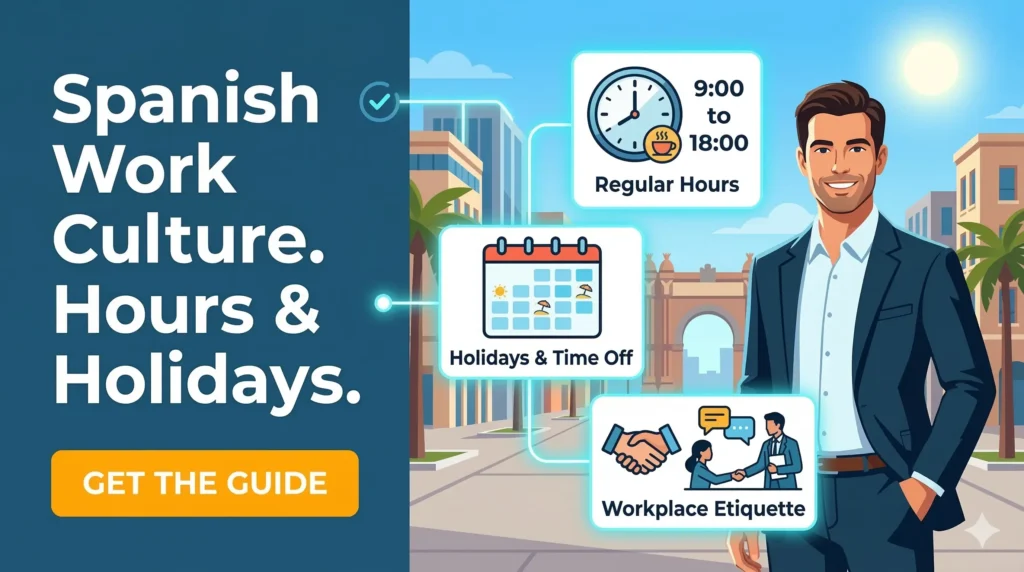
A typical jornada partida begins around 9:00 AM. The office completely empties from 2:00 PM to 4:00 PM for lunch, and then everyone returns to their desks to work from 4:00 PM until 7:00 PM or even 8:00 PM. This creates an incredibly long physical footprint at the office, often spanning eleven hours from start to finish, even if the actual active working hours only amount to the legal standard of forty hours per week.
Conversely, progressive startups, international tech hubs, and some public sector jobs are increasingly adopting the jornada intensiva (continuous shift). This looks much more like the Anglo-Saxon model, running straight from 8:00 AM to 3:00 PM or 4:00 PM with only a very brief thirty-minute pause for a quick lunch. When you are interviewing, clarifying which shift the company operates on is absolutely vital to your quality of life. An expat trying to manage childcare or evening language classes will find the jornada partida incredibly hostile to their personal schedule. To effectively negotiate these hours during your initial interviews, consult Finding a Job in Spain: CV, Interviews, and Networking.
Summer Hours (Jornada de Verano) and Friday Schedules
To combat the grueling reality of the split shift, many traditional Spanish companies offer a massive, culturally sacred compromise: the jornada de verano (summer hours). This is a phenomenal perk that expats absolutely love, but it drastically impacts corporate productivity.
From mid-June through mid-September, a significant portion of the Spanish corporate world permanently switches to an intensive, continuous shift. Offices will open slightly earlier at 8:00 AM and close completely by 3:00 PM every single day. The underlying logic is to allow workers to escape the blistering, dangerous afternoon heat of the Iberian summer and enjoy their afternoons at the municipal pool or the beach.
2. Understanding the Hierarchy and Office Dynamics
Beneath the warm, socially engaged surface of the Spanish office lies a surprisingly rigid, traditional corporate hierarchy. Navigating the power dynamics between managers and employees requires a delicate balance of respect and cultural fluency.
Formal Titles and the Use of Usted vs. Tu
The Spanish language has built-in mechanisms for establishing hierarchy and respect, primarily the distinction between the informal tú and the formal usted. For a foreign professional, knowing when to deploy these pronouns is a massive source of anxiety, as using the wrong one can immediately brand you as disrespectful or overly familiar.
In highly traditional sectors—such as legacy banking, corporate law, public administration, or heavy engineering—it is generally expected that you address senior management, older colleagues, and new clients using usted. This establishes a clear boundary of professional respect. However, modern tech startups, marketing agencies, and international hubs in Barcelona have almost entirely abandoned usted in favor of universal, informal tú, even when speaking to the CEO.
The best practice for an expat is to default to usted in your first written email or initial introduction. The Spanish counterpart will almost always immediately invite you to use tú by saying “Puedes tutearme” (You can use the ‘tú’ form with me).
Presenteeism (El Presentismo) and Leaving on Time
One of the most widely criticized aspects of traditional Spanish work culture is the concept of el presentismo (presenteeism). This is the deeply ingrained cultural belief that your dedication and value to the company are directly measured by the sheer number of physical hours you spend sitting at your desk, regardless of your actual productivity.
In many legacy companies, it is considered highly taboo to leave the office before your immediate manager or the company director leaves. If your shift technically ends at 6:00 PM, but the boss is still at their desk at 7:00 PM, a massive portion of the staff will sit idly at their computers, pretending to work, simply to avoid being the first person to walk out the door. Leaving exactly on time is sometimes passively aggressively viewed as “clock-watching” or lacking commitment to the team.
While the pandemic and the rise of remote work have severely dented this culture of presenteeism, it absolutely still exists in domestic firms. As an expat, you have to carefully read the room during your first few weeks. If you establish strict boundaries and leave precisely at 6:00 PM, you must ensure your actual output is flawless to counter any cultural resentment. Understanding this dynamic helps explain the hidden pressures behind the local compensation packages, which you can decode further in Spanish Salary Basics: Gross vs Net Pay and Common Deductions.
The Role of the Desayuno and Coffee Breaks
If the two-hour lunch break wasn’t enough to shock your system, the Spanish mid-morning desayuno (breakfast) will certainly complete the picture. This is not a quick trip to the office coffee machine; it is an institutionized, mandatory social ritual that dictates the morning workflow.
Around 10:30 AM or 11:00 AM, almost the entire office will stop working, grab their coats, and migrate to a local cafe down the street. For twenty to thirty minutes, colleagues will stand at the bar, drink heavily caffeinated café con leche, eat a piece of pan con tomate (toast with tomato), and aggressively debate football, politics, or weekend plans.
Refusing to participate in the desayuno because you are “too busy” is a massive networking mistake for a newly arrived expat. The mid-morning coffee break is where office politics are truly navigated, where cross-departmental favors are asked, and where you transition from being “the new foreigner” to an integrated member of the team.
3. Communication Styles and Meeting Etiquette
The way business is communicated, negotiated, and executed in Spain is heavily reliant on relationship-building. If you attempt to conduct a Spanish business meeting with the cold, hyper-efficient transactional style of Northern Europe, you will alienate your counterparts.
Directness vs. Politeness in Spanish Communication
Spanish communication can often feel like a paradox to foreigners. On one hand, Spaniards are incredibly direct, loud, and assertive when expressing opinions. They will frequently interrupt each other during meetings, speak over one another, and use strong, definitive language. To an American or a Brit, this can feel aggressive or argumentative.
However, this loudness is rarely rooted in anger; it is simply a display of passion and active engagement. In Spain, interrupting someone is often a sign that you are listening intently and care about what they are saying. Conversely, when it comes to delivering bad news, rejecting a proposal, or giving negative feedback, Spaniards will suddenly become highly indirect. They will use flowery language, soften the blow, and circle the core issue to preserve the interpersonal relationship and avoid public embarrassment.
You must learn to read between the lines. If a Spanish client says a proposal is “muy interesante, pero lo estamos evaluando” (very interesting, but we are evaluating it), it frequently means they are entirely passing on the project but want to spare your feelings. To master these subtle, unwritten communication cues, engaging with advanced listening comprehension exercises on SpanishPod101 can train your ear to catch the difference between a polite rejection and a genuine delay.
How Meetings Actually Run (Time and Agendas)
If a meeting is scheduled for 10:00 AM in Spain, do not expect the first slide of the presentation to appear on the screen at 10:01 AM. Spanish meetings have a highly fluid relationship with time and structure, prioritizing the human element over the written agenda.
The first ten to fifteen minutes of any meeting, even with external corporate clients, will be dedicated to small talk. You must engage in discussions about the weekend, family, the weather, or current events. Attempting to force the room to look at the agenda immediately is considered rude and purely transactional.
Furthermore, meetings frequently veer massively off-topic. Agendas are viewed as light suggestions rather than rigid legal frameworks. The goal of a Spanish meeting is rarely to reach a highly definitive, binding conclusion right then and there.
The Importance of Small Talk and Personal Relationships
In the Anglo-Saxon corporate world, trust is built through competence. If you deliver your reports on time and hit your KPIs, you are trusted. In Spain, trust is built through personal connection. Competence is expected, but it is entirely secondary to whether the team actually likes you as a human being.
You cannot succeed in a Spanish office if you keep your personal life entirely hidden. Colleagues will ask you highly personal questions about your marital status, your children, your housing situation, and your weekend plans. They are not being intrusive; they are attempting to build a relational bridge.
If you are an expat manager leading a team of Spanish locals, you absolutely must invest time in this social infrastructure. Ask about their families, remember the names of their children, and participate in the banter. A manager who issues cold, direct orders via email without ever engaging in small talk will face massive, passive-aggressive resistance from their team. Building this trust early makes navigating the rigid bureaucracy of local tax and employment law much easier when you eventually need HR’s help, a hurdle explored in How to File a Tax Return: A Guide for Expats (IRPF).
| Corporate Metric | Anglo-Saxon Model | Spanish Model |
| Trust Building | Based on competence and hitting deadlines | Based on personal relationships and social integration |
| Meeting Agendas | Rigid, timed, strictly followed | Fluid, flexible, serves as a general guide |
| Communication | Direct for business, polite in disagreements | Passionate and loud, but indirect with bad news |
| Lunch Breaks | 30-60 minutes, often eaten at the desk | 1.5 – 2 hours, strictly away from the desk |
4. The Generous System of Spanish Holidays and Leave
Spain boasts one of the most generous and fiercely protected systems of public holidays and paid leave in the entire world. Understanding how to leverage this system is the key to achieving the legendary European work-life balance.
National, Regional, and Local Holidays (Festivos)
The Spanish calendar is absolutely packed with bank holidays (festivos). However, the system is intensely decentralized. Every single year, a worker in Spain is legally entitled to a maximum of 14 public holidays. What confuses expats is that these 14 days are not uniform across the country.
The system is split into three tiers. There are eight national holidays that the entire country observes simultaneously (such as Christmas Day, New Year’s Day, and Hispanic Day on October 12th). The remaining days are dictated by your specific region (Autonomous Community) and your specific municipality.
For example, May 15th is the feast of San Isidro, and the entire city of Madrid completely shuts down. However, if you travel thirty minutes south to Toledo, it is a normal, busy working day. You must meticulously check the specific calendario laboral (labor calendar) published by your local town hall every January. Failing to do so might mean showing up to a locked office building because you missed a highly localized, obscure saint’s day.
The Concept of the Puente (Long Weekends)
The absolute greatest invention of the Spanish holiday system is the concept of the puente (the bridge). Because Spanish holidays are tied to exact numerical dates rather than floating days (like “the third Monday of the month” in the US), holidays frequently fall on a Tuesday or a Thursday.
When a national holiday falls on a Thursday, the entire Spanish corporate world will collectively agree to take Friday off as well, creating a massive four-day weekend. This act of bridging the holiday to the weekend is taking a puente. If the holiday falls on a Wednesday, some offices will simply shut down for the entire remainder of the week (an acueducto or aqueduct).
You must anticipate these puentes months in advance. During a major puente, such as the massive December constitution week (Dec 6th and Dec 8th), the country’s productivity grinds to an absolute halt. You cannot schedule major project launches, client onboarding, or crucial vendor meetings during a puente. The email out-of-office replies will be impenetrable.
Standard Vacation Days and August Shutdowns
In addition to the 14 public holidays, standard Spanish employment contracts legally mandate a minimum of 30 calendar days of paid vacation per year (which translates to roughly 22 working days).
The cultural expectation of exactly when you take these days is rigid. Spain essentially shuts down in the month of August. It is incredibly common for entire companies, especially in manufacturing, legal, and traditional consulting, to mandate that their employees take three or four consecutive weeks off during August.
If you are an expat attempting to push through projects, sign contracts, or even get a plumber to visit your apartment in August, you will face near-total systemic paralysis. The national motto for the month of August is effectively “We are closed; call back in September.” You must adapt your corporate expectations and personal travel plans to align with this massive, synchronized national shutdown.
5. Contracts, Pay Structures, and Bureaucracy
The psychological weight of Spanish work culture extends directly into how your salary is structured and how your job security is governed by the state. The administrative differences can cause severe cash flow issues for unprepared expats.
The 14-Pagas System (Extra Paychecks)
As briefly touched upon in other guides, you must mentally prepare for the shock of the 14-payment structure. The vast majority of traditional Spanish employment contracts do not divide your gross annual salary by twelve. They divide it by fourteen.
You receive a standard, somewhat suppressed monthly paycheck for twelve months. The remaining capital is clustered into two massive “extra paychecks” (pagas extraordinarias). By law and collective agreement, one is generally paid in late June or early July to fund the sacred summer vacation, and the second is paid in December to cover the heavy expenses of Christmas.
While locals love this enforced savings mechanism, it is a nightmare for a newly arrived expat trying to furnish an apartment and pay exorbitant security deposits. You must budget for the reality that your monthly take-home pay in February will be significantly lower than a pure 12-month division would suggest. To understand the exact timelines of when these transfers hit your account, you must read Spanish Payroll Calendar: When Salaries Are Typically Paid.
Trial Periods (Periodo de Prueba) and Job Security
Spanish labor law is famously protective of employees, making it highly difficult and expensive to fire a worker on a permanent contract. Because of this, companies heavily leverage the legal trial period (periodo de prueba) to aggressively vet new hires before locking them in.
Depending on your level of education and your specific industry agreement, this trial period can last anywhere from 15 days for basic labor up to six full months for highly qualified professionals and executives. During this window, the employer can terminate your contract instantly, without warning, without cause, and without owing you a single cent in severance pay (indemnización).
This is a period of massive anxiety for expats who have just uprooted their lives to move to Spain. You must treat every single day of the trial period as an extended interview. Ensure your attendance is flawless, your integration with the team is visible, and your output is undeniable. Only once the trial period expires does the legendary Spanish job security actually activate.
Managing Your Salary Across Borders
If you survive the trial period and your salary stabilizes, you still face the logistical hurdle of moving that money across borders. Many expats have lingering financial obligations in their home country, such as paying a UK mortgage or American student loans.
If you attempt to use a legacy Spanish bank like Santander or BBVA to wire a portion of your monthly paycheck back home, you will be financially crushed by hidden spreads. Traditional banks pad the exchange rate with massive, hidden profit margins. You could easily lose fifty euros of your hard-earned salary simply trying to move it across borders.
To fiercely protect your international capital, you must bypass the legacy banking system and use a dedicated currency specialist like Wise. By routing your cross-border salary transfers through Wise, you secure the true, transparent mid-market exchange rate. You completely eliminate the hidden bank markups, ensuring your salary safely reaches your home country untouched. If you are operating outside a corporate contract as an independent freelancer, managing these cross-border payments is even more critical; a reality detailed in The Autonomo System in Spain: How to Register as a Freelancer.
6. Dress Code and Professional Appearance
Spain is a country that deeply values aesthetics and personal presentation. How you dress and groom yourself sends an immediate, highly visible signal about your professionalism and your respect for the corporate environment.
The Unspoken Rules of Spanish Office Attire
While the global tech industry has normalized hoodies and sneakers, the broader Spanish corporate world remains surprisingly formal and deeply conscious of physical appearance. Dressing well is seen as a sign of respect for your colleagues and your clients.
In traditional sectors like finance, law, real estate, and public administration, a strict business formal dress code is still enforced. Men are expected to wear well-tailored suits and ties, while women wear formal business dresses or highly polished trousers and blouses. Even in sectors with a “business casual” environment, the Spanish interpretation of casual is much sharper than the American version. Khakis and a wrinkled polo shirt will make you look unkempt. “Casual” in Spain usually means dark, well-fitted denim, crisp button-down shirts, and high-quality leather shoes.
Adapting to the Intense Summer Heat
Maintaining this high level of professional presentation becomes a monumental challenge between June and September, when temperatures in Madrid and Seville routinely exceed 40 degrees Celsius (104 Fahrenheit).
Spanish offices are heavily air-conditioned, but the commute can be brutal. You must adapt your wardrobe materially. Linen suits, lightweight cotton button-downs, and highly breathable fabrics become mandatory. For men, ties are almost universally abandoned during the summer months, and lightweight blazers are carried over the arm rather than worn on the street.
However, you must never mistake the heat for permission to dress like a tourist. Wearing shorts, flip-flops, or sleeveless tank tops to a standard corporate office is an absolute violation of Spanish workplace etiquette, regardless of how hot it is outside. You must remain polished, utilizing seasonal fabrics to survive the climate without sacrificing your professional image.
Grooming, Fragrance, and Personal Presentation
Beyond clothing, Spanish work culture places a massive emphasis on holistic grooming. Hair must be sharply styled, and facial hair must be meticulously maintained. Looking disheveled or rushed is perceived as a lack of organizational skill.
Furthermore, Spain is a culture that heavily embraces fragrance. It is entirely standard and highly expected for both men and women to wear perfume or cologne in a professional setting. The subtle scent of a high-quality fragrance is considered a basic component of daily hygiene and professional presentation.
This emphasis on aesthetics extends directly to how you present your professional brand before you even get the job. If your CV lacks the culturally mandatory professional headshot, you are violating these exact aesthetic expectations. To understand how to format your physical appearance on paper, review Finding a Job in Spain: CV, Interviews, and Networking.
7. Socializing Outside the Office (After-Work Culture)
The ultimate secret to thriving in a Spanish company is understanding that the workday does not actually end when you log off your computer. The social bonds forged after hours are the invisible glue that holds the corporate structure together.
Cañas, Tapas, and Team Bonding
The Spanish “after-work” is a revered institution. Usually on a Thursday or Friday evening, an entire department will leave the office and migrate directly to a nearby bar for cañas (small draft beers) and tapas.
You must view these invitations as mandatory, especially during your first six months as an expat. If you consistently decline invitations because you want to go to the gym or go home to watch Netflix, you will rapidly become isolated. The after-work is where the rigid hierarchy of the office temporarily dissolves. It is where you learn the true, unvarnished opinions of your colleagues, where you navigate office politics, and where you establish yourself as a trustworthy cultural fit.
When attending, you must understand the Spanish round-buying system (pagar rondas). If a colleague buys the first round of beers for the group of five, you do not pull out a calculator and try to wire them €2.50. You simply wait, and when the glasses are empty, you step up to the bar and proudly purchase the second round for the entire group. This system of reciprocal generosity is fundamental to Spanish social integration.
Navigating Corporate Dinners and Christmas Parties
Beyond the casual weekly beers, Spanish companies host massive, highly orchestrated corporate events, the most important being the Cena de Navidad (Christmas Dinner).
The company Christmas dinner is a legendary event that often stretches deep into the early hours of the morning. It begins with a massive, formal sit-down meal, transitions to an open bar, and frequently ends at a nightclub at 4:00 AM.
While the atmosphere is incredibly festive, you must maintain a strategic level of professional discipline. Because the line between personal and professional life is so blurred in Spain, expats often make the fatal mistake of drinking too much and saying something highly inappropriate to a senior manager. You must enjoy the celebration, participate in the toasts, and bond with your team, but you must remember that you still have to face these people on Monday morning.
Establishing Boundaries as an Expat
The intense focus on personal relationships, long split-shift hours, and mandatory after-work socializing can easily consume your entire life. If you are not careful, your entire social circle will be entirely restricted to your coworkers.
You must consciously establish polite but firm boundaries. It is perfectly acceptable to participate in the mid-morning coffee breaks and the Thursday cañas, but gracefully exit the bar at 8:00 PM while the locals continue into the night. You must fiercely protect your personal time to ensure you don’t burn out. The Spanish work environment is a marathon, not a sprint. Managing your energy, your boundaries, and your cultural expectations is the only way to build a sustainable, successful expat career on the peninsula.
References
Primary sources (official)
- Boletín Oficial del Estado (BOE) – Estatuto de los Trabajadores (Jornada y Vacaciones): https://www.boe.es/buscar/act.php?id=BOE-A-2015-11430
- Ministerio de Trabajo y Economía Social – Calendario Laboral Oficial: https://www.mites.gob.es/es/informacion/calendarios/index.htm
Other helpful sources
- Expatica – Spanish business culture: https://www.expatica.com/es/working/employment-basics/business-culture-in-spain-106041/
- The Local Spain – Working in Spain (News & Culture): https://www.thelocal.es/tag/working-in-spain
Disclaimer
The information provided in this article is for educational and informational purposes only and does not constitute formal legal or HR advice. Spanish labor laws regarding the jornada intensiva, mandatory holiday allotments, and the precise length of trial periods are highly complex and heavily dictated by localized regional laws and highly specific industry union agreements (convenios colectivos). Always review your specific employment contract and consult with your company’s Human Resources department or a certified Spanish labor advisor (graduado social) regarding your exact schedule and legal leave entitlements.