How to Get a Resident Parking Permit in Spain (ZBE/Zones)
Watching the municipal tow truck drag my car away because I parked in a green zone without a resident permit was a brutally expensive welcome to Spain. Navigating the color-coded street lines and restrictive Low Emission Zones (ZBE) is a terrifying puzzle for new arrivals. This guide breaks down exactly how to secure your resident parking permit and avoid crippling fines.
Disclosure: This post may contain affiliate links. We may earn a commission at no extra cost to you if you make a purchase through these links. Read full disclosure.
Decoding the Spanish Street Parking System
If you buy or bring a car to Spain and your apartment building does not have an underground garage, your vehicle will live on the street. This immediately subjects you to the highly regulated, fiercely enforced municipal parking grids that dominate every major Spanish city.
Green Lines Versus Blue Lines
Spanish street parking is governed by regional systems, most notably the SER (Servicio de Estacionamiento Regulado) in Madrid and the AREA system in Barcelona. When you drive down a city street, you will notice the parking bays are painted either blue or green. Misunderstanding the difference between these two colors will ruin your budget.
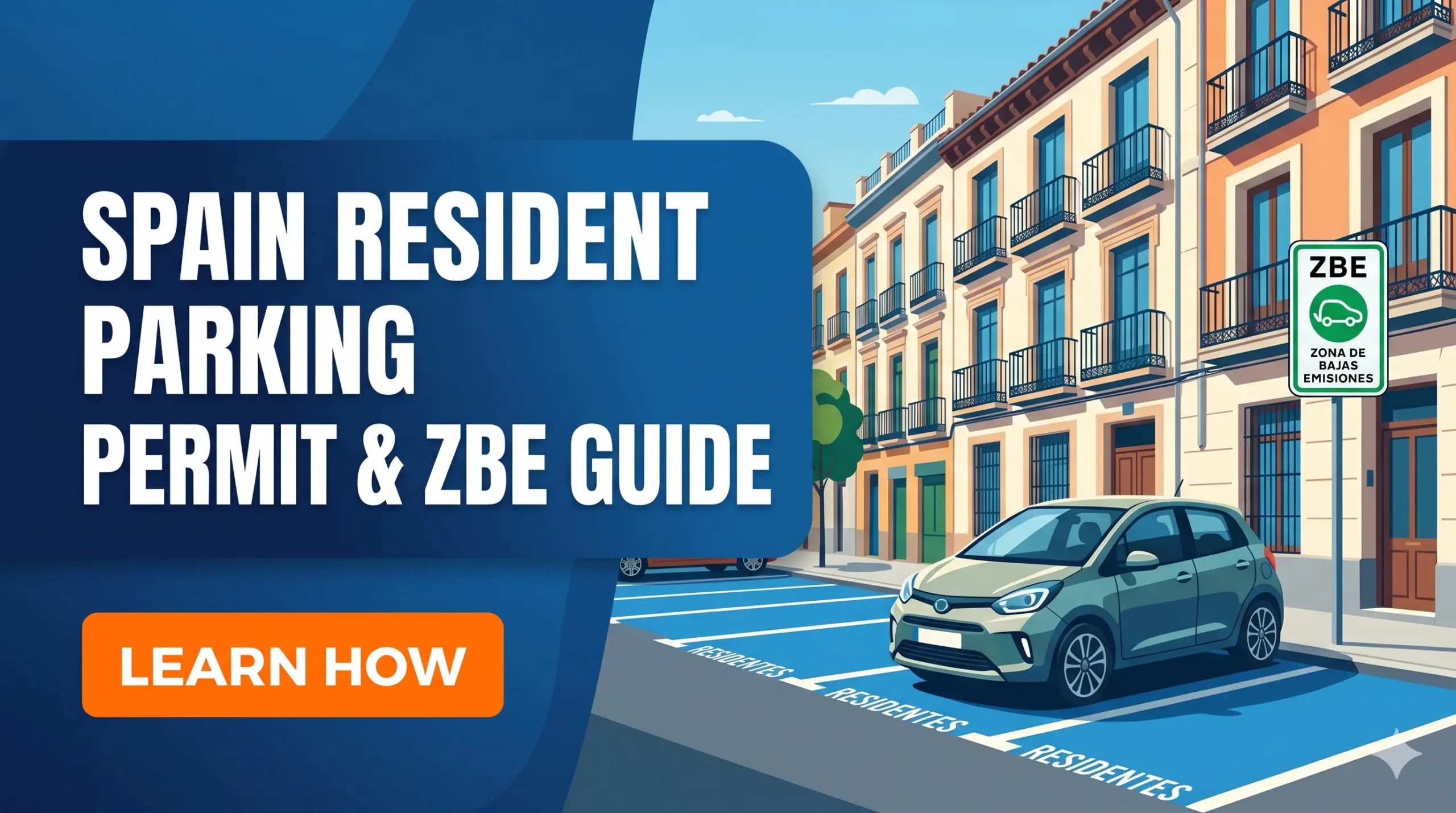
Blue lines (zona azul) are designed for visitors and high-turnover parking. Anyone can park there, but the maximum stay is strictly capped, usually at two to four hours. Green lines (zona verde) are explicitly prioritized for the residents of that specific neighborhood (barrio). While visitors can technically park in a green zone, the meters will charge them a massive premium, and they are usually kicked out after just one hour.
For residents holding a valid parking permit, the green zone is a sanctuary. By paying a tiny annual municipal fee—usually between 25 and 50 euros for the entire year depending on the city—you are granted the right to park in your neighborhood’s green zones indefinitely without feeding the meter. Factoring this annual fee into your baseline calculations is a crucial step when organizing your Cost of Living in Spain: Budgeting for Expats.
The Threat of the Grúa Municipal
Parking in a regulated zone without paying, or overstaying your ticket by even a few minutes, does not just result in a piece of paper under your windshield wiper. Spanish parking enforcers are ruthless, and they frequently travel alongside the Grúa Municipal (the city tow truck).
If your car is towed, the enforcer will leave a highly distressing, brightly colored triangular sticker on the curb where your car used to be, detailing the address of the municipal impound lot. Retrieving your car is a logistical nightmare. You must travel to the impound lot, pay a massive towing fee (often exceeding 150 euros), and then pay the original parking infraction fine on top of it.
The impound lots generally require a physical debit or credit card for payment. If you have just arrived in the country and your foreign cards are flagging international fraud alerts, you will be stranded. Ensuring you have localized financial infrastructure ready for these emergencies is vital, a process covered in Opening a Bank Account in Spain as a Non-Resident.
The Rise of the ZBE (Low Emission Zones)
Getting a parking permit is no longer just about paying for the space; it is about proving your car is legally allowed to exist in the city center. Spain is aggressively rolling out Zonas de Bajas Emisiones (Low Emission Zones or ZBE) across all municipalities with over 50,000 inhabitants.
To enter a ZBE, your car must display a circular environmental sticker (distintivo ambiental) issued by the Dirección General de Tráfico (DGT). These stickers categorize vehicles based on their emissions (Zero, ECO, C, or B). If your older vehicle does not qualify for a sticker, it is legally banned from entering the city center. Driving into a ZBE without the correct sticker will trigger automated traffic cameras to issue an instant 200-euro fine.
You do not automatically receive this sticker. You must physically go to a local post office, present your car’s registration and your ID, and pay a small fee to have it printed. Because postal wait times can be agonizing, understanding the best hours to go is essential; review How Package Pickup Works at Correos (Aviso, ID, Hours) before making the trip.
The Bureaucratic Checklist for Your Permit
You cannot simply walk into a city hall, point at your car, and buy a resident parking permit. The municipal government requires you to build an unassailable paper trail proving your physical and fiscal ties to that exact neighborhood.
The Empadronamiento Baseline
The foundational document for almost every administrative task in Spain is the Certificado de Empadronamiento (the municipal census document). You are only eligible for a resident parking permit if you are officially registered as living in a regulated parking zone.
To get on the padrón, you must secure a formal rental contract for a long-term apartment. If you are living in a short-term Airbnb or a hotel, you cannot get the padrón, and therefore, you cannot get a resident parking permit. The parking permit you receive will be strictly tied to your specific barrio. You cannot use a permit for the Salamanca neighborhood to park for free in Chamberí. Securing that initial long-term lease is a massive financial hurdle detailed in Renting in Spain: How to Budget for Deposits, Fees, and Utilities.
Matching Your DGT Registration
This is the specific administrative trap that catches ninety percent of expats. For the city to grant you a resident parking permit, the official address listed on your car’s registration document (Permiso de Circulación) at the federal DGT must perfectly match the address on your municipal padrón.
If you bought a used car from a dealership in Valencia, but you currently live and rent an apartment in Madrid, the Madrid city hall will deny your parking permit application. Their system will see that the DGT thinks your car “lives” in Valencia. You must first navigate the DGT portal to officially change the vehicle’s fiscal address to your new Madrid apartment before the city hall will even look at your parking application.
The IVTM Road Tax Requirement
Spanish bureaucracy is fiercely interconnected. You cannot receive a municipal benefit if you owe the government money. To be approved for a resident parking permit, your local road tax—known as the Impuesto sobre Vehículos de Tracción Mecánica (IVTM)—must be fully paid and up to date.
The IVTM is an annual municipal tax based on the horsepower and environmental impact of your vehicle. If you just imported a car or recently purchased one, the tax might be pending, or it might have been paid to a different municipality by the previous owner. You must provide proof of payment. To prevent missing this annual tax in the future and having your parking permit revoked, you must set up a direct debit (domiciliación) with your Spanish bank, a routine process explored in Student Finances in Spain: Bank Accounts and Budgeting Tips.
The Application Process and Survival Tactics
Once you have gathered your padrón, updated your DGT registration, and paid your road tax, you must face the final hurdle: actually submitting the application to the city.
Applying Online via City Portals
The most efficient way to apply for your Autorización de Residente is through your city hall’s electronic headquarters (Sede Electrónica). In Madrid, for example, you can process the entire SER resident application online if you possess a Spanish Digital Certificate (Certificado Digital) or access via the Cl@ve PIN system.
The digital portals are notoriously fragile. The authentication gateways frequently time out, and uploading heavy PDF copies of your car registration and ID requires a stable, uninterrupted connection. If your connection drops while processing your digital certificate, you will have to start the frustrating multi-page application entirely over. Using a reliable, expat-focused home fiber and mobile data provider like Tiekom ensures you can navigate the municipal portals without timing out or losing your progress.
Furthermore, once your permit is approved, you will heavily rely on municipal parking apps (like ElParking or e-park) to manage your vehicle or pay for visitor zones when you travel outside your designated neighborhood. Having a robust mobile data plan from Tiekom guarantees you can instantly pay the parking meter from your smartphone while walking away from your car, preventing surprise fines.
Navigating In-Person Appointments
If you do not have a Digital Certificate, or if the municipal software refuses to validate your foreign identification number (NIE), you will be forced to apply in person at an Oficina de Atención a la Ciudadanía (Citizen Attention Office).
You cannot simply walk in; you must secure a cita previa (prior appointment) online. When you attend your appointment, bring original physical copies of absolutely everything: your passport, your TIE card, your rental contract, your padrón certificate, your car’s Permiso de Circulación, and your road tax receipt. Spanish civil servants are notorious for rejecting digital copies on a smartphone screen. If you fail to bring a physical photocopy of a required document, they will send you home and force you to book another appointment. To ensure your proof of address documents are pristine and acceptable, review the strict standards outlined in What Proof of Address Do Spanish Banks Accept?.
Protecting Your Car on the Street
Securing the resident permit is a massive victory, but you must now face the physical reality of Spanish street parking. If your apartment building does not offer a private garage—a common reality discussed in How to Deal With Spanish Building Rules (Pets, Noise, Renovations)—your vehicle will be entirely exposed to the elements and the local driving culture.
Parallel parking in Spain is colloquially known as a contact sport. Locals frequently park by “touch,” gently bumping the cars in front and behind them to squeeze into impossibly tight spaces. If you value your car’s paint job, ordering heavy-duty rubber bumper guards from Amazon Spain on day one is a mandatory survival tactic to prevent your vehicle from being covered in scratches within a month.
Equally destructive is the fierce Mediterranean weather. Because your car will be baking on the asphalt year-round, the relentless Spanish sun will absolutely destroy your interior dashboard and melt any adhesive accessories. Ordering a thick, reflective sunshade and a specialized magnetic windshield holder for your DGT emissions sticker from Amazon Spain prevents your interior from cracking and ensures your required government stickers remain visible and undamaged.
| Requirement | Where to Process | Document Needed | Purpose |
| Proof of Address | Local Town Hall | Certificado de Empadronamiento | Proves you live in the regulated zone |
| Vehicle Address | DGT (Traffic Authority) | Permiso de Circulación | Aligns your car’s legal home with your address |
| Road Tax | Local Town Hall / Bank | IVTM Payment Receipt | Proves you do not owe municipal debts |
| Emissions Status | Correos (Post Office) | DGT Environmental Sticker | Allows legal entry into the city’s ZBE |
| Resident Permit | City Portal (Sede Electrónica) | Digital Certificate / Cl@ve | Grants unlimited parking in your green zone |
References
Primary sources (official)
- Dirección General de Tráfico (DGT) – Zonas de Bajas Emisiones (ZBE): https://www.dgt.es/muevete-con-seguridad/viaja-seguro/zonas-de-bajas-emisiones/
- Ayuntamiento de Madrid – Servicio de Estacionamiento Regulado (SER) Residentes: https://sede.madrid.es/portal/site/tramites/menuitem.62876cb64654a55e2dbd7003a8a409a0/?vgnextoid=3bbc52afa5ce6410VgnVCM1000000b205a0aRCRD
- Àrea Verda Barcelona – Residentes: https://www.areaverda.cat/es/informacion/residentes
Other helpful sources
- Expatica – Driving and Parking in Spain: https://www.expatica.com/es/living/transportation/driving-in-spain-101461/
- RACE – Todo lo que debes saber sobre las ZBE en España: https://www.race.es/zonas-de-bajas-emisiones
Disclaimer
The information provided in this article is for educational and informational purposes only and does not constitute formal legal or municipal advice. Spanish parking regulations, including the exact boundaries of the Servicio de Estacionamiento Regulado (SER), the implementation timelines for Zonas de Bajas Emisiones (ZBE), and the specific documentation required for resident permits, vary drastically by municipality and are subject to frequent local bylaws. Always verify the current parking zone maps, emissions requirements, and digital portal procedures directly with your local town hall (ayuntamiento) before parking a vehicle on public streets.