Should You Use a Real Estate Agent in Spain? Pros and Cons
Staring at an idealista listing and realizing the agency wants a massive, non-refundable commission just to open a door is a crushing expat realization. I once handed over a full month of rent to an agent who simply downloaded a templated lease and vanished. This guide breaks down the brutal pros and cons of using a Spanish real estate agent.
Disclosure: This post may contain affiliate links. We may earn a commission at no extra cost to you if you make a purchase through these links. Read full disclosure.
The Reality of the Spanish Real Estate Market
Before you can decide whether to hire a professional or go it alone, you must understand how the property market actually operates in the Iberian Peninsula. If you approach the house hunt using the exact same assumptions you developed in the United States or Northern Europe, you will quickly find yourself incredibly frustrated and financially drained.
How Inmobiliarias Dominate the Portals
In many countries, a centralized Multiple Listing Service (MLS) forces real estate agents to cooperate and share inventory. Spain has no such national database. Instead, the market is highly fragmented and fiercely territorial. Real estate agencies, known locally as inmobiliarias, aggressively canvas neighborhoods to secure exclusive rights to list properties.
Because of this aggressive hoarding, the vast majority of properties on major portals like idealista and Fotocasa are controlled by agencies, not private owners. When you see a beautiful apartment online and call the phone number, you are almost never speaking to the person who actually owns the flat. You are speaking to an agent who acts as a gatekeeper.
Furthermore, these agencies frequently use a classic bait-and-switch tactic. They will leave a listing for a gorgeous, underpriced flat active on the portal long after it has been rented or sold. When you call, they will tell you that specific flat just went off the market, but they have “similar properties” they can show you. To protect yourself from these frustrating lead-generation tactics, you must be highly skeptical of listings that look too good to be true, a survival tactic explored deeply in Common Financial Scams Targeting Expats in Spain (and How to Avoid Them).
The Housing Law and the Agency Fee Trap
For renters, the decision to use an agency is heavily influenced by the aggressive financial demands these companies make. Historically, Spanish agencies forced the tenant to pay their massive commission fee—usually equal to one full month of rent plus a 21% Value Added Tax (IVA)—simply for the privilege of signing the lease.
In May 2023, the Spanish government passed a sweeping Housing Law designed to protect tenants. Under this new legislation, it is strictly illegal for agencies to charge the tenant this massive finder’s fee for standard, long-term residential contracts. The law explicitly states that the landlord must pay the agency’s commission.
However, agencies instantly adapted to this law by aggressively pushing “temporary contracts” instead of permanent residential leases. A temporary contract, usually lasting exactly eleven months, is legally exempt from the new housing law protections. Therefore, if an agency labels a flat as a temporary rental, they will absolutely force you, the expat tenant, to pay their massive commission fee. You must read every listing carefully to understand what type of contract is being offered. To navigate these aggressive legal loopholes safely, review Student Housing in Spain: Options and Typical Contracts.
Pros of Using a Real Estate Agent in Spain
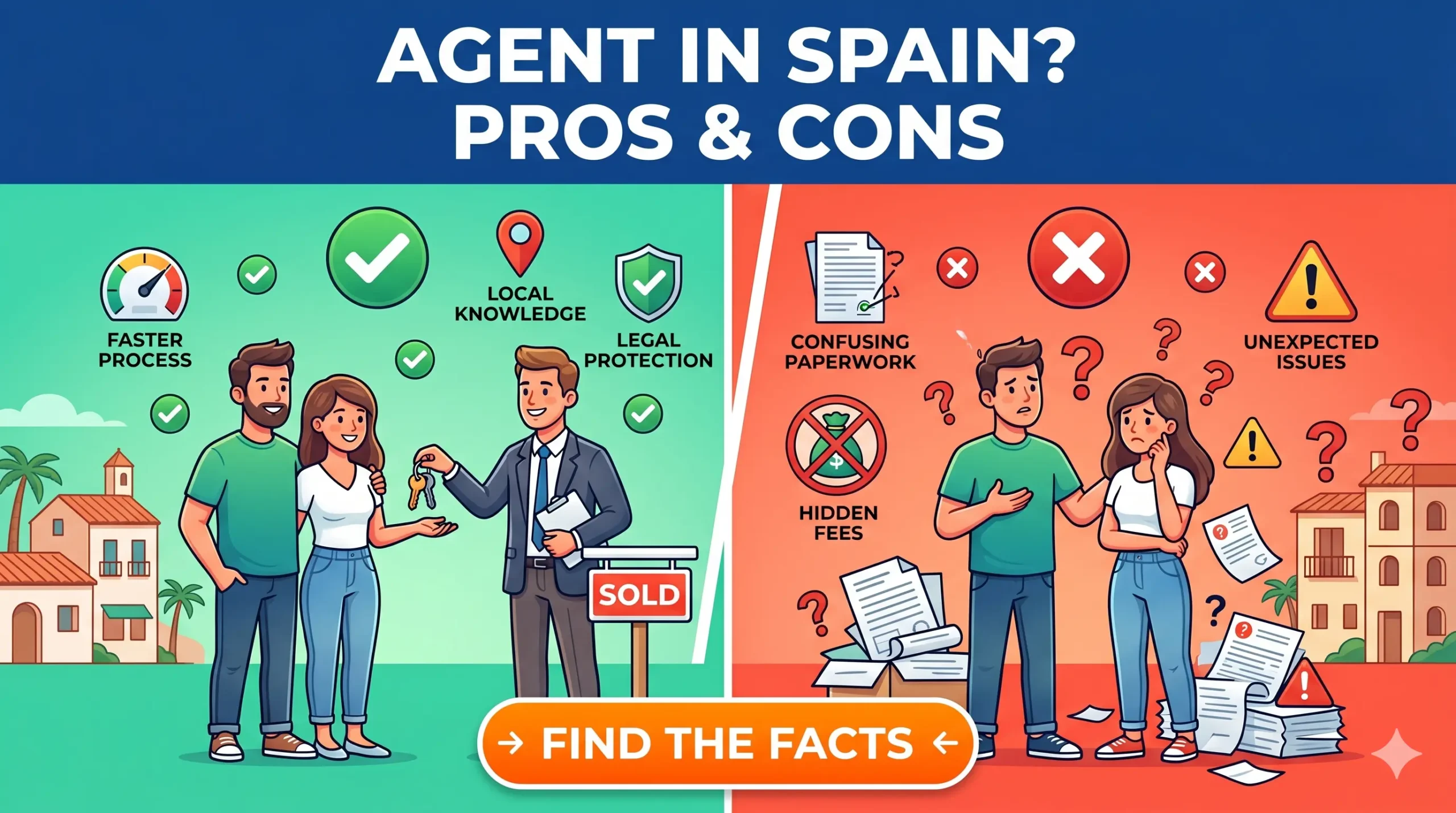
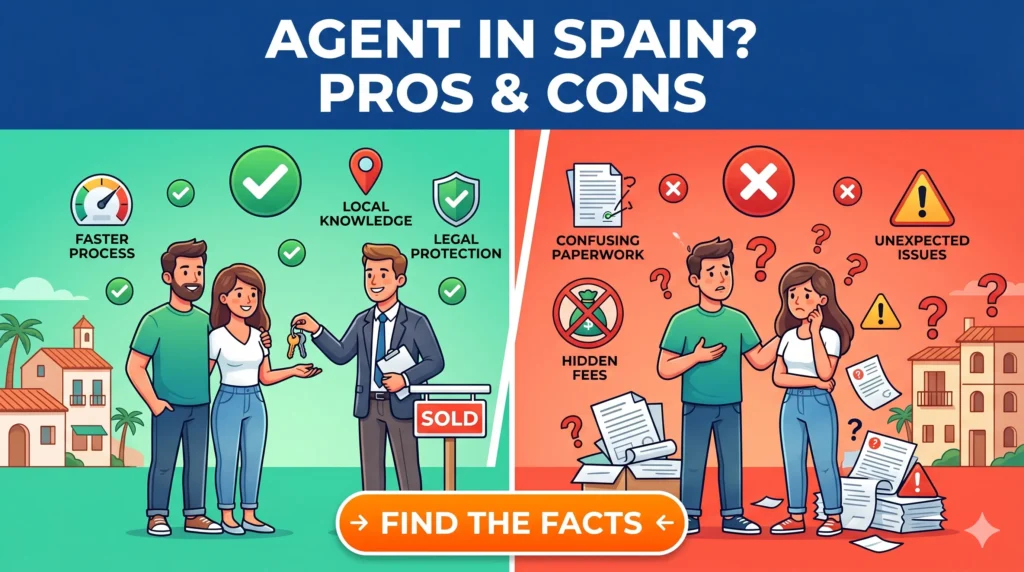
Despite the high costs and aggressive tactics, there are highly specific scenarios where partnering with a reputable Spanish real estate agent is not just helpful, but absolutely vital for your survival and sanity.
Bypassing the Language and Bureaucracy Barrier
If your Spanish is limited to ordering coffee, navigating the fast-paced, high-pressure environment of Spanish real estate is impossible. Landlords and private sellers rarely speak fluent English, and they will almost always ignore inquiries sent in English or calls originating from foreign phone numbers. Having an active local number through an expat-centric telecom provider like Tiekom ensures your calls actually connect and aren’t immediately flagged as international spam by suspicious owners.
A bilingual real estate agent acts as your localized translator and cultural liaison. They handle the rapid-fire WhatsApp messages required to secure a viewing before a flat disappears. They also help decode the hyper-specific local jargon used in property descriptions, translating the reality of what “semi-furnished” or “interior flat” actually means. To build your own baseline vocabulary before touring properties, deeply review How to Read Spanish Real Estate Listings: Key Words Decoded.
Most importantly, an agent handles the initial negotiation and drafts the legally binding contracts in formal Spanish. While you should always have a lawyer review a purchase agreement, having an agent handle the baseline bureaucratic paperwork saves you hours of exhausting translation work.
Access to Unlisted Properties and Off Market Deals
The absolute best apartments in major Spanish hubs like Madrid, Barcelona, and Valencia never actually make it onto the internet. In Spain, personal relationships and word-of-mouth are king.
Legacy real estate agents who have operated in a specific neighborhood for decades have massive networks of older landlords and property investors. When a desirable flat becomes vacant, these landlords simply toss the keys to their trusted local agent. The agent then calls their internal waitlist of qualified clients to rent or buy the property before it is ever photographed for idealista.
If you physically walk into a local inmobiliaria office, dress well, and clearly state your budget and requirements, the agent might pull a set of keys out of their desk for a “pocket listing” that matches your needs perfectly. To be the first person an agent calls when an off-market deal drops, you must be highly responsive. Having a robust mobile data plan from Tiekom ensures you receive those critical WhatsApp messages instantly while you are out exploring your new city, allowing you to beat the massive crowds to the viewing.
Cons of Using a Real Estate Agent in Spain
The primary reason veteran expats frequently advise against using real estate agents is the severe lack of consumer protection and the heavily skewed power dynamics inherent in the Spanish system.
The Exorbitant Costs and Hidden Fees
If you are buying a property, the agency commission is staggering. Spanish real estate agents typically charge anywhere from 3% to 5% of the total purchase price, plus 21% IVA. While the seller customarily pays this fee, some aggressive agencies in highly saturated expat coastal areas will attempt to charge the buyer an additional “search fee” ranging from 1% to 3%. You must clarify exactly who is paying the commission before you sign a representation agreement.
If you are renting and get trapped in the temporary contract loophole mentioned earlier, paying an agency fee on top of your security deposit and first month of rent requires massive upfront liquidity. Sinking thousands of euros into non-refundable agency fees severely limits your ability to buy furniture or survive your first few months. Factoring these aggressive sunk costs into your transition plan is a critical step detailed in Renting in Spain: How to Budget for Deposits, Fees, and Utilities.
The Lack of Exclusive Representation
In the United States and the United Kingdom, it is common to hire a “buyer’s agent” who has a fiduciary duty to represent your best financial interests and negotiate the price down. In the standard Spanish real estate model, the agent almost exclusively represents the seller or the landlord.
The inmobiliaria is legally contracted by the property owner to get the highest possible price for the asset. Even if the agent is incredibly friendly and driving you around to view different properties, you must remember that they do not work for you. Their ultimate goal is to close the deal as quickly as possible to secure their commission. They will rarely point out structural flaws in an apartment, and they will frequently pressure you by claiming there are “three other couples” waiting to sign the lease if you hesitate.
Exaggerations and Disappearing Acts
Spanish real estate agents are notorious for visually exaggerating the size of a property. They frequently advertise the built square meters rather than the actual usable space, or they use wide-angle lenses to make a tiny kitchen look massive. You cannot trust the numbers on the listing. A veteran expat tactic is to order a cheap digital laser measuring tool from Amazon Spain before you start attending viewings. Pulling this out of your pocket to verify the true dimensions of a bedroom instantly shifts the power dynamic and prevents the agent from lying to your face. To understand exactly how these measurements are manipulated, read Spanish Apartment Sizes: m², Floor Numbers, and Listing Terms Explained.
Furthermore, the agent’s customer service drops to absolute zero the exact second the contract is signed and their commission is paid. If the boiler breaks the day after you move in, the agency will tell you to call the landlord directly. They do not manage the property; they simply broker the transaction. Because you cannot trust who else the agent or the landlord has given keys to in the past, your very first step after signing a lease should be ordering a high-security dual-clutch lock cylinder from Amazon Spain and changing your front door lock immediately for your own safety.
DIY vs Agency Making the Final Decision
Deciding whether to pay an agency or hunt for a flat independently depends entirely on your budget, your timeline, and your tolerance for intense Spanish bureaucracy.
When to Go It Alone Direct from Owner
If you have a tight budget, patience, and conversational Spanish skills, bypassing the agencies and renting or buying directly from a private owner (particular) is highly lucrative.
To find these elusive deals, you must filter property portals specifically for “Particular” listings, though you must constantly verify that sneaky agents haven’t misclassified their listings to appear in this filter. A more traditional, highly effective method is walking the streets of your desired neighborhood looking for physical “Se Vende” (For Sale) or “Se Alquila” (For Rent) signs hanging from balconies. Calling the phone number on a hand-written balcony sign is the best way to bypass the inmobiliaria mafia entirely.
If you manage to secure a private deal, you must be incredibly organized. You will be responsible for tracking the contracts, verifying the property registry, and securing the municipal census documents without professional hand-holding. Ordering a heavy-duty, fireproof document organizer from Amazon Spain ensures you keep all these critical, original physical documents perfectly safe and sorted as you navigate the municipal offices alone.
Setting Up Your Home After the Search
Whether you use an agent or go direct to the owner, the true administrative nightmare begins after you sign the contract. No real estate agent is going to sit on hold with a utility company for three hours to transfer the electricity bill into your name. You are entirely on your own for the setup.
If you rented an “unfurnished” flat, you might arrive to find a concrete box lacking a refrigerator or a washing machine. Ordering essential heavy white goods and standalone wardrobes directly from Amazon Spain is the fastest way to make an empty flat livable without renting a commercial van to navigate local hardware stores.
More critically, you must establish your home internet immediately to resume remote work and stay connected. Navigating the customer service menus of legacy Spanish telecom monopolies in broken Spanish is agonizing. Utilizing an expat-focused provider like Tiekom ensures you can set up your high-speed home fiber network in plain English, completely bypassing the aggressive bureaucratic roadblocks traditional providers place in front of foreigners. Managing these essential activations transforms an empty flat into a functional home, a holistic process deeply explored in Utility Costs in Spain: Electricity, Gas, Water, and Internet. To ensure your baseline capital can absorb these immediate setup shocks, meticulously review Cost of Living in Spain: Budgeting for Expats.
| Feature | Using a Real Estate Agency | Going DIY Direct from Owner |
| Upfront Costs | Very High (Commissions and agency fees) | Low (Only standard legal deposits) |
| Language Barrier | Low (Agents often speak English) | High (Requires conversational Spanish) |
| Property Access | High (Access to off-market keys) | Low (Must hunt for balcony signs) |
| Legal Paperwork | Handled by the agency | You must draft or verify contracts |
| Post-Sign Support | None (They vanish after payment) | None (Direct landlord communication) |
References
Primary sources (official)
- Boletín Oficial del Estado Ley por el derecho a la vivienda: https://www.boe.es/buscar/act.php?id=BOE-A-2023-12203
- Ministerio de Vivienda y Agenda Urbana: https://www.mivau.gob.es/
Other helpful sources
- idealista – Top questions to ask an estate agent when buying property in Spain: https://www.idealista.com/en/news/property-for-sale-in-spain/2025/12/03/873765-top-questions-to-ask-an-estate-agent-when-buying-property-in-spain
- idealista – Property buying costs in Spain taxes and fees: https://www.idealista.com/en/news/financial-advice-in-spain/2026/01/12/7875-the-costs-and-taxes-associated-with-buying-a-home-in-spain
Disclaimer
The information provided in this article is for educational and informational purposes only and does not constitute formal real estate, legal, or financial advice. The Spanish real estate market is highly regional, and the application of the 2023 Housing Law regarding agency commissions (honorarios de agencia) is subject to differing legal interpretations based on whether a contract is classified as a permanent residential lease (vivienda habitual) or a temporary contract (contrato de temporada). Always personally verify property dimensions, carefully review contract terms regarding hidden commissions, and consult with an independent, certified Spanish property lawyer (abogado inmobiliario) before transferring any funds or signing legally binding documents.