How to Read Spanish Real Estate Listings: Key Words Decoded
Trying to decode a Spanish apartment listing on property portals feels like deciphering a highly deceptive ancient text. I once eagerly toured an eighty-square-meter flat only to realize the agent counted the communal stairwell and half a balcony. This guide translates the confusing jargon of Spanish real estate listings, so you know exactly what you are actually renting before signing a lease.
Disclosure: This post may contain affiliate links. We may earn a commission at no extra cost to you if you make a purchase through these links. Read full disclosure.
Cracking the Code on Apartment Sizes and Layouts
When you look at real estate portals in the Anglo-Saxon world, the square footage listed is generally the actual, walkable space you have to live in. Spain operates on a completely different standard of measurement. If you blindly trust the headline number on a Spanish property listing, you will face severe spatial disappointment upon viewing the flat.
Built Versus Usable Square Meters
The most critical vocabulary distinction you must master is the difference between built meters and usable meters. By default, almost every real estate agent and landlord in Spain advertises the metros construidos (built square meters) because it is the larger, more impressive number. This metric includes absolutely everything within the perimeter of the apartment, including the physical footprint of the structural pillars, the thickness of the exterior brick walls, and the interior partitions.
Conversely, metros útiles refers to the actual, physical space where you can step, place furniture, or lay down a rug. As a general rule of thumb, the usable space will be fifteen to twenty-five percent smaller than the advertised built space. If you see an eighty-square-meter apartment listed, expect it to actually feel like a sixty-square-meter flat. Understanding exactly what you are paying for is the first defense mechanism you must build, a concept deeply explored in Spanish Apartment Sizes: m², Floor Numbers, and Listing Terms Explained.
To make matters worse, some listings advertise metros construidos con elementos comunes. This means the number they are advertising literally includes your proportionate slice of the building’s lobby, the elevator shaft, and the stairwell. Because floor plans are rarely provided, a highly recommended veteran tactic is to purchase a cheap laser measuring tool from Amazon Spain. Bringing this small device to your viewings allows you to instantly verify the true dimensions of a bedroom before signing a binding contract.
The Truth About Rooms and Bathrooms
You must also decode how the space is divided. In Spain, a listing will often state the number of habitaciones (rooms) rather than dormitorios (bedrooms). While these terms are frequently used interchangeably, a sneaky landlord might list a flat with three habitaciones, but upon arrival, you realize one is a tiny windowless storage closet and only two are viable bedrooms.
When a listing mentions a bathroom, look for the distinction between a baño completo (full bathroom) and an aseo. A full bathroom includes a toilet, sink, and either a bathtub or shower. An aseo is simply a half-bath with a toilet and a sink, meaning you cannot shower in it. If you are planning to share the flat with roommates, misreading an aseo as a second full bathroom will create massive morning bottlenecks. To navigate the complexities of finding a suitable shared living situation, deeply review Student Housing in Spain: Options and Typical Contracts.

Decoding Floor Levels and Building Features
The physical location of an apartment within a Spanish building is rarely as simple as counting up from the street. The naming conventions for floors are rooted in older architectural traditions, which frequently obscure exactly how many flights of stairs you will actually have to climb.
Hidden Floors and the Elevator Trap
In Spain, the ground floor is always referred to as the Bajo or Planta Baja. However, between the ground level and the first floor (Planta 1), classic Spanish buildings frequently insert hidden floors. You might encounter an Entreplanta (Mezzanine), followed by a Principal (Main Floor). If you rent an apartment listed as Planta 1, you might actually be walking past the Bajo, up to the Entreplanta, past the Principal, and finally arriving at your apartment on the physical fourth story of the building.
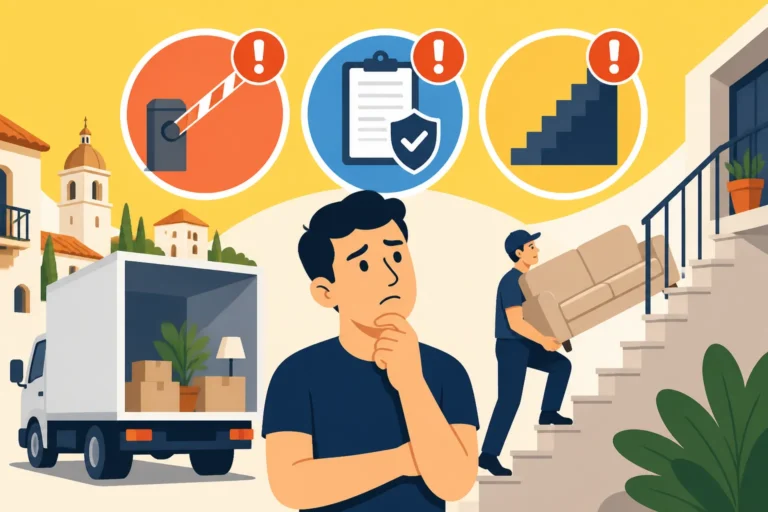
This brings us to the most vital phrase in any Spanish listing: Sin Ascensor (Without Elevator). If you rent a fourth floor without an elevator in a building with high ceilings, you will be climbing nearly a hundred steps every single time you buy groceries. The daily physical toll of this cannot be overstated. If you move into a walk-up flat, you will quickly find yourself ordering heavy groceries, cleaning supplies, and bottled water via Amazon Spain simply to avoid the brutal physical labor of hauling them up the stairs yourself.
Exterior Versus Interior Facing Flats
In Spain, flats are strictly categorized as either Exterior or Interior. An Exterior apartment means the primary windows face the open street. These flats command premium prices because they receive direct, natural sunlight. However, Spanish streets are famously loud, so an Exterior flat guarantees you will hear the terrace bars and municipal street sweepers at night.
An Interior apartment means the windows face a patio de luces (an internal architectural courtyard). Interior flats are significantly cheaper and wonderfully quiet, but they can be crushingly dark. There is also a massive technological penalty to Interior flats. The thick, historic plaster walls surrounding these interior courtyards frequently block mobile cellular signals entirely. If you choose an interior flat, you will likely have zero cell reception in your living room, making a robust home fiber connection from Tiekom an absolute necessity on day one so you can rely on Wi-Fi calling. Setting up this localized infrastructure smoothly is a crucial integration step detailed in Utility Costs in Spain: Electricity, Gas, Water, and Internet.
Understanding Furnishings and Utilities
When you filter listings on Idealista or Fotocasa, you will encounter localized jargon regarding what is actually included inside the physical walls of the flat. Misunderstanding these terms will severely impact your moving budget.
What Unfurnished Actually Means
When filtering searches, you will see flats listed as Amueblado (Furnished) or Sin Amueblar (Unfurnished). You must completely recalibrate your expectations of what unfurnished means in the Spanish market.
In many countries, an unfurnished flat still comes with large kitchen appliances, built-in closets, and light fixtures. In Spain, Sin Amueblar frequently means the landlord is handing you a completely empty concrete box. There will be bare wires hanging from the ceiling where lightbulbs should be. Most shockingly, the kitchen may completely lack a refrigerator (nevera) or a washing machine (lavadora). Furthermore, older Spanish flats rarely have built-in closets (armarios empotrados), requiring you to buy standalone wardrobes.
If you sign a lease for a Sin Amueblar flat, you will immediately need to drop thousands of euros to make it habitable. Ordering essential heavy white goods and standalone wardrobes from Amazon Spain is often the fastest way to equip an empty flat without needing to rent a commercial van to navigate local hardware stores. To ensure your initial capital is ready to handle these massive, sudden expenses, you must proactively set up your local financial infrastructure, a process detailed in Opening a Bank Account in Spain as a Non-Resident.
Heating Air Conditioning and Internet Setup
Pay extreme attention to the climate control features listed in the ad. Many older flats lack central heating entirely. If a listing says Calefacción Central (Central Heating), it usually means the entire building’s heat is controlled by the community president, and the cost is often included in the rent. If it says Calefacción Individual, you control the heat, but you are responsible for the massive winter gas or electricity bills.
If the flat has no heating listed, winters inside a Spanish stone building can be brutally damp and freezing. To combat the lack of central heating, ordering heavy thermal curtains and space heaters from Amazon Spain is the quickest fix to survive January. Decoding how these specific heating systems impact your monthly utility budget is a survival skill heavily detailed in Cost of Living in Spain: Budgeting for Expats.
Additionally, when a listing claims to have internet pre-installed, it usually just means the physical fiber cable reaches the building. You still have to activate a contract. When setting up your new apartment, you don’t want to fight with local telecommunication monopolies in broken Spanish; using an expat-friendly provider like Tiekom ensures you get your internet running smoothly without the frustrating bureaucratic roadblocks legacy providers impose on foreigners.
| Spanish Listing Term | English Translation | What It Actually Means for Expats |
| Metros útiles | Usable square meters | The actual walkable space inside the flat. |
| Sin ascensor | No elevator | You will carry everything up the stairs daily. |
| Piso interior | Interior flat | Faces a courtyard; quiet, but dark with poor cell signal. |
| Sin amueblar | Unfurnished | Often completely empty, lacking a fridge and washing machine. |
| Armarios empotrados | Built-in closets | You will not need to buy standalone wardrobes. |
| Gastos de comunidad incluidos | HOA fees included | The rent covers building maintenance and stairwell cleaning. |
Navigating Rental Conditions and Agent Fees
The final hurdle of decoding a Spanish real estate listing is understanding the financial demands at the bottom of the page. The deposit structures and agency fees in Spain are notoriously hostile to new arrivals.
The Fianza and Extra Guarantees
Spanish law dictates that for a standard long-term rental, the landlord must request a one-month security deposit known as the Fianza. This money must be legally deposited by the landlord into a regional government holding account.
However, you will frequently see a term called Garantía Adicional or Meses de Aval. Because Spanish eviction laws heavily favor tenants, landlords are terrified of expats abandoning the flat and fleeing the country without paying rent. To protect themselves, they will ask for extra guarantees. A listing might demand the legal one-month fianza plus two additional months of rent upfront as an extra guarantee. For foreigners without a permanent Spanish payroll (nómina), landlords might even demand a six-month bank guarantee (aval bancario), locking up thousands of euros of your liquidity. Navigating these aggressive financial demands is a core part of your survival strategy, explored heavily in Renting in Spain: How to Budget for Deposits, Fees, and Utilities.
The Agency Fee Trap
Finally, you will often see notes about Honorarios de Agencia (Agency Fees). When you find an apartment on idealista, you are almost always dealing with a real estate agency rather than the actual owner. Historically, Spanish agencies forced the tenant to pay their massive commission fee—usually equal to one month’s rent plus 21% VAT—simply for the privilege of signing the contract.
Under the recent 2023 Housing Law (Ley por el Derecho a la Vivienda), it is now strictly illegal for agencies to charge the tenant this fee for standard, long-term residential contracts (contrato de vivienda habitual). The landlord must now pay the agency.
However, agencies have adapted to this law by aggressively pushing temporary contracts (contratos de temporada). A temporary contract, usually lasting less than eleven months, is legally exempt from the new housing law. Therefore, if a listing specifies “alquiler temporal,” the agency will absolutely force you to pay their massive finder’s fee. You must read the listing carefully to understand what type of contract is being offered. To defend yourself against these loopholes and other predatory financial traps, deeply review Common Financial Scams Targeting Expats in Spain (and How to Avoid Them).
References
Primary sources (official)
- Boletín Oficial del Estado (BOE) – Ley 29/1994 de Arrendamientos Urbanos (LAU): https://www.boe.es/buscar/act.php?id=BOE-A-1994-26003
- Boletín Oficial del Estado (BOE) – Ley 12/2023 por el derecho a la vivienda: https://www.boe.es/buscar/act.php?id=BOE-A-2023-12203
Other helpful sources
- idealista – Glossary of Real Estate Terms in Spain: https://www.idealista.com/en/news/property-for-sale-in-spain/2019/08/21/68831-spanish-real-estate-glossary-terms-you-need-know
- Fotocasa – Guía del Alquiler para Inquilinos: https://www.fotocasa.es/fotocasa-life/alquiler/guia-alquiler-inquilinos/
Disclaimer
The information provided in this article is for educational and informational purposes only and does not constitute formal legal or real estate advice. The Spanish rental market, specifically the application of the Ley de Arrendamientos Urbanos (LAU) and the protections regarding honorarios de agencia (agency fees) under the 2023 Housing Law, is highly complex and subject to differing interpretations for temporary versus permanent residential contracts. Real estate listings on portals like idealista frequently blur the lines between metros construidos and metros útiles. Always demand a physical walkthrough, verify the legal contract type, and consult with a certified Spanish lawyer (abogado) before transferring any funds for a fianza or signing a legally binding lease agreement in Spain.