How to Use Spain’s Recycling Punto Limpio Facilities
Staring at a burnt-out microwave and realizing it legally cannot go into any of the five colorful street bins is a distinctly frustrating expat milestone. I once carried a leaky container of old frying oil for blocks, completely terrified of facing a municipal fine. This guide breaks down exactly how to navigate Spanish recycling centers so you can dispose of awkward household waste legally.
Disclosure: This post may contain affiliate links. We may earn a commission at no extra cost to you if you make a purchase through these links. Read full disclosure.
What Exactly is a Punto Limpio
In Spain, standard waste management is highly regulated and heavily monitored by local communities. The standard street bins—blue for paper, yellow for plastic packaging, green for glass, brown for organic, and grey for general waste—are for everyday consumables only. You cannot simply dump an old mattress, a broken toaster, or a bucket of leftover paint next to them. If you do, you risk steep municipal fines and the extreme, vocal wrath of your Spanish neighbors.
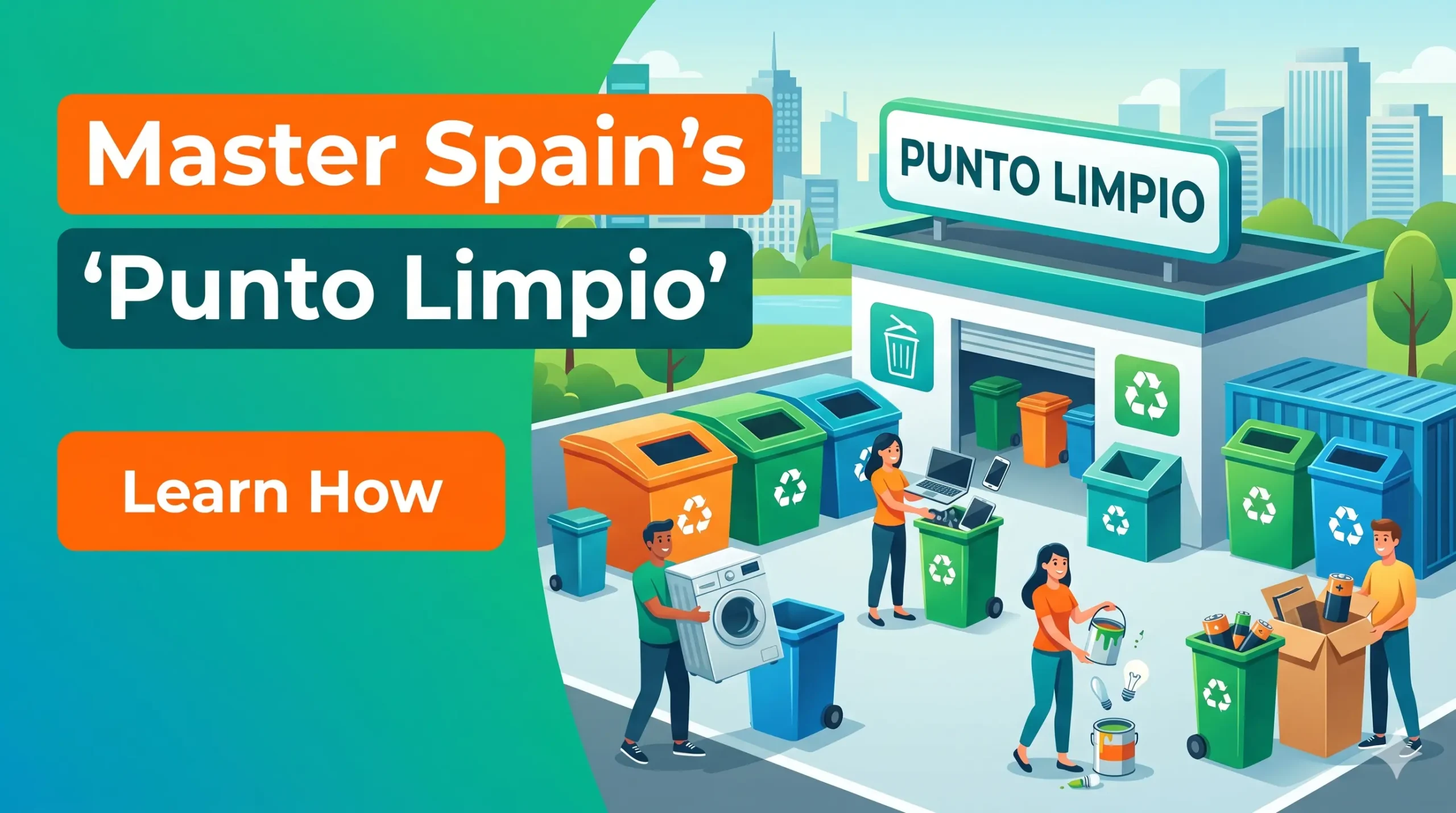
This brings us to the Punto Limpio (Clean Point). These are specialized, free municipal eco-parks designed specifically to handle hazardous, bulky, or electronic waste that cannot be processed by the standard daily garbage trucks. They are the cornerstone of the Spanish circular economy, ensuring that dangerous chemicals do not seep into the groundwater and that heavy metals from old electronics are safely recovered rather than buried in a landfill.
Understanding how to use these facilities is an absolute necessity, especially when you are clearing out packing materials or old junk left behind by previous tenants, a frustrating scenario we explore deeply in Renting an Apartment in Spain: A Guide for Expats.
Fixed Versus Mobile Facilities
There are two main ways to interact with the Spanish eco-park system, and which one you use will depend entirely on whether or not you own a car.
The first option is the Punto Limpio Fijo (Fixed Point). These are massive, permanent industrial facilities usually located on the industrial outskirts of your municipality. They look like large drive-through warehouses with enormous industrial dumpsters sorted by material. You generally need a personal vehicle to reach them safely, as walking down an industrial highway with a broken television is highly dangerous.
The second, far more accessible option is the Punto Limpio Móvil (Mobile Point). These are specialized municipal trucks that park in specific neighborhood plazas or street corners at highly specific hours—for example, Wednesdays from 14:30 to 16:30 at a particular plaza. This is a lifesaver for expats living in dense city centers without cars. You simply walk up to the truck and hand your items to the technician.
Because the mobile trucks change locations every single day and strictly adhere to their brief operational windows, checking the active municipal timetable online is mandatory. I rely heavily on Tiekom for my mobile data specifically for this reason. Their coverage never drops, which means I can reliably load the clunky local city hall website on my phone while standing on the street corner, allowing me to confirm if the mobile truck is delayed or if I am simply waiting on the wrong block.

Items You Must Take to a Punto Limpio
Common Household Hazardous Waste
Standard household items instantly become hazardous waste the moment they are empty or broken. The most common hurdle for expats involves used cooking oil. In Spain, pouring used cooking oil down the kitchen sink is heavily frowned upon and legally restricted in many municipalities because it creates massive blockages and destroys local water treatment plants. You must collect your old frying oil in a sealed container and take it to the Punto Limpio to be poured into special collection vats.
I highly recommend ordering a leak-proof oil collection funnel and dedicated jug from Amazon Spain to keep under your kitchen sink. Utilizing a proper container completely stops the agonizing, sticky mess of trying to pour cold, greasy olive oil into an old, flimsy water bottle.
Beyond cooking oil, there is a strict list of household chemicals that must be surrendered to the technicians at these facilities. This includes leftover wall paint, heavy chemical solvents, and aerosol cans that are not completely empty. You must also bring all dead alkaline batteries and blown fluorescent lightbulbs here, though you can occasionally find small drop-off cylinders for batteries and bulbs at the entrance of massive supermarkets like Mercadona or Carrefour. Proper disposal of these toxic elements prevents environmental contamination and aligns with the strict civic rules often enforced by neighborhood associations, an administrative layer we discuss in A Guide to Spanish Community Fees.
Bulky Items and Electronic Waste
Any appliance that requires a plug or a battery falls under the category of RAEE (Residuos de Aparatos Eléctricos y Electrónicos). This means every single broken laptop, shattered smartphone, frayed charging cable, or dead hairdryer must go to the Punto Limpio.
Hauling a heavy, broken appliance three blocks to the mobile truck point by hand is a miserable, exhausting experience. Buying a cheap, foldable utility trolley on Amazon Spain is one of the smartest investments an expat can make to save their back. You can load heavy desktop computers or old microwaves onto the wheeled cart, strap them down, and effortlessly roll them to the neighborhood drop-off point.
| Waste Item | Standard Street Bins | Punto Limpio Facility |
| Empty plastic water bottles | Yes (Yellow Bin) | No |
| Broken microwaves or laptops | No | Yes (RAEE section) |
| Used cooking oil | No | Yes (Special oil vats) |
| Leftover wall paint | No | Yes (Chemical section) |
| Old mattresses or furniture | No (Unless scheduled) | Yes (Fixed facilities only) |
| Organic food scraps | Yes (Brown Bin) | No |
Step by Step Guide to Using the Facilities
Navigating Limits and Identification
You cannot just back a rented moving van up to a municipal Punto Limpio and empty an entire house. The facilities have strict cantidades admisibles (admissible quantities) per person, per day. For example, the Madrid city council might limit you to depositing one large home appliance, five liters of cooking oil, and three fluorescent bulbs per visit. They enforce these strict limits to prevent commercial businesses and private contractors from exploiting the free residential recycling system.
When you arrive at the gate of a fixed facility, the technician will often ask for your identification. You should bring your physical TIE card, or your official green NIE paper accompanied by your original passport. In some strict municipalities, they may even ask for your empadronamiento to prove that you actually live in the town paying for the facility.
To keep my waste perfectly sorted in the trunk of my car and avoid being turned away by an impatient technician, I ordered a set of modular, color-coded recycling bags from Amazon Spain. Handing the technician pre-sorted, clean bags speeds up the inspection process incredibly and prevents you from holding up the line of cars behind you.
Understanding the Tasa de Basuras
Expats are often surprised to learn that utilizing the Punto Limpio is entirely free at the point of drop-off. You do not pay the technician to take your broken television. However, this system is heavily funded by your local taxes.
Depending on your specific municipality, you might pay an annual Tasa de Basuras (garbage tax). Sometimes this tax is paid directly by the property owner, and sometimes the lease dictates that it is pushed to the tenant. Learning how to identify these sneaky local municipal charges is a fundamental part of Understanding Utility Bills in Spain. Because you are already paying for this eco-park service through your local taxation, taking advantage of the facilities ensures you actually get value out of your mandatory municipal contributions while avoiding steep fines that can ruin your budget, a financial reality detailed in Cost of Living in Spain.
Managing Bulky Waste and Seasonal Clear Outs
Booking Municipal Furniture Pickups
If you do not own a car and physically cannot get a heavy mattress or an old sofa to the fixed Punto Limpio on the outskirts of town, do not panic. Most Spanish town halls (ayuntamientos) offer a free bulky item pickup service, commonly referred to as recogida de muebles.
However, you cannot just drag the sofa to the curb whenever you feel like it. You must call the town hall or book the pickup online. They will give you a highly specific date, time, and location instruction (for example, “Leave it next to the green glass bin on Tuesday between 20:00 and 22:00”). If you leave the furniture outside of this specific operational window, the local police can track it back to your apartment and issue a massive illegal dumping fine.
To book this curbside service, you almost always have to navigate clunky, outdated regional web portals. Having a solid home broadband connection from Tiekom ensures you can comfortably translate these dense municipal web pages and submit your collection request without the site timing out halfway through the form. Alternatively, if you need to call the town hall directly to arrange a bulky waste pickup, having a clear mobile connection from Tiekom prevents the call from dropping while you frantically navigate their agonizing automated Spanish phone menus. Understanding how to manage your home telecommunications is a massive hurdle we break down in Best Internet Providers in Spain for Expats.
The Winter and Summer Appliance Cycle
When the harsh Spanish seasons change, expats often pull their cheap electric space heaters out of the closet only to realize they are dead, or they discover their ancient oscillating fan is rattling violently. Discarding these properly is essential when dealing with the extreme plunging temperatures noted in Winter in Spain: What to Expect or when you are finally upgrading your coastal apartment’s cooling systems, a costly process discussed in Is Air Conditioning Worth It in Spain? Cost and Comfort Guide.
Before you toss an old smartphone, tablet, or smart-home hub into the massive electronic waste bin at the eco-park, you must remember that these industrial bins are essentially open cages. Anyone walking by can see exactly what is inside. Always physically destroy the hard drive or securely digital-wipe the device to factory settings. Dealing with proper electronic disposal and protecting your data privacy is just as crucial as safely wiring your new apartment, an infrastructure challenge we highlight in Setting Up Electricity and Gas in Spain. Treat the Punto Limpio not as a frustrating chore, but as the final, responsible step in managing your modern Spanish household.
References
Primary sources official
- Ministerio para la Transición Ecológica y el Reto Demográfico (MITECO) – Puntos Limpios: https://www.miteco.gob.es/es/calidad-y-evaluacion-ambiental/temas/prevencion-y-gestion-residuos/flujos/domesticos/gestion/sistema-recogida/puntos-limpios.html
- Ayuntamiento de Madrid – Puntos Limpios del Ayuntamiento: https://www.madrid.es/portales/munimadrid/es/Inicio/Medio-ambiente/Recogida-de-residuos/Puntos-Limpios-del-Ayuntamiento-de-Madrid
- Administración General del Estado – Eliminación de residuos domésticos: https://administracion.gob.es/pag_Home/Tu-espacio-europeo/derechos-obligaciones/ciudadanos/consumidores/conexion-servicios/residuos.html
Other helpful sources
- Organización de Consumidores y Usuarios (OCU) – Puntos limpios: qué llevar: https://www.ocu.org/consumo-familia/consumo-colaborativo/informe/puntos-limpios
- Ecoembes – Buscador de Puntos Limpios y Dudas de Reciclaje: https://ecoembesdudasreciclaje.es/buscador-de-puntos-limpios/
Disclaimer
The information provided in this guide is exclusively for educational and informational purposes and does not constitute official legal or municipal advising. The rules governing Puntos Limpios, including accepted materials, specific cantidades admisibles (daily limits), and municipal bulky waste pickup schedules, vary drastically between different Spanish autonomous communities and individual town halls (ayuntamientos). While we strive to ensure absolute accuracy regarding best practices, you should always consult your local city hall’s official website or environmental department to verify exact operating hours, identification requirements, and specific local dumping fines before disposing of hazardous or bulky waste.