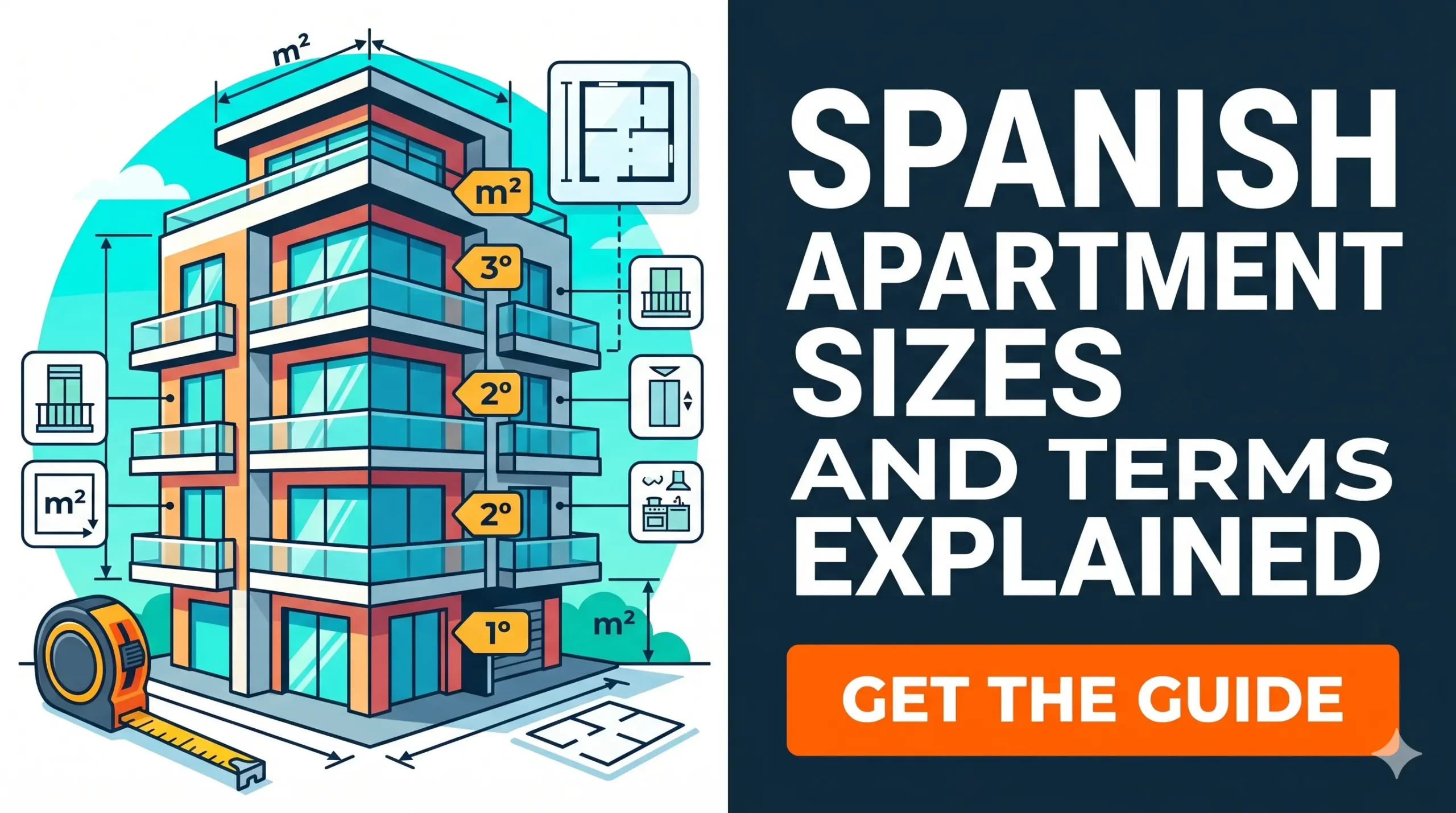
Spanish Apartment Sizes: m², Floor Numbers, and Listing Terms Explained
Scrolling through Spanish idealista listings and arriving at a flat that feels half the advertised size is a devastating expat rite of passage. I once rented a “first-floor” apartment that actually required hauling my heavy luggage up three steep flights of stairs. This guide decodes Spanish real estate vocabulary, explaining true square meters, floor numbers, and deceptive listing terms.
Disclosure: This post may contain affiliate links. We may earn a commission at no extra cost to you if you make a purchase through these links. Read full disclosure.
Decoding Spanish Square Meters (Metros Cuadrados)
When you look at real estate portals in the US or Northern Europe, the square footage listed is generally the actual, walkable space you have to live in. Spain operates on a completely different standard of measurement. If you blindly trust the headline number on a Spanish property listing, you will face severe spatial disappointment.
Metros Construidos vs. Metros Útiles
The most critical vocabulary distinction you must master is the difference between metros construidos (built square meters) and metros útiles (usable square meters). By default, almost every real estate agent and landlord in Spain advertises the metros construidos because it is the larger, more impressive number.
Metros construidos includes absolutely everything within the perimeter of the apartment, including the physical footprint of the structural pillars, the thickness of the exterior brick walls, the interior partitions, and the ventilation ducts. You cannot put a sofa inside a brick wall, but you are paying for that space.
Conversely, metros útiles refers to the actual, physical space where you can step, place furniture, or lay down a rug. As a general rule of thumb, the metros útiles will be 15% to 25% smaller than the advertised metros construidos. If you see an 80m² apartment listed, expect it to actually feel like a 60m² flat. Because floor plans are rarely provided for standard rentals, a highly recommended veteran tactic is to purchase a cheap laser measuring tool from Amazon Spain. Bringing this small device to your viewings allows you to instantly verify the true dimensions of a bedroom before signing a binding contract.
The Communal Space Trap
If the discrepancy between built and usable space wasn’t confusing enough, the Spanish Ley de Propiedad Horizontal (Horizontal Property Law) introduces a third, highly misleading metric: metros construidos con elementos comunes (built meters with common elements).
Under Spanish property law, every apartment owns a fractional percentage of the building’s shared spaces. If a listing uses this metric, the 100m² number they are advertising literally includes your proportionate slice of the building’s lobby, the elevator shaft, the stairwell, and the rooftop terrace. Unscrupulous agencies frequently use this number to artificially inflate the perceived value of tiny flats.
You must always explicitly ask the real estate agent, “¿Cuántos metros útiles tiene?” (How many usable meters does it have?). Failing to clarify this distinction will result in you overpaying for a cramped space, drastically impacting the initial math you laid out when planning your Cost of Living in Spain: Budgeting for Expats. Understanding exactly what you are paying for is the first defense mechanism you must build, a concept deeply explored in Renting in Spain: How to Budget for Deposits, Fees, and Utilities.
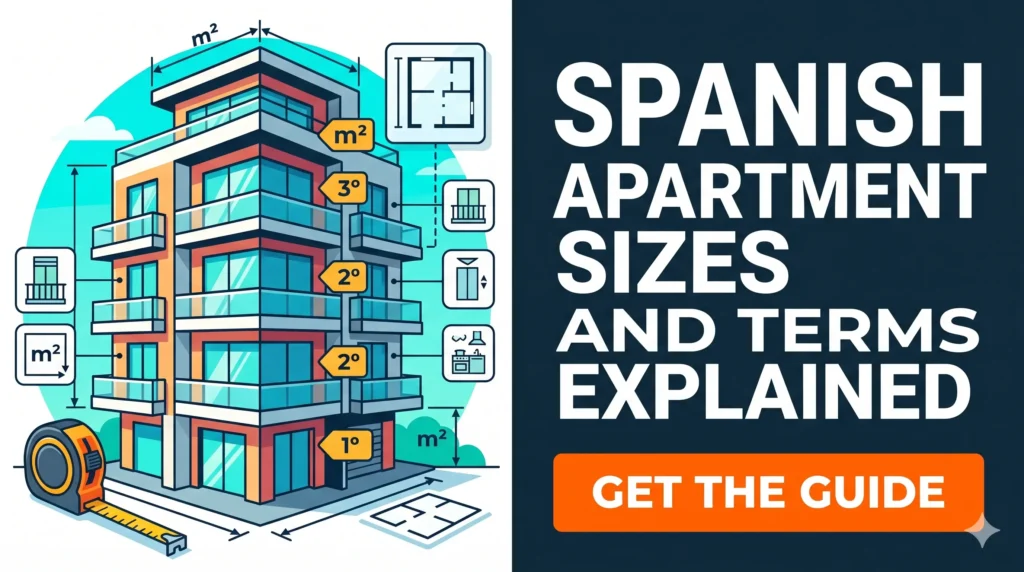
Understanding Spanish Floor Numbers
The physical location of an apartment within a Spanish building is rarely as simple as counting up from the street. The naming conventions for floors are rooted in 19th-century architectural traditions, which frequently obscure exactly how many flights of stairs you will actually have to climb.
The Ground Floor and Mezzanines
In the Anglo-Saxon world, the first floor is usually the ground floor. In Spain, the ground floor is always referred to as the Bajo (or Planta Baja). This is street level.
However, between the Bajo and the Planta 1 (First Floor), classic Spanish buildings frequently insert “hidden” floors. You might encounter an Entreplanta (Mezzanine), which is a half-floor above the street, followed by a Principal (Main Floor), which was historically the grandest, most expensive apartment built for the original building owner.
If you rent an apartment listed as Planta 1, you might assume you only have to walk up one flight of stairs. In reality, you might be walking past the Bajo, up to the Entreplanta, past the Principal, and finally arriving at your “first-floor” apartment, which is physically located on the third or fourth story of the building.
| Spanish Listing Term | US Equivalent Floor | Physical Flights of Stairs (Approximate) |
| Bajo | Ground Floor (1st Floor) | 0 |
| Entreplanta | Mezzanine | 1 |
| Principal | Main Floor (Often 2nd Floor) | 2 |
| Planta 1 | First Floor (Often 3rd Floor) | 3 |
| Ático | Penthouse / Top Floor | Varies (Highest point) |
Elevators and the Sin Ascensor Reality
The architectural charm of historic Spanish city centers comes with a severe logistical penalty: the lack of elevators. If an apartment listing contains the phrase Sin Ascensor (Without Elevator), you must take this warning incredibly seriously.
Renting a Cuarto Sin Ascensor (Fourth floor without an elevator) in a building with high ceilings means you will be climbing 80 to 100 steps every single time you buy groceries, walk the dog, or take out the trash. The daily physical toll of this cannot be overstated.
Furthermore, if you rent an unfurnished flat without an elevator, moving heavy items becomes an absolute nightmare. Local moving companies will charge massive surcharges, or simply refuse to haul heavy white goods up narrow, spiraling Spanish staircases. To bypass this friction, many expats simply order their heavy furniture, mattresses, and washing machines directly from Amazon Spain, leveraging their delivery networks to handle the brutal physical labor of carrying the items up to the fourth floor. To navigate the unspoken rules of moving in without infuriating your new neighbors, you must review How to Deal With Spanish Building Rules (Pets, Noise, Renovations).
Crucial Vocabulary in Apartment Listings
Beyond the physical dimensions and the floor height, Spanish apartment listings are filled with localized jargon that dictates your ultimate quality of life. Misunderstanding these terms will completely ruin your expat experience.
Exterior vs. Interior Flats
In Spain, flats are strictly categorized as either Exterior or Interior. An Exterior apartment means the primary windows face the open street. These flats command premium prices because they receive direct, natural sunlight. However, Spanish streets are famously loud, so an Exterior flat guarantees you will hear the trash trucks at 2:00 AM and the terrace bars until dawn.
An Interior apartment means the windows face a patio de luces (an internal architectural courtyard or light well). Interior flats are significantly cheaper and wonderfully quiet, but they can be crushingly dark, sometimes requiring you to keep the lights on even at noon. Because you are staring at your neighbors’ windows across a narrow two-meter gap, airflow is often virtually non-existent.
There is also a massive technological penalty to Interior flats. The thick, historic plaster and brick walls surrounding these interior courtyards frequently block mobile cellular signals entirely. If you rent an Interior flat, you will likely have zero 4G reception in your living room. You absolutely must establish a robust home fiber connection from an expat-friendly provider like Tiekom on day one, so you can rely on Wi-Fi calling to communicate. Trying to coordinate apartment viewings and signing leases also requires a reliable data connection, making a Tiekom mobile plan essential while you navigate the city’s chaotic rental market.
Furnished, Unfurnished, and Kitchen Appliances
When you filter listings, you will see flats listed as Amueblado (Furnished) or Sin Amueblar (Unfurnished). You must completely recalibrate your expectations of what “unfurnished” means in Spain.
In many countries, an unfurnished flat still comes with large appliances, built-in closets, and light fixtures. In Spain, Sin Amueblar frequently means the landlord is handing you a completely empty concrete box. There will be bare wires hanging from the ceiling where lightbulbs should be. Most shockingly, the kitchen may completely lack a refrigerator (nevera) or a washing machine (lavadora). There will just be a gaping hole under the counter with a water pipe. Furthermore, older Spanish flats rarely have built-in closets (armarios empotrados), requiring you to buy standalone wardrobes (armarios).
If you sign a lease for a Sin Amueblar flat, you will immediately need to drop thousands of euros to make it habitable. Ordering essential heavy white goods and standalone wardrobes from Amazon Spain is the fastest way to equip an empty flat without needing to rent a commercial van to navigate local big-box hardware stores. To ensure your initial capital is ready to handle these massive, sudden expenses, you must proactively set up your local financial infrastructure, a process detailed in Opening a Bank Account in Spain as a Non-Resident and What Proof of Address Do Spanish Banks Accept?.
Cocina Equipada and Calefacción
If you do not want to buy your own refrigerator, you must explicitly filter your searches for flats with a Cocina Equipada (Equipped Kitchen). Even then, you must physically check the photos. A kitchen might be “equipped” with an oven and a stove (vitrocerámica), but still lack a fridge or a dishwasher (lavavajillas). Always ask for a written inventory (inventario) before signing the lease, a critical legal protection explored in Student Housing in Spain: Options and Typical Contracts.
Finally, pay extreme attention to the heating system (calefacción). Many older flats in coastal Spain and Andalusia lack central heating entirely, relying solely on small, plug-in space heaters. Winters inside a Spanish stone building can be brutally damp and freezing. If a listing says Calefacción Central (Central Heating), it usually means the entire building’s heat is controlled by the community president, and you cannot adjust the thermostat yourself. If it says Calefacción Individual, you control the heat, but you are also responsible for the massive winter gas or electricity bills. Decoding how these specific heating systems impact your monthly utility budget is a survival skill heavily detailed in Utility Costs in Spain: Electricity, Gas, Water, and Internet.
References
Primary sources (official)
- Boletín Oficial del Estado (BOE) – Ley 49/1960 sobre Propiedad Horizontal: https://www.boe.es/buscar/act.php?id=BOE-A-1960-10906
- Ministerio de Vivienda y Agenda Urbana – Normativa de habitabilidad: https://www.mivau.gob.es/
- Sede Electrónica del Catastro (To verify official registered square meters): https://www1.sedecatastro.gob.es/
Other helpful sources
- Fotocasa – Diccionario Fotocasa, glosario del sector inmobiliario: https://www.fotocasa.es/fotocasa-life/inspiracion/diccionario-fotocasa/
- Idealista – La diferencia entre metros útiles y construidos: https://www.idealista.com/news/inmobiliario/vivienda/2021/04/13/789947-diferencia-entre-metros-utiles-y-construidos
Disclaimer
The information provided in this article is for educational and informational purposes only and does not constitute formal real estate, legal, or architectural advice. Real estate advertising standards regarding metros construidos (built meters) versus metros útiles (usable meters) are loosely regulated in the Spanish private rental market. Always physically verify the usable space, confirm the inclusion of specific white goods via a signed inventario, and personally inspect the functionality of elevators and heating systems before signing any legally binding Contrato de Arrendamiento (lease agreement). Consult with a registered Spanish real estate agent (Agente de la Propiedad Inmobiliaria) or legal counsel if you suspect false advertising or contractual irregularities.