Childcare in Spain: Nurseries, Costs, and Waitlists
Navigating Spain’s early childhood education system requires understanding the differences between public and private centers, mastering the points-based admission waitlists, and knowing your eligibility for state subsidies. This comprehensive guide details costs, application timelines, and essential tips for expatriate parents.
Disclosure: This post may contain affiliate links. We may earn a commission at no extra cost to you if you make a purchase through these links. Read full disclosure.
The Structure of Early Education in Spain
In Spain, early childhood education and care is collectively known as Educación Infantil. It is entirely voluntary; mandatory schooling in Spain does not legally begin until a child turns six years old and enters primary school (Educación Primaria).
Despite being voluntary, attendance rates in Spain are exceptionally high. The vast majority of children attend some form of structured early education, which focuses heavily on social, emotional, and motor development through play, rather than rigid academic instruction.
Educación Infantil is officially divided into two distinct cycles:
Primer Ciclo (First Cycle): Ages 0 to 3
This first cycle covers infants and toddlers from the age of 16 weeks (which coincides with the end of the standard statutory maternity and paternity leave in Spain) up to three years old.
Facilities catering to this age group are commonly referred to as guarderías (daycares) or escuelas infantiles (nursery schools). Because this cycle is not considered a mandatory part of the universal education system, it is generally fee-based, although regional governments heavily subsidize public centers to make them affordable for working parents.
Segundo Ciclo (Second Cycle): Ages 3 to 6
The second cycle functions as preschool or kindergarten. These classes are typically attached to standard primary schools (colegios).
While still technically voluntary, almost 100% of Spanish children are enrolled in the second cycle. A massive benefit of this cycle is that in public and state-funded semi-private schools, the tuition for the Segundo Ciclo is completely free. Parents are only responsible for supplementary costs such as meals, extracurricular activities, and school supplies.
Understanding how your child transitions from the Primer Ciclo into the Segundo Ciclo and eventually into primary education is crucial for long-term planning. You can explore the broader educational timeline in our comprehensive overview of The School Enrollment in Spain: Registration Steps for Foreign Families.
Types of Nurseries and Childcare Centers
When exploring your options for the 0 to 3 age group, you will encounter three primary types of childcare centers. Your choice will dictate your monthly costs, your schedule flexibility, and the complexity of the admissions process.
1. Public Centers (Escuelas Infantiles Públicas)
Public nurseries are owned and managed by the local regional government or municipality (Town Hall).
- The Pros: They are by far the most affordable option, as fees are heavily subsidized by the state and scaled according to your household income. The facilities are strictly regulated, maintaining high standards for safety, square footage, and outdoor play areas.
- The Cons: Because they are cheap and reliable, the demand wildly outstrips the supply. Securing a spot is exceptionally difficult and relies on a strict points-based waitlist system. Furthermore, their operating hours are rigid (typically 9:00 AM to 4:00 PM), and they rigidly follow the official school calendar, closing for long periods during Christmas, Easter, and the entire summer.
2. Semi-Private Centers (Centros Concertados)
A colegio concertado is a uniquely Spanish institution. These are privately run schools that receive partial funding from the government. Many, though not all, are affiliated with the Catholic Church.
- The Pros: They offer a middle ground. The fees are significantly lower than pure private nurseries but slightly higher than public ones. Many parents choose concertados because they offer a seamless transition; a child can enter the nursery at age one and stay in the exact same institution all the way through high school.
- The Cons: Like public schools, they are subject to government admission rules and waitlist systems, meaning you are not guaranteed a spot simply because you are willing to pay.
3. Private Centers (Guarderías Privadas)
Private nurseries operate entirely independently of state funding and government admission lotteries.
- The Pros: They offer total flexibility. You can enroll your child at any time of the year, provided they have physical space. They frequently offer extended hours (from 7:30 AM to 7:00 PM) to accommodate demanding corporate schedules, and many remain open throughout the summer months. Private centers are also where you will find specialized pedagogical models, such as Montessori, Waldorf, or bilingual English-Spanish immersion programs.
- The Cons: They are the most expensive option. You must bear the entire cost of tuition out of pocket, which can be a significant monthly financial burden.
Comparison of Nursery Types in Spain
| Feature | Public Nursery (Pública) | Semi-Private (Concertada) | Private Nursery (Privada) |
| Ages Accepted | 16 weeks to 3 years | Often 0 to 18 years (seamless transition) | 16 weeks to 3 years |
| Admission Process | Strict government points system | Points system (state-regulated) | Direct application to the center |
| Tuition Costs | €100 – €350 / month | €200 – €450 / month | €450 – €900+ / month |
| Operating Hours | Rigid (Usually 9 AM – 4 PM) | Standard school hours | Highly flexible (7:30 AM – 7 PM) |
| Summer Schedule | Closed late June to September | Closed late June to September | Often open through July and August |
| Language Options | Spanish / Regional Language | Spanish / Regional Language | Bilingual and International options |
Understanding the True Costs of Childcare
When budgeting for childcare in Spain, it is vital to look beyond the advertised base tuition fee. Nurseries often break their pricing structures down into several different components. Ensure you factor these into your overall relocation budget by consulting our Cost of Living in Spain: Monthly Budget Guide for Expats.
Base Tuition (Escolaridad)
For a private nursery, base tuition generally ranges from €450 to €900 per month, depending heavily on the city. Madrid and Barcelona command the highest prices, while centers in Valencia or Andalusia will be closer to the lower end of the spectrum. For public nurseries, the base tuition is calculated using a sliding scale based on your previous year’s income tax return, often falling between €100 and €350.
The Dining Room Fee (Comedor)
Spanish culture places a massive emphasis on a hot, sit-down midday meal. Almost all nurseries have an on-site kitchen or a catered dining service (comedor). If your child stays past 12:30 PM, they will eat at the nursery. This is rarely included in the base tuition. Expect to pay an additional €100 to €150 per month for the comedor.
Extended Hours (Horario Ampliado)
If you require drop-off before 9:00 AM (often called los primeros del cole or breakfast club) or pick-up after 4:00 PM, nurseries charge supplementary fees. This is usually billed in 30-minute or one-hour increments and can add €50 to €100 to your monthly invoice.
Enrollment and Material Fees (Matrícula y Materiales)
Private nurseries almost universally charge an annual non-refundable enrollment fee (matrícula) just to secure your child’s spot, which typically costs between €200 and €400. Furthermore, many centers charge a supplementary annual or termly fee to cover the cost of art supplies, wet wipes, and educational materials.
Alternative Childcare Options
If formal nurseries do not fit your schedule or budget, Spain offers several alternative childcare arrangements popular among the expatriate community.
Nannies and Babysitters (Niñeras)
Hiring a private nanny to come to your home is an excellent option for families seeking personalized care or bilingual exposure. The cost of a nanny varies by region and experience, but you can generally expect to pay between €10 and €15 per hour. If you hire a nanny on a permanent, full-time basis, you are legally required to register them as a domestic worker with the Spanish Social Security system and pay employer contributions.
Au Pairs
Au pairs are typically young international students (aged 18 to 30) who live with a host family. In exchange for free room and board and a small weekly stipend of pocket money (usually €70 to €100), they provide up to 30 hours of childcare and light housework per week. This is a highly cost-effective option if you have a spare bedroom in your home.
Day Mothers and Nest Homes (Madres de Día / Casas Nido)
An emerging trend in Spain—heavily regulated in regions like Galicia, Madrid, and Navarra—is home-based provision. Certified early childhood educators open their own adapted, safety-inspected homes to small groups of children (usually a maximum of four children per educator). This provides a deeply personalized, calm, and family-like environment for infants under three years old, bridging the gap between a private nanny and a large, noisy nursery.
The Public Waitlist and the Points System
If you decide to pursue a spot in a subsidized public nursery or a semi-private concertado, you must prepare yourself to navigate the municipal points system (baremo de puntos).
Because there are never enough public spots for every child, the government allocates seats based on a strict meritocracy designed to prioritize local residents and vulnerable families. During the application process, your family profile is evaluated, and points are awarded for various criteria. The applicants with the highest total points are admitted first.
While the exact point values fluctuate slightly depending on your Autonomous Community, the core criteria are universally similar:
1. Proximity (Catchment Area)
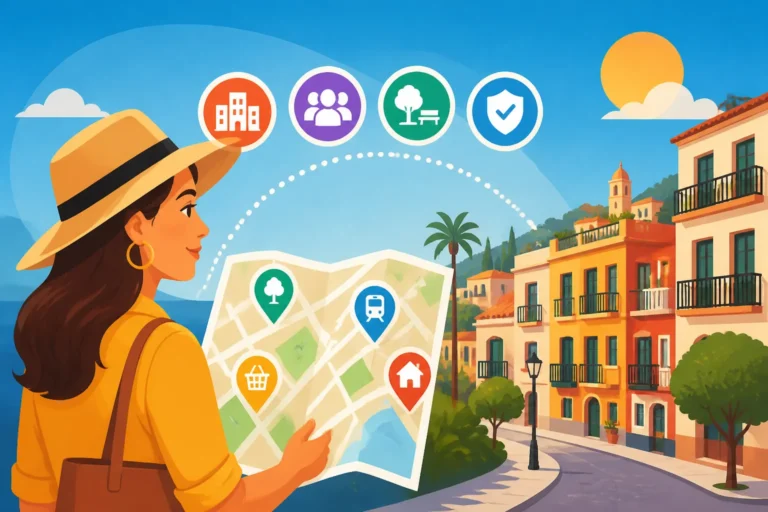
This is the most heavily weighted factor. You receive the maximum number of points if your registered family home is located within the direct catchment area (zona de influencia) of the nursery. You can also receive points if the workplace of one of the parents is located within the catchment area, though this usually yields fewer points than the home address.
2. Existing Siblings
If you already have an older child currently enrolled in the exact same nursery or attached primary school, you are awarded a massive point bonus. The system tries to keep families together to ease logistical burdens on parents.
3. Employment Status
Priority is given to households where childcare is a necessity for economic survival. You will receive significant points if both parents work full-time. Single-parent families (familias monoparentales) also receive a specific point boost to support their childcare needs.
4. Household Income (Renta)
Public centers exist to ensure equitable access to education. Therefore, families whose combined annual income falls below certain regional thresholds receive extra points. You must authorize the education department to check your Spanish tax records to verify this.
5. Special Circumstances
Additional points are awarded if the child applying, a sibling, or a parent has a legally recognized physical or mental disability. Furthermore, legally recognized Large Families (Familias Numerosas—typically defined as having three or more children) receive bonus points.
How to Apply: The Enrollment Timeline
The application process for public and concertado nurseries is highly regimented. Miss a deadline by a single day, and your application will be rejected.
March to April: Research and Open Days
During the early spring, nurseries host Jornadas de Puertas Abiertas (Open Days). This is your opportunity to tour the facilities, meet the directors, and ask about their pedagogical approach. You must often register in advance online to attend these tours.
April to May: The Application Window
The official preregistration window (preinscripción) typically opens in April or May and lasts for roughly two weeks. You must submit your application either online via your regional education portal or in person at your first-choice school. You will list your preferred nurseries in order of preference.
Required Documentation:
To submit a valid application, you must be administratively prepared. You will typically need:
- The passports and NIE/TIE cards of both parents. If you need to secure this identification, review Getting an NIE for Employment or Study: Practical Overview.
- The child’s birth certificate or passport.
- The Libro de Familia (an official Spanish family book). If you are an expat without one, your translated and apostilled foreign birth and marriage certificates usually suffice.
- The Certificado de Empadronamiento proving your local address. For a guide on obtaining this vital document, read How to Register Your Address (Empadronamiento) as a Renter in Spain.
- Proof of your child’s vaccinations.
Late May to June: The Lists and the Lottery
At the end of May, the schools publish the provisional lists displaying every applicant’s calculated point score. You have a brief window (usually three days) to file an objection if you believe they miscalculated your points.
Once the points are finalized, the inevitable happens: multiple families have the exact same point score fighting for the final available spot. To resolve this cleanly, the regional government holds a public lottery, drawing a random tie-breaker number.
Late June: Formal Enrollment (Matriculación)
If you are successful and admitted to a nursery, you must return to the school during a strict one-week window in June to formally sign the enrollment papers (formalizar la matrícula). If you fail to show up during this week, you automatically forfeit your spot to the next child on the waiting list.
For those who are not admitted, the child is placed on a rolling waiting list. If a family moves away or drops out during the school year, the school will call the next family on the list. Because public spots are so difficult to secure, it is highly recommended that expatriates simultaneously reserve a spot at a private nursery as a backup plan, even if it means sacrificing a non-refundable enrollment fee.
Financial Aid and Childcare Subsidies
To ease the financial burden of early education, the Spanish government offers several subsidies and tax incentives. Even if you choose a private nursery, you may be eligible for significant financial relief.
The Working Mother Tax Deduction
The national Spanish tax agency (Hacienda) provides a specific deduction for working mothers with children under the age of three. Mothers who are actively employed and contributing to the Spanish Social Security system can claim a deduction of up to €1,200 per year. You can choose to have this applied as a lump sum reduction on your annual tax return, or you can apply (via Modelo 140) to receive it as a direct monthly payment of €100 into your bank account.
To understand how this deduction interacts with your overall tax residency status, consult our guide on Understanding Spanish Payslips.
Regional Childcare Vouchers (Cheques Guardería / Bono Infantil)
Many Autonomous Communities offer their own direct financial aid to help cover the costs of private nurseries.
- In the Community of Madrid, the Cheque Guardería provides a monthly voucher (usually between €100 and €160) to families using authorized private nurseries, provided the parents meet certain income requirements.
- In the Valencian Community, the Bono Infantil operates similarly, subsidizing a significant portion of the monthly invoice for children attending authorized 0-3 centers.
To utilize these regional vouchers, you must ensure that the private nursery you select is officially authorized and registered with the regional department of education. Unregistered “play centers” or informal daycares do not qualify for these state subsidies.
Conclusion
Securing childcare in Spain requires a blend of cultural understanding, meticulous administrative preparation, and proactive planning. While the public system’s points-based waitlists and strict timelines can feel daunting to newly arrived expatriates, the quality of care and the focus on early socialization make the effort incredibly worthwhile.
By researching your catchment area before signing a rental lease, ensuring your municipal empadronamiento is up to date, and exploring both the public lotteries and the flexible private market, you can find a nurturing environment for your child. Whether they end up in a heavily subsidized public escuela infantil or a bilingual private guardería, they will be stepping into an educational culture that deeply values their happiness, autonomy, and development.
References
Primary sources (official)
- Ministerio de Educación, Formación Profesional y Deportes: https://www.educacionyfp.gob.es/
- Eurydice (European Commission on Education Systems – Spain): https://eurydice.eacea.ec.europa.eu/national-education-systems/spain/overview
- Agencia Tributaria (Working Mother Tax Deduction info): https://sede.agenciatributaria.gob.es/
Other helpful sources
- Expatica Guide to Childcare in Spain: https://www.expatica.com/es/living/family/childcare-spain-101464/
- Health Plan Spain (Daycare and Preschool Overview): https://www.healthplanspain.com/blog/expat-tips/1486-daycare-and-preschool-in-spain.html
Disclaimer
The information provided in this article is for educational and informational purposes only. Public nursery admission criteria, municipal point allocations, tuition costs, and government subsidy availability vary significantly between Spanish Autonomous Communities and can change annually. We strongly recommend consulting your local Town Hall (Ayuntamiento) or regional Department of Education for the most accurate and up-to-date application deadlines for your specific neighborhood.